Van's Air Force

The definitive Van's Aircraft support community! Buying, building or flying an RV? Join our exclusive family of mentors and enthusiasts!

What MOSAIC Means for RV Owners

DeltaRomeo

doug reeves: unfluencer
Staff member
…just published.

The FAA’s Modernization of Special Airworthiness Certification rule, known as MOSAIC, took effect in phases beginning October 2025. Aviation media has called it the most significant regulatory overhaul since the Sport Pilot and Light Sport Aircraft rule was introduced in 2004.
Part 2 is Still Coming, and It’s a Big Deal

 
So can non builders of 14s and 10s take that 16 hour course and do their own maintenance and annuals?
Yes. The expanded inspection rules apply to any E-AB(*), regardless of whether or not a sport pilot could (or does) fly it.

Anyone can do maintenance on an experimental, and has always been able to do so; only the condition inspection requires any qualifications.

(*) once it gets updated operating limitations
 
Wonder how that will affect kit purchase v factory built. If you have the money, just buy a completed plane, take 16 hours of garbage, and then do your own annuals. What could go wrong?
For how many years now have the light sport guys been taking the” 16 hours of garbage” now and their air planes haven’t been falling out of the sky. That great track record is the reason MOSAIC got approved by the FFA .
 
It takes 1900 classroom hours to become an A&P. 16 hours to do your own conditional inspection. Quite the pendulum swing
Man….i think you guys are missing the point entirely. Try to go find an A&P who knows your RV as well as a builder does…in fact…most facilities won’t even touch them, cuz they don’t want the liability…the maintenance world keeps shrinking and getting more expensive….so to my way of thinking, having built several of these over the last 40 years…buyers of an RV…mostly have no idea of workmanship, relying on a pre-buy…if you get a good one from guys like Walt or Gary Brown or any. REAL RV guys…good….if not, a lot can get missed.

If this encourages owners to educate themselves with 16 hours of classroom about critical things you should be looking at all the time…it’s more likely that the ship you fly is going to get maintained more than one time a year, like I see LOTS of non-builder, owners believe to be okay.

I hear it all the time…”my airplane’s a true gas and oil airplane”…bravado…but guess what…it’s not.

And I’ don’t care which, model…or factory assistance, or any of it….they’re not gas and oil airplanes. Whole notion is plumb stupid.

Getting owners hands into their ship…getting them to take a class and hopefully leave knowing that there’s a lot more to this than maybe they thought…those are good things, getting the wheels turning are excellent t things.

Having the reality check that THERE IS NO BACKUP PLAN….

You are the backup plan….so get serious about it. Learn, question, involve others…that’s the point. If I never heard again,,,,,”I don’t know anything about maintenance…I trust my mechanic…”. then I’ll be glad to put an end to those sorts of dumb comments.

The reason they allowed this, is because we have demonstrated a commitment to safety and quality as edicts for our own survival….and we should all want to be part of that process.

 
IIRC, you can do an inspection with the 16 hour course, but repair authorization takes the longer course (several weeks).
I also would like to know where this idea is coming from. There have always been rules for experimental aircraft that allowed for anyone to work on them. There is no requirement for any of those individuals to hold any type of certification to do so. No age requirement, no knowledge requirement, no education requirement, no license requirement. Is it a good idea to have knowledge, education, experience? You bet! Required? Nope!
 
I also would like to know where this idea is coming from. There have always been rules for experimental aircraft that allowed for anyone to work on them. There is no requirement for any of those individuals to hold any type of certification to do so. No age requirement, no knowledge requirement, no education requirement, no license requirement. Is it a good idea to have knowledge, education, experience? You bet! Required? Nope!

I think the confusion comes at least partially from the name of the Repairman's certificate. If you see builders talking about getting their repairman's cert along with the airworthiness process for their aircraft, it's not a completely unreasonable assumption to make that you need to have one to do repairs in some sense of the word.
Of course that isn't the case, but most pilots are probably coming at it from the certified aircraft perspective of "there are a limited set of people allowed to do most maintenance tasks on airplanes" and making the leap to "this must be how you get that credential for the plane you built".
 
Under MOSAIC, the RV-12iS becomes more relevant than ever. Its clean stall speed sits comfortably within Sport Pilot limits, making it accessible to a broader range of pilots than at any point in its history.

Most of the article is pretty fluffy marketing, but this line is just straight up not true, right? The RV-12iS is available to exactly the same range of pilots as before, because it was already flyable by sport pilots.
 
I also would like to know where this idea is coming from. There have always been rules for experimental aircraft that allowed for anyone to work on them. There is no requirement for any of those individuals to hold any type of certification to do so. No age requirement, no knowledge requirement, no education requirement, no license requirement. Is it a good idea to have knowledge, education, experience? You bet! Required? Nope!
You’re right, I didn’t read the question accurately enough! for EAB you can repair whatever you want. For the LSA, however, one would need the LSRM.
 
"Under MOSAIC, the RV-12iS becomes more relevant than ever."

True for me, for the MOSAIC model's IMC capabilities.

"The MOSAIC model about to enter production includes updated creature comforts, a heated pitot tube in the wing, and will have the ability to fly in actual instrument conditions. "
 
So can non builders of 14s and 10s take that 16 hour course and do their own maintenance and annuals?

You (or anyone else) can do all maintenance on any EAB without taking any course.

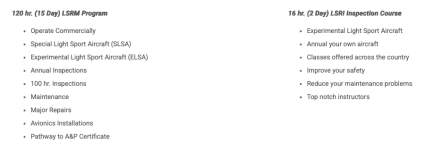
The 16 hour course allows you to receive an LSA Repairman certificate with inspection privileges,
(LSRI) which allows you to make a condition inspection logbook entry for an EAB that you own.
 
Last edited:
You (or anyone else) can do all maintenance on any EAB without taking any course.
There's definitely some confusion on this though. When I got my LSRI certificate one of the FSDO guys I was speaking with stated I couldn't perform maintenance on my EAB with just the LSRI. He said I needed the LSRM for that...
 
You (or anyone else) can do all maintenance on any EAB without taking any course.

The 16 hour course allows you to receive an LSRM certificate with inspection privileges, which allows you to make a condition inspection logbook entry for an EAB that you own.
Strictly speaking, I think the 16-hour course lets you get the LSRI (Light Sport Repairman - Inspection), letting someone do the CI on a qualifying aircraft he or she owns, while the two-weekish course lets you get the LSRM (Light Sport Repairman - Maintenance), allowing you to work on and do inspections on other people’s qualifying aircraft.

I think. Standard MOSAIC rule applies - I could be wrong, as could we all. 🤣

The FAA used somewhat weird terminology here I think, since in the certified world, “inspectors” (A&P with IA) are a more highly trained category than people approved to do “maintenance” (A&Ps).
 
Last edited:
There's definitely some confusion on this though. When I got my LSRI certificate one of the FSDO guys I was speaking with stated I couldn't perform maintenance on my EAB with just the LSRI. He said I needed the LSRM for that...
I’m not particularly surprised that a random FSDO guy doesn’t have the details straight. Probably not a subject matter he works on day in and day out.

But his willingness to confidently make pronouncements regarding things he’s ignorant of is an impressive example of a major regulatory problem.
 
I’m not particularly surprised that a random FSDO guy doesn’t have the details straight. Probably not a subject matter he works on day in and day out.

But his willingness to confidently make pronouncements regarding things he’s ignorant of is an impressive example of a major regulatory problem.
I routinely just reference the FAA order relating to this topic. What was even more frustrating was both of us (safety inspector and I) reading the same order but him interpreting it 180 out from what it actually reads.
 
Back
Top