Van's Air Force

The definitive Van's Aircraft support community! Buying, building or flying an RV? Join our exclusive family of mentors and enthusiasts!

Bullseye's RV-8 Build

Dec 12, 2025 - HS Disassembly and Skin Deburring

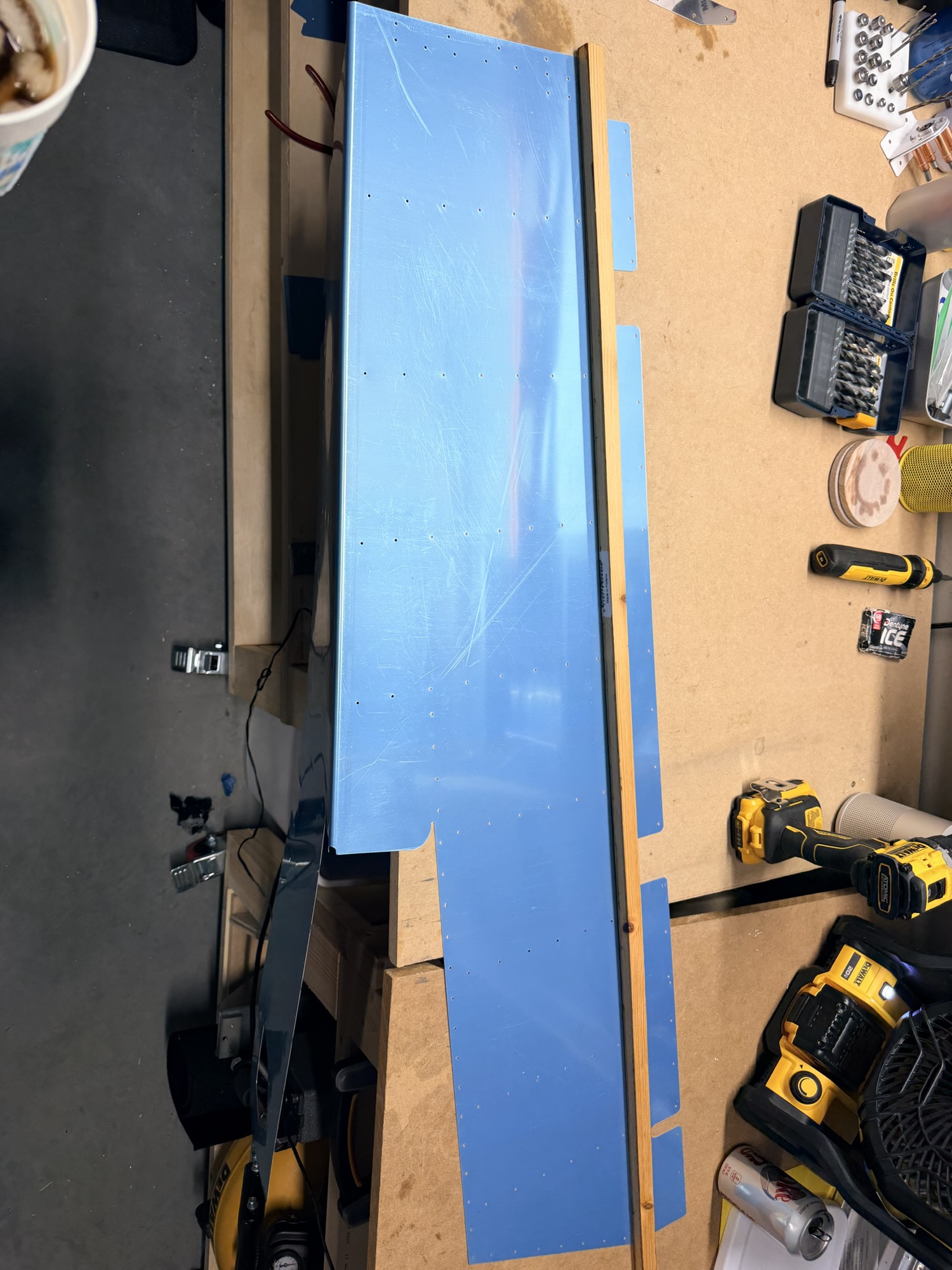
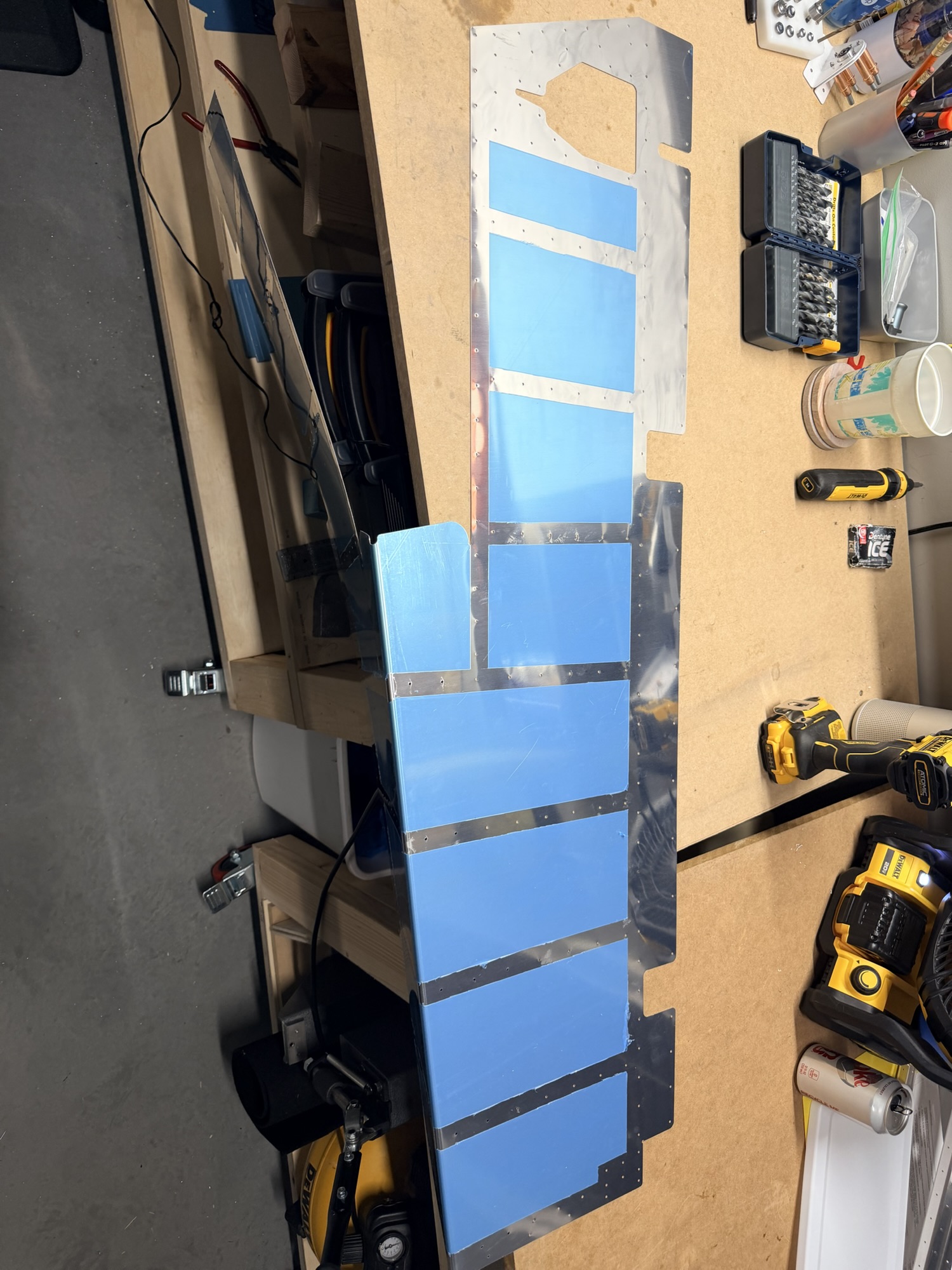
Late today, I was able to sneak out to the garage and get some tedious deburring and dimpling done on the HS skins.

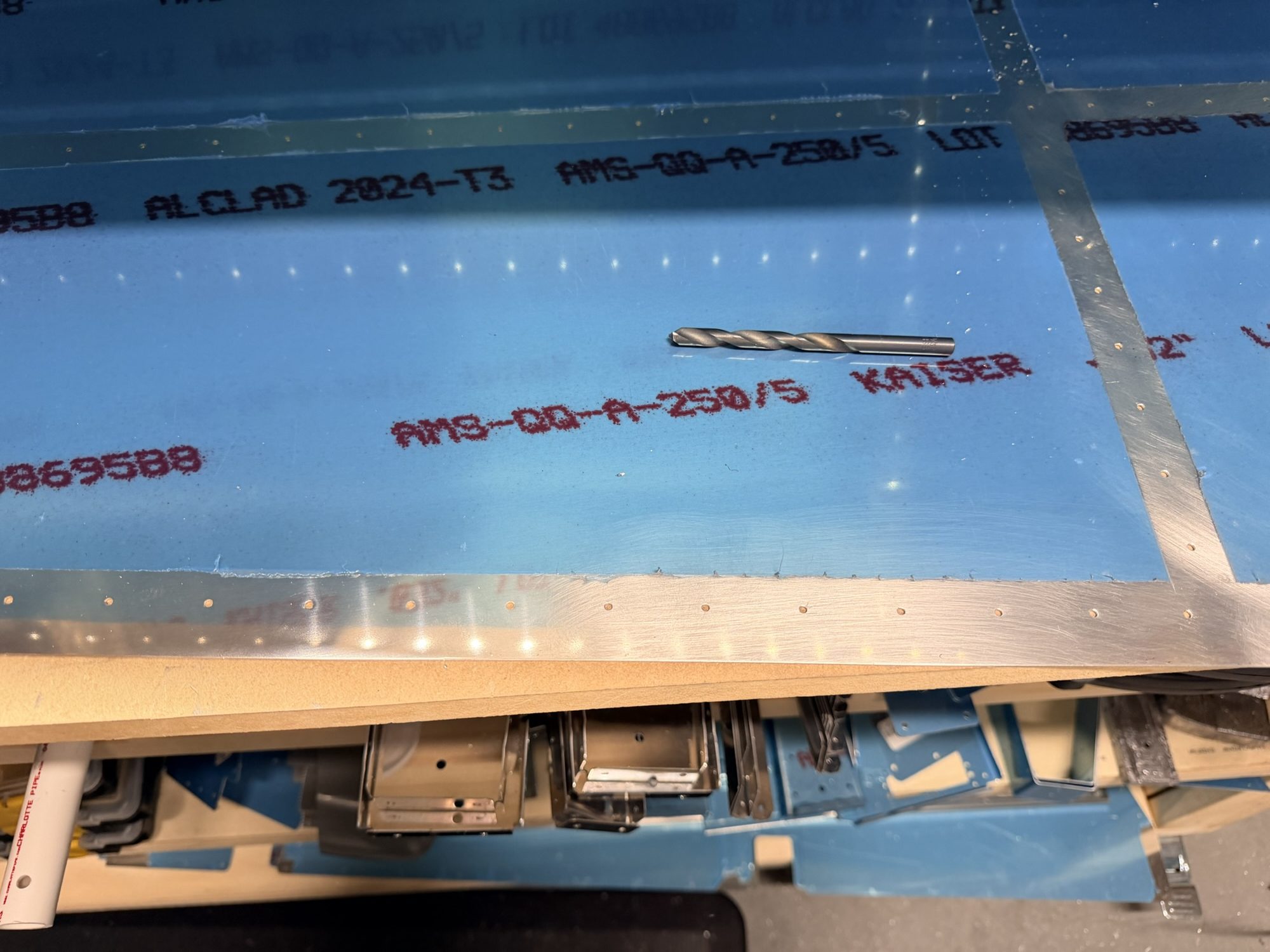
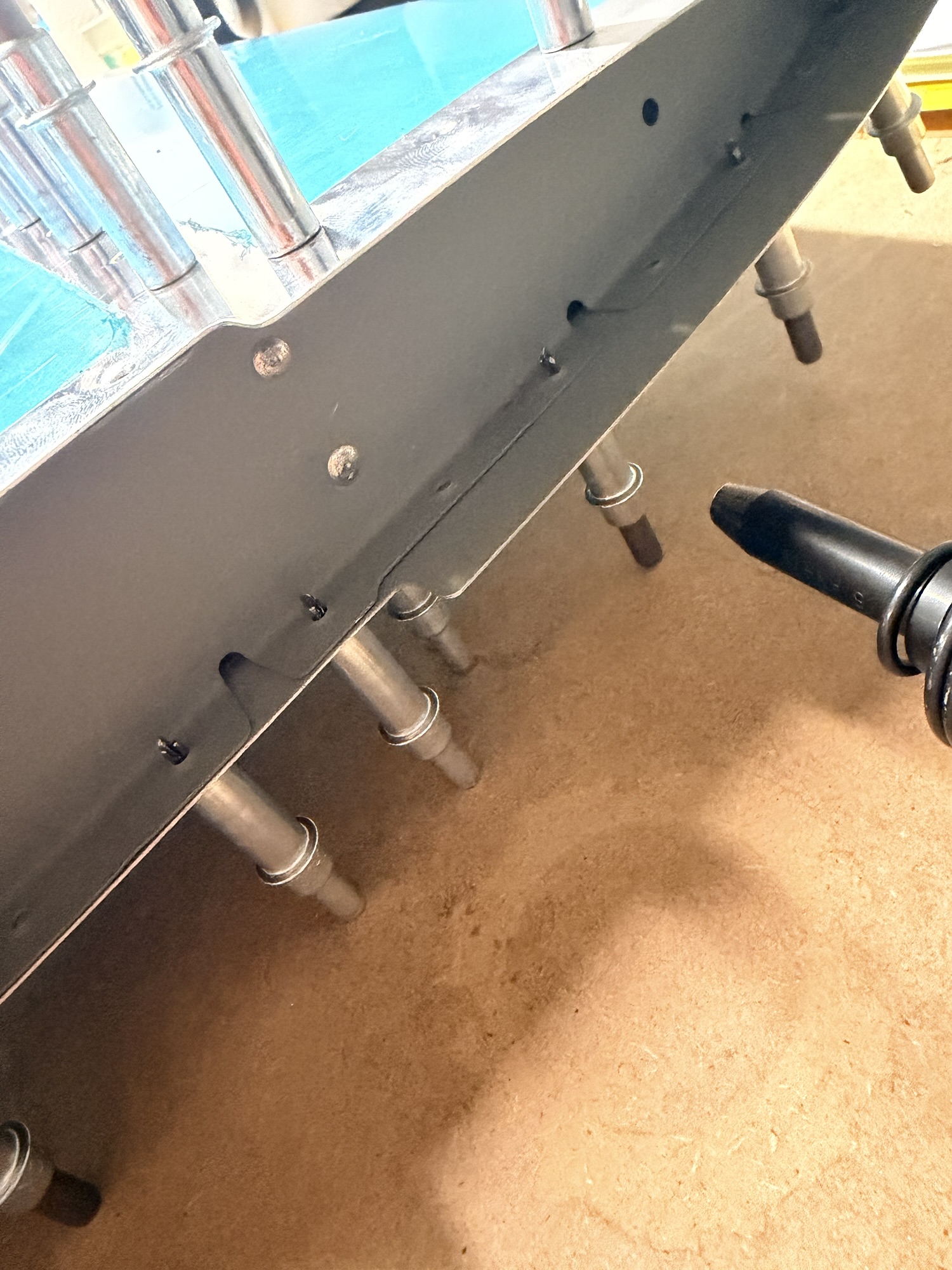
First step, deburr each hole using an oversize drill bit, twisted once or twice in the fingers.

img_0836-e1767915300301.jpg


deburring tool, front and center.

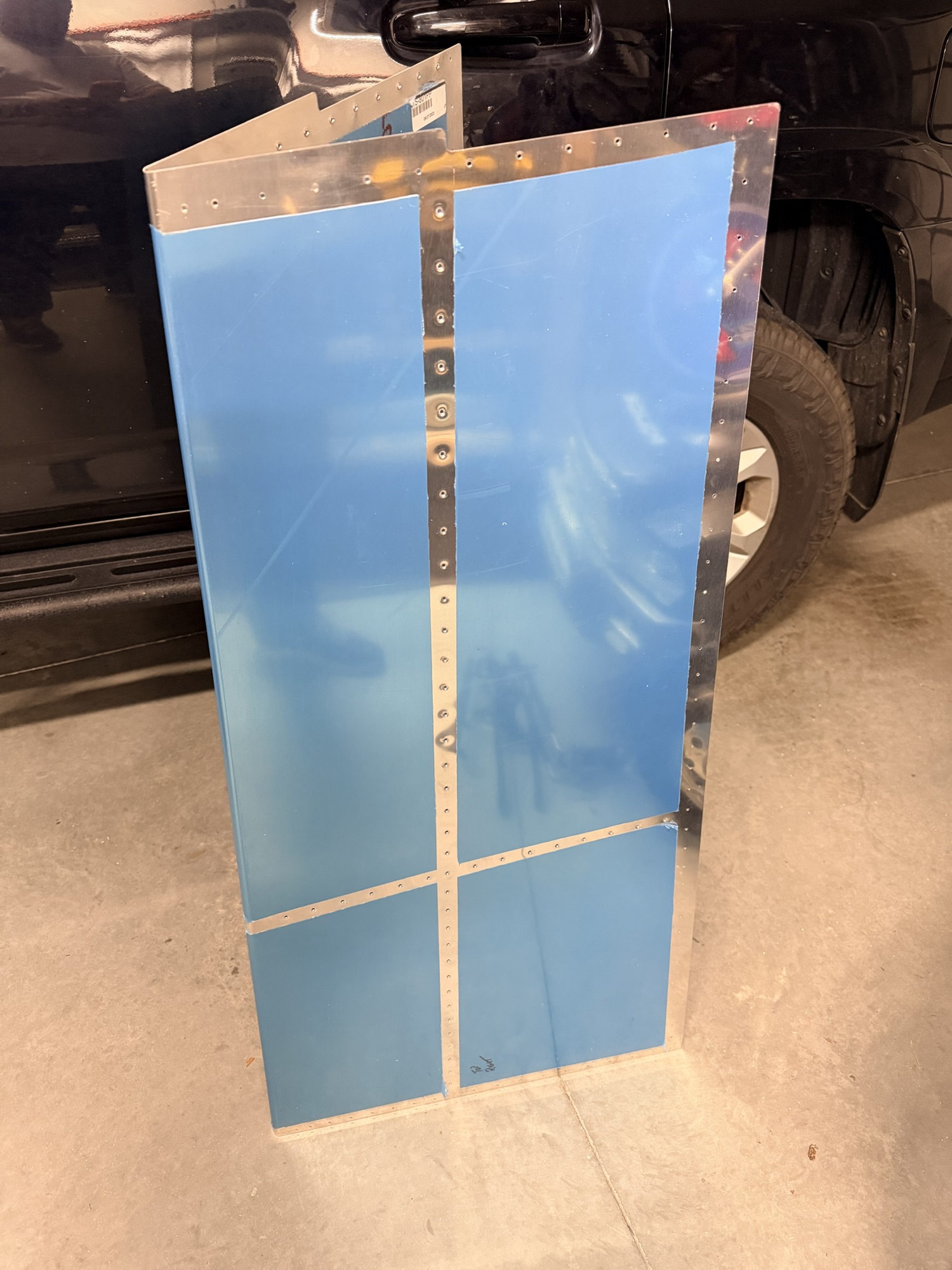
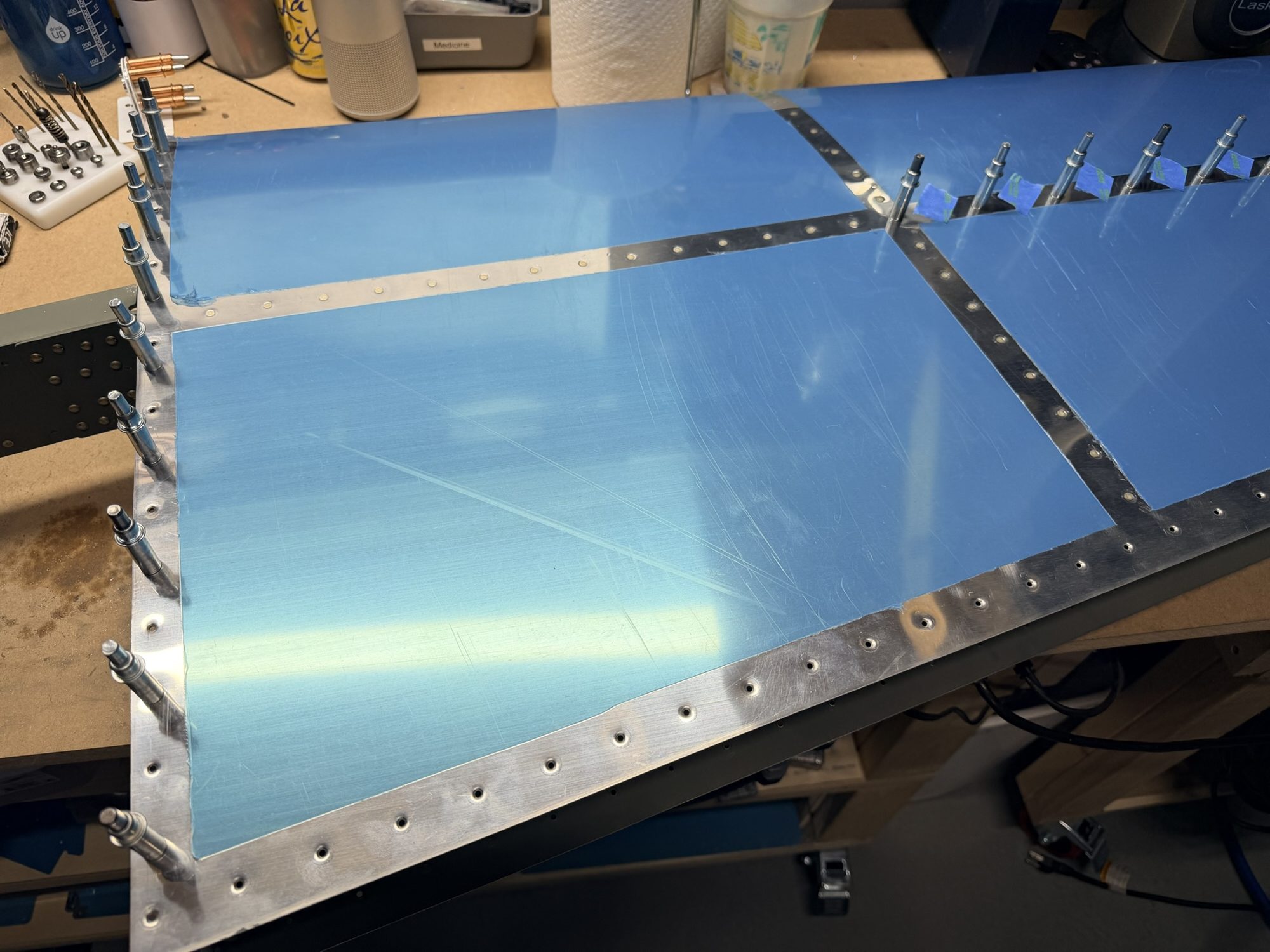
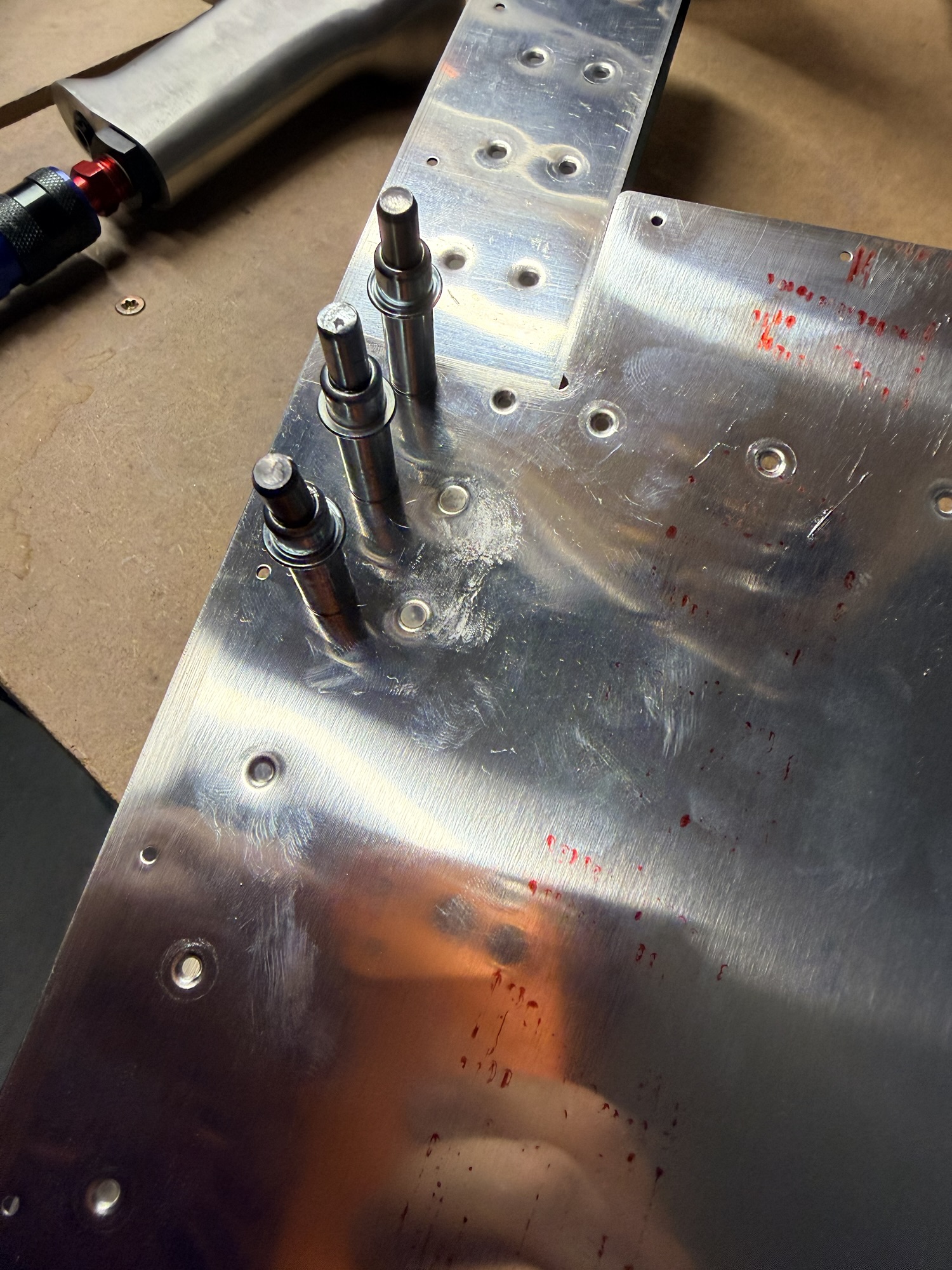
Then, I set up the DRDT-2 tool and dimpled all the hard-to-reach holes.

img_0837.jpg


Then set aside for work on the other skin.

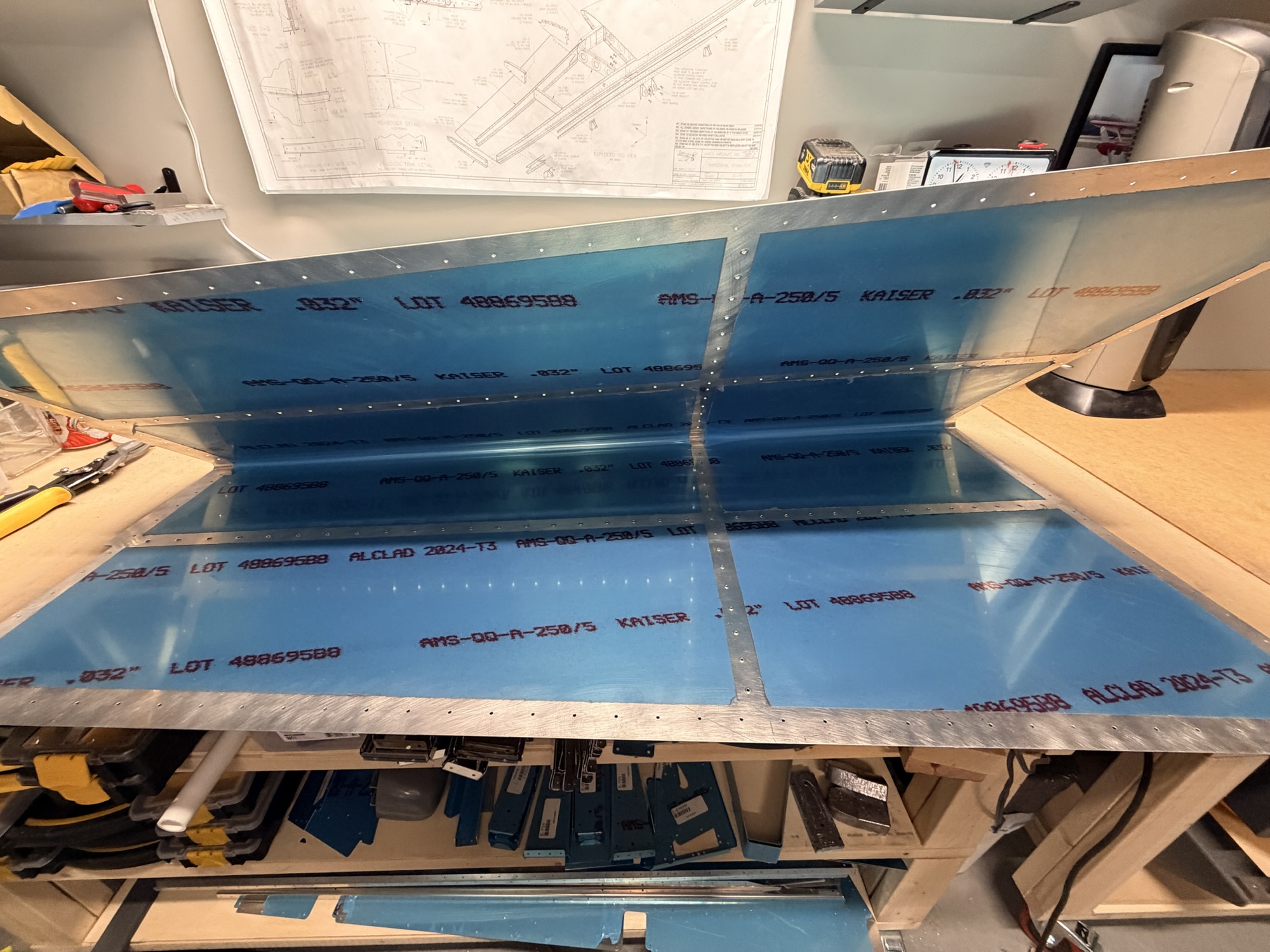
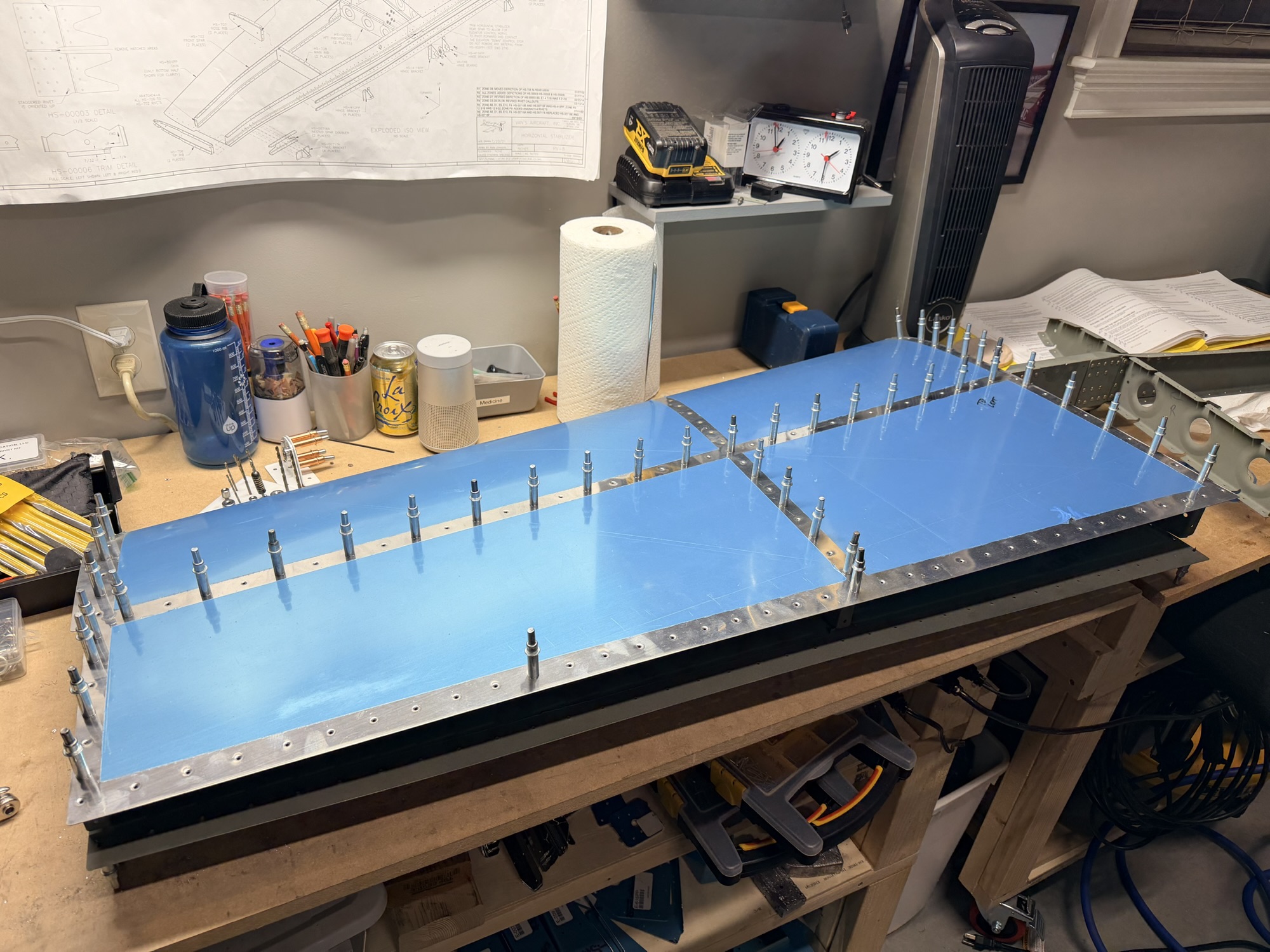
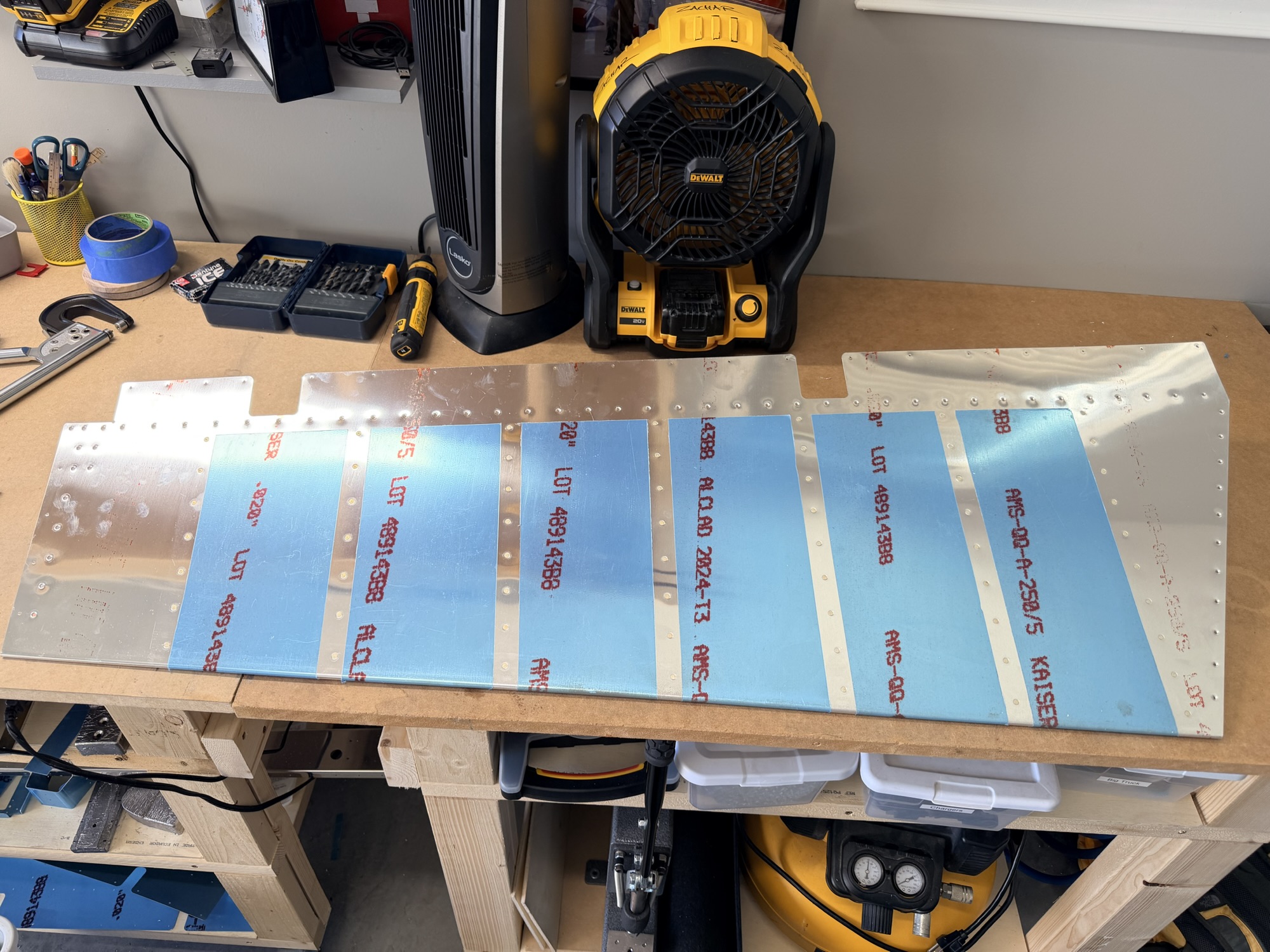
After both were done, I scuffed the inside and got set up to use the hand-squeezer to dimple all the exterior holes not needing the DRDT-2.

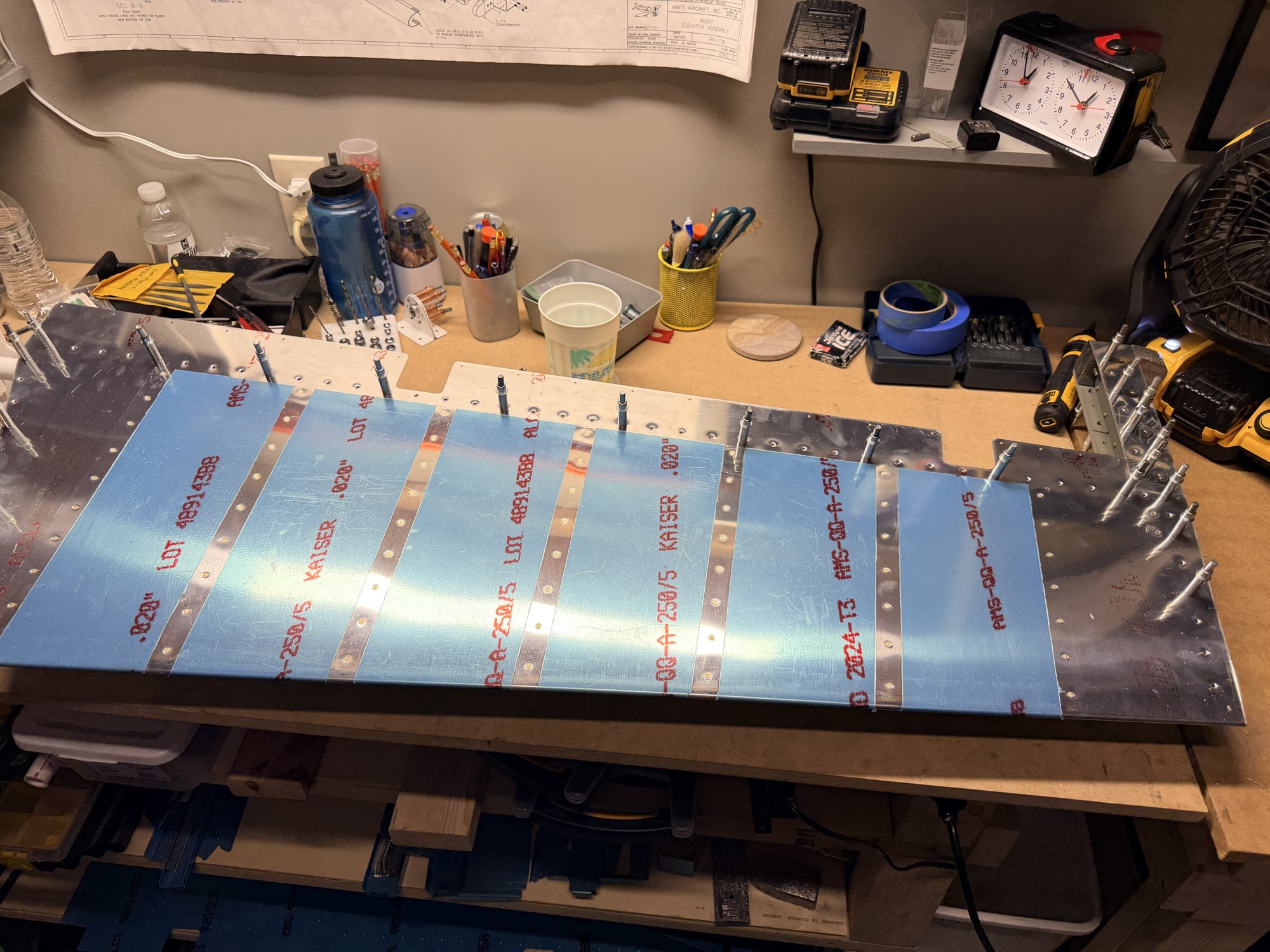
img_0838.jpg


Ready for edge dimpling, sir!

You can see my economy hand squeezer in the left corner of this picture.

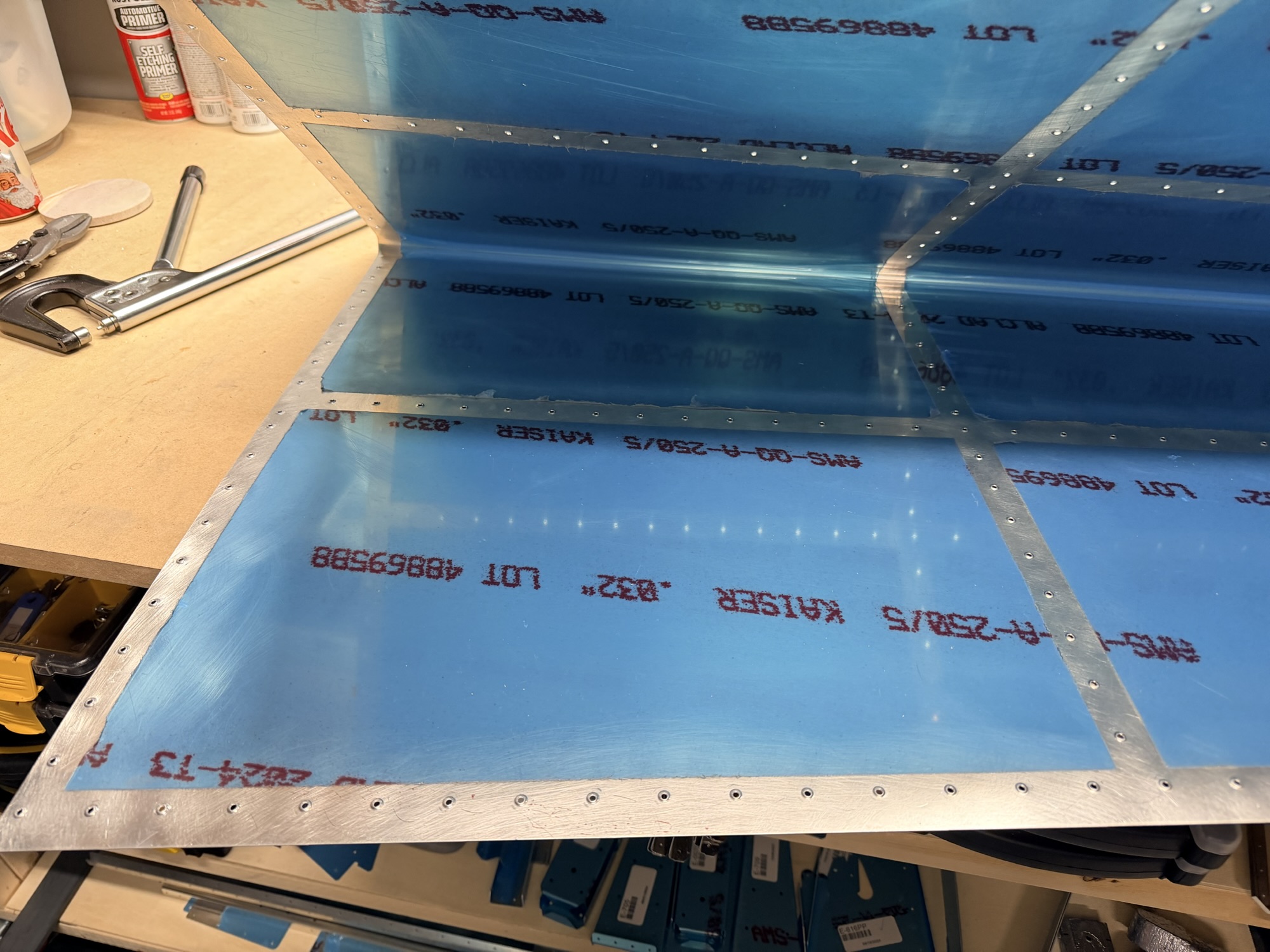
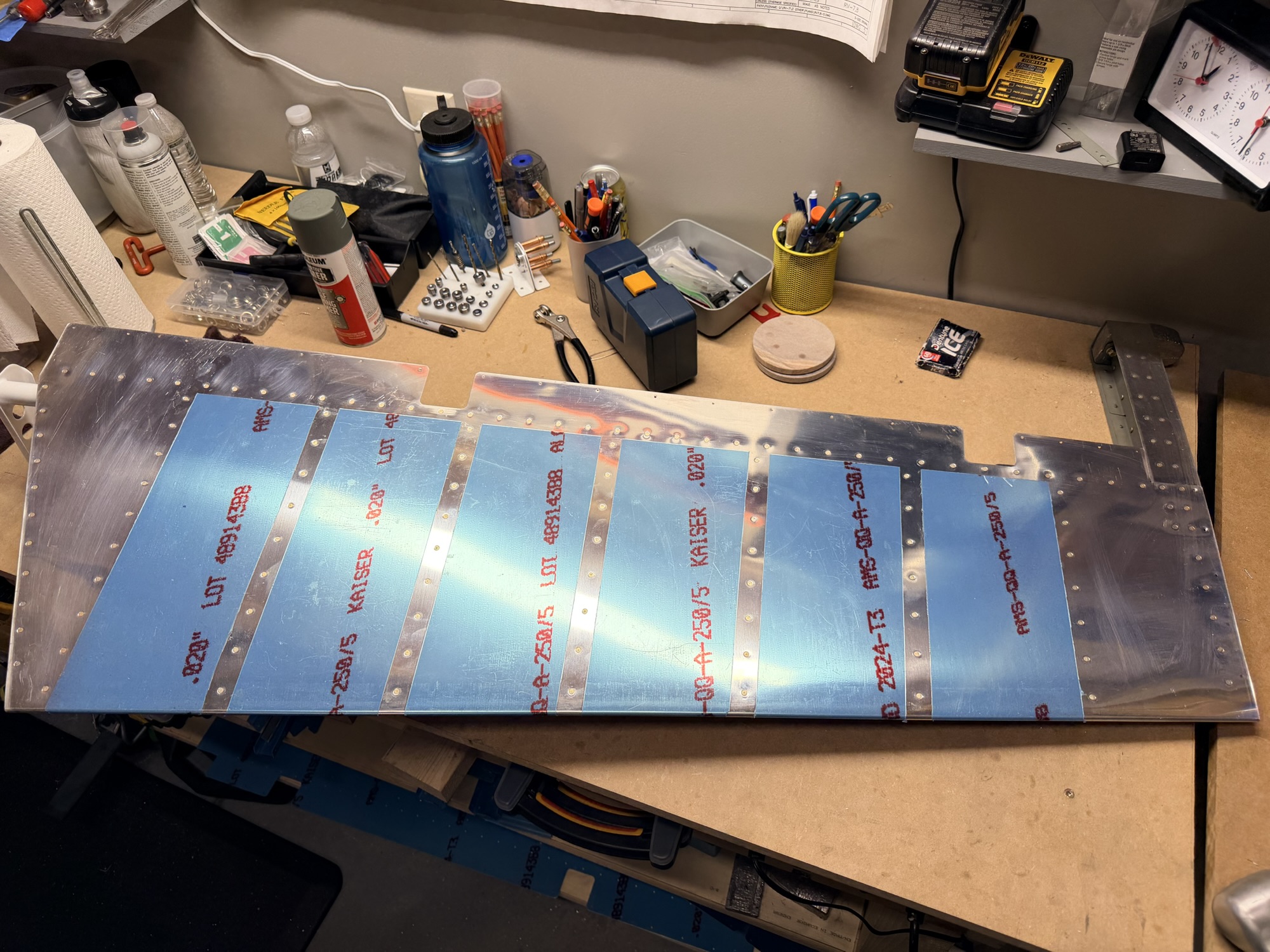
img_0839.jpg


Don't those dimples look nice?

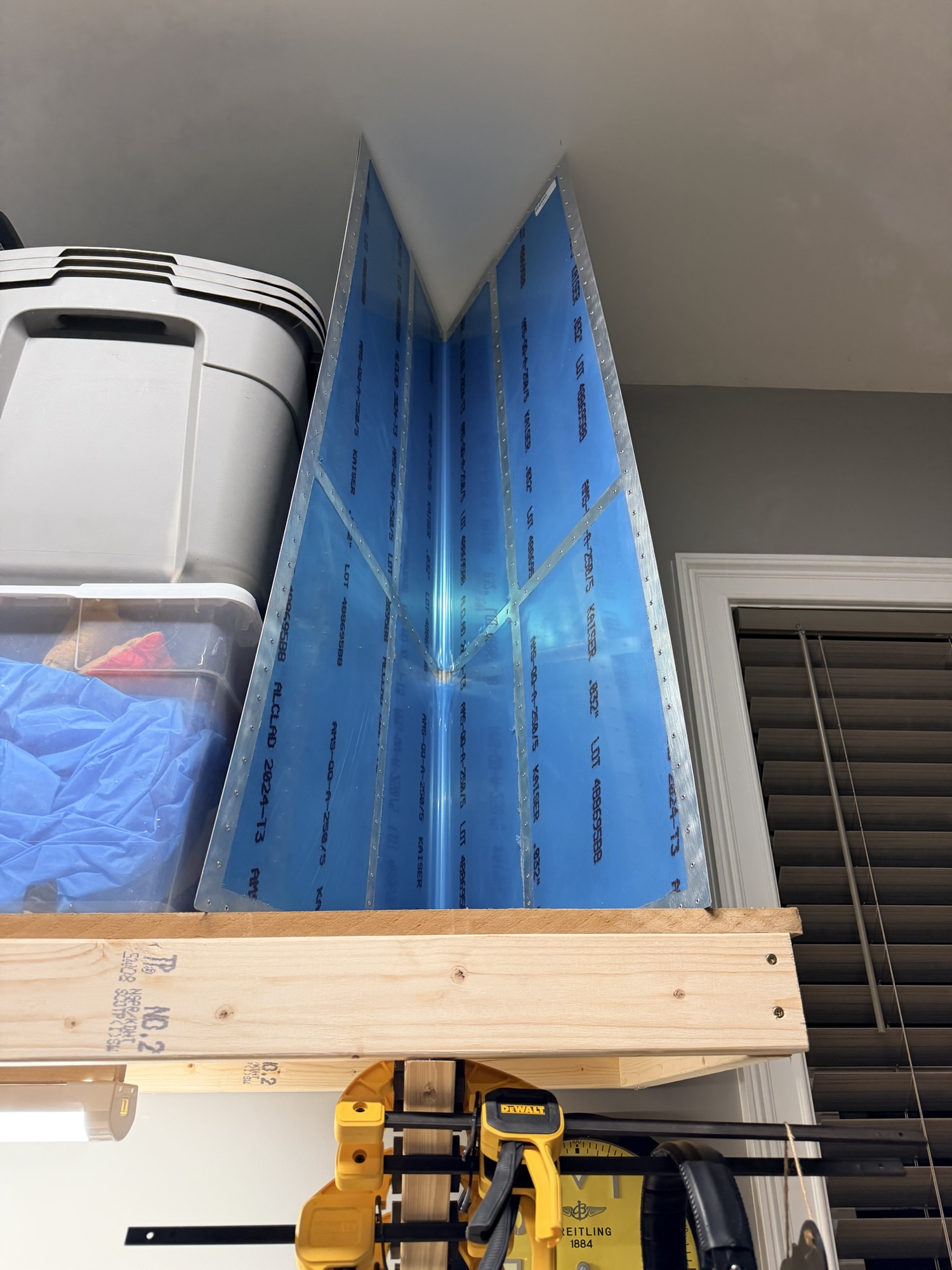
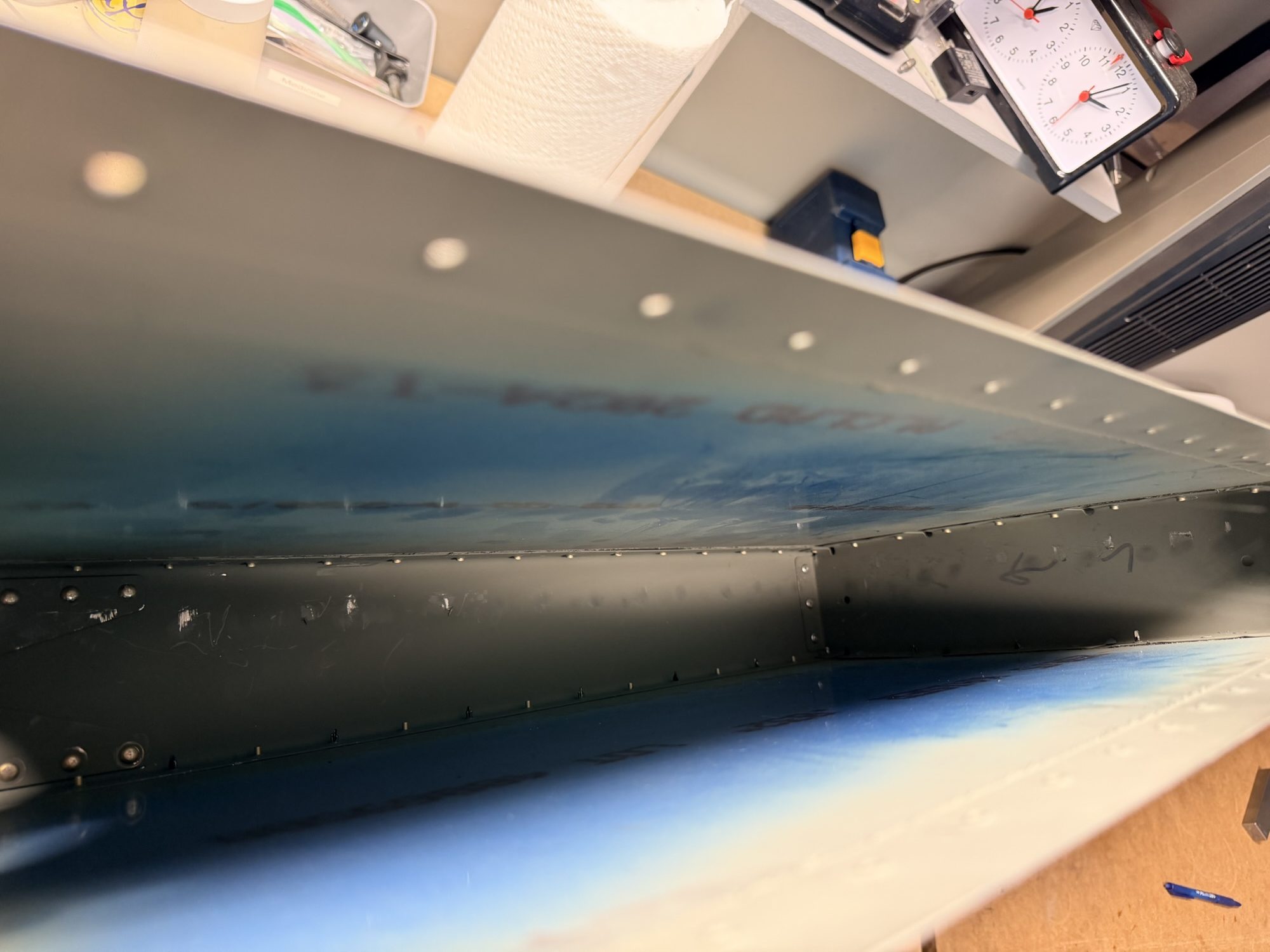
Once both skins were complete, I put them up on the shelf for safe-keeping.

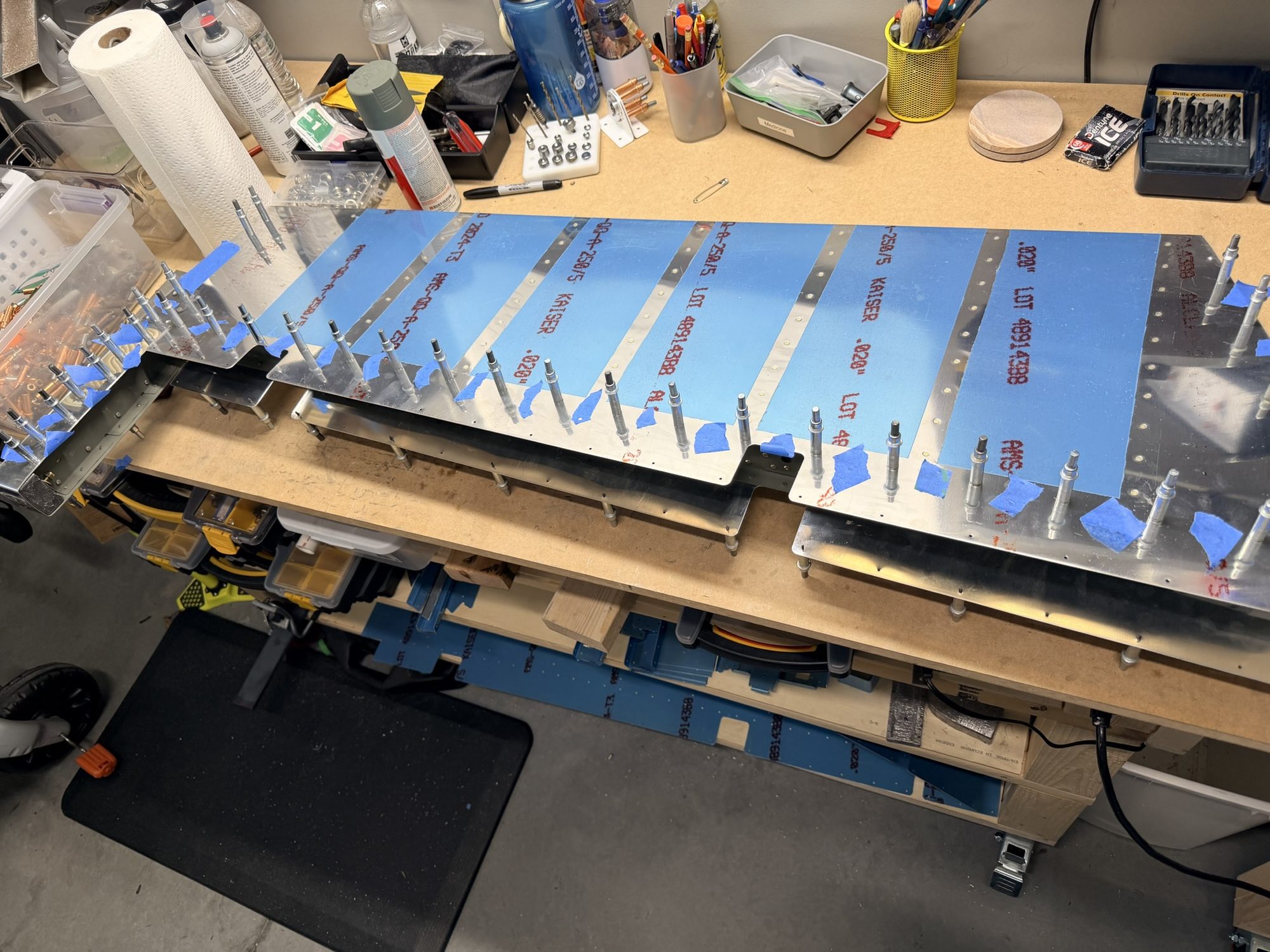
img_0840.jpg


ready for priming and riveting.

2.0 of quiet work.
 
Last edited:
Jan 1, 2026 - Prepped HS Ribs

Some of the most tedious and boring work on an RV is rib prep. First you have to edge finish in all the little nooks and crannys. Then,deburr the holes, dimple, scuff, etc.

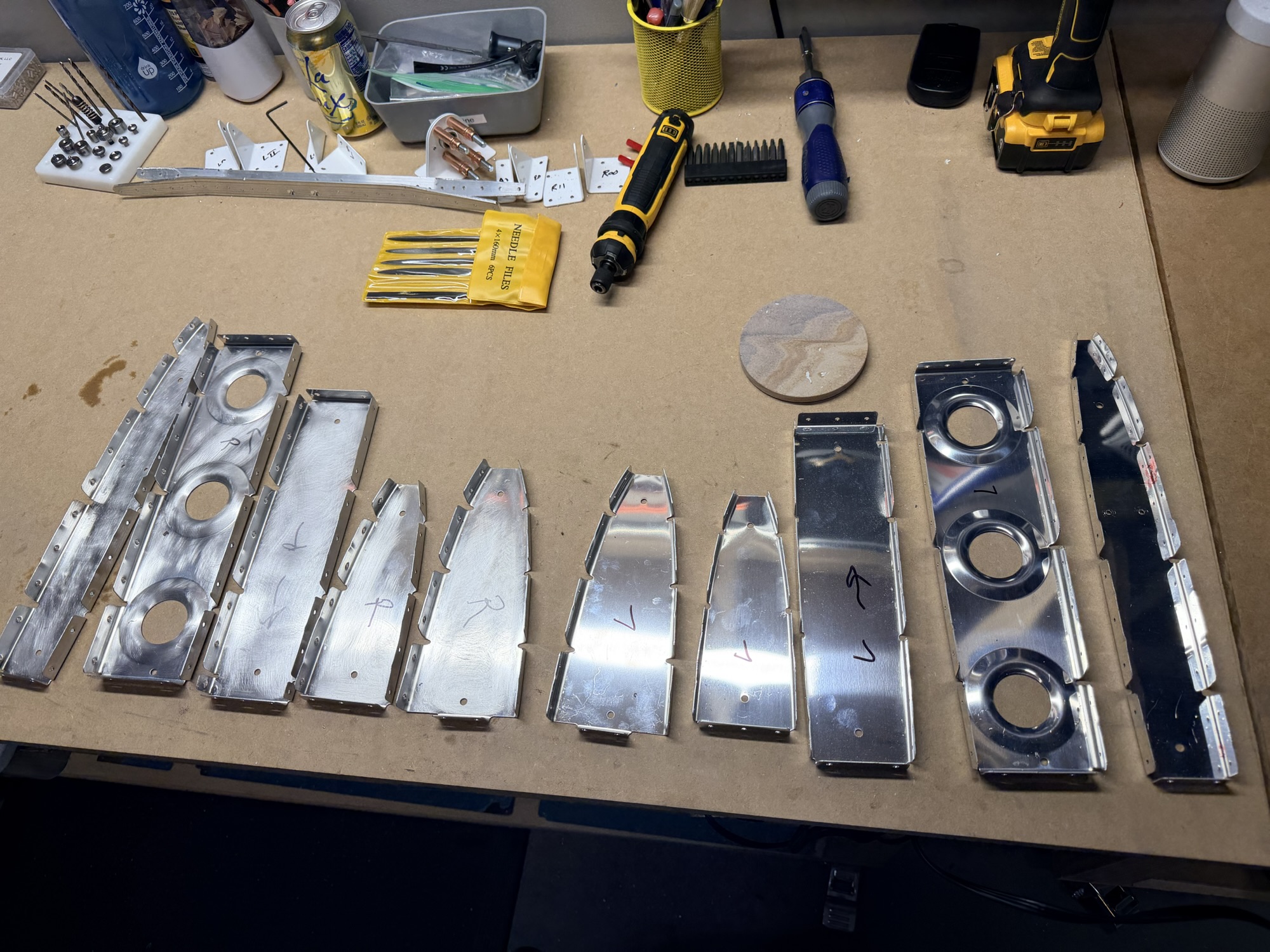
Here are half of them (the left half) complete. I'm about 1 hour in here.

img_1018.jpg


5 down, 5 to go.

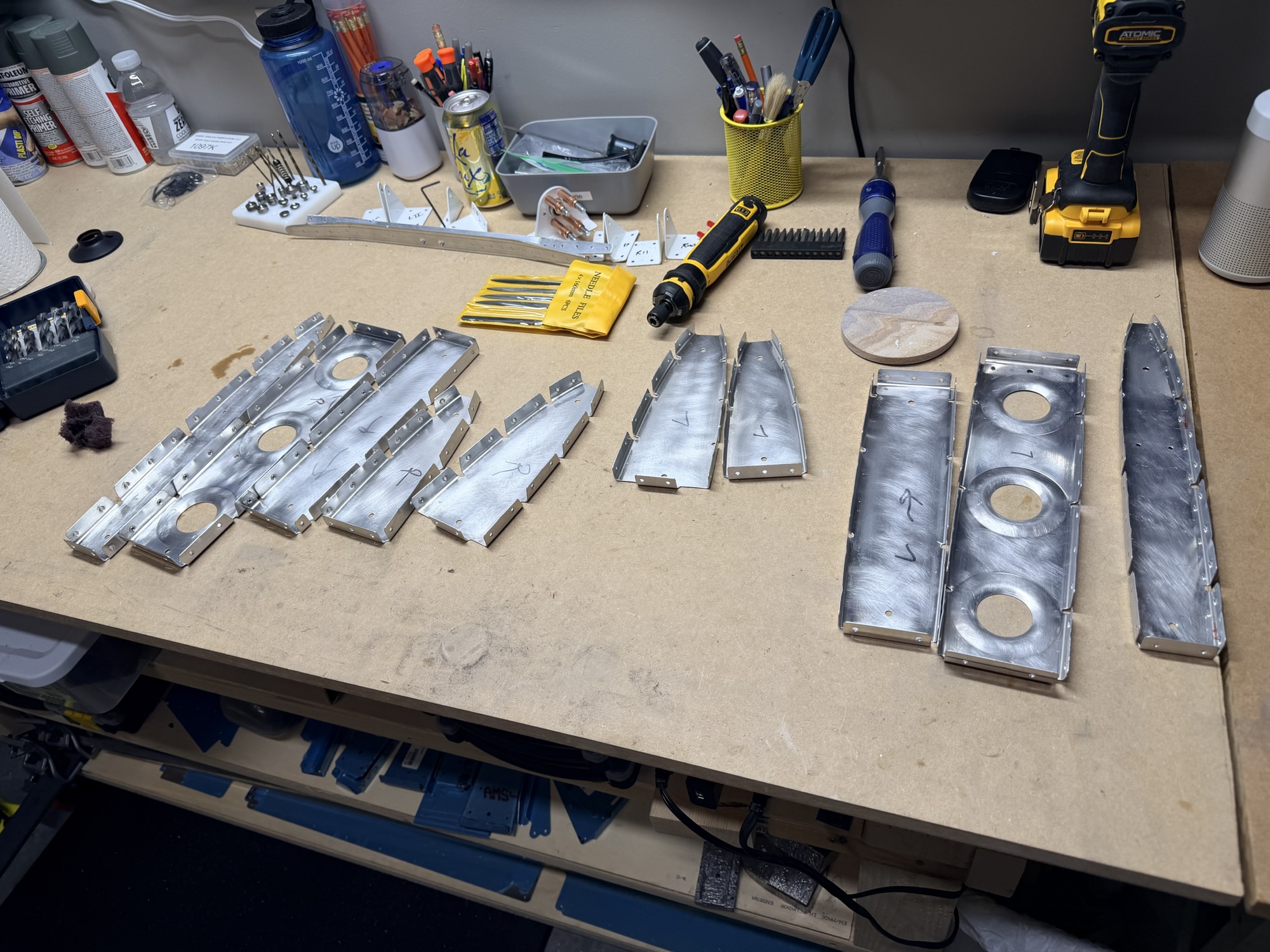
For some reason I went faster on the second set. Here's all 10. ready for cleaning and priming.

img_1019.jpg


Shiny and dull, all at the same time.

1.5 hours
 
Feb 20, 2026 - Prep and Prime HS Rear Spar

It's been awhile since I had to the time to work on the airplane, but I got a fairly big chunk of prep done on the horizontal stabilizer rear spar.

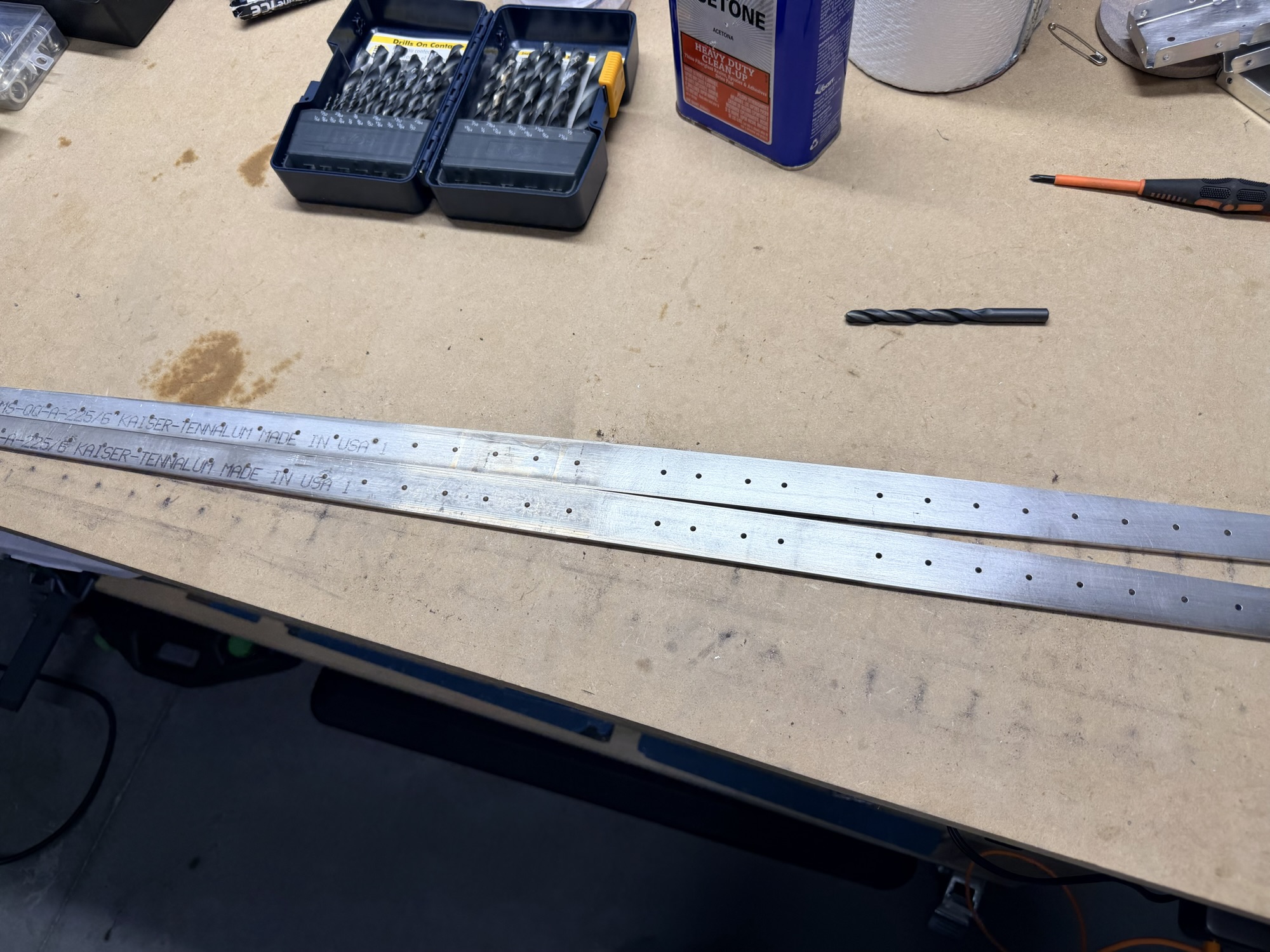
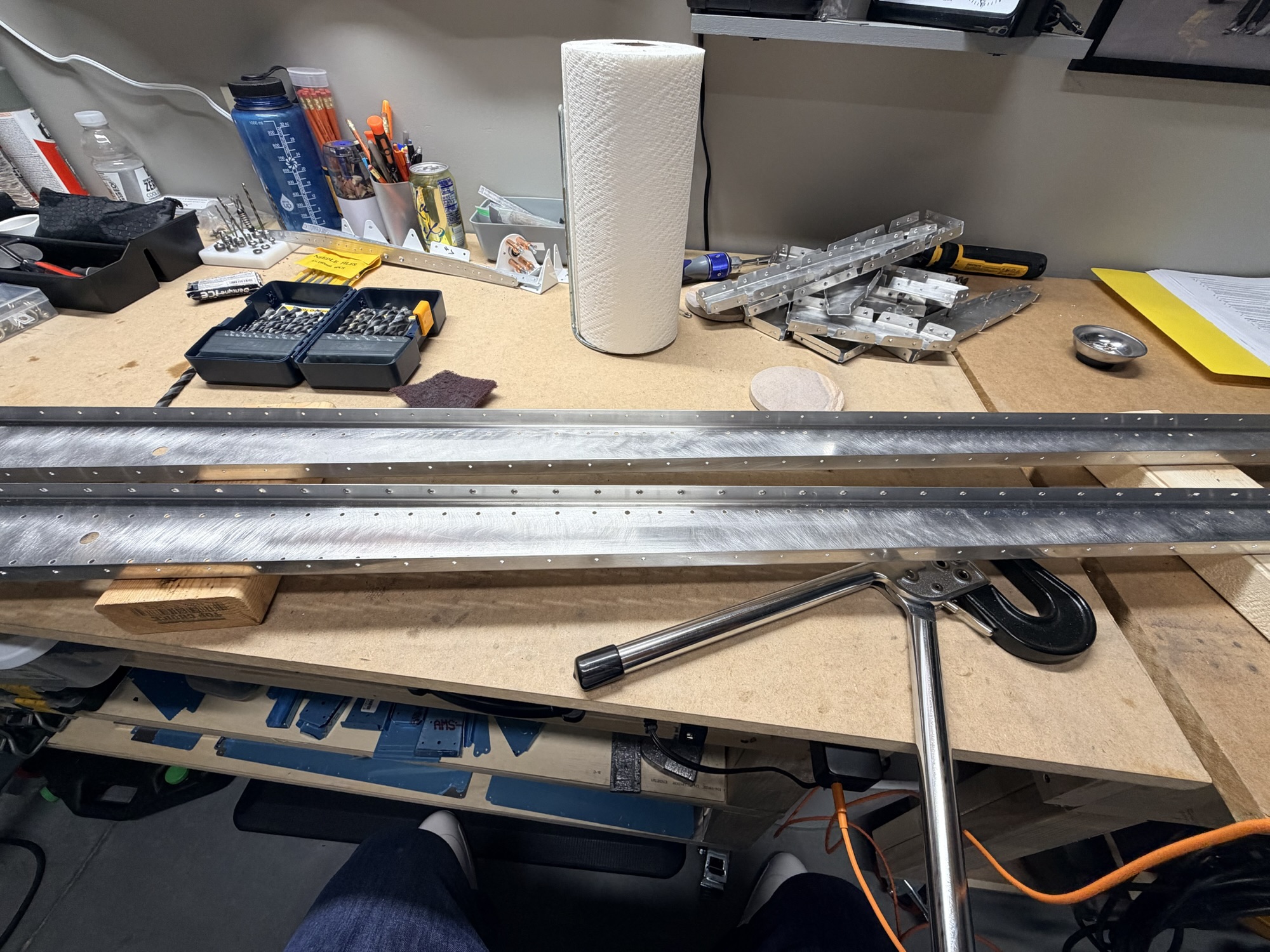
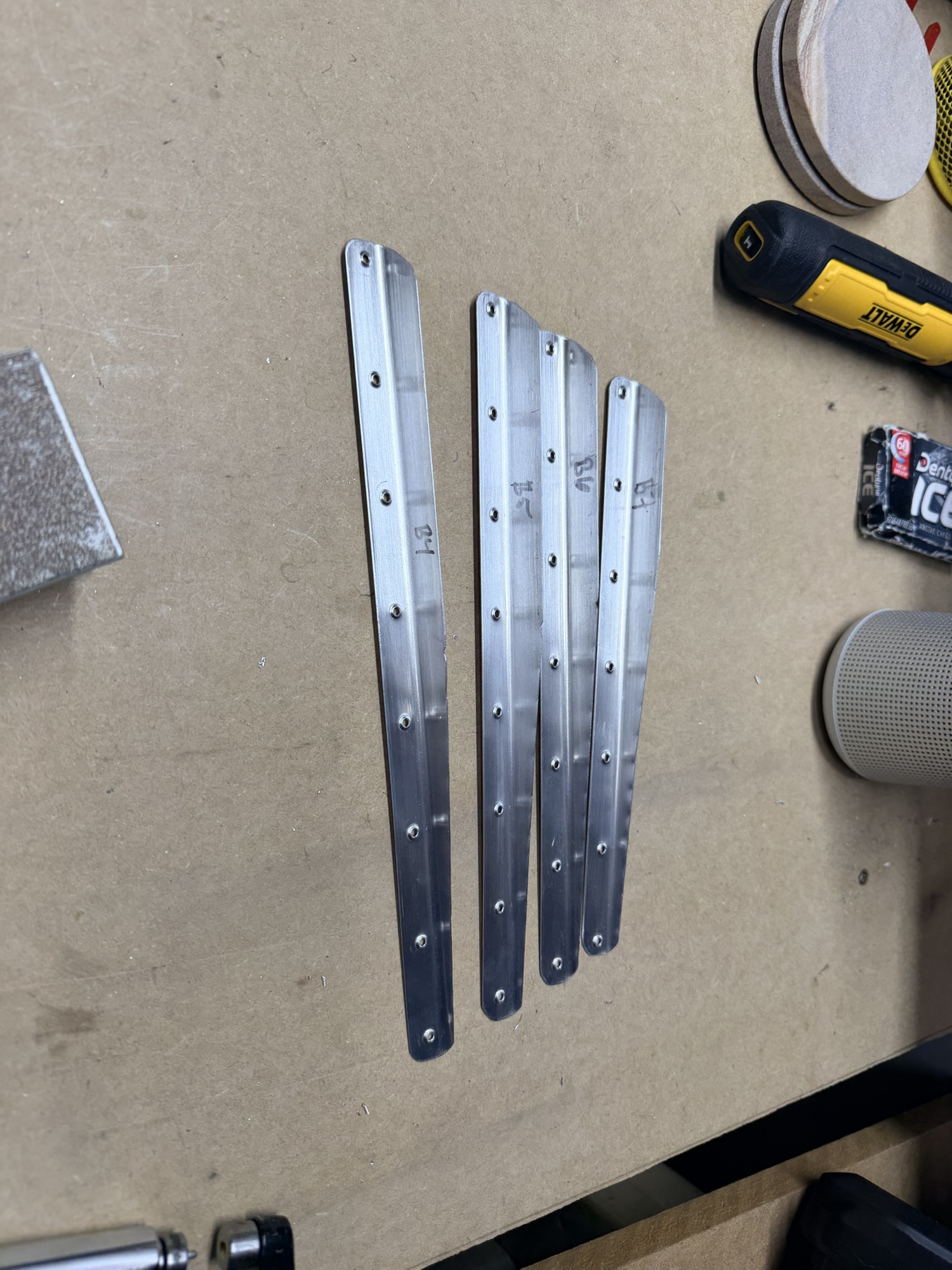
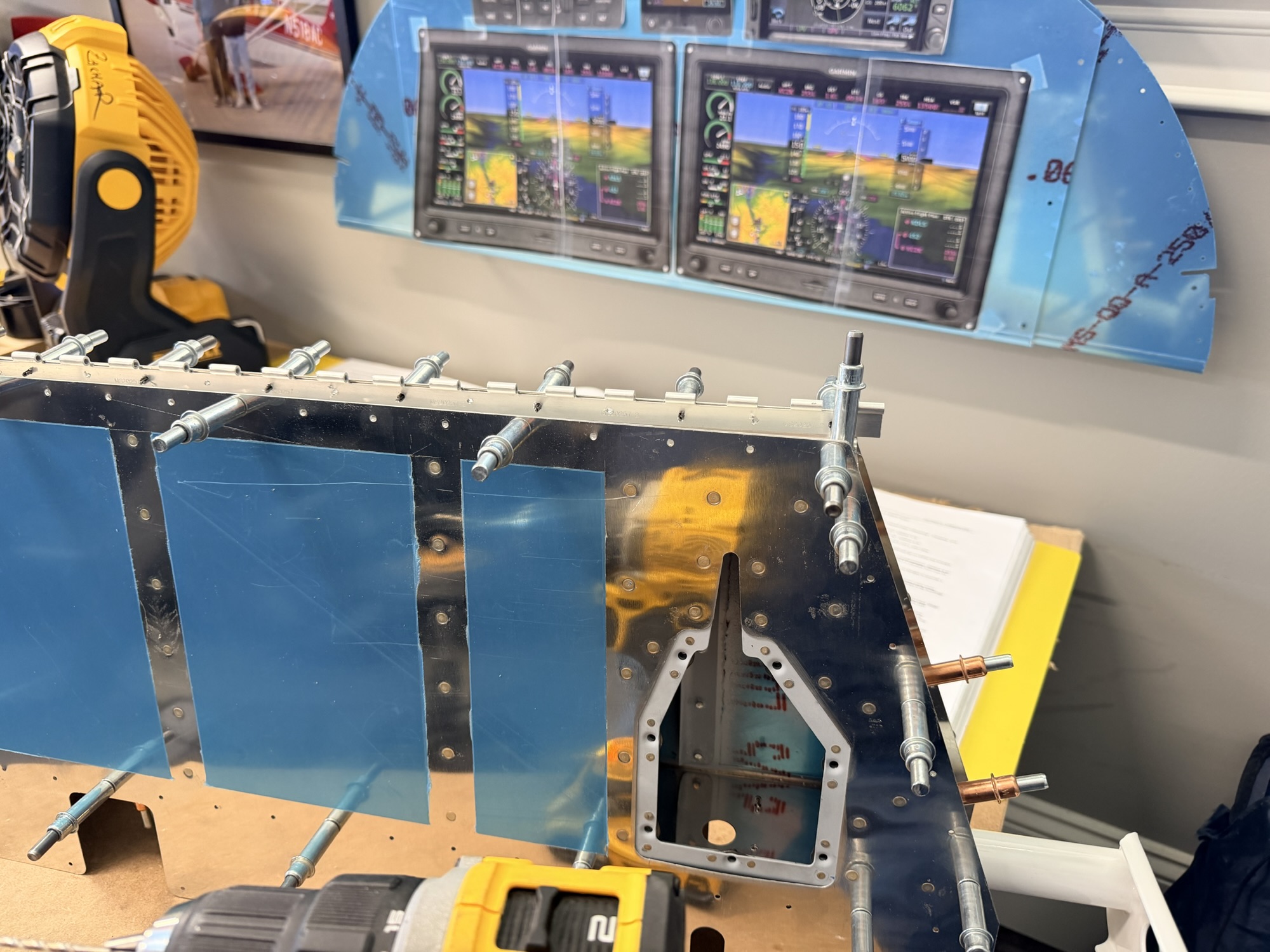
First, I needed to edge-finish, debur, and scuff the rear spar reinforcement bars.

img_1680.jpg


dull bars to shiny bars

Next up, let's finish dimpling the rear spar channels.

img_1681.jpg


channels down dimpled, time for cleaning and priming

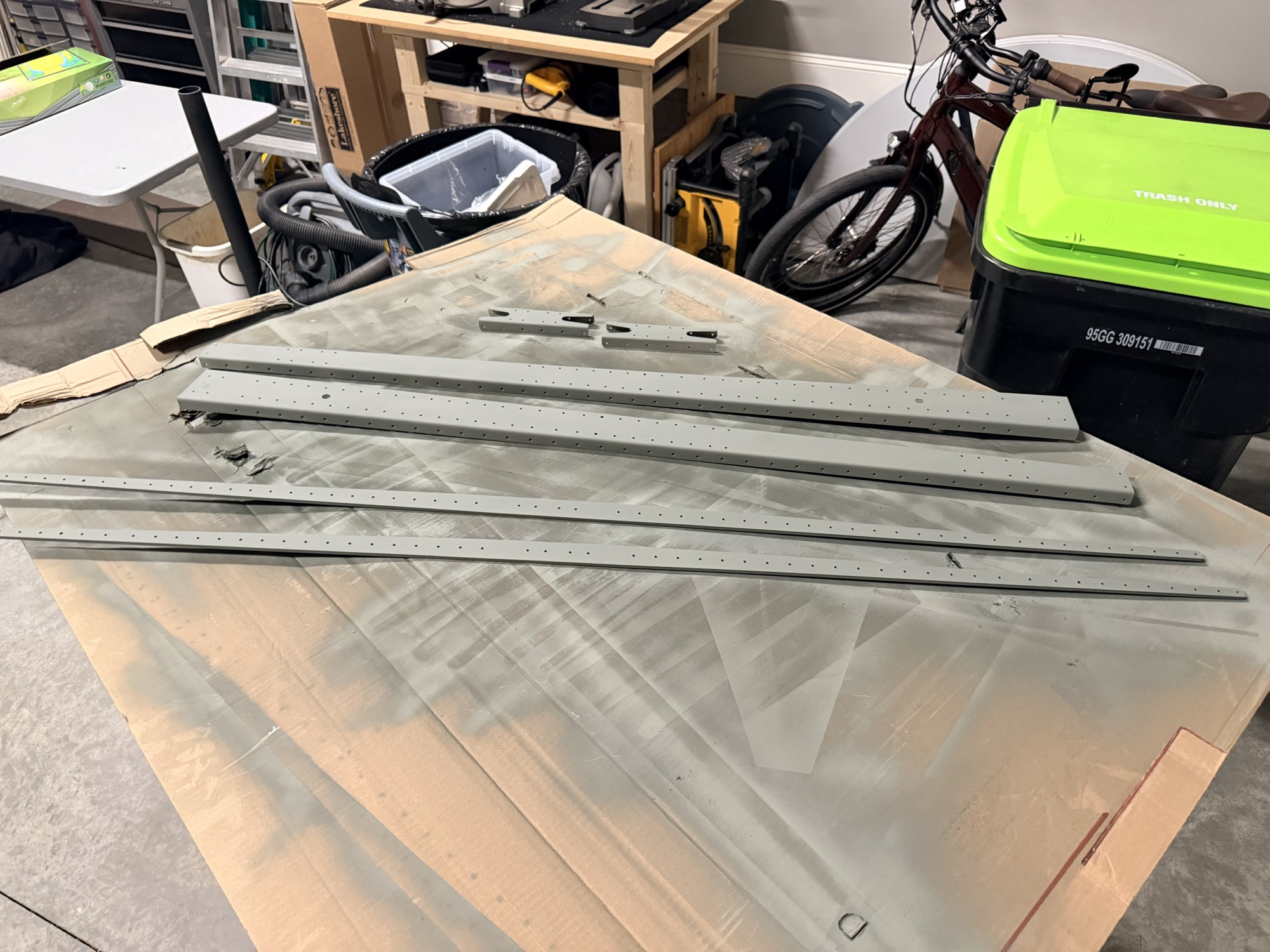
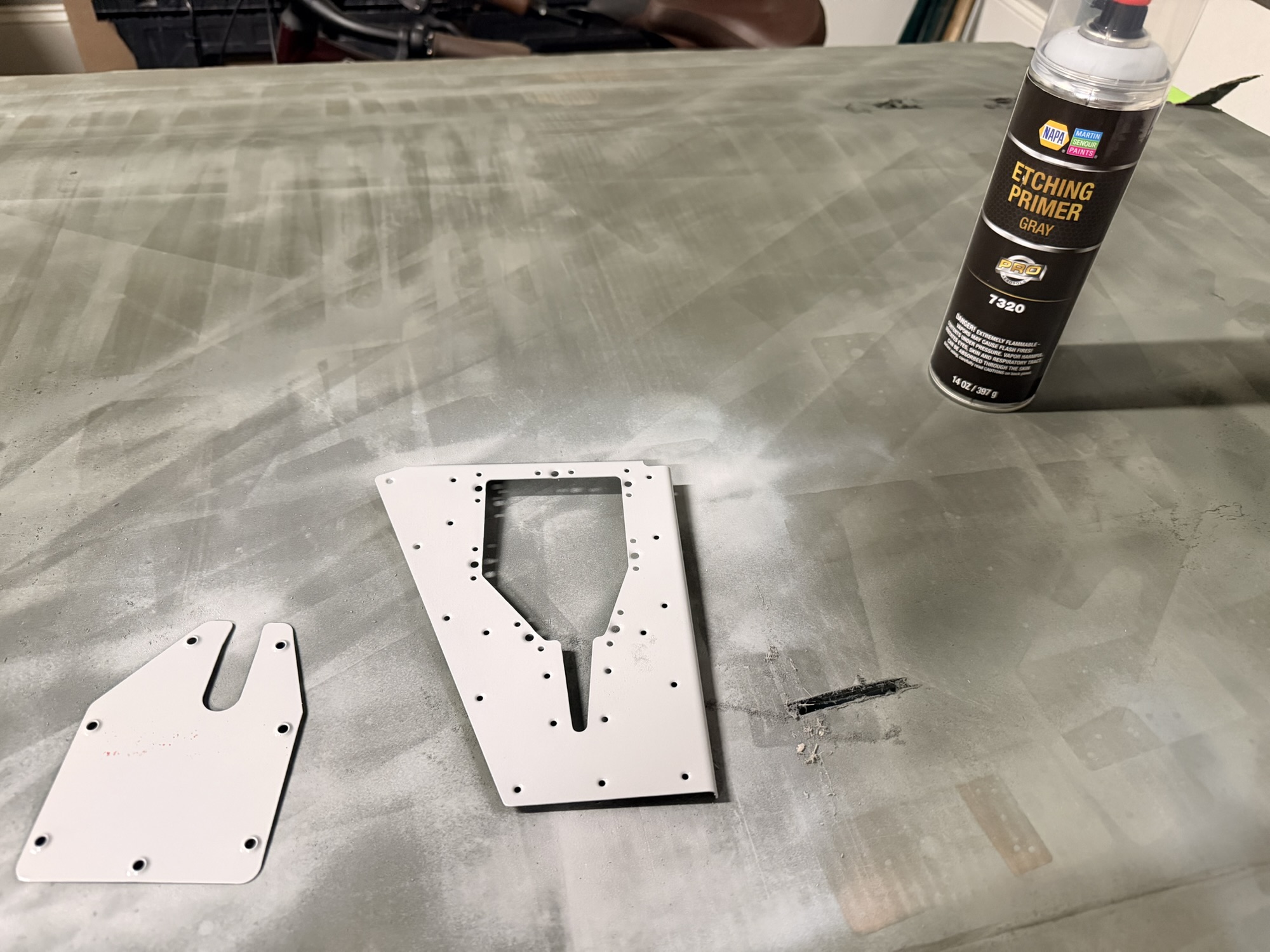
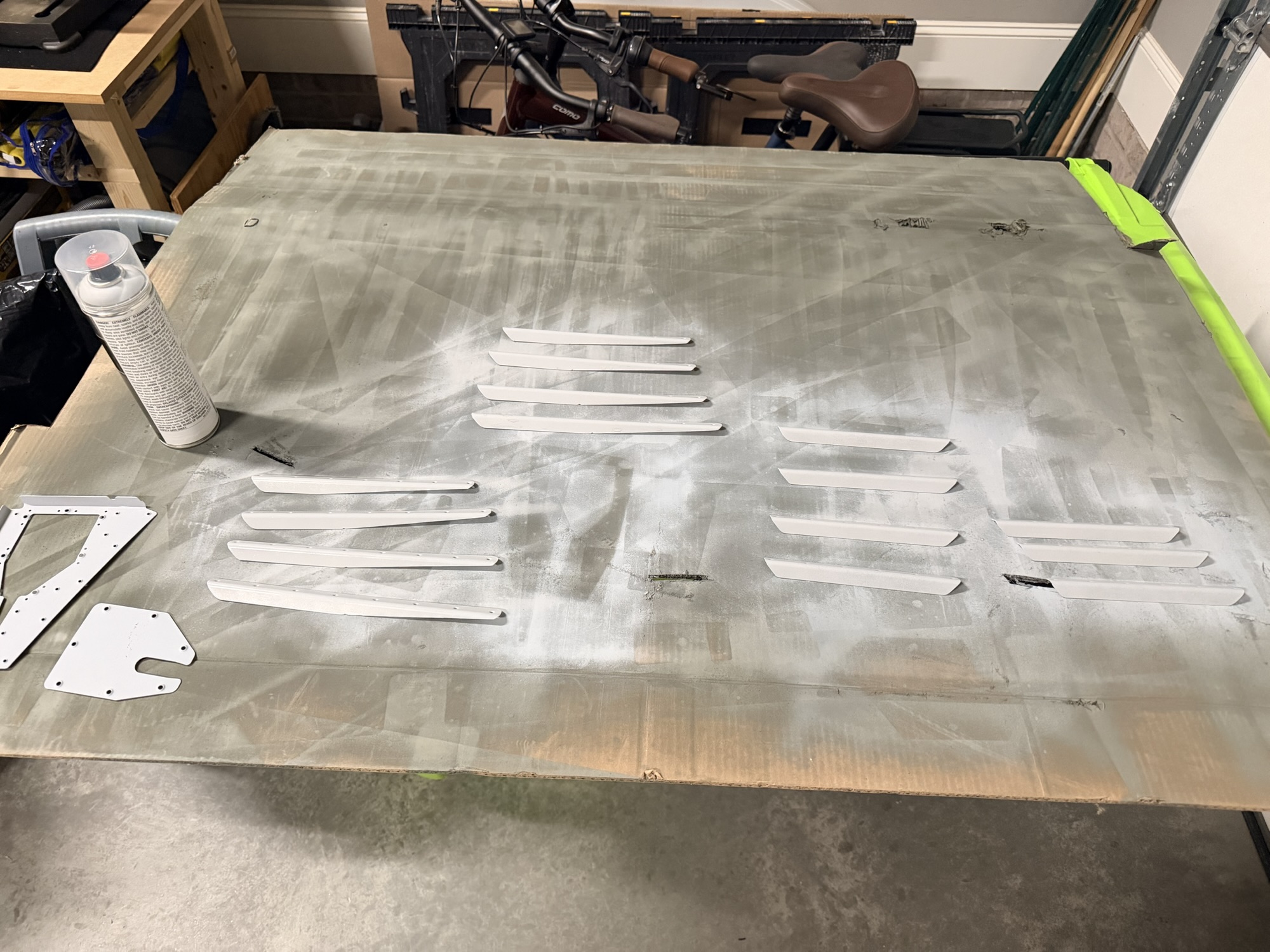
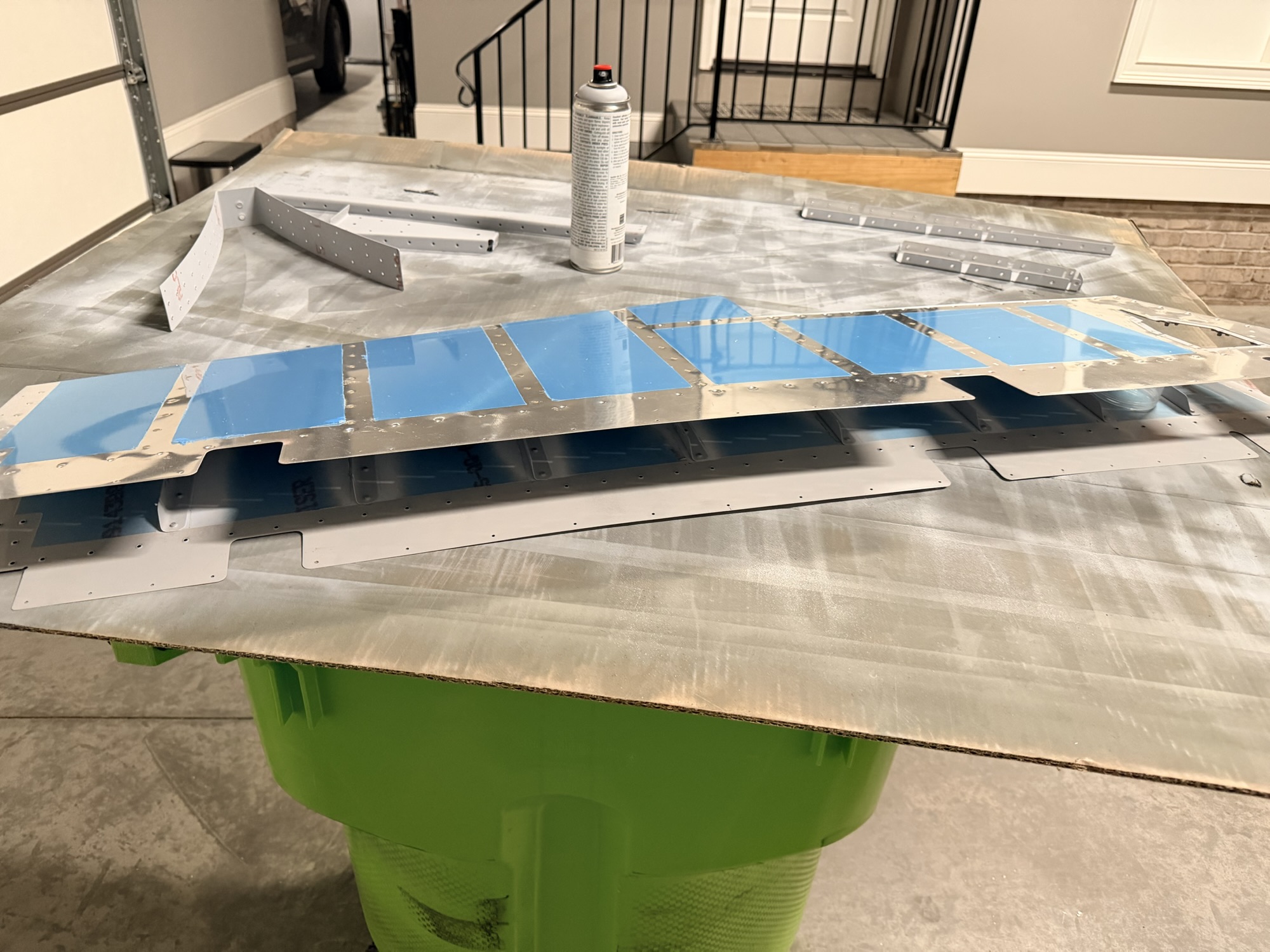
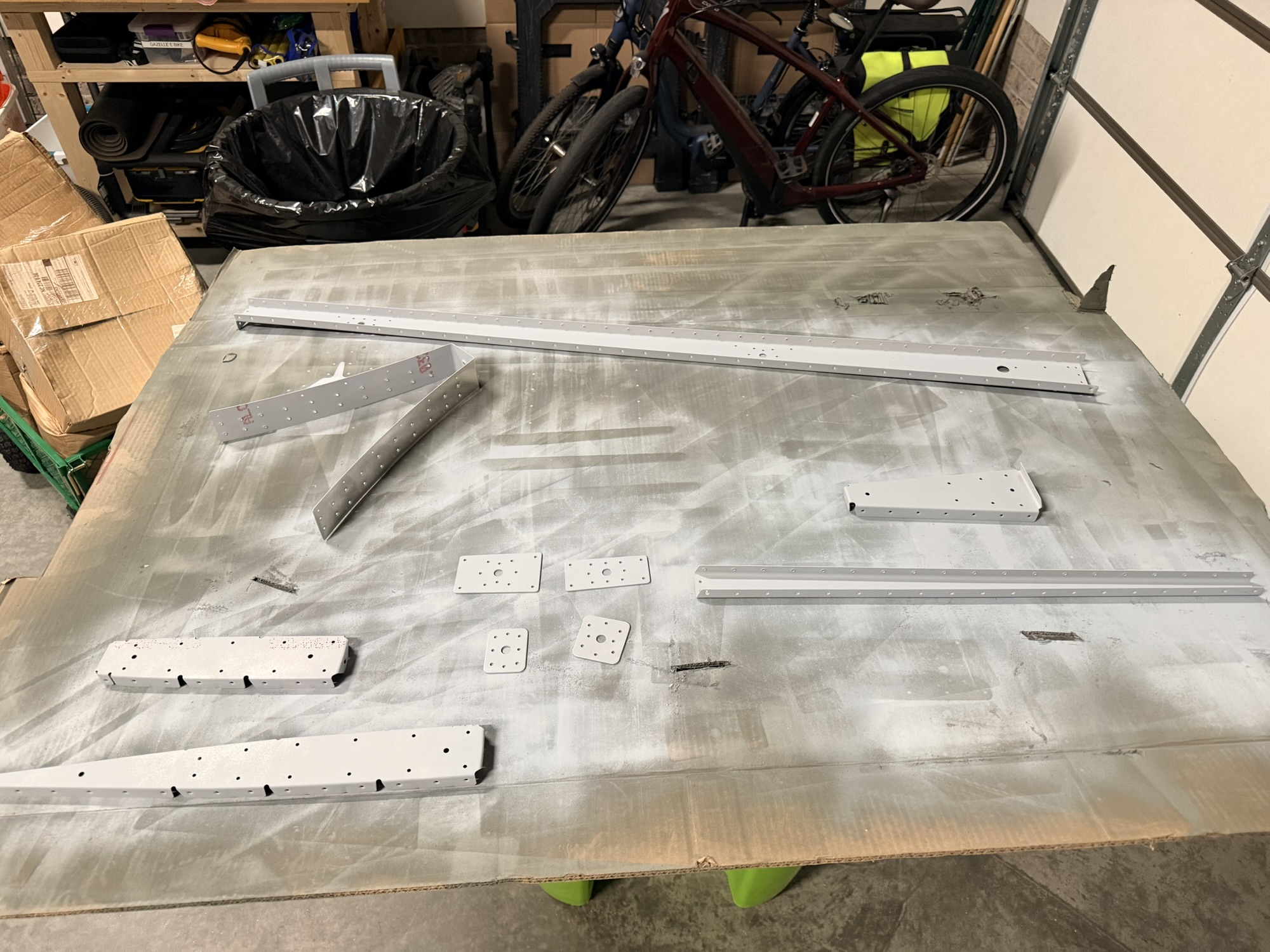
Finally, I got the bars, channels, and the two hinge bracket doublers primed on my very professional priming station.

img_1683.jpg


This (green) self -tching primer is not my favorite. I'm going to go back to the NAPA stuff once it runs out.

A WHOLE HOUR today. Progress is progress, though.
 
Feb 23, 2026 - Riveting HS Rear Spar Bars and Hinge Brackets

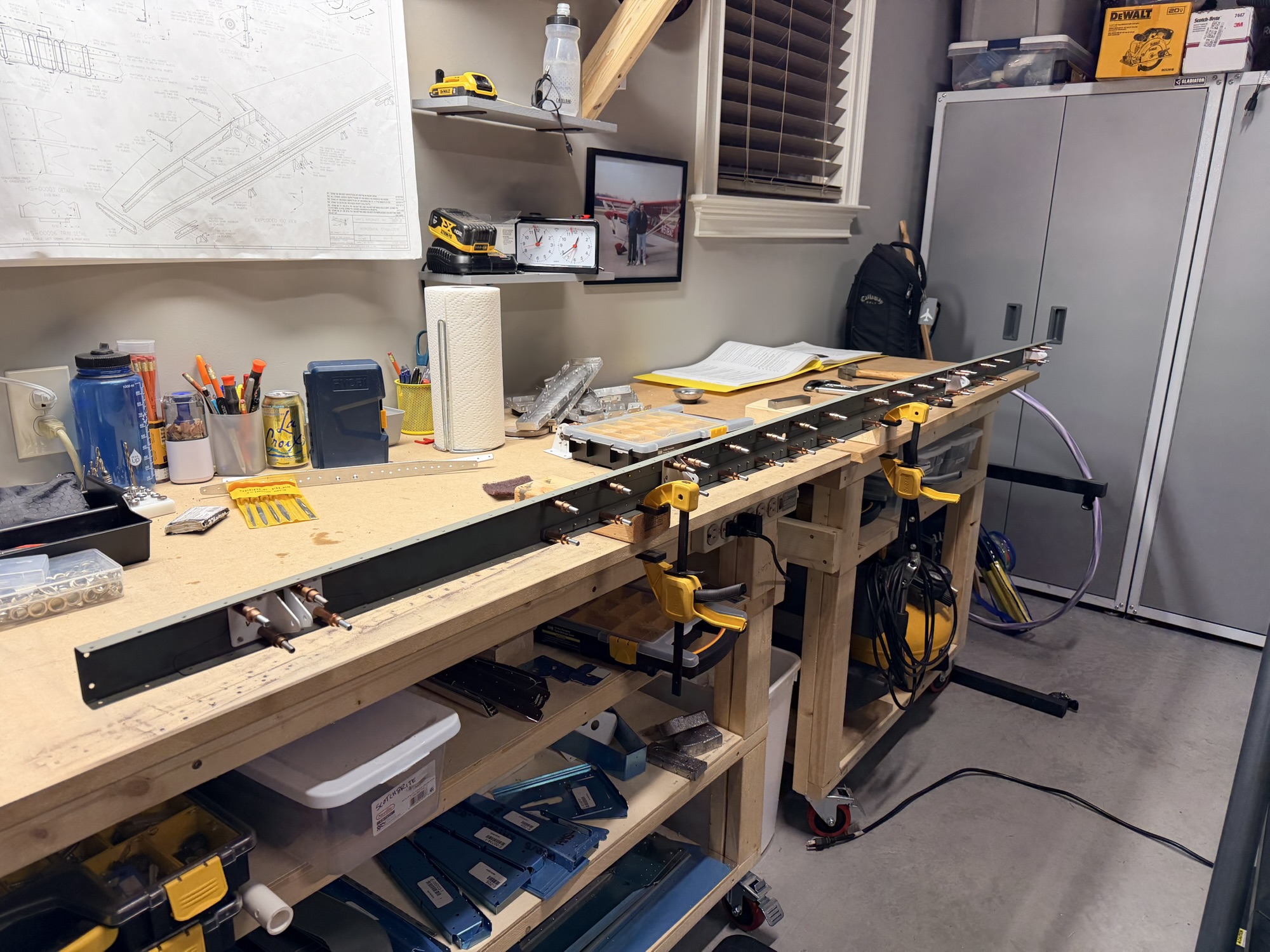
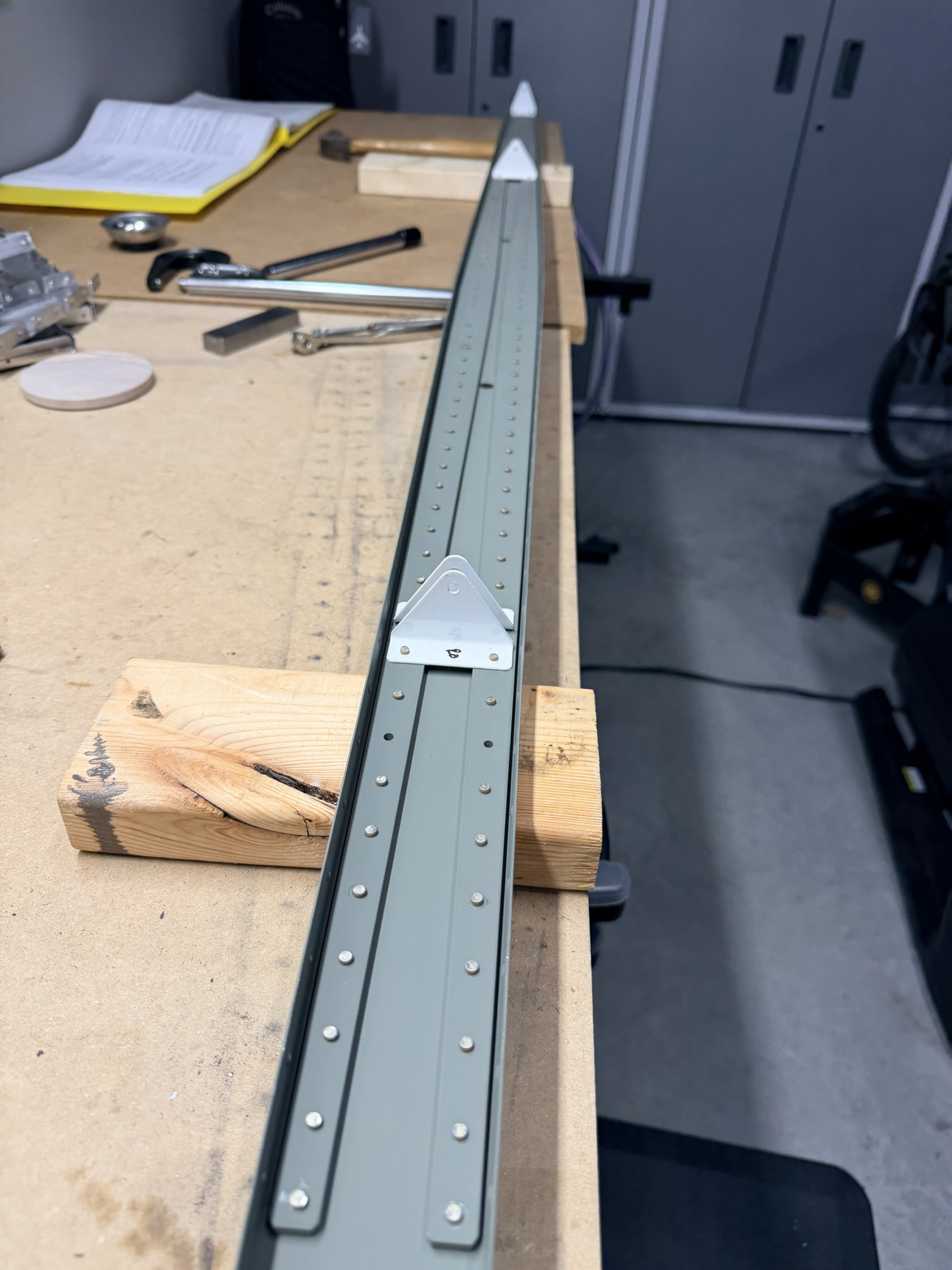
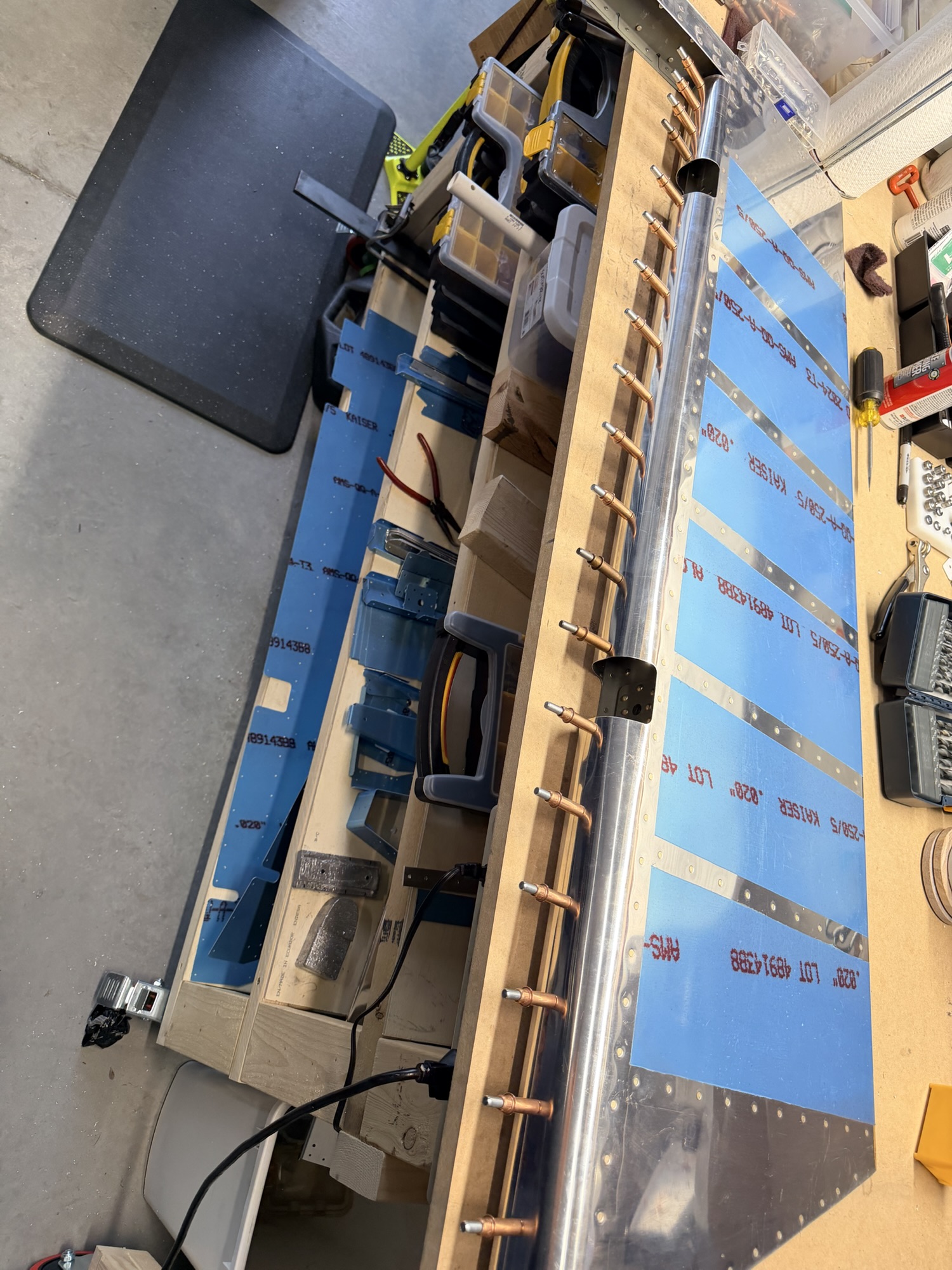
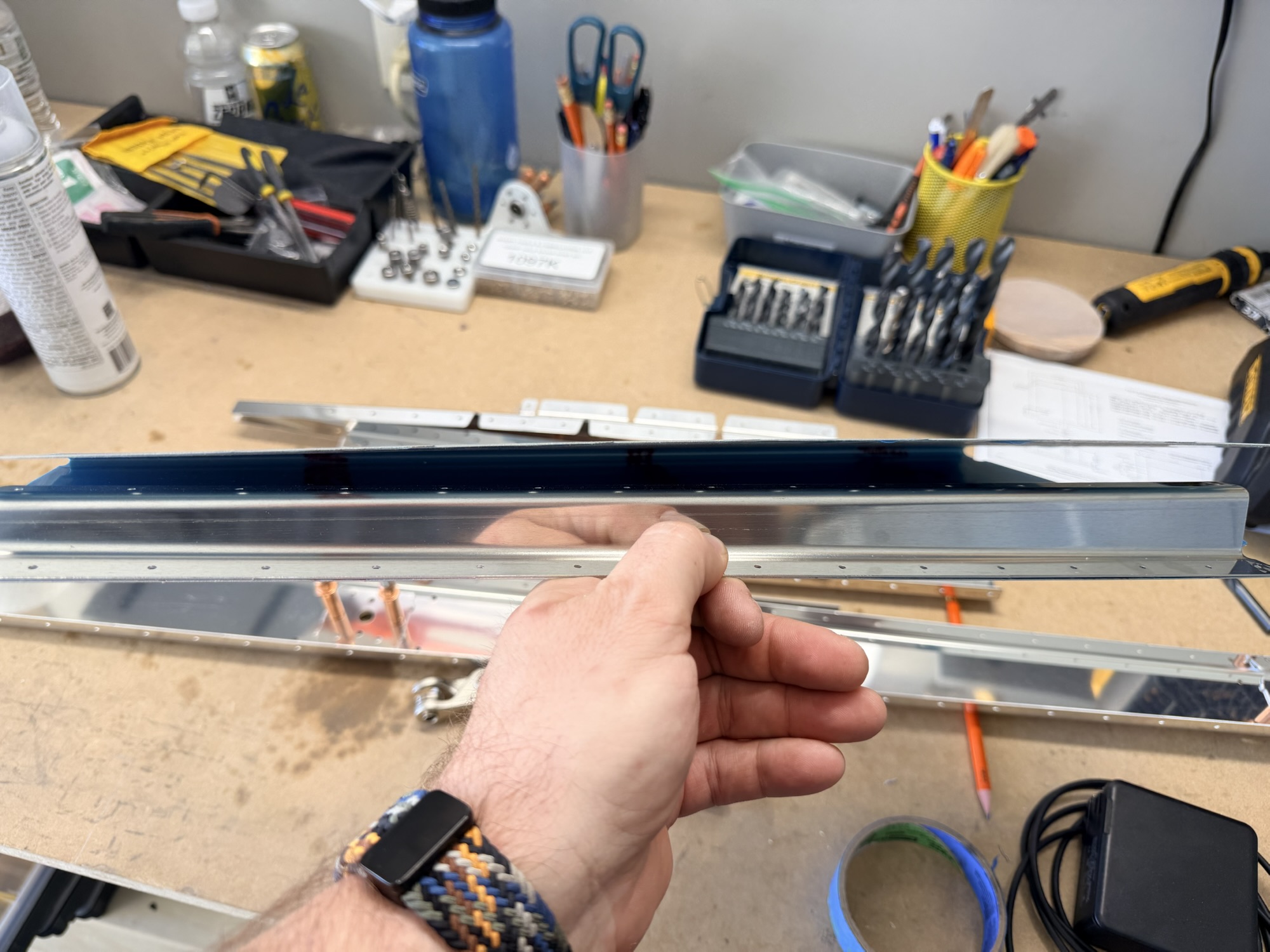
First up, a nice shot of how long the horizontal stabilizer rear spar is. I remember being suprised with the RV-7. It's just as big on the RV-8.

Here, everything is clecoed together, ready for riveting.

img_1708.jpg


ready for a rivet day!

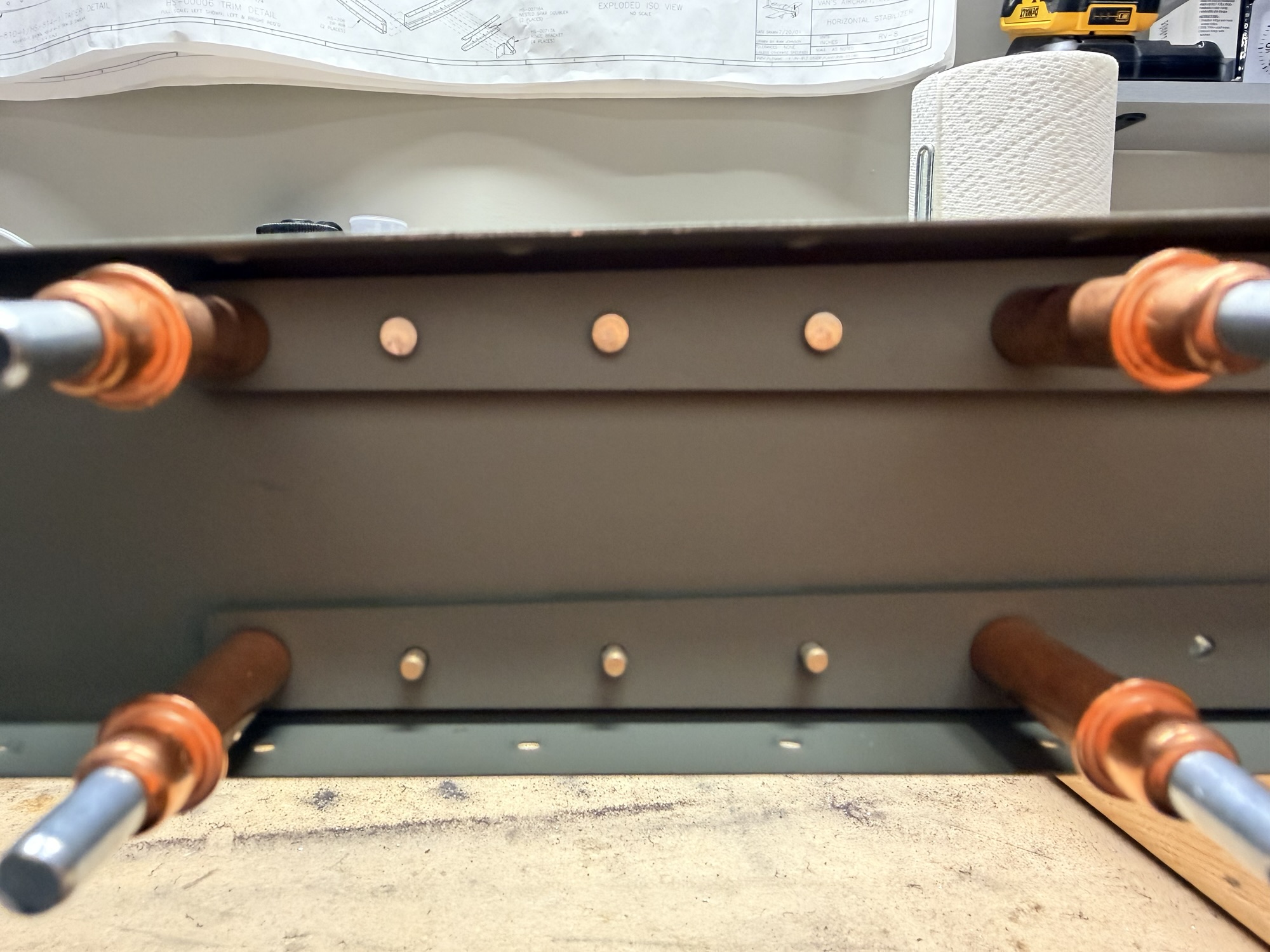
I squeezed the first three rivets on the HS reinforcement bars, and was pleasantly surprised. Clamping to the table helped keep everything aligned.

img_1709.jpg


The upper rivets are nicely formed shop heads.

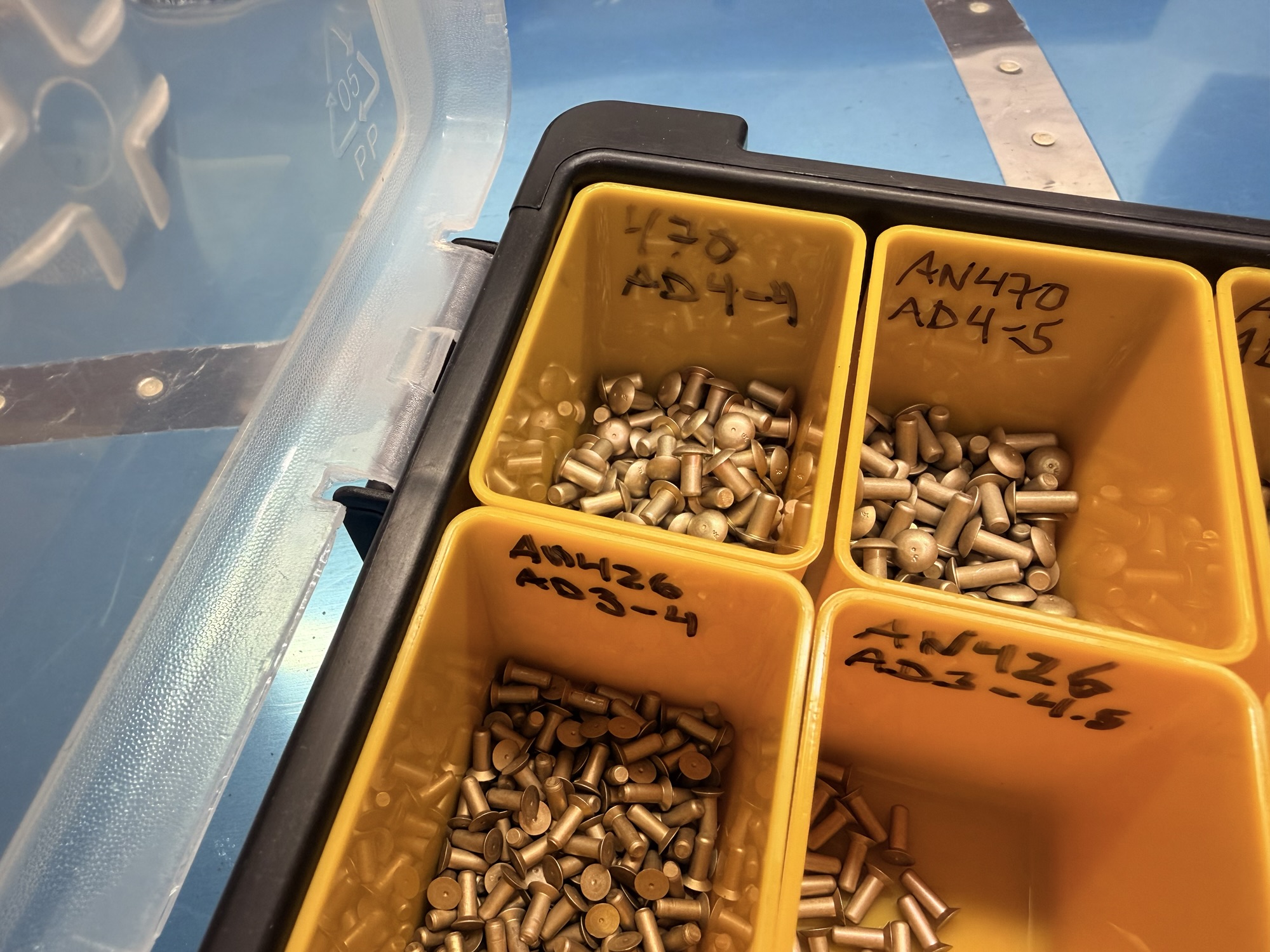
Then, I set the phone down for a few minutes and got into the groove. Most of these are AN470AD4-6 rivets, with -5s at the outboard hinge brackets and -7s for the brackets that sit on top of the bars.

img_1710.jpg


The open holes are for HS ribs, I didn't forget any.

1.0 hours tonight, squeezed 116 AN470AD4- rivets. I was pleasantly surprised with my economy hand squeezer, but I still want the Main Squeeze one from cleveland. I wish they weren't backordered.
 
Feb 24, 2026 - HS Front Spar Prep and Riveting

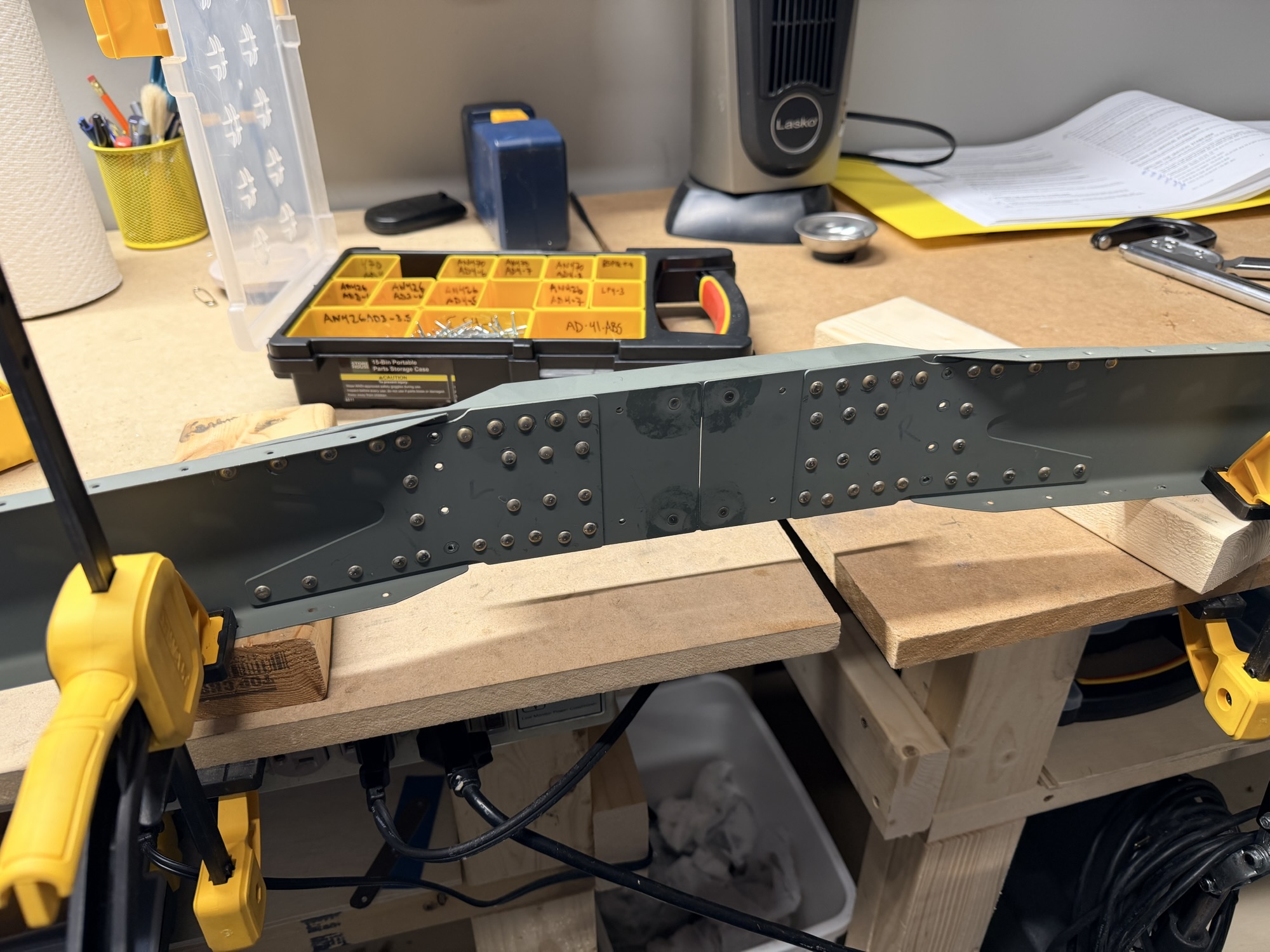
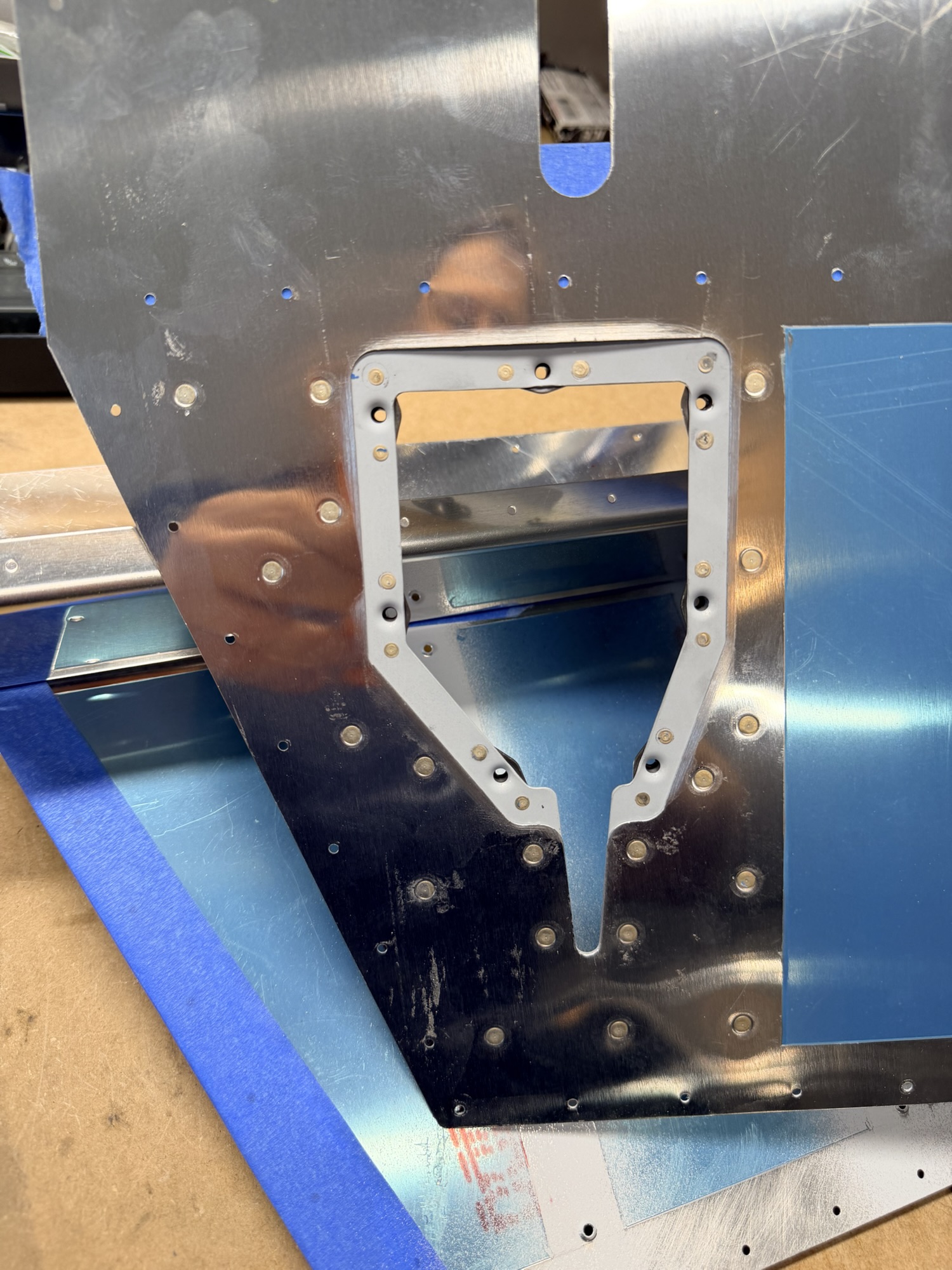
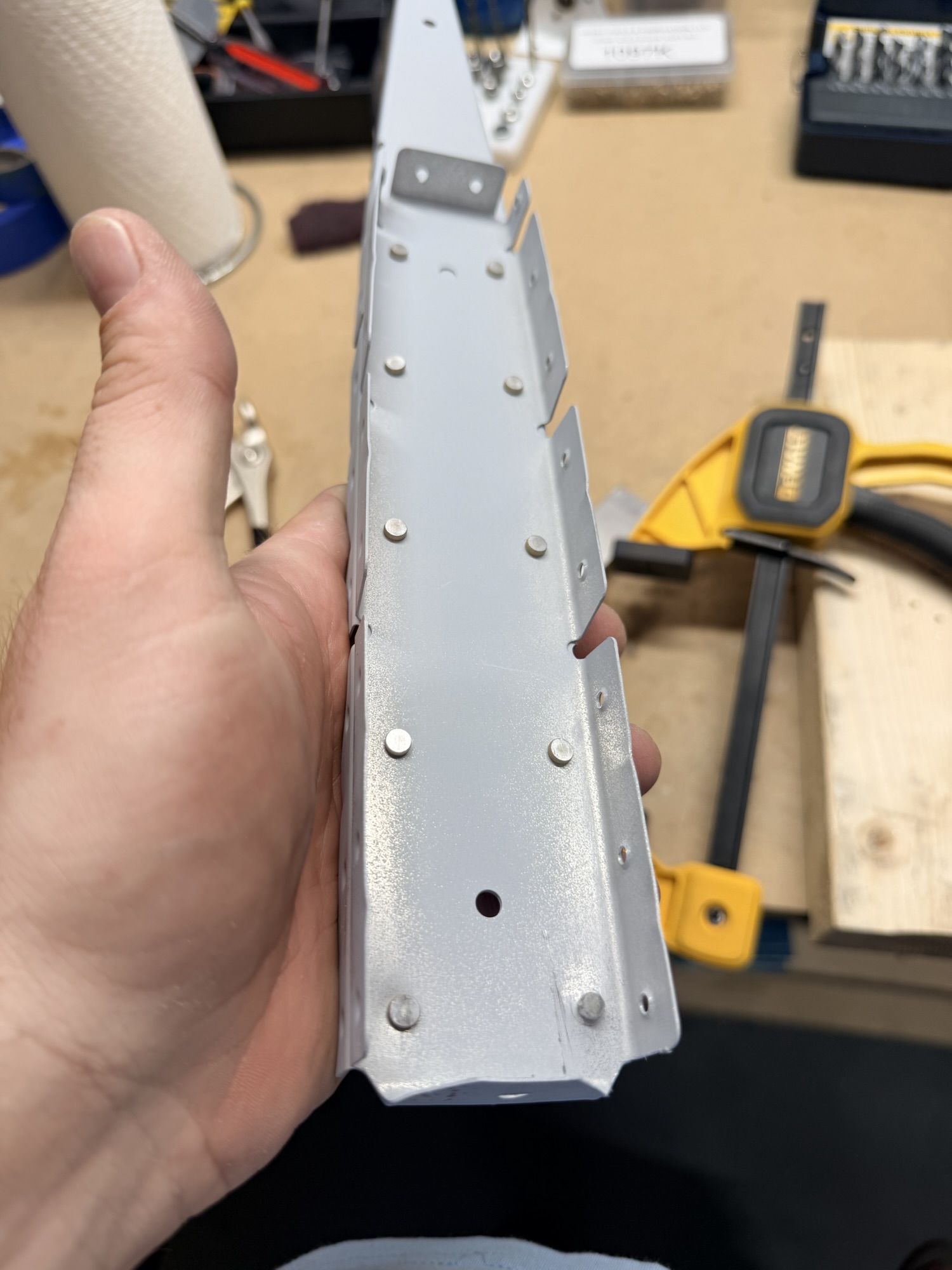
I started assembling the horizontal front spar today. Different from the RV-7, Vans has added two reinforcement plates to the aft side of the spar channels with a LOT of rivets in them.

img_1716.jpg


There are couple candidates for replacement in these 56 rivets...

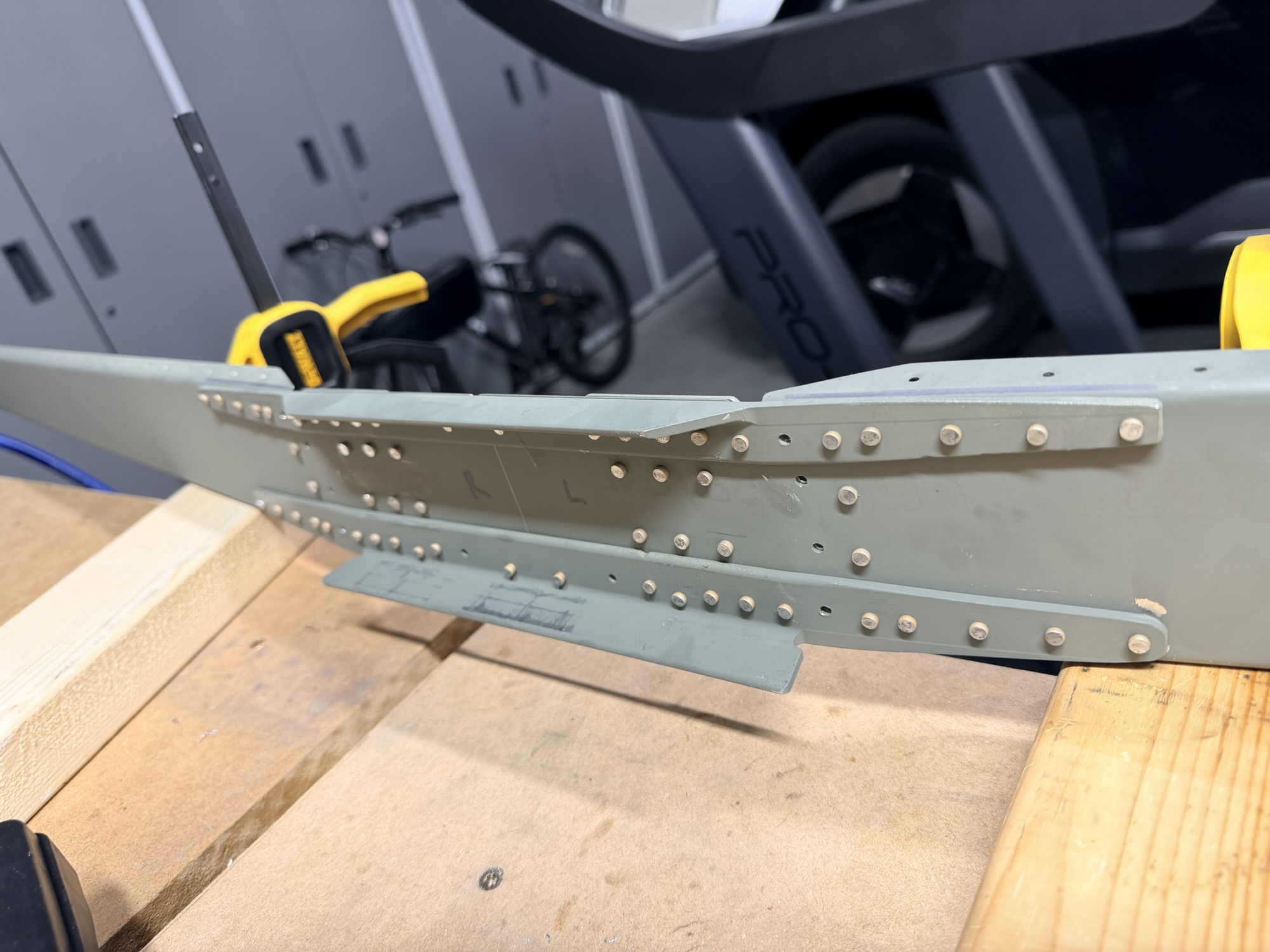
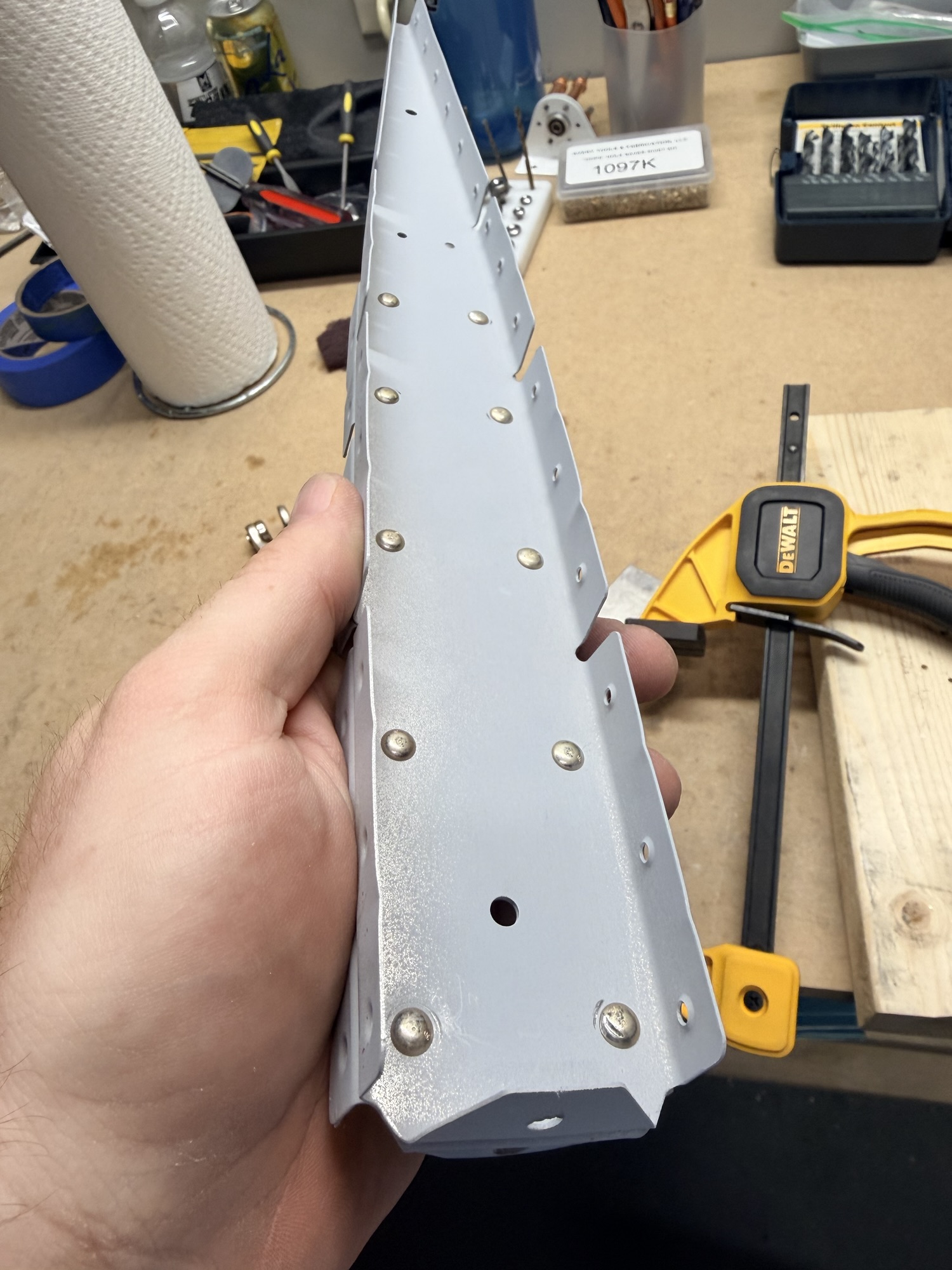
Here's a look at the shop heads.

img_1717.jpg


This green primer scuffs WAY too easily.

I need a NAPA trip soon for new self-etching primer.

2.0 hours of prep, priming, and riveting.
 
Feb 25, 2026 - Left HS Skin Riveting

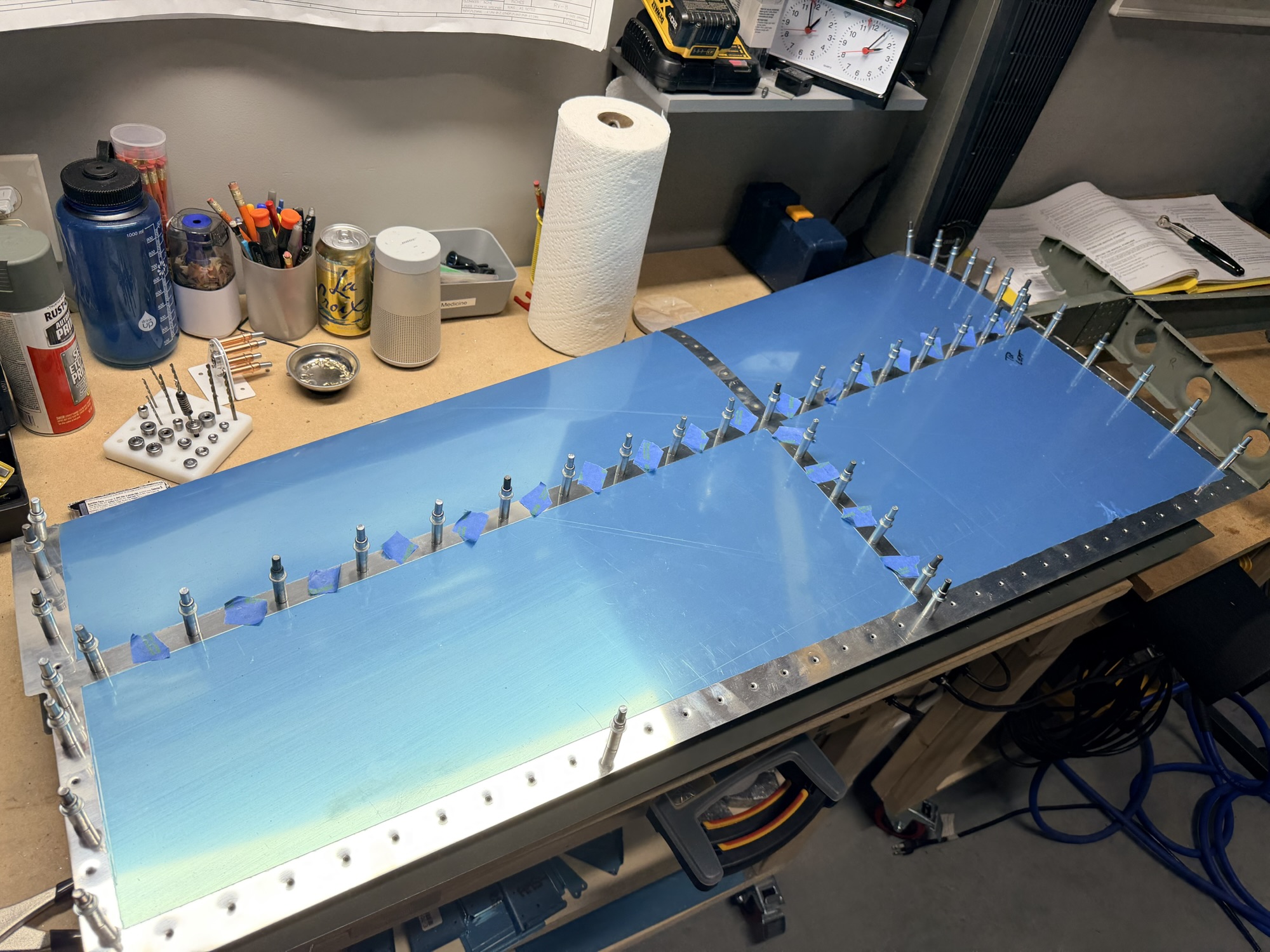
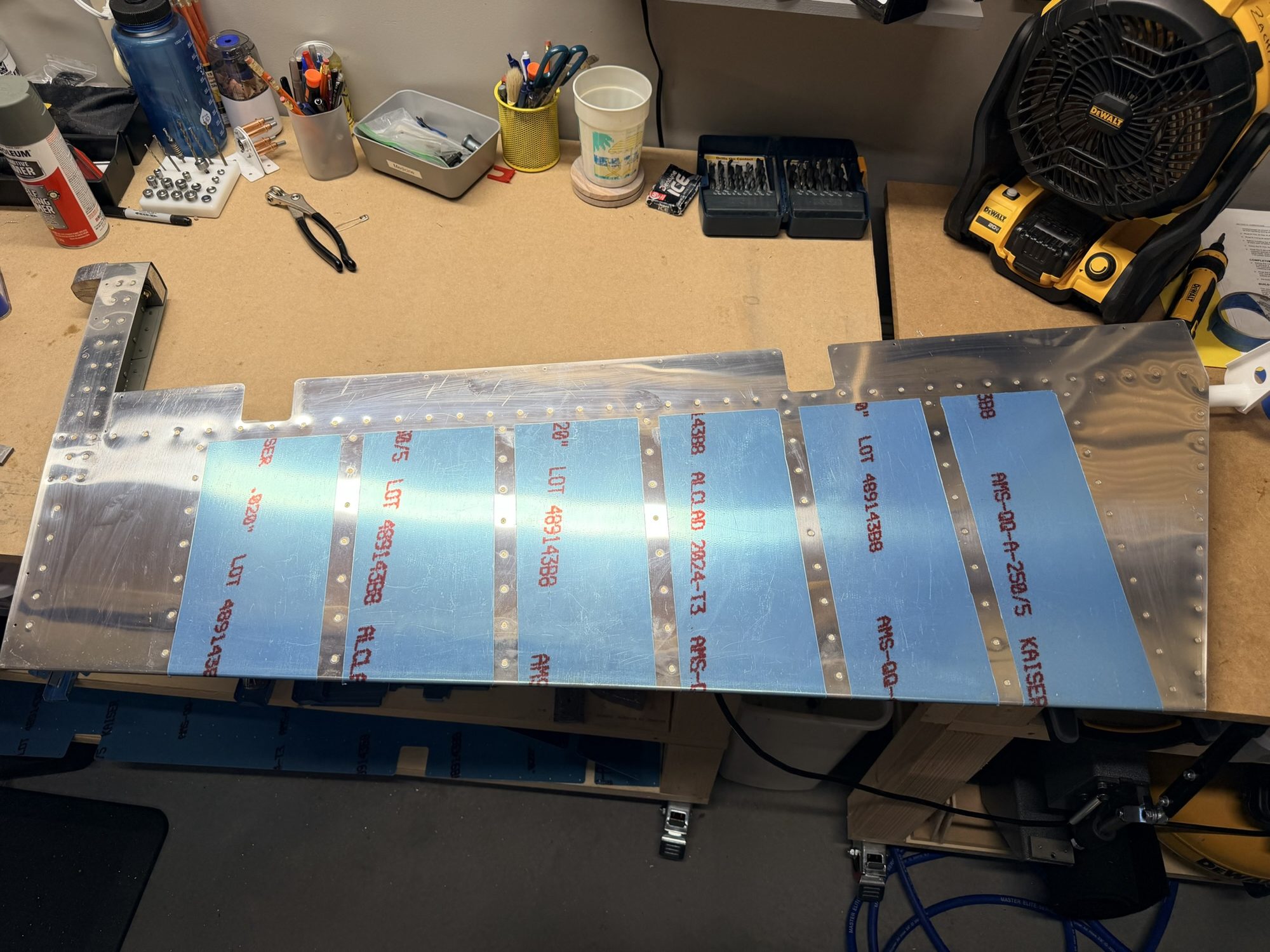
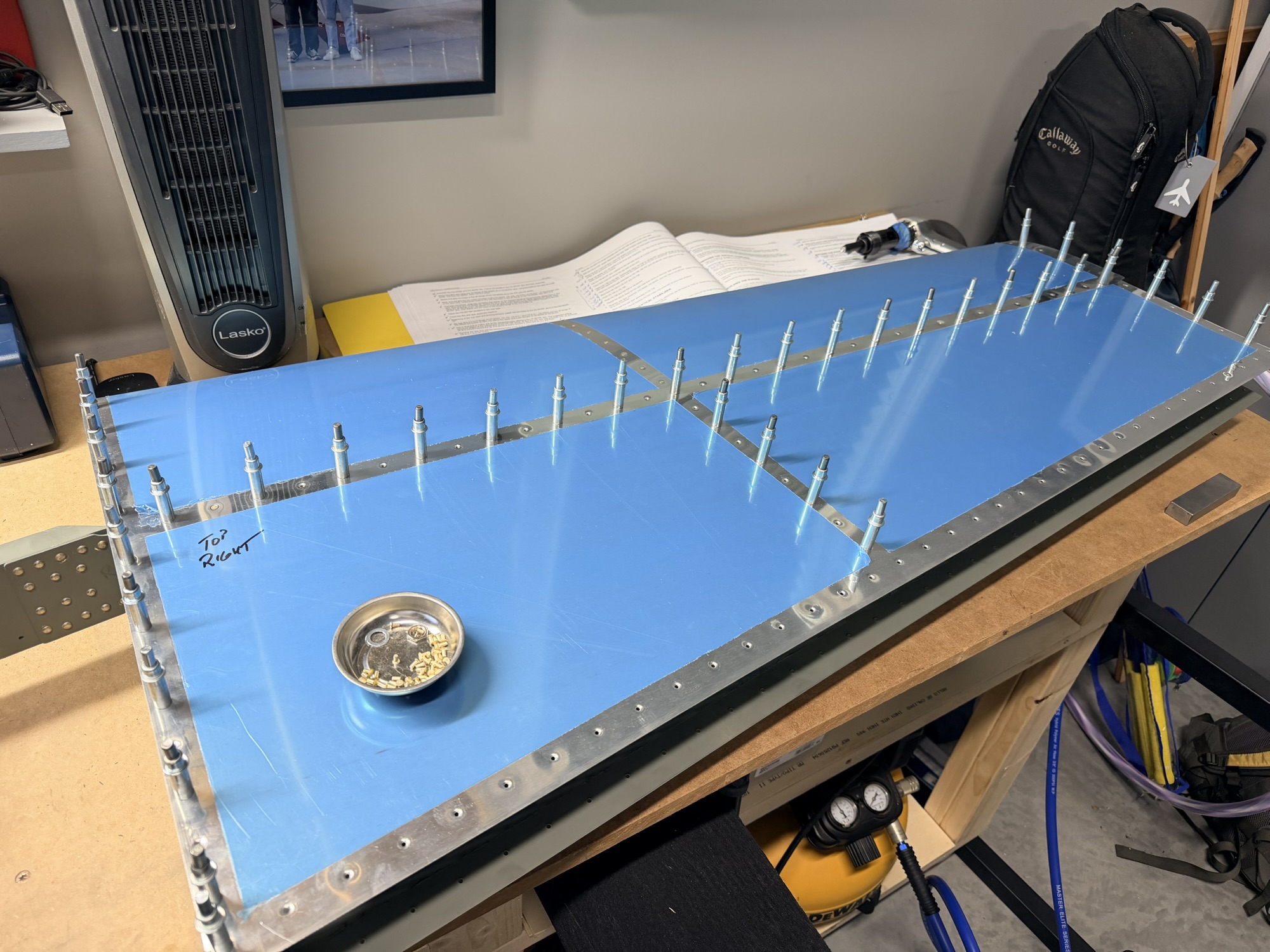
Over lunch, I started riveting the HS skeleton to the front spar, then realized the next step required primed skins. I grabbed them from their high spot in the garage, then got them prepped and primed.

After a fairly hectic day with family and work, I got back into the garage looking forward to finishing the horizontal stabilizer. Of course, I didn't get to finish, but I did get pretty far on the left skin.

First, you're supposed to grab the left HS skin and cleco then rivet the middle forward rib to the top side of the skin. Of course, this is the left HS forward rib. Notice what's wrong? No dimples. Ugh.

img_1721.jpg


Dimpling only cost me about 2 minutes here.

Alright, next, you cleco the tip rib and the middle aft rib to the skin and the aft flange of the forward rib rib to help hold the skin tight. I riveted the top and bottom skins to the forward rib.


img_1722.jpg


Pretty flush rivets. no mistakes here.

Next, I removed the forward sections of blue vinyl for the bays that are about to be closed up by installing the forward spar.

img_1723-e1772078984720.jpg


Vinyl removed!

Once the vinyl was removed, I clecoed in the fwd spar, then saw this....

img_1724.jpg


Apparently I forgot the aft-most flush rivet on the forward rib.

So, I un-cleco-ed and removed the forward spar assembly to buck that one rivet and then reinstalled the forward spar.

After that was done, I blind-riveted the middle aft rib to the forward spar and the middle forward rib with LP4-3 blind rivets.

img_1726.jpg


There's no way to buck these, so blind rivets are used.

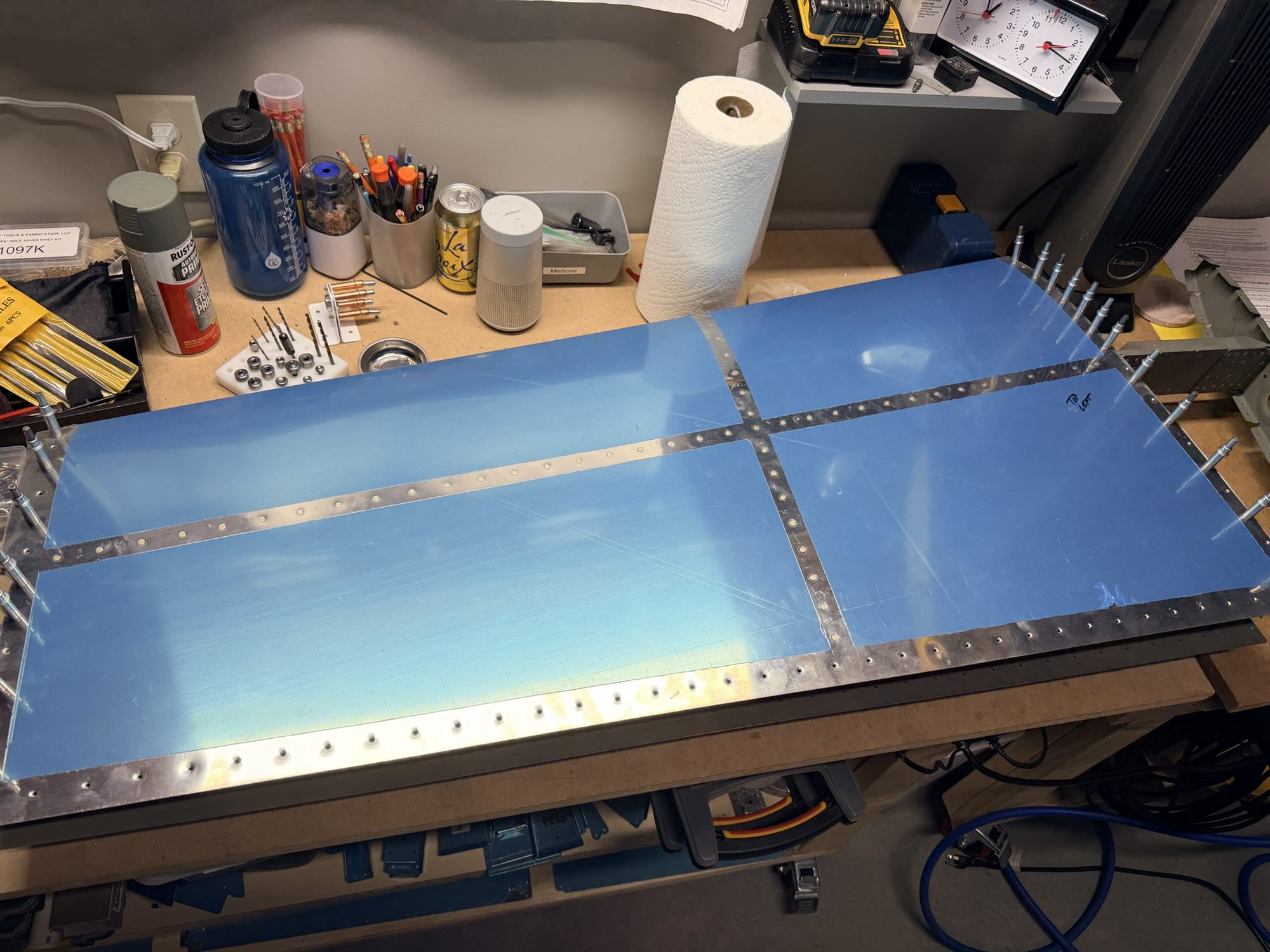
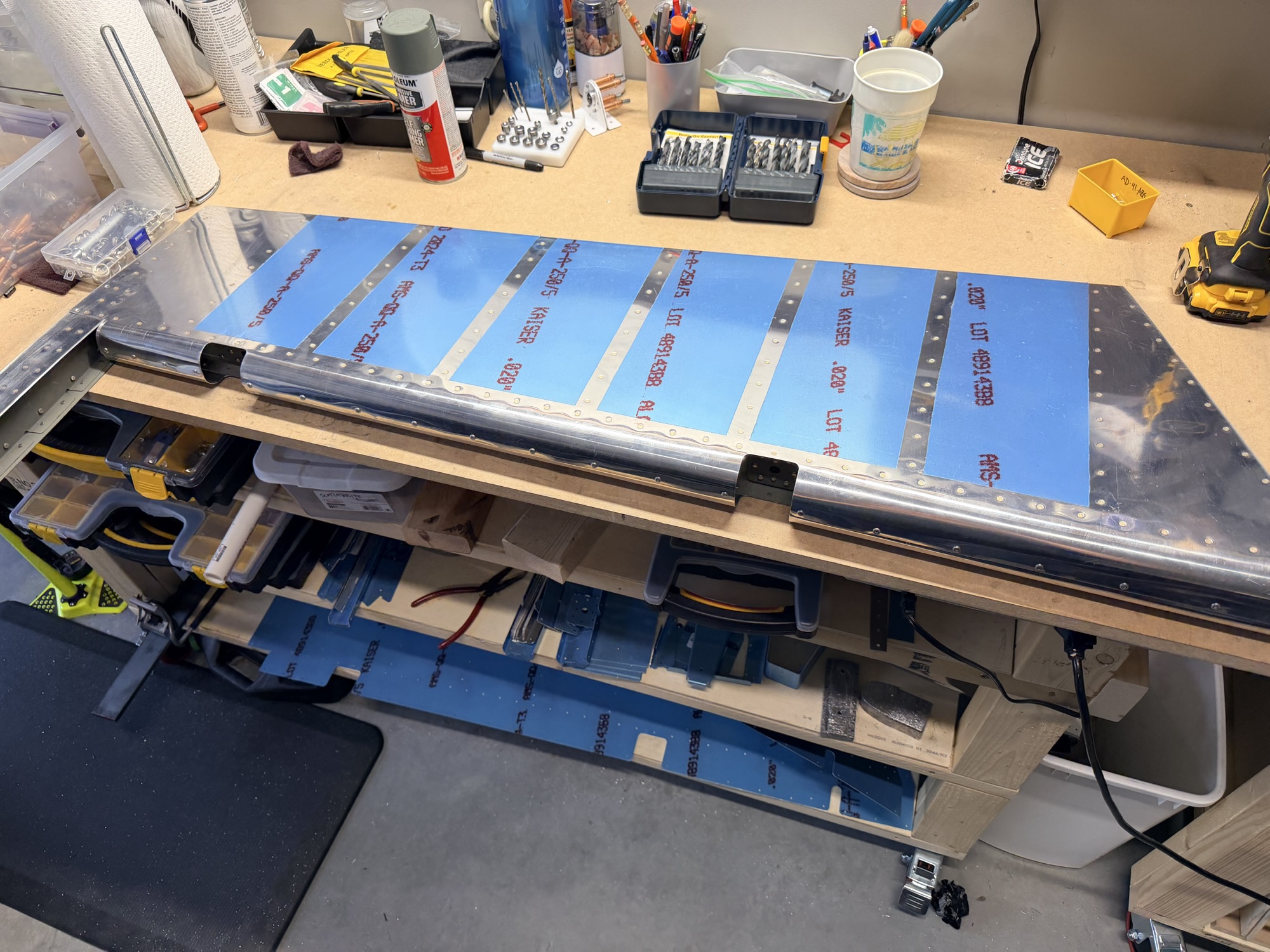
Once complete, I finished clecoing the skin on the skeleton, then flush-riveted the lower left skin of the HS to the skeleton. I usually cleco every other whole, then rivet, remove the clecos, insert the other half of the rivets, then transfer the blue tape over.

After a handful of rivets, the skin is starting to look smoooooooooth.

img_1728-e1772078959612.jpg


I love this step in each sub assembly.

After finishing up the lower skin of the LH HS, i flipped it back upright and started in on the upper skin of the L HS.

img_1725.jpg


Same deal. Cleco 50%, rivet, then move the clecos.

Here's a shot of some shop heads in case anyone is interested later.

img_1729-e1772078937448.jpg


nice shop heads!

I think this picture is out of order. Before you start skin-riveting, they want you to use AN470 rivets here on the tip rib. No problemo!

img_1727.jpg


Easy peasy.

Back to the upper surface of the LH HS skin.

img_1730.jpg


You can see my every-other trick with blue tape to minimize scratches.

Finally, I capped off the night by finishing the upper surface.

img_1731-e1772078914108.jpg


It's beginning to look like an airplane!

8 rivets and 0.5 hours on the first ribs and skin prep & priming.
103 more rivets on the skin and skeleton during evening hours.

111 rivets and 2.5 hours total today. wuhoo!
 
Last edited:
Feb 26, 2026 - Almost Finished Horizontal Stabilizer

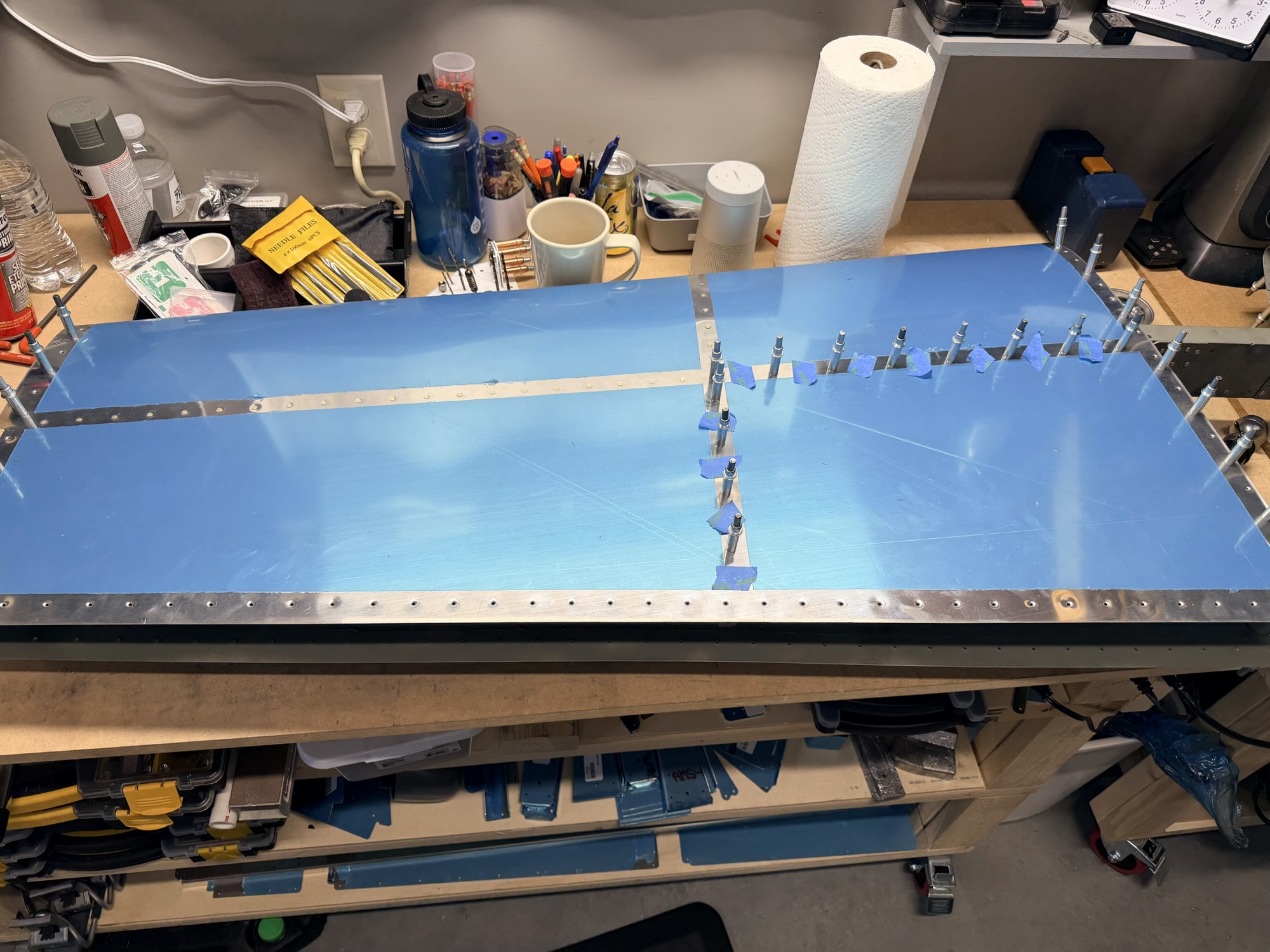
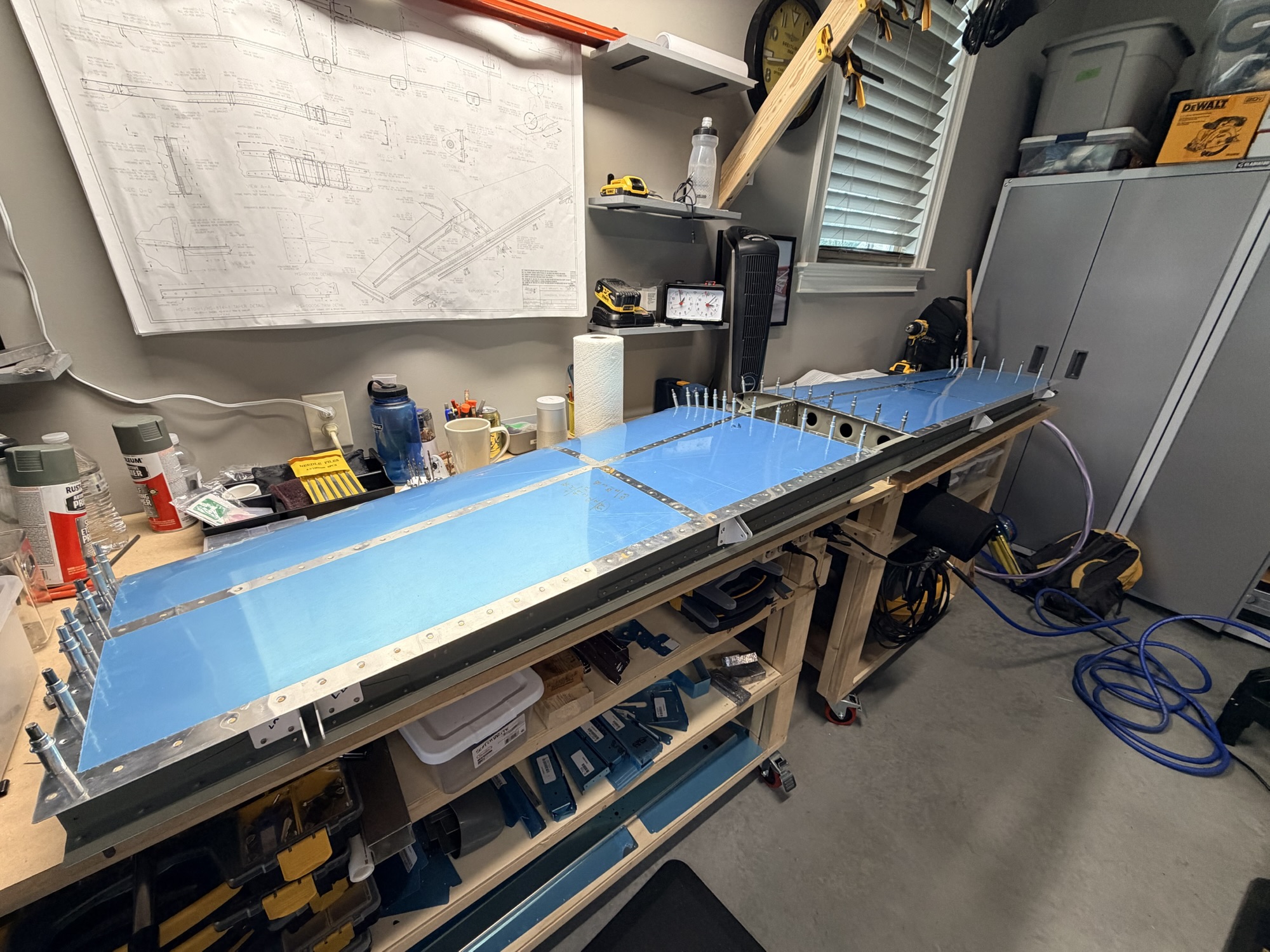
Well, I ALMOST finished the horizontal stabilizer today. (Hint: I finished it except for the center hinge bracket, which needs a #12 drill bit and some AN3 bolts, but for the purposes of this post, it's done.
img_1738.jpg


I can't remember why I took this picture of the AN470AD4-4 rivets. I had to use these on the tip rib to front spar and tip rib to rear spar rivets today.
A couple actions shots of the riveting.

img_1727.jpg


I can't remember taking this picture. Maybe just riveting the tip rib to the front spar on the right side?

Once the tip rib was riveted, I turned toward riveting the skins.

img_1740.jpg


This is midway through riveting the top of the right HS skin.

img_1741.jpg


I think this is me almost done with the bottom of the right HS skin.

I stopped mid-evening once I had the rear spar installed. All that's left are the inboard and tip ribs.

img_1743.jpg


This was mid-evening, when I'd finished the rear spar, but not yet completed the tip and inboard ribs.

Once I'd finished those ribs, I pulled the blue vinyl off and hung her up.

img_1753.jpg


It's beautiful.

4.0 hours. 365 rivets. 2 drilled out and replaced.
 
March 5, 2026 - Right Elevator Stiffener Preparation

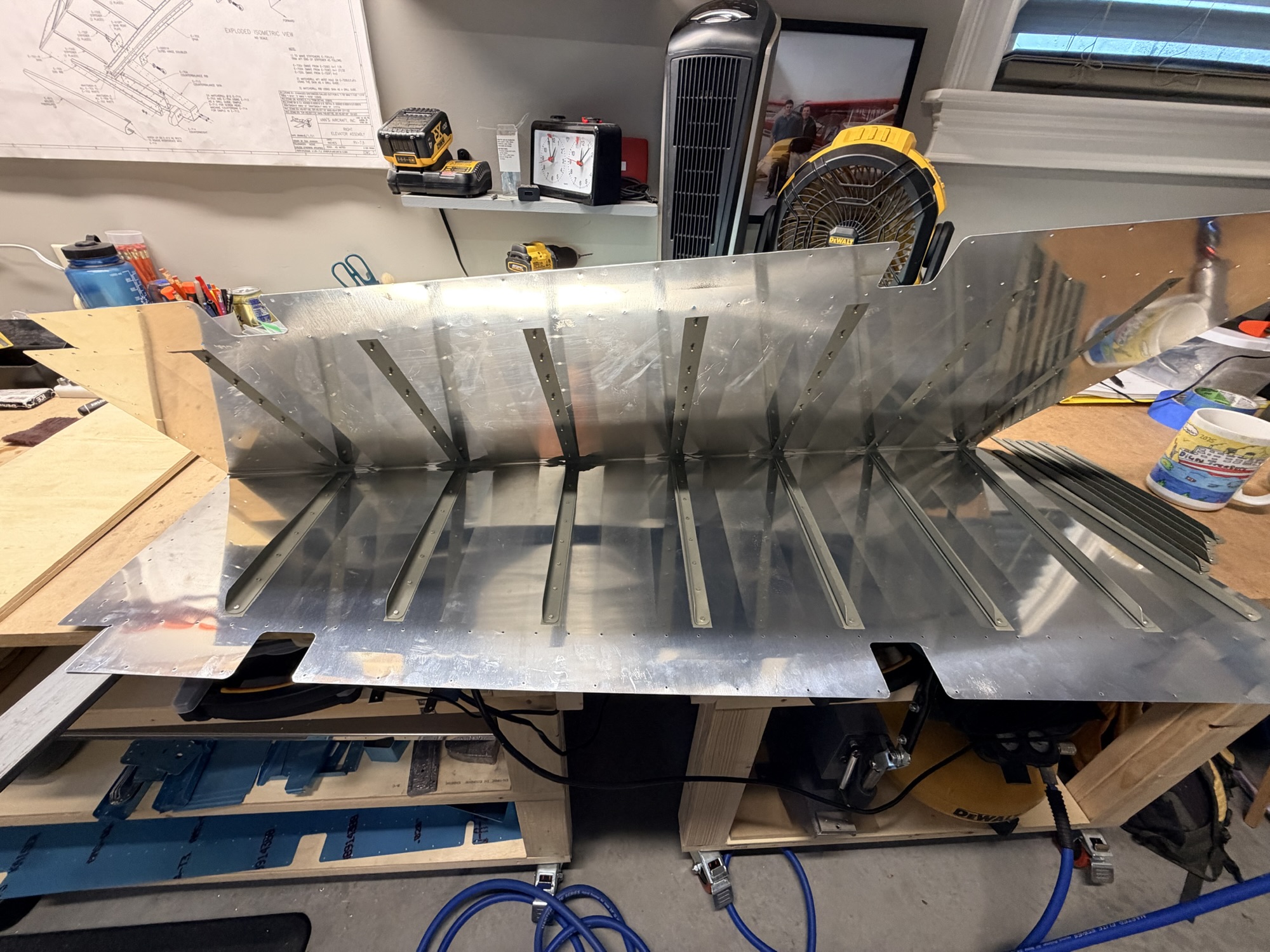
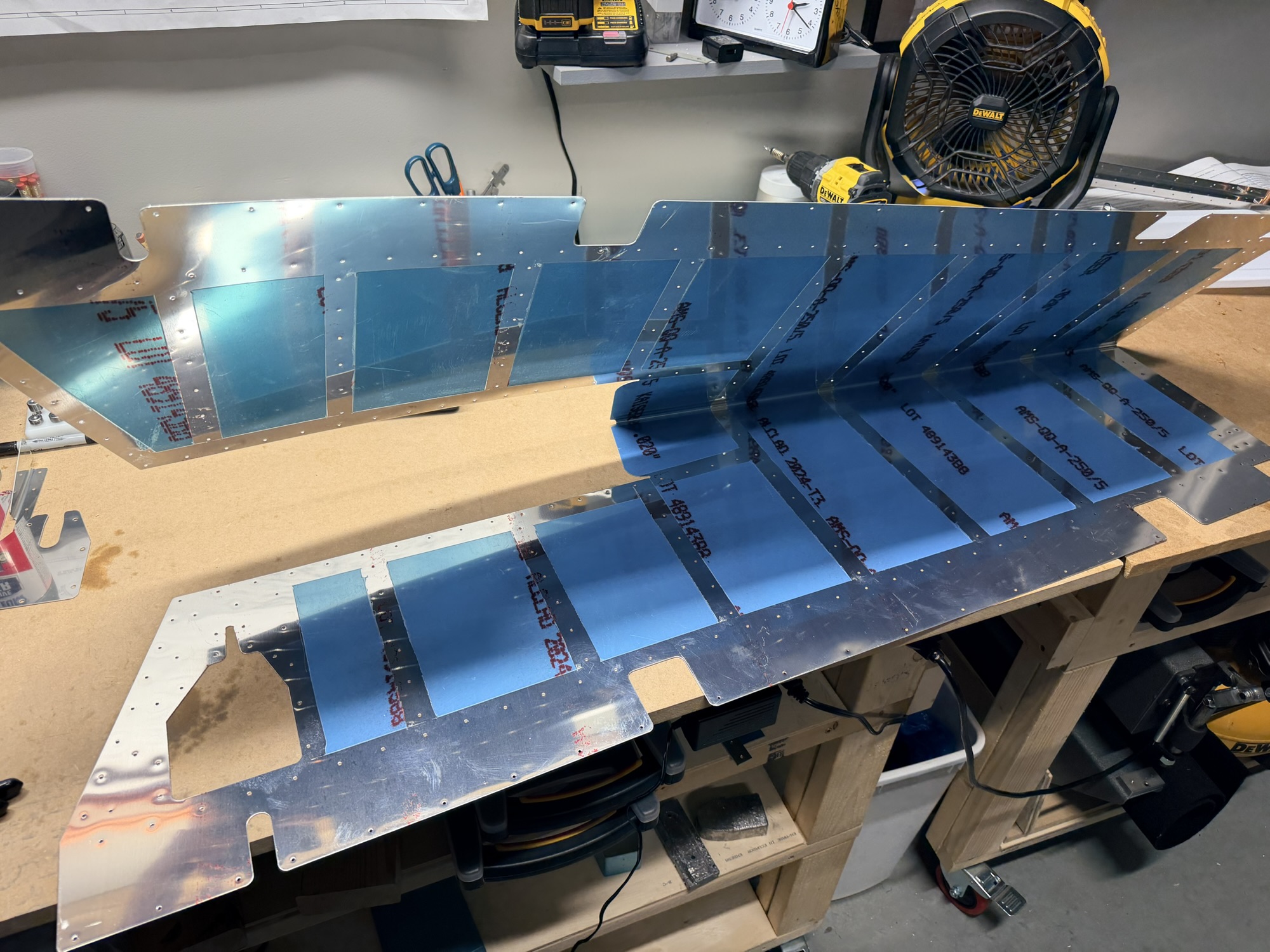
Worked on edge-finishing the right elevator stiffeners, then clecoing them into place on the right elevator skin.

img_1789.jpg


I love the clecoing stage. Most of the time it's the first time the parts start to look like an airplane.

1.5 hours.
 
March 6, 2026 - More Right Elevator Stiffeners

Over lunch today I got a few more things done on the right elevator stiffeners.

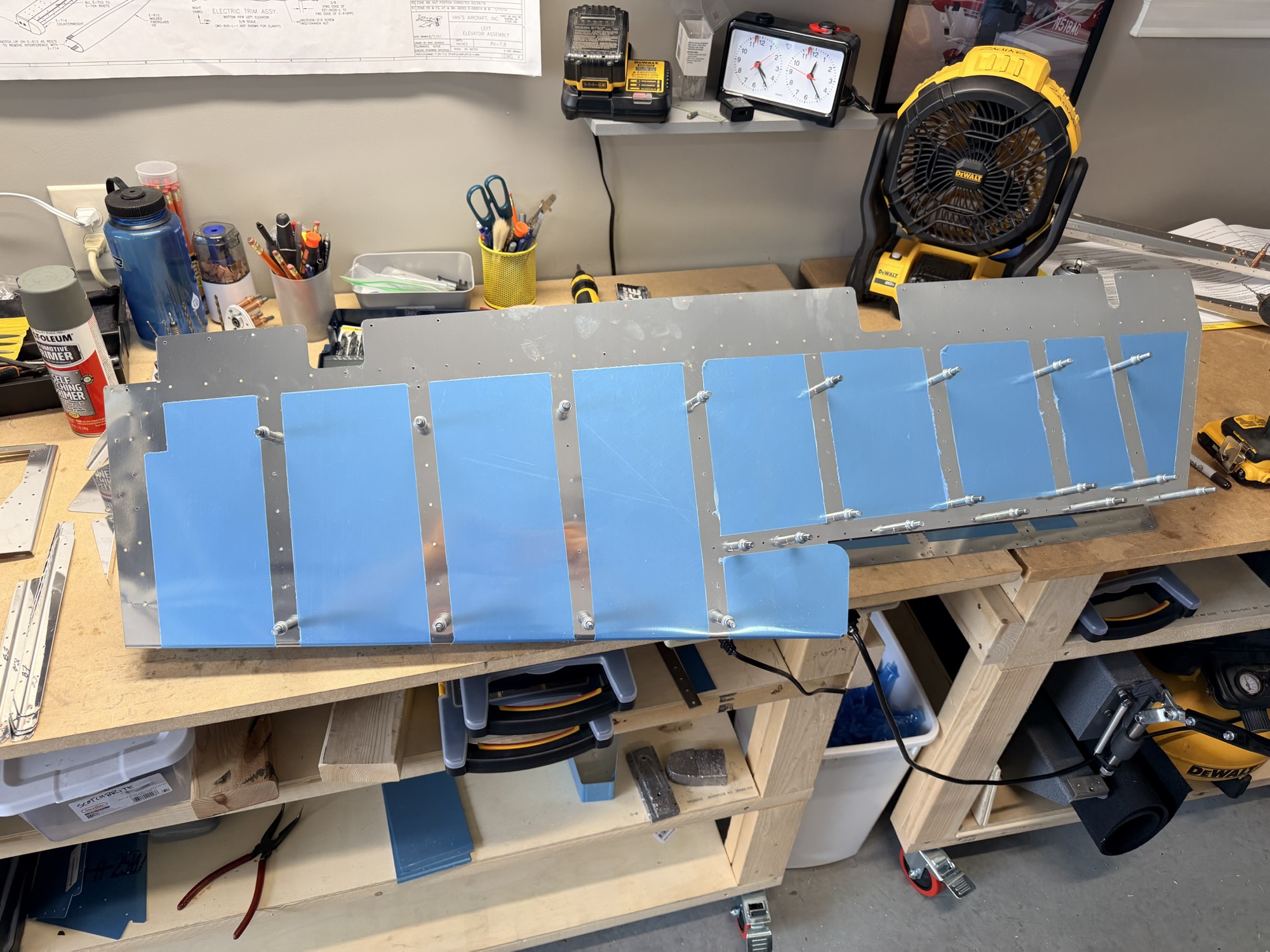
As they sit now, I have top and bottom right elevator stiffeners prepped and primed, ready for backriveting.

img_1797.jpg


But definitely not in order...

I tried something new this time with peeling off all the internal blue vinyl at once, then masking what I didn't want to prime. It worked okay, but while the soldering iron trick is a little more time consuming, I admit it leaves a better result.

img_1796.jpg


Right elevator skin primed, ready for backriveting.

2.0 total, resulting in some primed parts. Maybe some back-riveting this weekend.
 
March 8, 2026 - Right Elevator Stiffener Riveting and Matchdrilling

This weekend, I had the right elevator stiffeners and skin prepped for backriveting but no good time to be loud.

So, in between dropping the kids at school and the start of the workday, BAM. 116 perfectly backriveted AN426AD3-3.5 rivets.

img_1842.jpg


Here's the first 7.

After 51 more (on that side), here's the right elevator bottom stiffeners riveted.

img_1841.jpg


Halfway done with the RE stiffeners.

After finishing up the top, I had to stop and admire the work.

img_1843.jpg


So smooth.

Then, on to matchdrilling the right spar assembly and skin. First, they want you to cleco together the tip rib, the counterbalance rib, the counterbalance, and the counterbalance skin. After doing that, I started matchdrilling the lead counterbalance, but immediately broke the drill bit.

img_1844.jpg


Ugh.

It was a solid 30 minutes of measuring and backdrilling from behind, then pounding the drill bit through with a punch. From both sides. It finally come out and I was left with pretty clean holes. After countersinking the counterbalance, I dimpled the skin with a #8 dimple (it's supposed to be #10).

That's a pretty good dimple, but it's not perfect.

img_1845.jpg


Close it not good enough here.

Without spending $50 on a #10 dimple die, I decided to cleco the assembly back together and use a flush set to settle the screw a little better.

img_1846.jpg


Before...

asdf

img_1847.jpg


After

I think this turned out great. Next up was rib, spar, and skin prep. I spent another 1.5 hours working on bending the skin, matchdrilling, and then dimpling the end rib, counterbalance rib, spar, and skin. But all I got from all that work was this lousy picture of the skin post dimpling.

img_1850.jpg


I'm not yet happy with it's bend angle, but it was the best I could do with my table bending brake.

3.5 hours today, 116 rivets backriveted.
 
March 11, 2026 - Right Elevator Spar Riveting

Well, it was quite the productive hour in the garage tonight. After a few days of drilling, disassembly, deburring, dimpling, countersinking, scuffing, cleaning, priming, etc., it was finally time to start putting together the right elevator for good.

First up, let's get the tip rib and counterbalance rib riveted together.

img_1866.jpg


10 AN470AD4-4 rivets.

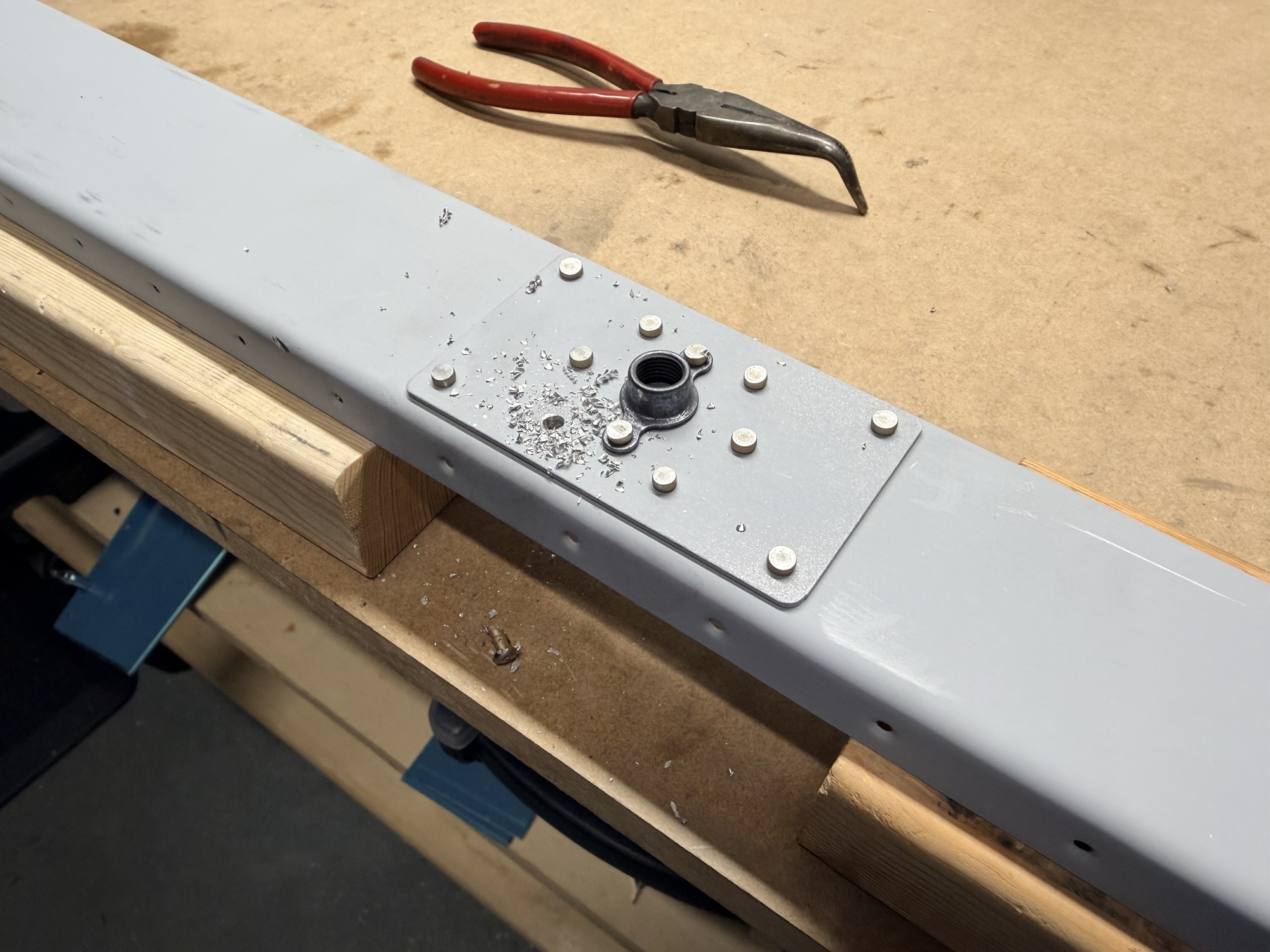
Next some reinforcement plates with the rod end nutplates on the out part of the right elevator spar.

img_1867.jpg


12 more rivets, this time AD-5, -5, and -7 size.

Then more for the inboard part of the right elevator spar.

img_1868.jpg


12 more.

Of course, here's some manufactured heads for your viewing pleasure.

img_1869.jpg


I think this is the inboard side.

and some more...

img_1870.jpg


The outboard side.

Next up, let's get the root rib and the elevator horn attached.

img_1871.jpg


16 more rivets. 4 of them flush heads.

Here's a shot of the exterior of the elevator horn.

img_1872.jpg


"Clamped" between my two benches, of course.

Then, we attach the tip rib assembly to the spar itself with 4 rivets.

img_1873.jpg


4 more AN470AD4-4s.

Manufactured heads for you...

img_1874.jpg


those are rivets.

Next, we rivet the two hard-to-reach rivets on the counterbalance skin.

img_1875.jpg


Two on this side...

img_1876.jpg


And two on this side.

Finally, it's time to cleco on the skin. You can tell from this picture that my trailing edge bend is not perfect. My bench-long bending brake did not work as expected, so I'm going to have to use the trailing edge squeeze tool that van's describes in the manual to remedy this.

img_1877.jpg


It looks pretty, but that trailing edge bend is NOT good enough.

1.0 hours, 58 rivets. Tomorrow will be skin riveting!
 
March 11, 2026 - Right Elevator Spar Riveting

Well, it was quite the productive hour in the garage tonight. After a few days of drilling, disassembly, deburring, dimpling, countersinking, scuffing, cleaning, priming, etc., it was finally time to start putting together the right elevator for good.

First up, let's get the tip rib and counterbalance rib riveted together.

img_1866.jpg


10 AN470AD4-4 rivets.

Next some reinforcement plates with the rod end nutplates on the out part of the right elevator spar.

img_1867.jpg


12 more rivets, this time AD-5, -5, and -7 size.

Then more for the inboard part of the right elevator spar.

img_1868.jpg


12 more.

Of course, here's some manufactured heads for your viewing pleasure.

img_1869.jpg


I think this is the inboard side.

and some more...

img_1870.jpg


The outboard side.

Next up, let's get the root rib and the elevator horn attached.

img_1871.jpg


16 more rivets. 4 of them flush heads.

Here's a shot of the exterior of the elevator horn.

img_1872.jpg


"Clamped" between my two benches, of course.

Then, we attach the tip rib assembly to the spar itself with 4 rivets.

img_1873.jpg


4 more AN470AD4-4s.

Manufactured heads for you...

img_1874.jpg


those are rivets.

Next, we rivet the two hard-to-reach rivets on the counterbalance skin.

img_1875.jpg


Two on this side...

img_1876.jpg


And two on this side.

Finally, it's time to cleco on the skin. You can tell from this picture that my trailing edge bend is not perfect. My bench-long bending brake did not work as expected, so I'm going to have to use the trailing edge squeeze tool that van's describes in the manual to remedy this.

img_1877.jpg


It looks pretty, but that trailing edge bend is NOT good enough.

1.0 hours, 58 rivets. Tomorrow will be skin riveting!
 
I never post but love this forum and your build is especially enjoyable to follow. Keep the pic's comin'.
 
March 11, 2026 - Right Elevator Skin Riveting

Well, today I was able to knock out the right elevator skin riveting.

I ended up bucking 99% of these, with the last few on each end rib being squeezed. Everything went great with no rivets requiring drilling out.

Here's an in-process show of the top of the right elevator. I've got rivets set in every other hole, with blue tape on top of them. (To prevent the rivet gun from scuffing the surface, but it also acts as a really good marker for the rivets ready to be set. Also, I can make sure the bucking bar is in position by tapping on each rivet from the bottom and seeing it push up against the tape. Without the tape, the rivet would pop out of its hole and have to be set back into position.)

img_1882-e1773357667166.jpg


Half the rivets ready to be set.

This is the top of the right elevator, skin riveting complete.

img_1884.jpg


Starting to look pretty!

Then here's the bottom of the right elevator, skin riveting complete.

img_1883-e1773357677750.jpg


I'm still not happy with that trailing edge bend.

I know, the trialing edge bend needs a little more coaxing. Vans describes a tool in the manual on how to improve it.

1.5 hours, 73+71 = 144 rivets.
 
March 15, 2026 - Almost Finished Right Elevator

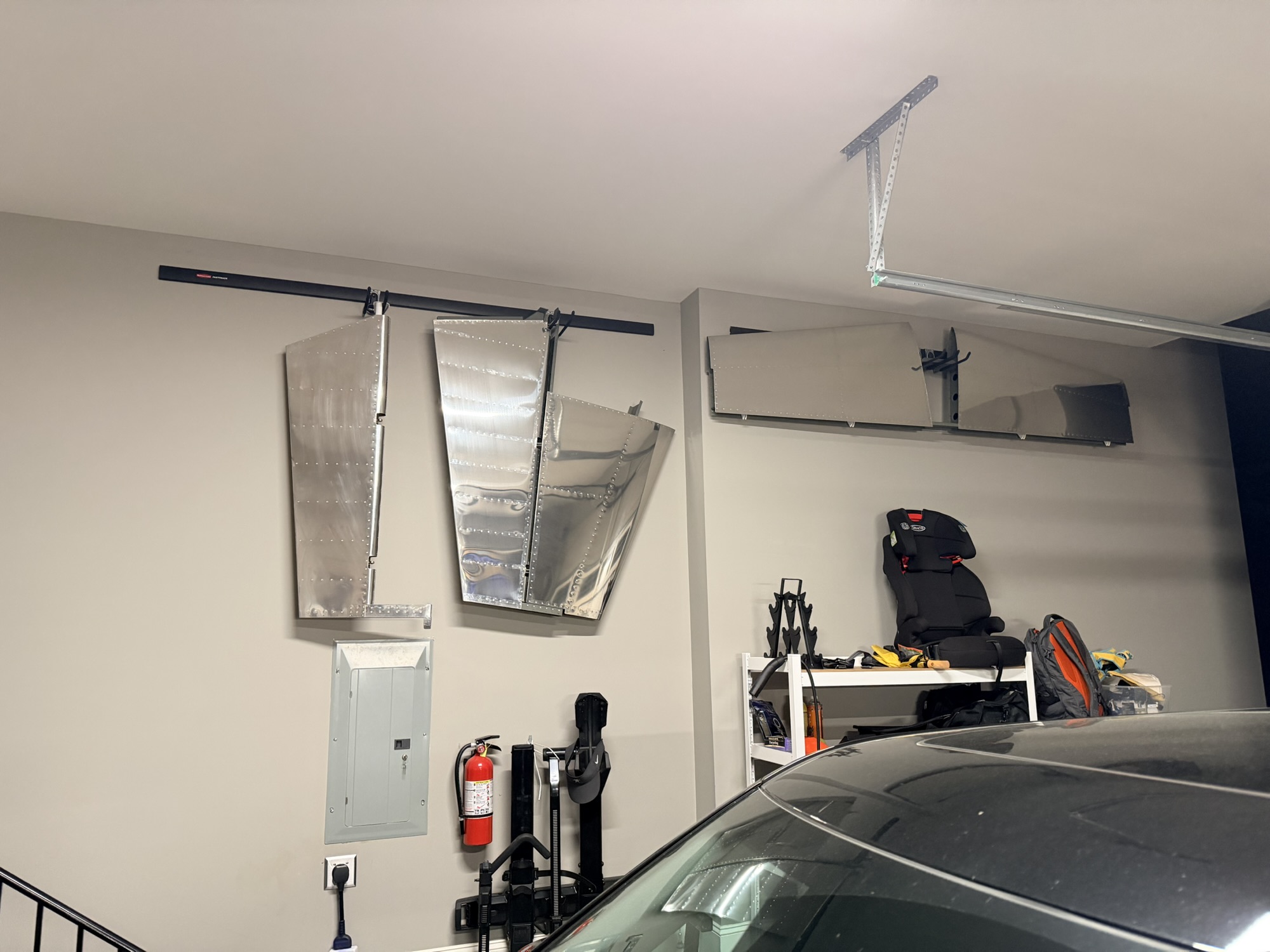
Tonight, I rolled the right elevator leading edges and got them blind riveted, then hung the right elevator on the wall of VICTORY!

I didn't do as good of a job this time with taking in-process photos, but the skin rolling (and edge-rolling), with the normal amount of cursing and cussing.

Here's the right elevator skin after rolling, hand-squeezing, and clecoing.

img_1912.jpg


They were pretty nice bends, if I do say so myself.

Then, put down the camera again and worked on pulling the blind rivets to make it permanent.

img_1913.jpg


20 blind rivets, to be exact.

There's still a little to do, but next up is moving onto the left elevator. Up to the wall of VICTORY you go!

img_1914.jpg


The wall of VICTORY also has a fire extinguisher so it's also called the wall of "UH OH."

1.0 in the early evening hours (stay tuned for some later hours devinyling). 20 blind rivets, no mistakes.
 
March 15, 2026 - Left Elevator Devinyling

After dinner, I managed to get back out to the garage for some more work. Time to get organized for the left elevator. Due to the trim tab, etc., there are more parts to work on. Yay!

A really good easy night for me is to identify all the parts and take off all the blue vinyl.


None of these pictures include the devinyled ribs, spars, reinforcement places, etc. Honestly that was about 2/3 of the 90 minutes I spent working on it.

You only get pictures of the soldering iron devinlying.

img_1915.jpg


My setup is a skinny piece of wood to be the straight-edge for the dull soldering iron.

Even though I did the interior first, here's a shot of the exterior.

img_1916.jpg


It's more work, but I like the results it gives.

Finally, a gratuitous shot of the interior devinyled.

img_1917.jpg


After priming, I'll pull the rest of the blue off.

1.5 more hours tonight, no additional rivets of course.
 
March 16, 2026 - Left Elevator Stiffener Matchdrilling

Today, a short hour in the shop matchdriling the left elevator stiffeners to the left elevator skin.

img_1919.jpg


Here's the top half of the elevator skin, with stiffeners clecoed to the inside.

The rest of that process is boring, but I assure you I matchdrilled all the stiffeners, and in every hole, to both sides of the skin.

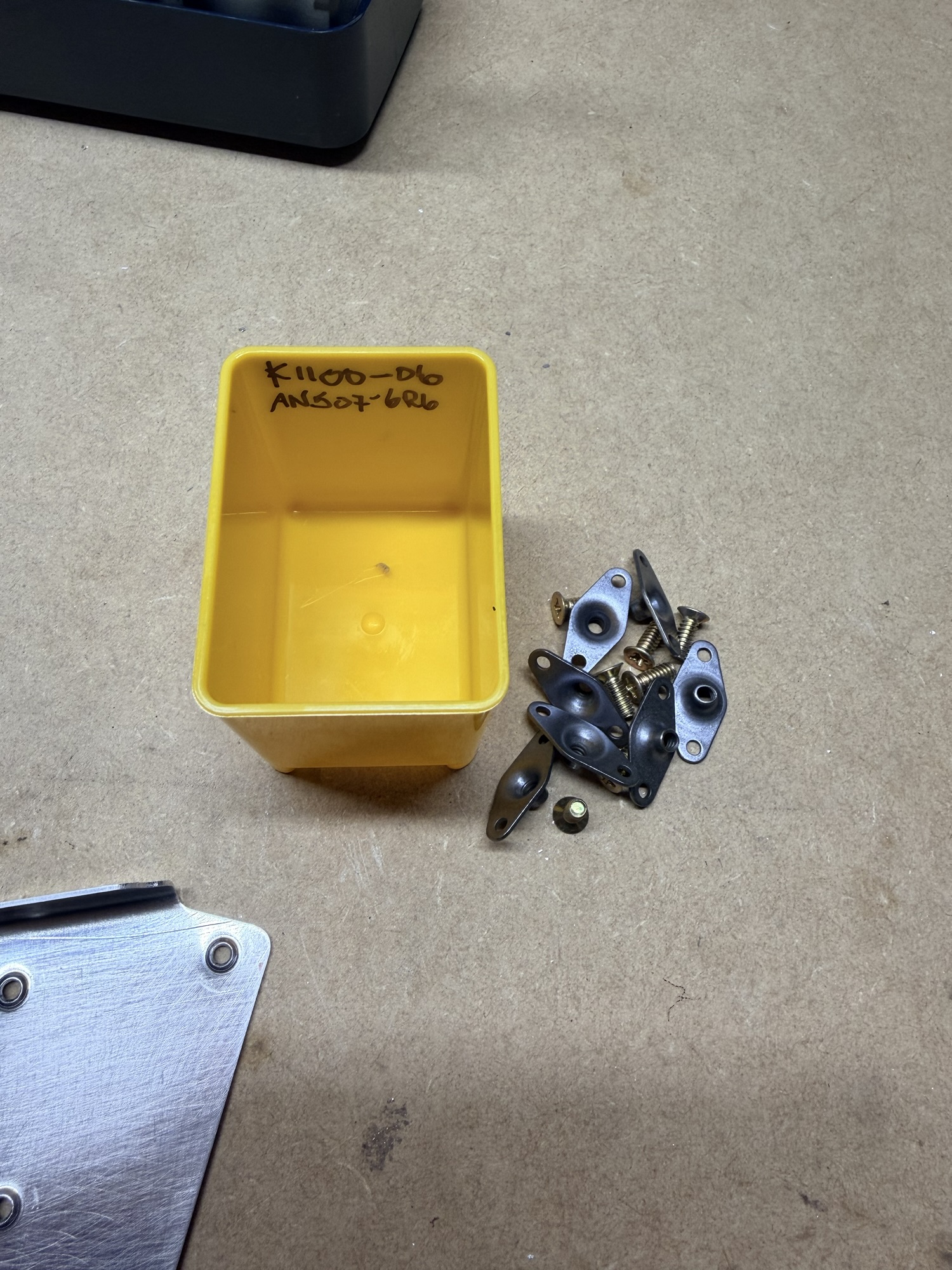
The fun part about the left elevator is the elevator trim reinforcement plate. Pictures are a little out of order here, but you use K1100-06 (dimpled nutplates for a #6 screw) to allow the access plate to screw down to the reinforcement plate.

img_1924.jpg


I managed to locate the appropriate hardware.

Then I clecoed the nutplates to the reinforcement plate and matchdrilled.

img_1925.jpg


matchdrilling.

After matchdrilling, I decided to set the dimpled cover plate onto the reinforcement so you know how things fit together.

img_1926.jpg


Like a glove.

1.0 hours on the stiffeners today.
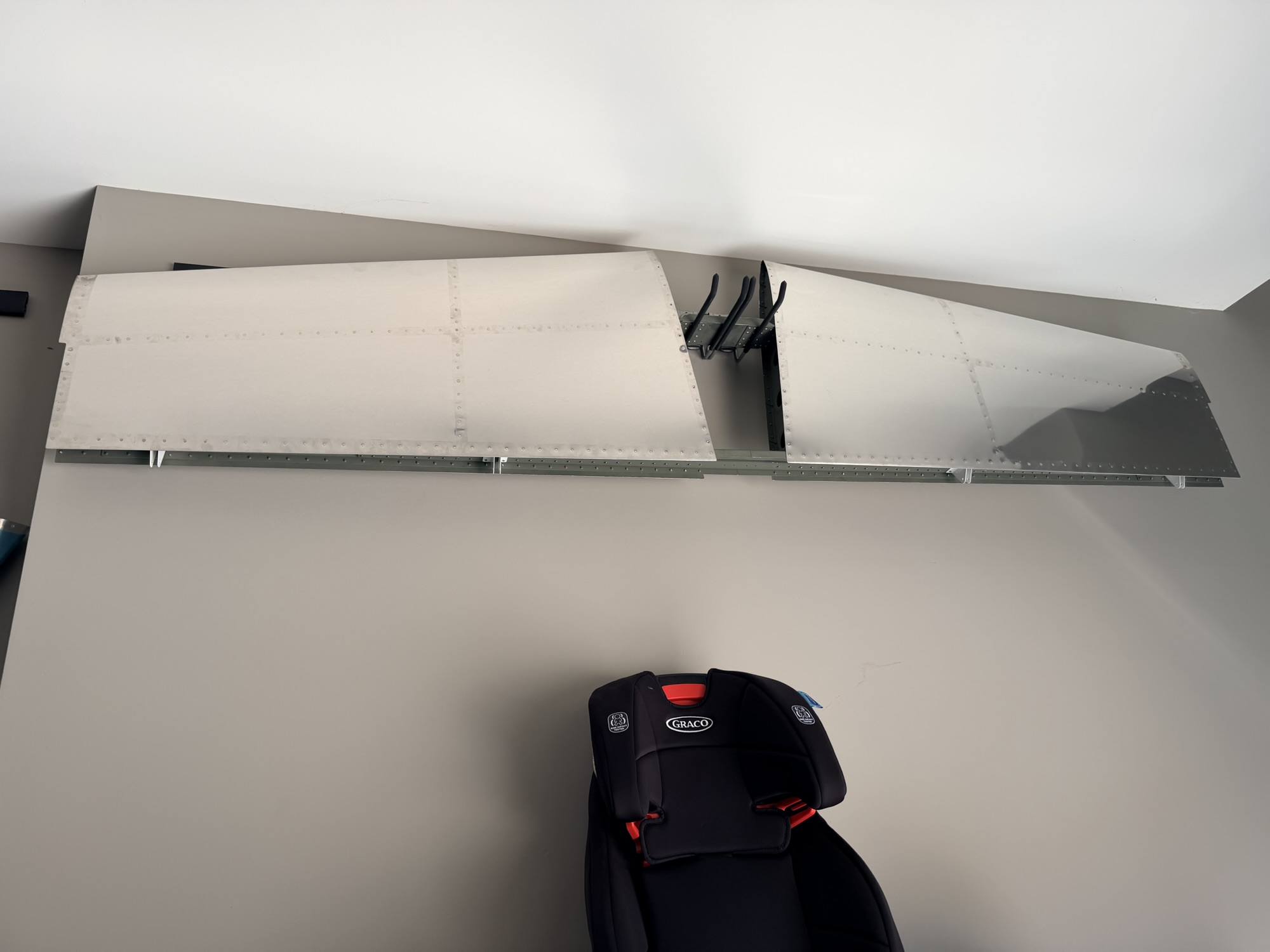
 
March 20, 2026 - Left Elevator Stiffener Prep

After a long week of travel, I managed to sneak in the shop tonight just before bedtime.

First up, finish prepping the reinforcement plate. I'm using oops rivets here, coutnersunk, instead of trying to dimple the nutplate attach holes on the plate and the nutplate ears.

img_1963.jpg


Oops rivet countersinks are much shallower.

Then, the boring task of edge-finishing, deburring, and dimpling stiffeners. This is after four of them, but I think there were 16 total. Maybe only 15.

img_1965.jpg


Ready for cleaning and priming.

Ahhh, yes! I finally get to use NAPA self-etching primer. Guys, it is so much better than the walmart stuff.

img_1964.jpg


The color is better too.

img_1966.jpg


15 stiffeners, I was wrong.

1.5 hours of stiffener prep.
 
March 21, 2026 - Left Elevator Stiffener Riveting

I didn't take a lot of pictures today, but I did manage to bang out a few rivets.

With the stiffeners prepped, it was time to move on to riveting. I started with the trim reinforcement plate.

img_1972.jpg


I don't love how the nutplate hangs over the edge a little, but I'm sure it's as designed.

Then, the usual backriveting job for the rest of the stiffeners, both top and bottom.

img_1973.jpg


Pretty rivets.

1.0 hours, 135 rivets. 0 needing replacement. Wuhoo!
 
March 23, 2026 - Left Elevator Bending and Trim Tab Work

Well, with the stiffeners completed, I could either go back to the spar, or bend the elevator and start working on the trim tab.

I decided to work on the trim tab.

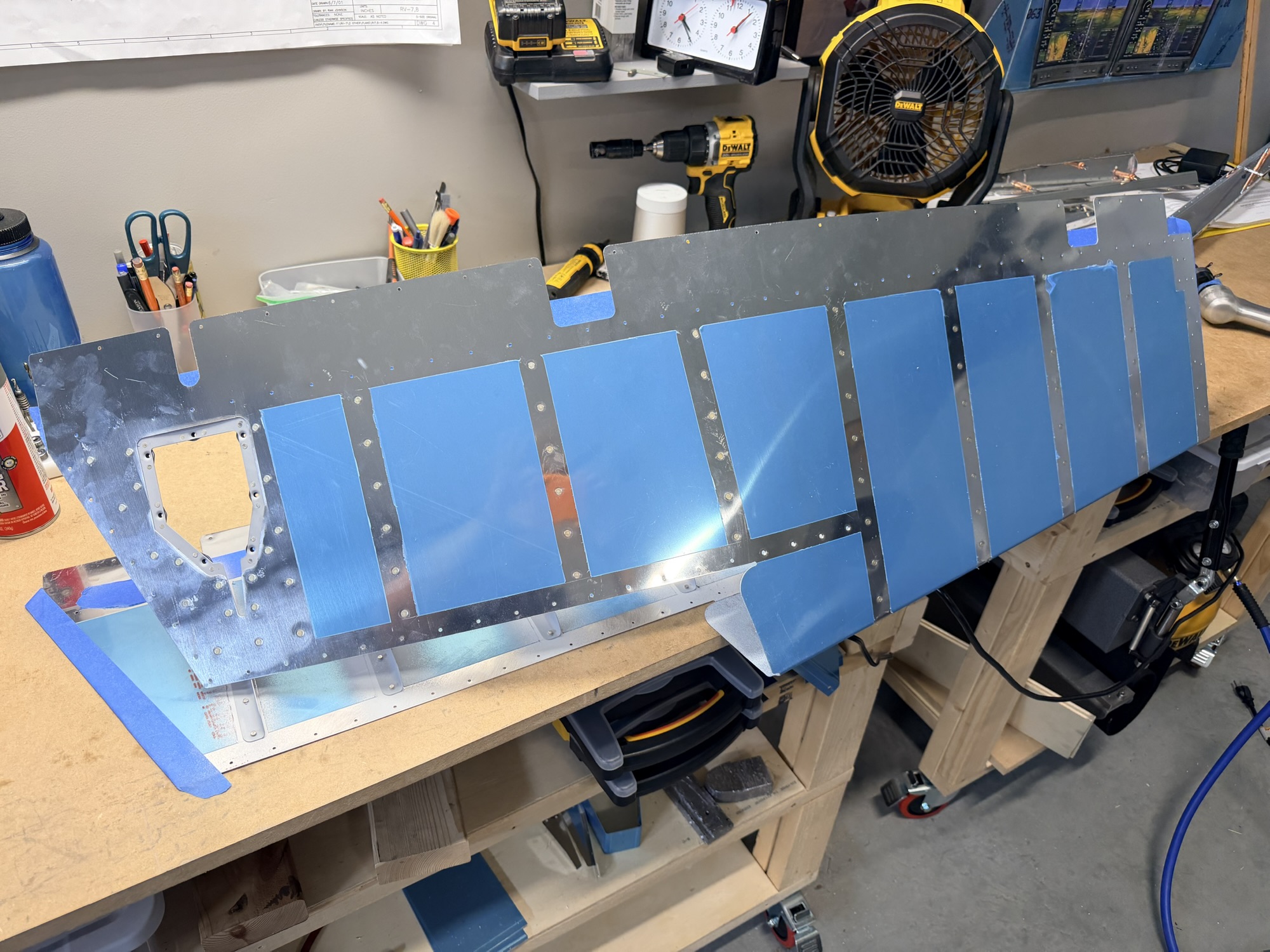
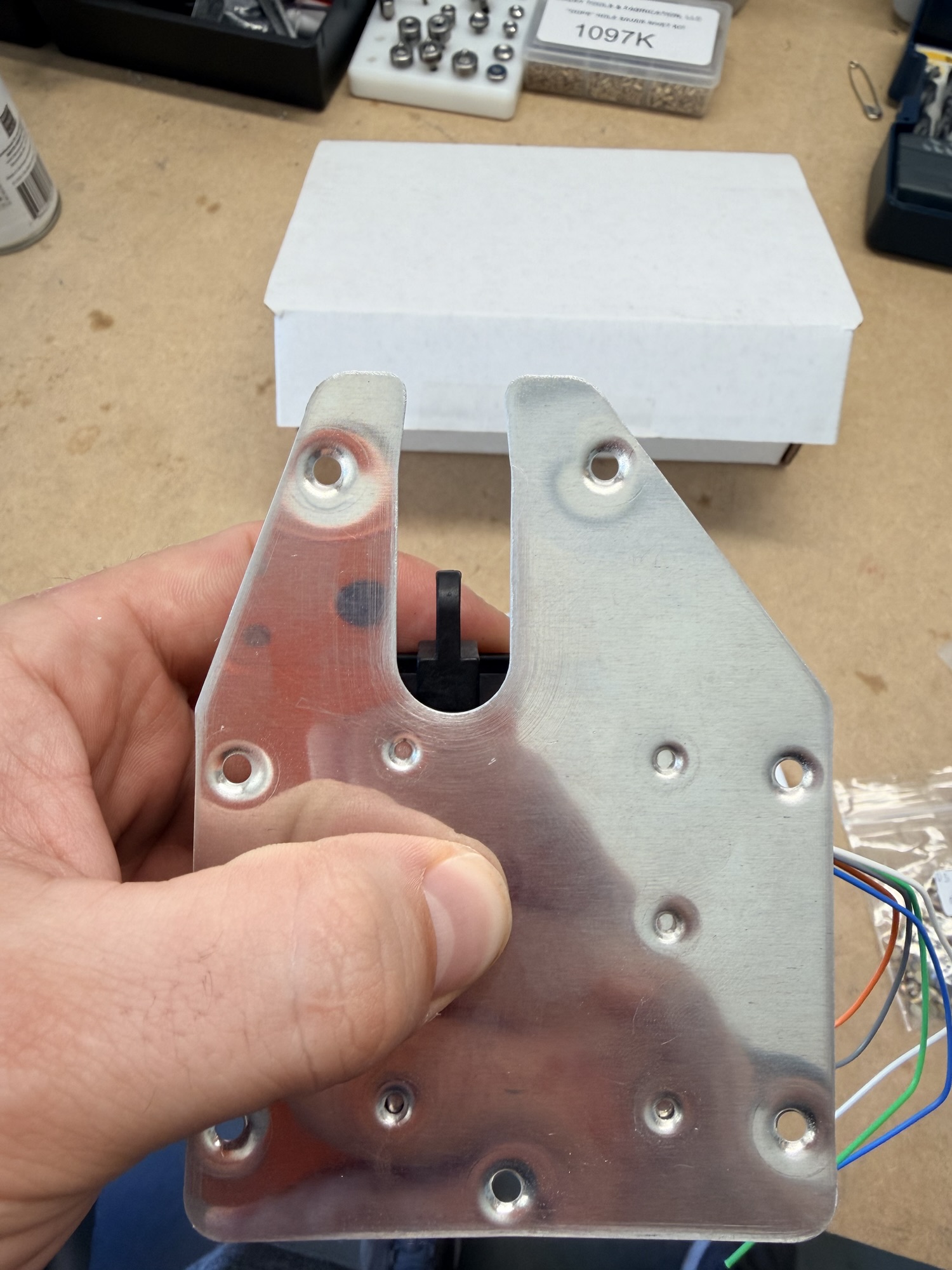
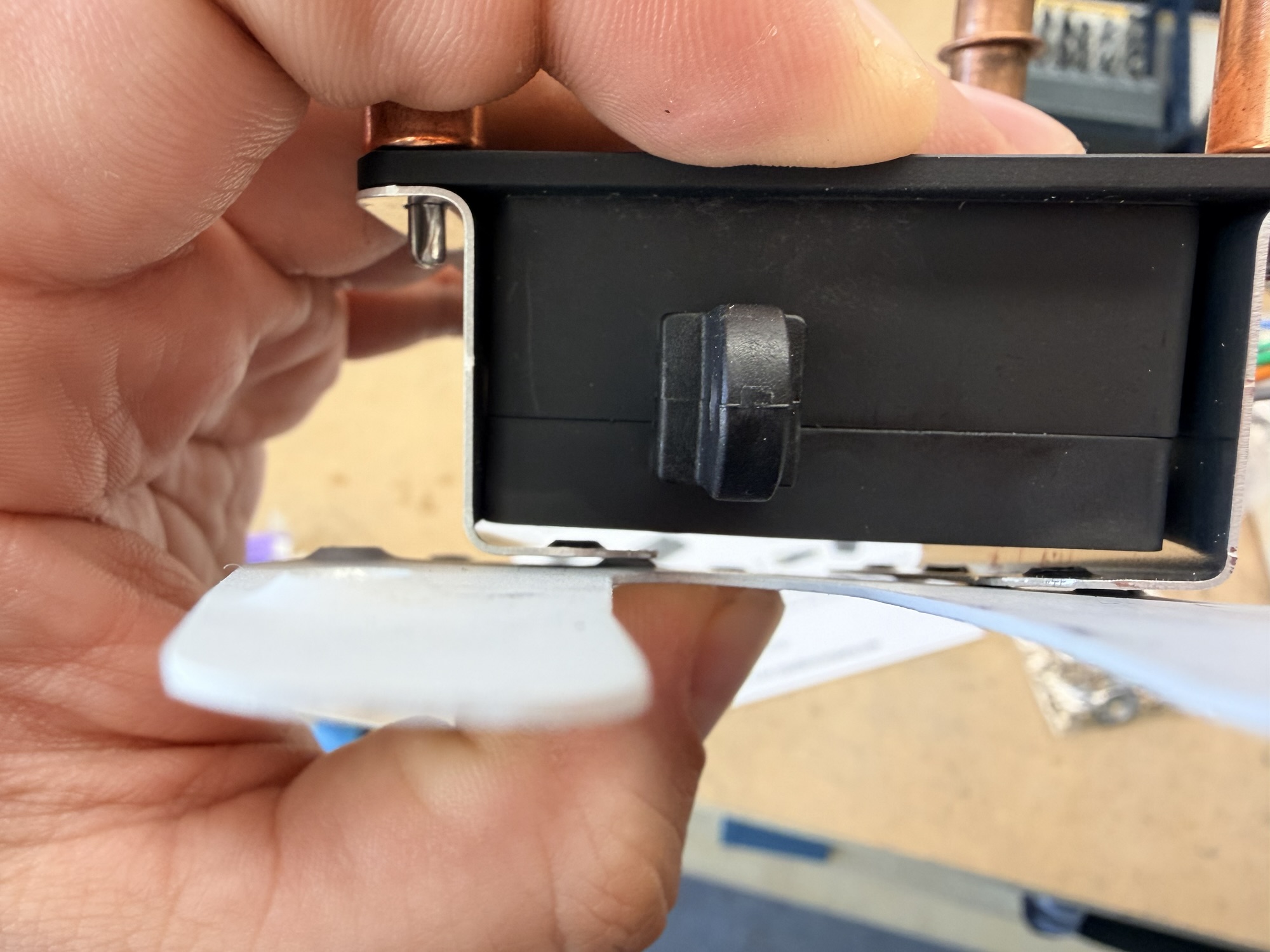
The other day, I laid out the brackets for the elevator trim tab servo. By "laid out" I mean I measured once, then drilled deburred and dimpled.

The problem is that once I did that, then held up the motor in it's correct spot (like the picture below), none of the holes lined up.

Apparently everyone except me knows that the dimension on the plans are not correct. It's better to eyeball it.

img_2020.jpg


clevis aligned with opening...check. attach holes aligned? Nope.

If you look closely, the dimples on the brackets are a simple-width left of where my drilled (and dimpled) holes in the cover plate are.

No biggie. It's only a $10 new cover plate. I'll put it on the list.

img_2021.jpg


A dimple-width wrong.

Anyway, time to be more productive on something.

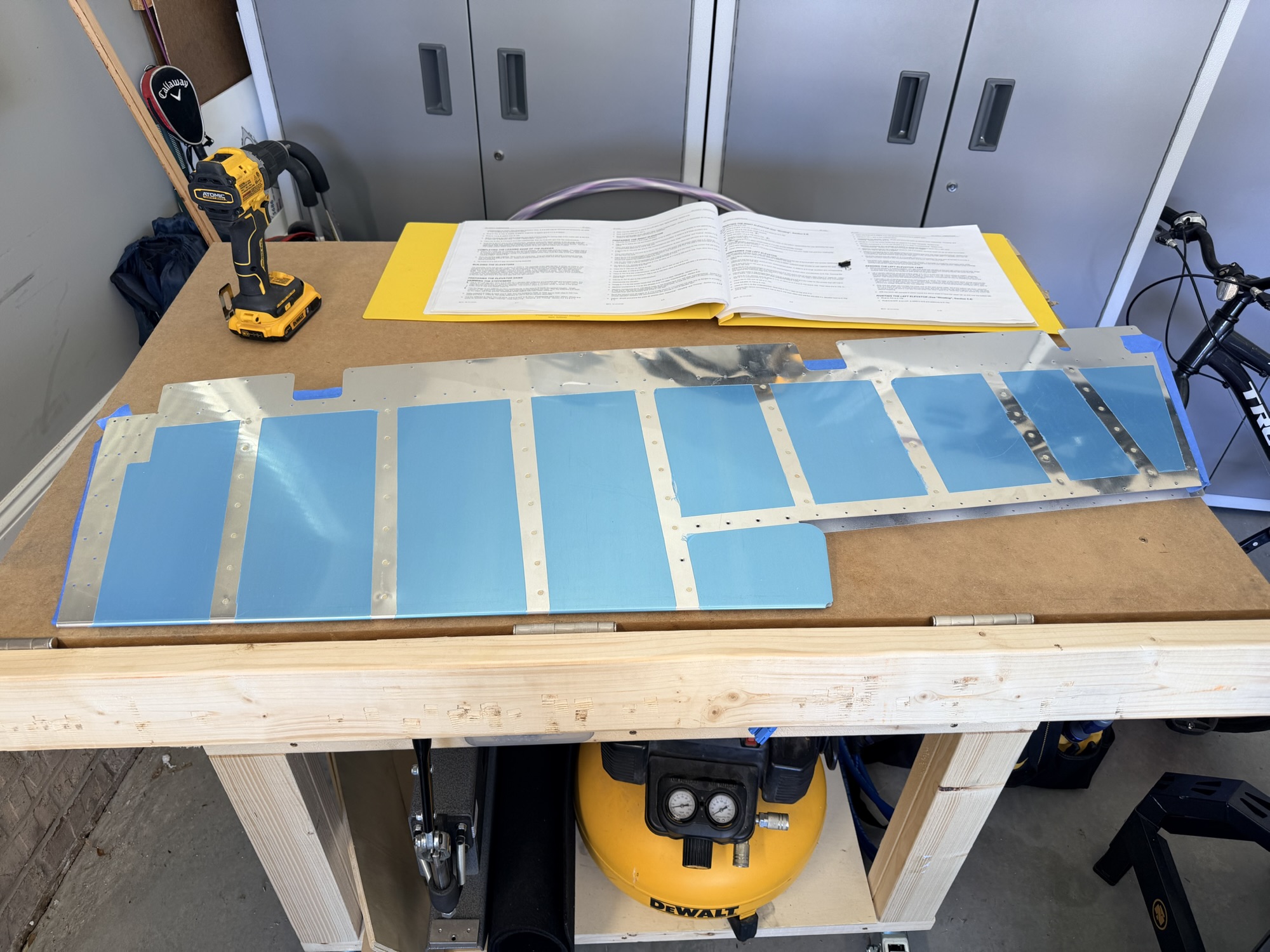
With the stiffeners riveted, the manual clears you to bed the elevator trailing edge and the trim tab.

Here's the left elevator after being bent.

img_2022.jpg


Bendy bendy

And the tab. Since there are no stiffeners, you have to be careful not to overbend. Here I am checking the bend against the trim tab spar.

img_2023.jpg


Needs a little more "oompf."

Then, after a long bout of "will he, won't he" I remembered a lot of my thoughts about bending the tab ears on the elevator and the trim tab.

I re-read all my thoughts from this post on my RV-7 build from June of 2010: https://rv7aerosports.com/2010/06/20/started-working-on-the-elevator-tab

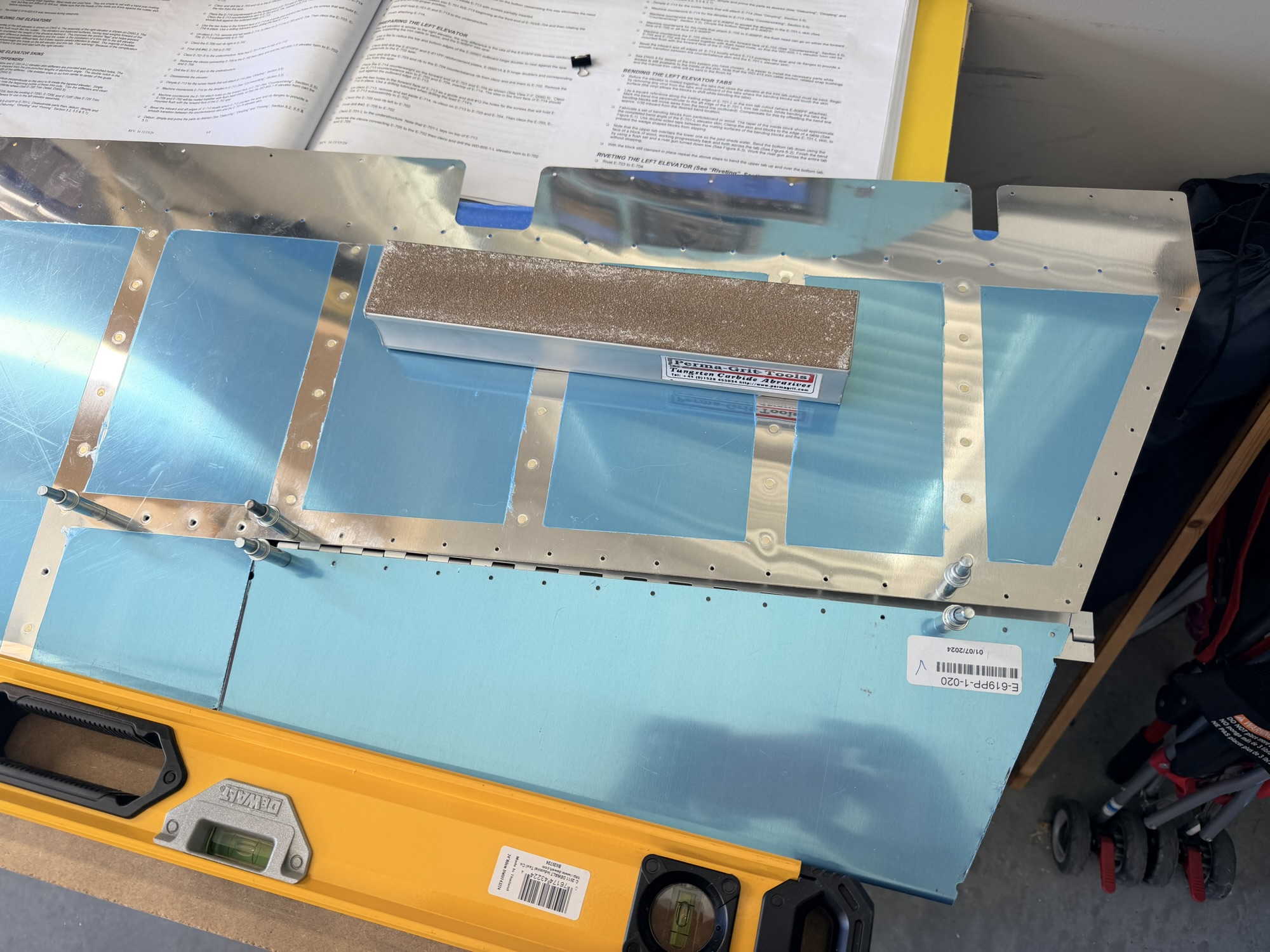
And I quickly decided to go the same route.

First, I measured and marked the tab for trimming.

img_2024.jpg


Left a little for the sanding block, of course.

Then, I started mocking up the left elevator skin, marking a cut line that would again leave some for the sanding block.

img_2025.jpg


Cut here.

After snipping the elevator skin, too, I was able to start positioning the tab.

img_2026.jpg


Now where is that hinge stock?

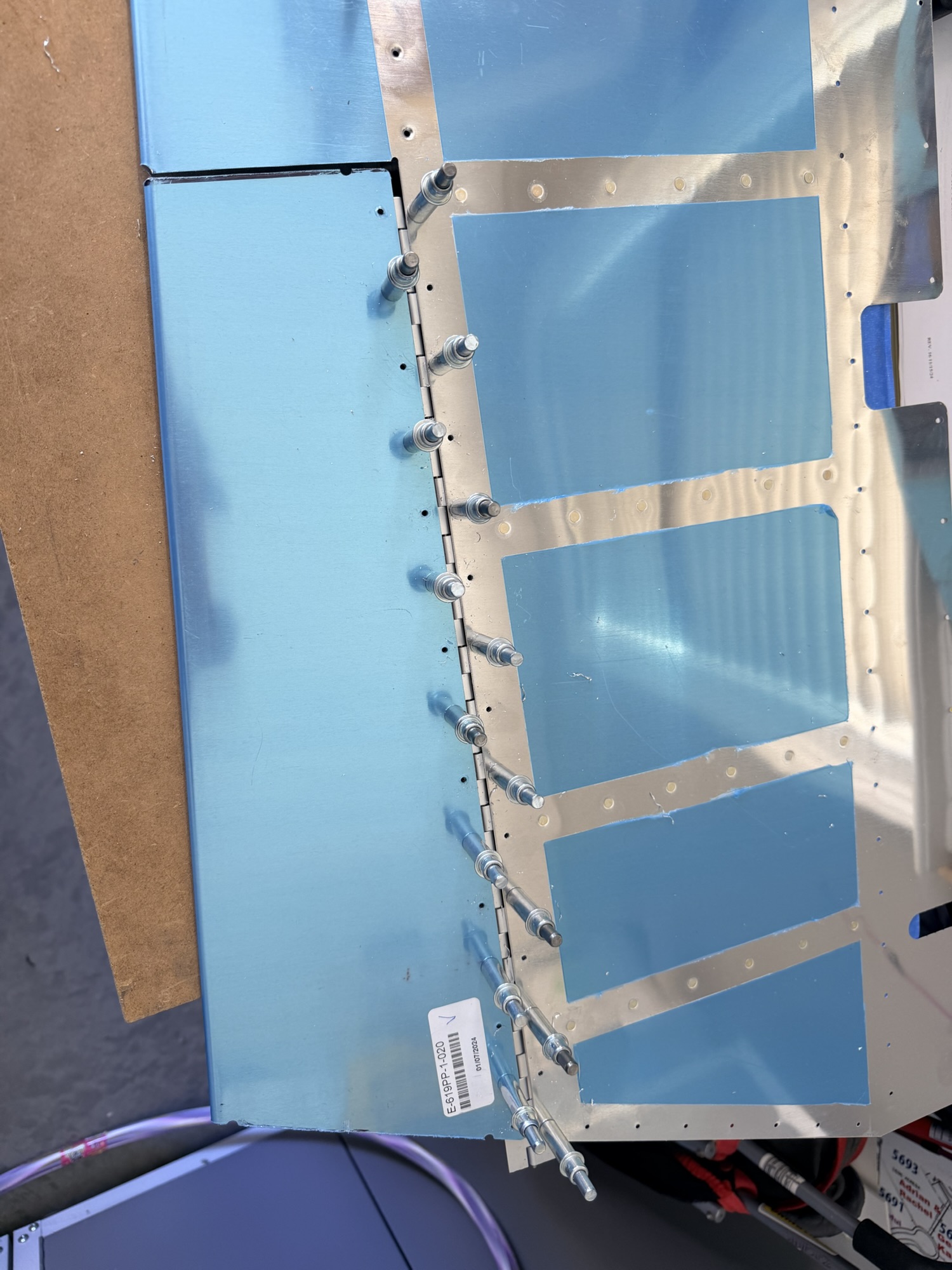
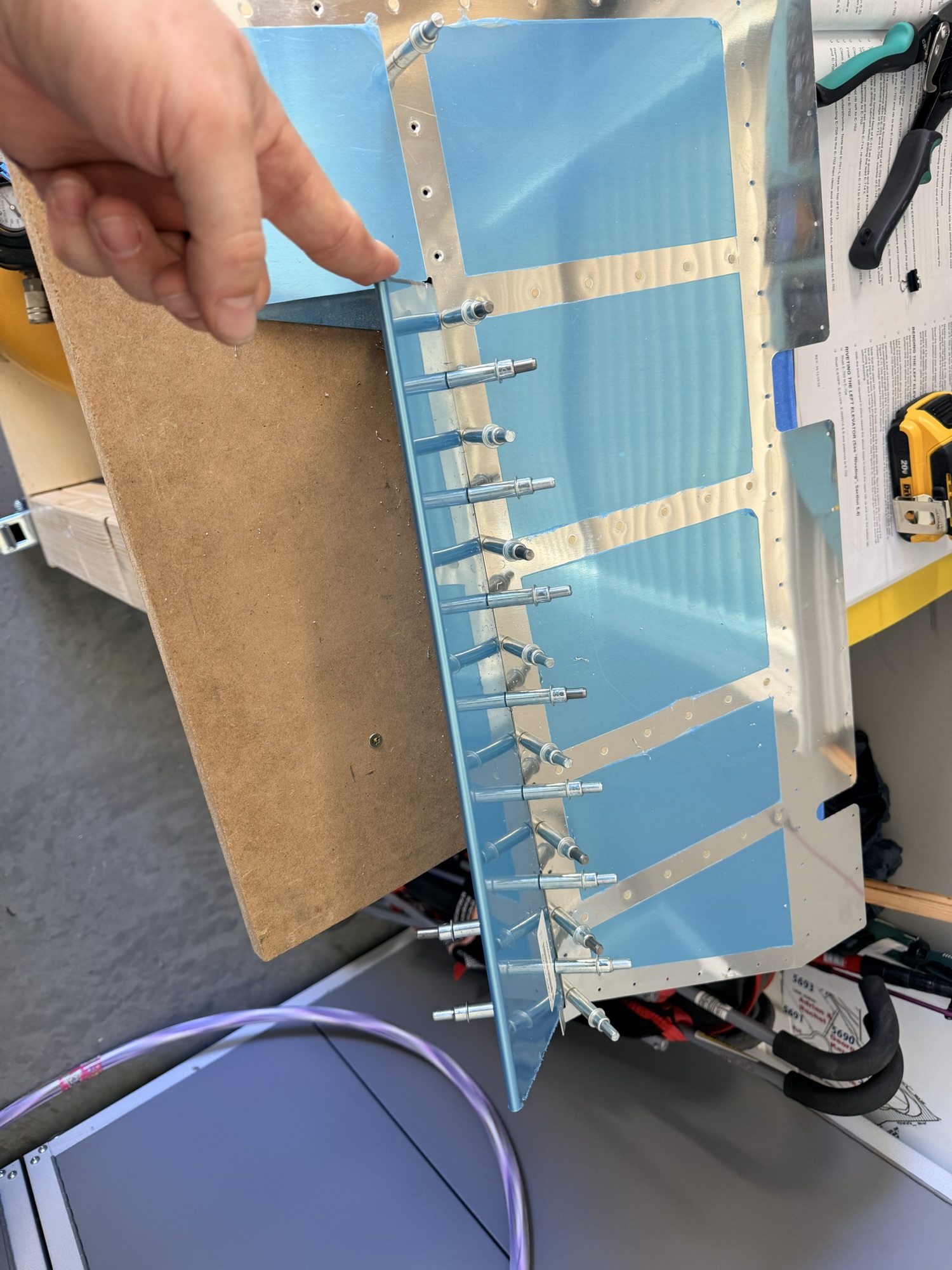
Next, one by one I drilled and clecoed the hinge stock, verifying after each hole that things were still aligned.

img_2027.jpg


Slow and steady wins the race.

Of course I stopped taking pictures when it got hard. But the end result makes me VERY happy. The hinge gap is perfectly square, the inboard edge of the tab is aligned with the inboard edge of the elevator, and MOST IMPORTANTLY, the aft edge of the tab is aligned with the aft edge of the elevator.

img_2028.jpg


Hinge drilled, etc.

Of course, I included an action shot for you.

img_2029.jpg


tada!

No binding, and a perfectly aligned elevator trim tab.

1.5 hours, very happy with the result.


March 24, 2026 - Left Elevator Matchdrilling, Prep, Priming, and Riveting

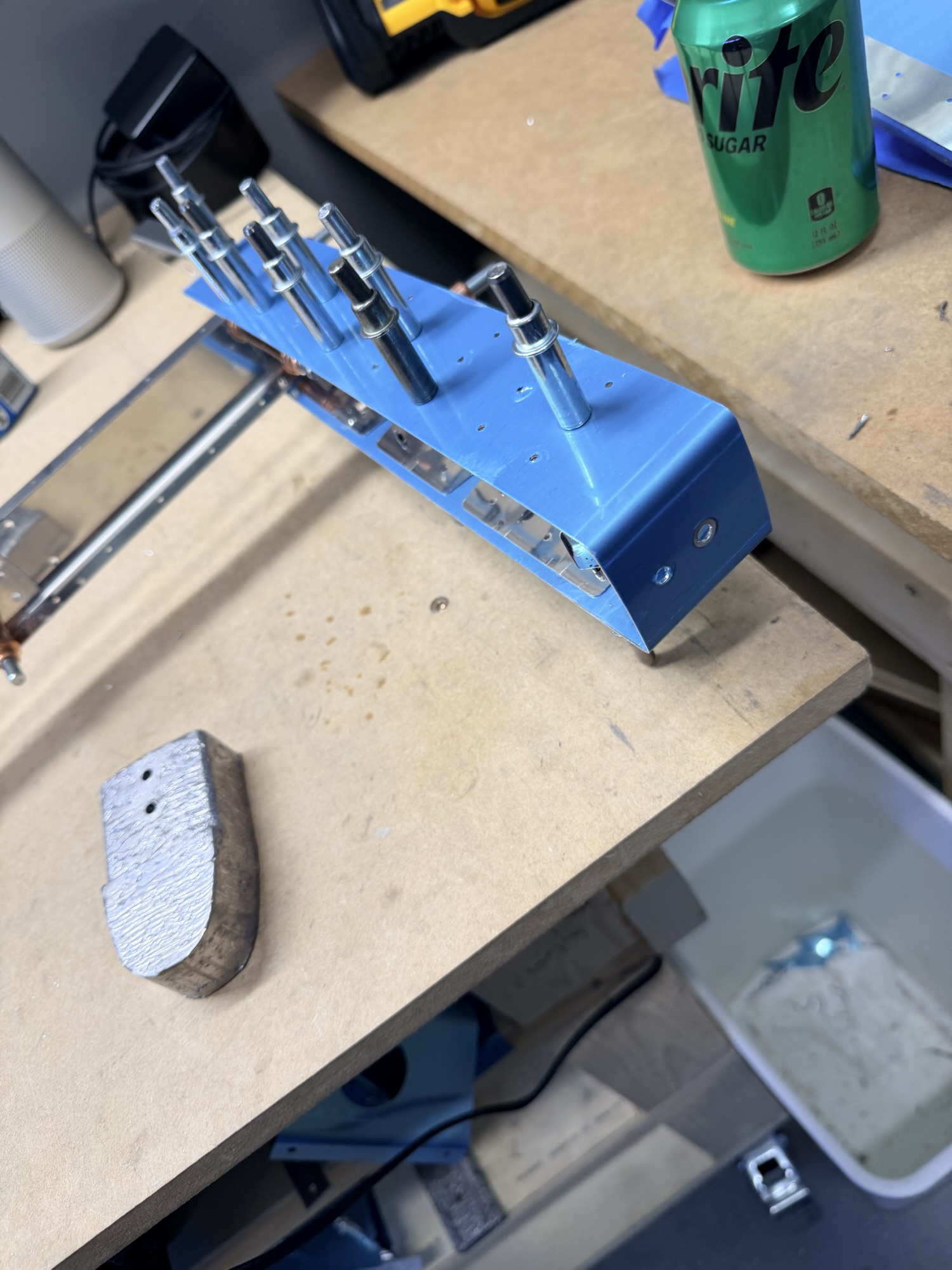
It was a quiet evening in the house tonight, so I buckled down to some airplane work.

First up, a few pictures of the counterbalance ribs and skin. You can see here I've already drilled the counterbalance weight. This time, I used some machine oil to lube the drill bit. No issues.

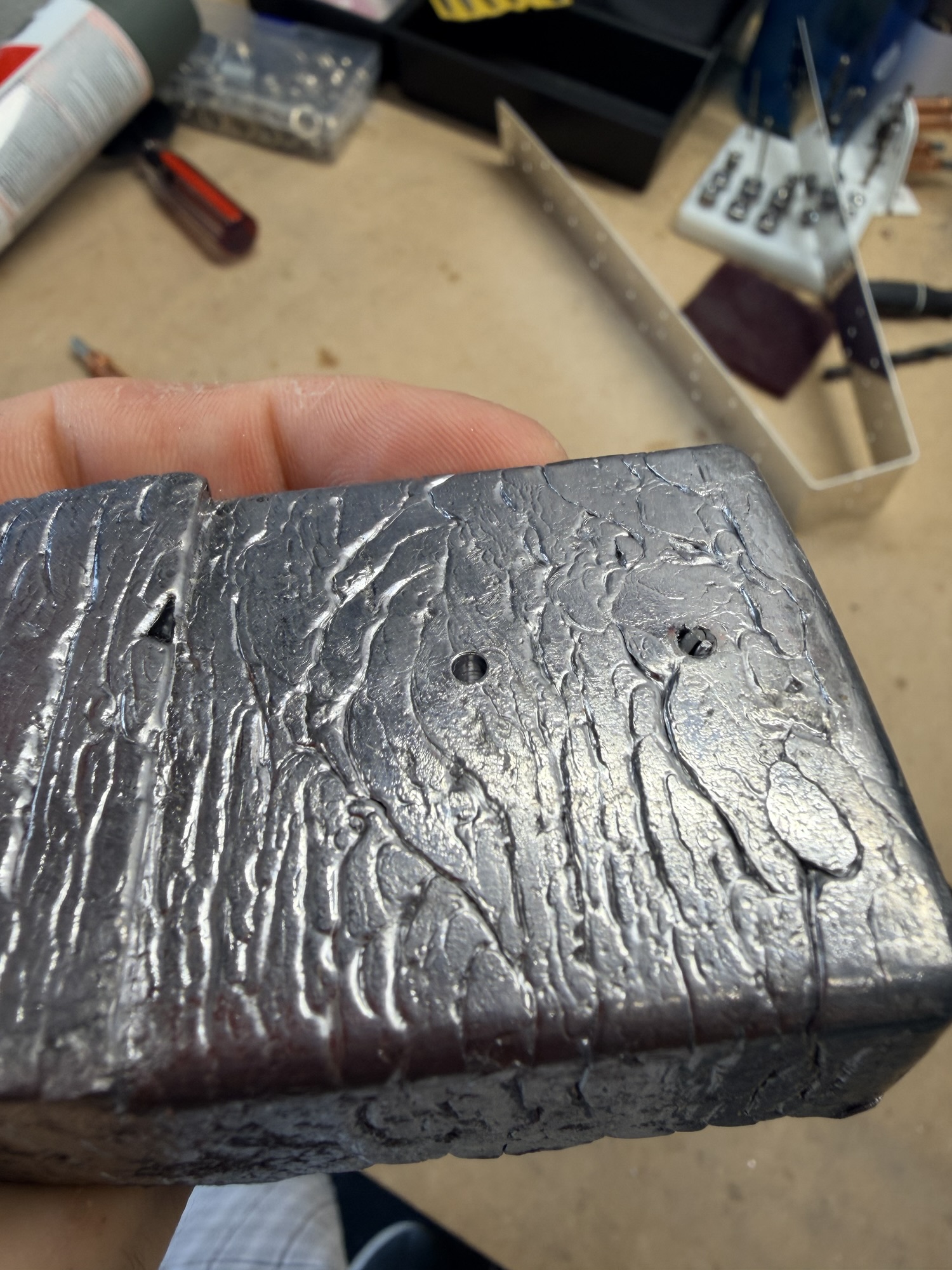
img_2034.jpg


Counterbalance weight drilled to #12.

After drilling, I countersunk the weight using a 1/2" drill bit.

img_2039.jpg


It's sunk. Countersunk.

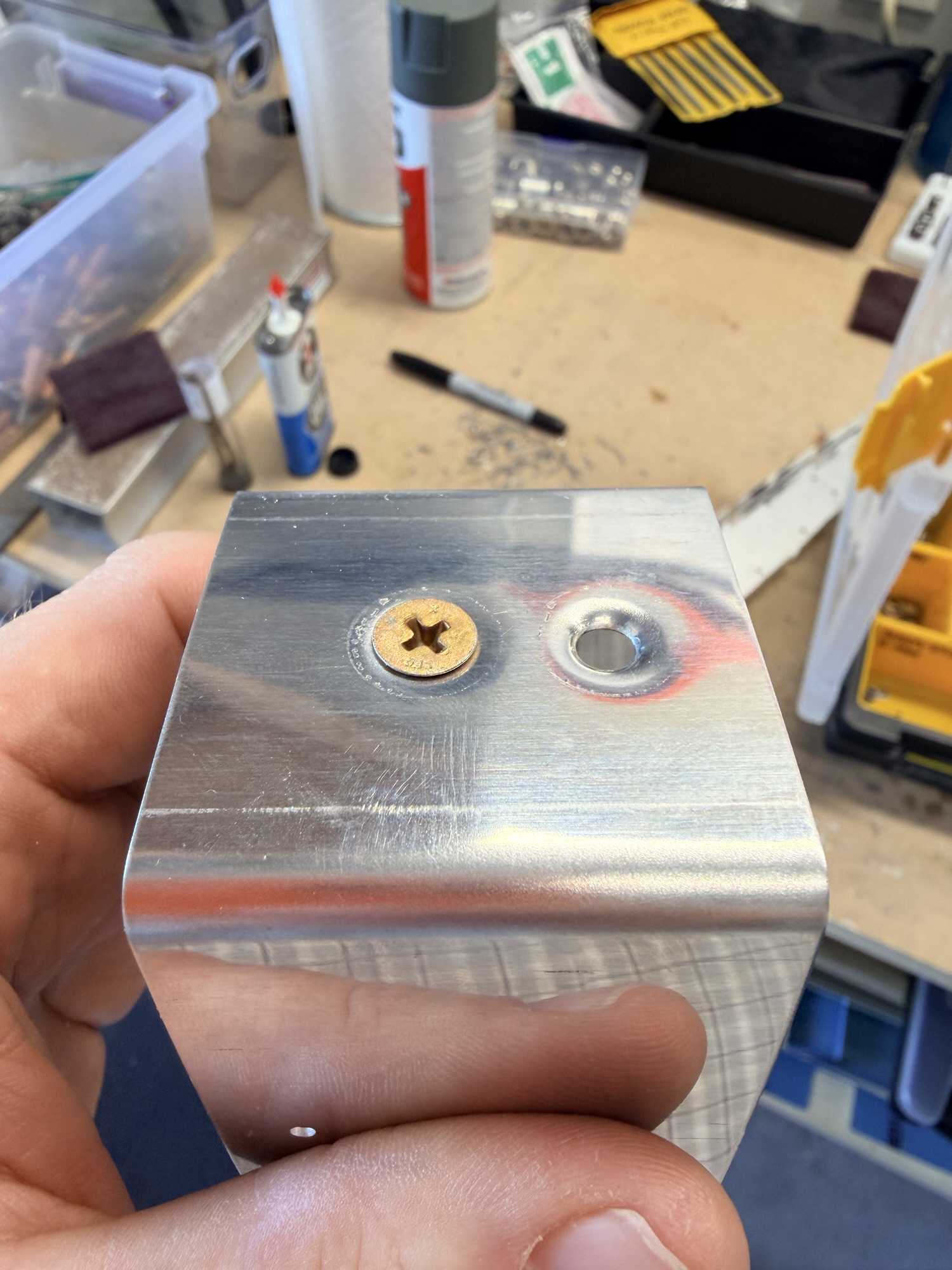
Then, back into the skin it goes for my dirty-dimpling maneuver. I put the #10 screws in the #8 dimpled holes (with the countersunk counterweight behind it).

img_2040.jpg


Screws ready to act as dimple dies.

After putting some tape over the screw heads, I hit it a few times with the flush set. After the big reveal...

img_2041.jpg


That'll do.

Nicely dimpled screw holes.

Or I could just buy #10 dimple dies. Nah.

Next up, some matchdrilling of the left elevator spar to the inboard rib.

img_2035.jpg


LE spar and inboard rib.

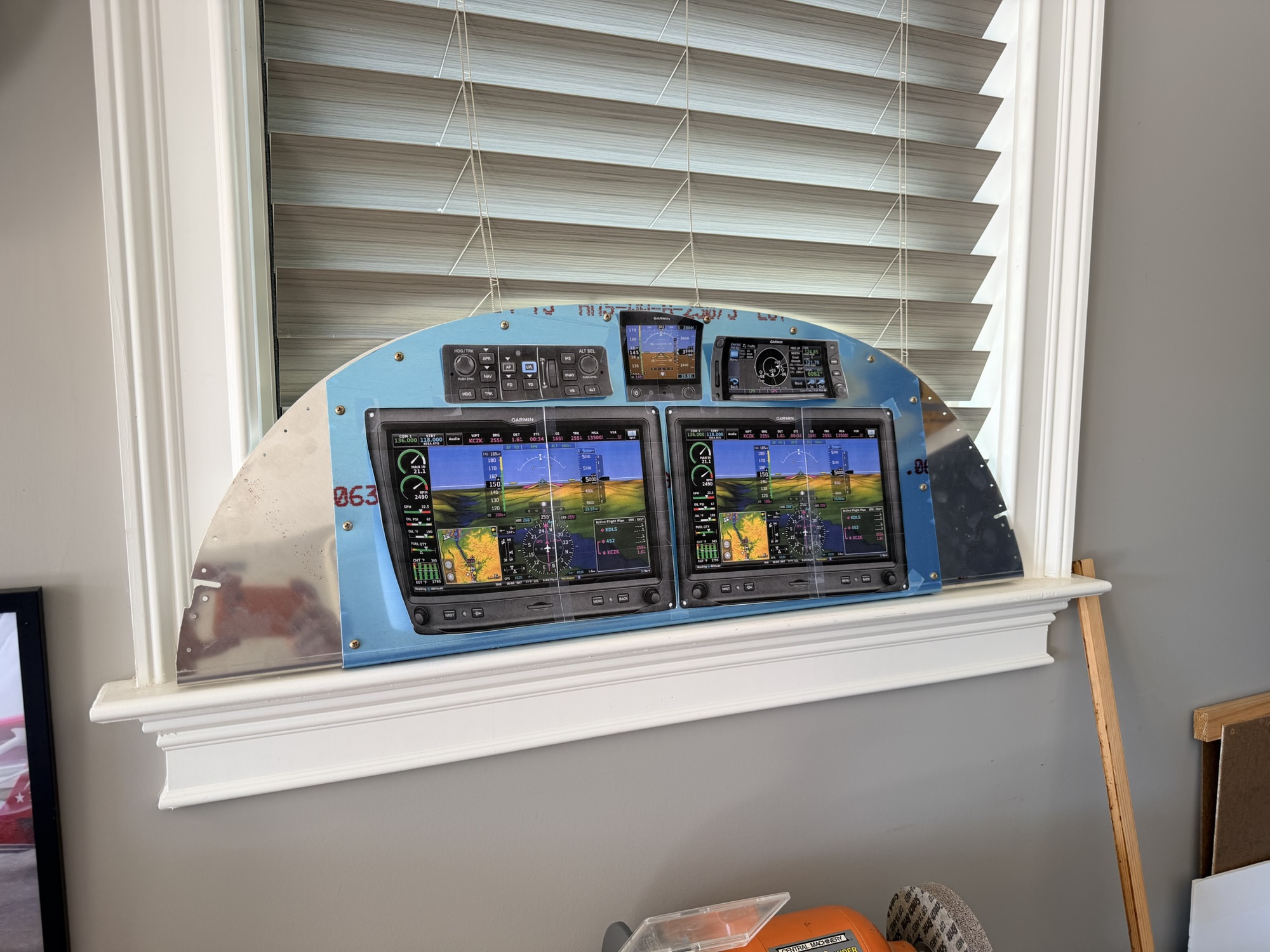
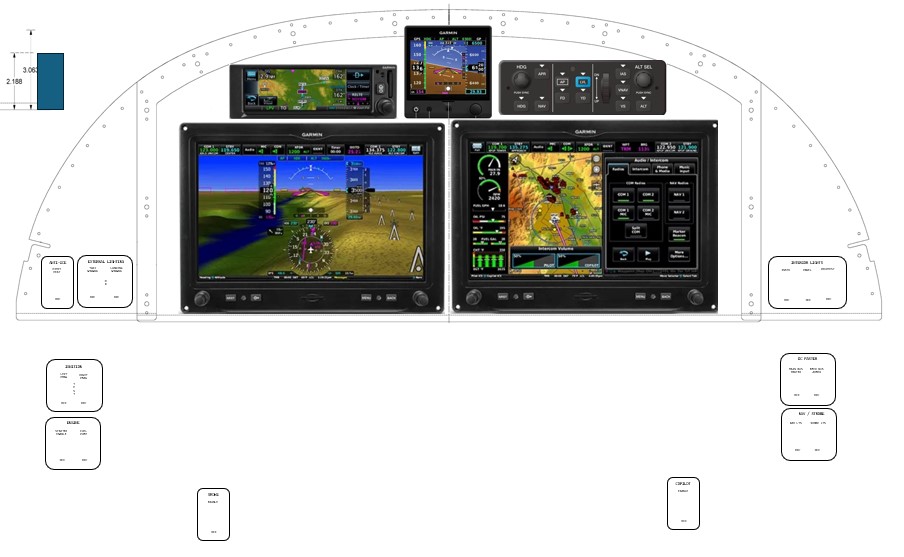
Apparently, I skipped ahead in the pictures to matchdrilling the skin. I might've positioned the skin here to show off my panel mockup.

img_2038.jpg


This is the bottom of the left elevator

I took this wide-angle shot just to remind myself that I'd completed the matchdrilling on the skins.

img_2036.jpg


Upside-down left elevator.

Then, I matchdrilled the elevator horn.

img_2037.jpg


I konw it's upside-down.

Once everything was matchdrilled, it's time to disassemble, deburr, scuff, dimple.

img_2042.jpg


Counterbalance skin, scuffed and dimpled.

Here are the spar reinforcement plates, edge-finished, deburred, scuffed, and ready for priming.

img_2043.jpg


Ready for paint.

Some prep work on the inboard rib and tab spar. Van’s wants you to countersink either piece for flush rivets (not for any real flush reason…I think they need to be #40 size holes, and they don’t give you any universal head AN470AD3 rivets). Anyway, per standard practice, I dimpled both.

img_2046.jpg


Double dimple.

I skipped a few pictures here, but here's the elevator skeleton, primed.

img_2048.jpg


I love the NAPA self-etching primer.

After some more deburring, scuffing, and dimpling the skin, I got it on the fancy paint booth and primed the remaining interior surfaces.

img_2049.jpg


We're getting closer.

So about here, I realized I had another hour's worth of effort in me, and it wasn't quite bedtime. Let's rivet something!

I started with the counterbalance and tib rib.

img_2050.jpg


10 rivets there.

img_2051.jpg


Here are the shop heads.

Then I moved on to the spar. I set 33 of the 34 rivets, then had trouble with the very last one.

img_2052.jpg


Here it is drilled out.

Here's the front side, with the new rivet in place and the old rivet as example for any future rivets who want to give me trouble.

img_2053.jpg


That rivet did me dirty.

This is the outboard set.

img_2054.jpg


Looking good.

Shop heads.

img_2055.jpg


Looking good again!

img_2056.jpg


More shop heads.

3.5 hours total, 34 rivets, with one needed to be drilled out. Maybe I'll get to skin riveting later this week.
 
March 25, 2026 - Left Elevator Riveting

Another great night in the shop tonight. First thing's first, let's get the inboard rib riveted to the spar.

img_2058.jpg


4 nice AN426AD3-3.5 rivets here.

Then, 4 more rivets, this time AN470AD4-4s to connect the tip and counterbalance ribs to the spar.

img_2059.jpg


Conjunction junction.

Next, we'll finish the skeleton by attaching the elevator horn to the spar and inboard ribs. 12 more rivets here. I think we're up to 20 so far.

img_2060.jpg


Yes, the skeleton is currently upside-down.

Then, almost a full 30 minutes of pulling out the interior blue vinyl. Is it time consuming, yes. Does it leave a beautiful untouched surface on the interior? Also yes.

img_2061.jpg


It's like a work of art.

Now, let's start riveting on the skin. The manual has you start with these two flush rivets on the top and bottom of the skins to avoid using a blind rivet.

img_2062.jpg


4 more here, but I didn't count these until the end, stay tuned.

An hour or so passed at this moment in the picture-taking. Bu after doing a bunch of skin to spar riveting, I made it here, to these hard-to-reach rivets.

img_2065-e1774486989483.jpg


I did manage to set all of these with no issue, even though they are hard to reach.

Wait, these might be out of order. Here's an in-progress shot of the bottom of the left elevator as I'm working on riveting the skin to the spar.

img_2063.jpg


Upside down and backwards.

This is now the top side of the left rudder with most of the skin-to-spar rivets complete.

img_2064.jpg


lots of flush rivets, so pretty.

Again, a few minutes pass by without a picture, then...

img_2067.jpg


Here's a "finished" shot of the top side of the left elevator.

Yes, there are a few rivets missing at the tab hinge area, but I was having trouble there, time to walk away.

img_2066.jpg


And the requisite bottom of the left elevator picture.

170 plus some rivets over 3.0 hours in the garage. There are still some things to do to finish the left elevator, but it's definitely getting close.
 
March 26, 2026 - Finished Elevator Trim Tab

Well, I spent a solid 2.5 hours in the garage today working on the left elevator trim tab.

First step, let's find all the pieces (like the two halves of the trim tab horn) and get them clecoed to the rest of the structure.

img_2071.jpg


The 1/8" cleco is making sure the two halves are aligned during matchdrilling.

Then, I decided to forego the folding of the tab halves, instead going with a fabricated riblet. (I made two of them, one for each side of the tab.)

img_2072.jpg


Cleverly, I offset the rear attach holes so I would have less trouble riveting.

Then, I drilled, disassembled, deburred, dimpled, scuffed, and primed the skeleton and interior of the tab skin.

Of course, I got lazy about pictures, so here's a finished shot of the bottom of the trim tab.

img_2073.jpg


The rivet gun got away from my on two rivets in the middle of the tab. I may choose to replace this all later, but for now, it's fine.

Because I'm lucky, I was able to finish the top half of the tab with no mistakes.

img_2075.jpg


Finished!

Here's another shot of the bottom half.

img_2074.jpg


Doesn't look to bad here.

Of course, I had to stick the hinge pin in and see how it looked.

img_2076.jpg


It looked DAMN BEAUTIFUL.

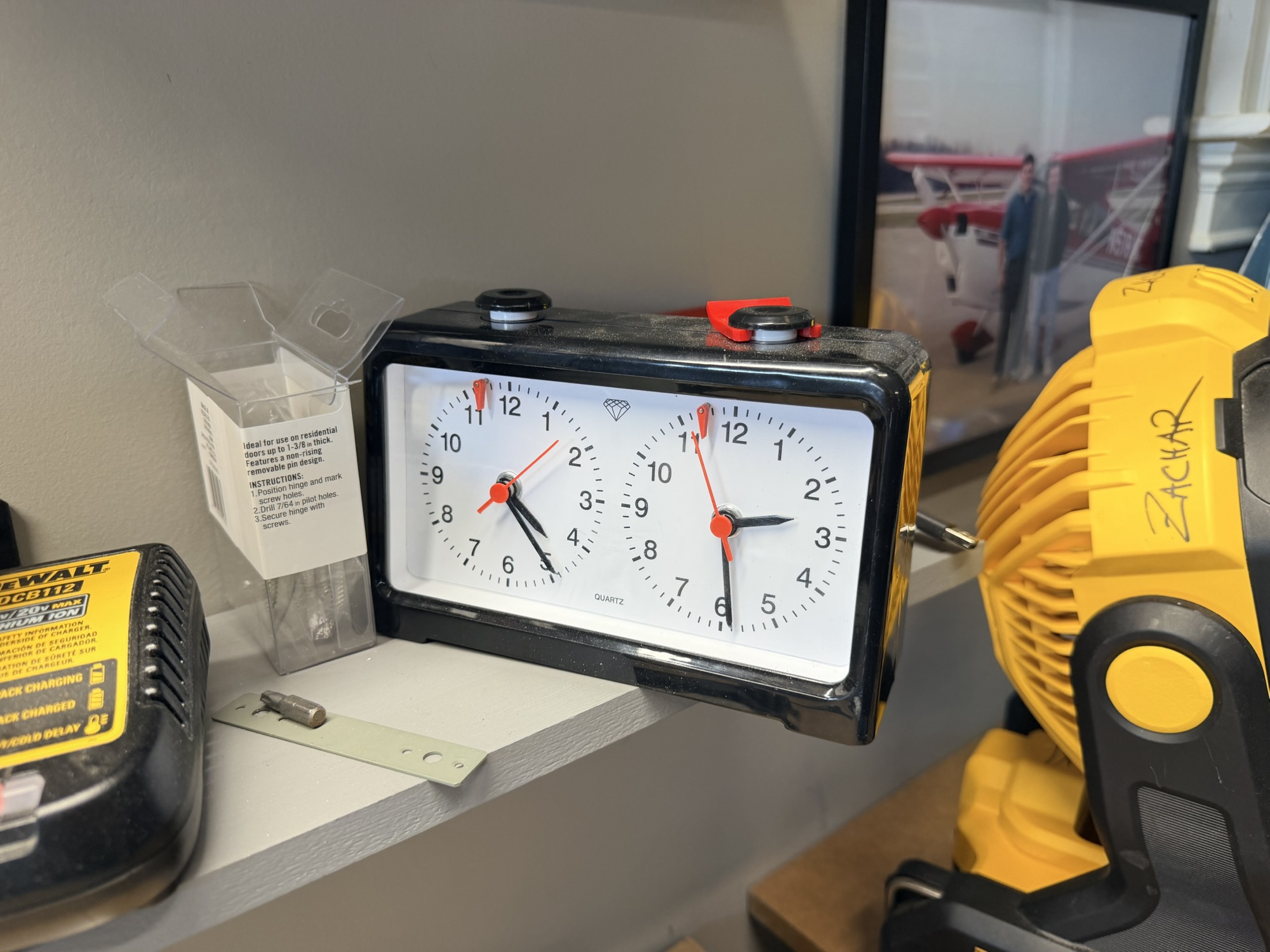
Anyway, when I can see the future and know I won't post tonight's work for a few days, I sometimes take a picture of my time-keeper. 2.5 hours tonight.

img_2077.jpg


I always use the right side to keep time, I have no idea what the left side was timing.

2.5 hours. 42 rivets.
 
April 6, 2026 - Almost Finished Left Elevator

Well, it's been a few days since I was in the shop, but I got a lot done today in just 1.5 hours.

First up, I rolled the leading edges (all 6 of them) on the left elevator. Here's the final product. Yikes, those bends are not perfect.

img_2142.jpg


Bends complete.

With #30 clecos holding it all together...

img_2143.jpg


I'm missing a single cleco on the left side, just because I am about to start blind riveting.

After some blind riveting, here's the rolled leading edge.

img_2144.jpg


It looks like an elevator!

After 1 hour and 22 blind rivets, I pulled out the rod ends and bolts/nuts to connect the elevators to the horizontal stabilizer. Then, I remembered that I never finished the center hinge bearing and bracket.

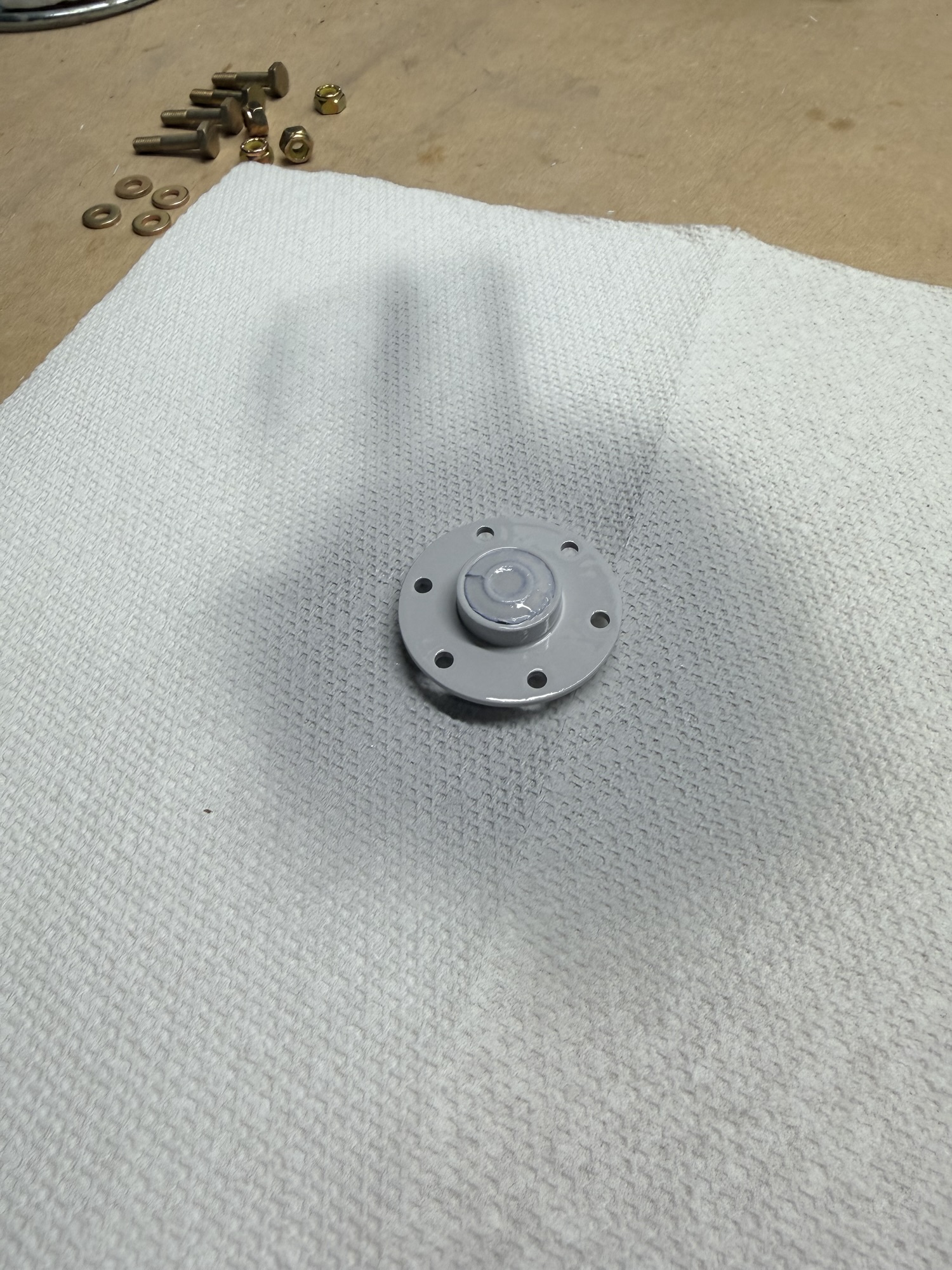
Let's get that sucker prepped and primed!

img_2149.jpg


I love this self-etching primer.

With a few minutes left before bedtime, I grabbed the horizontal stabilizer off the wall and started messing with rod end bearing installation to tackle skin trimming. I half-mounted the left elevator so I could mark the HS skin for trimming.

img_2150.jpg


This was fun, but frustrating.

I still have quite the list to finish the empennage.
  • Trim HS skins to allow elevator counterbalance clearance.
  • Finish center bearing bracket and bolt to HS
  • Emp fiberglass tips
But the wing kit is on the way.

1.5 hours, 22 rivets.
 
April 7, 2026 - The First Elevator Mounting

The first elevator mounting. Now that you know how it ends, let's look at how it starts.

After I almost finished the left elevator yesterday, I "mounted" it into the hinges using some AN3 bolts, but nested the elevator counterbalance horn into the horizontal skin so I could carefully mark (and then trim) the horizontal stabilizer skin.

img_2151.jpg


Here are my initial cut marks...on the bottom.

<insert HS flipping noises here>

img_2152.jpg


Here are my initial cut marks...on the top.

After an initial trim....

img_2153.jpg


You can see where I've trimmed back the skin in the foreground, but not yet the background.

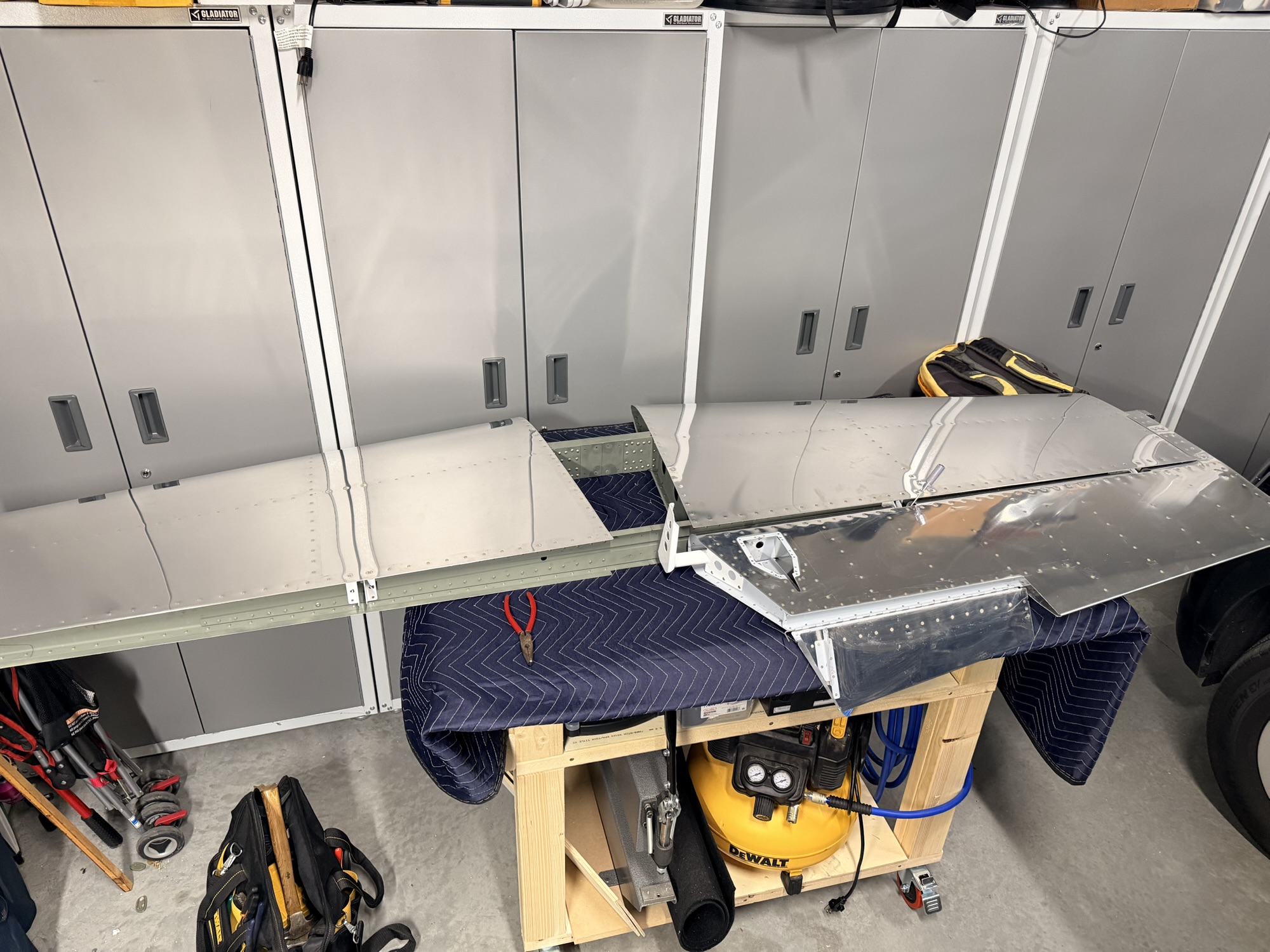
After two (three?) more identical trims, I mounted both elevators to the HS. Wow.

img_2154.jpg


It really feels like an airplane now.

After about 10 minutes of just staring at it smiling, I looked around at anything else I could accomplish in the few minutes I had before bedtime.

Oh yeah, the center hinge bracket. Time to get this thing riveted and bolted to the HS Rear Spar.

img_2156.jpg


Here's a little cleco and clamp action.

Then 6 quick universal head rivets.

img_2157.jpg


6 rivets tonight.

Then another ten minutes of admiring the HS assembly on the rolling workbench.

img_2155.jpg


So excited about this.

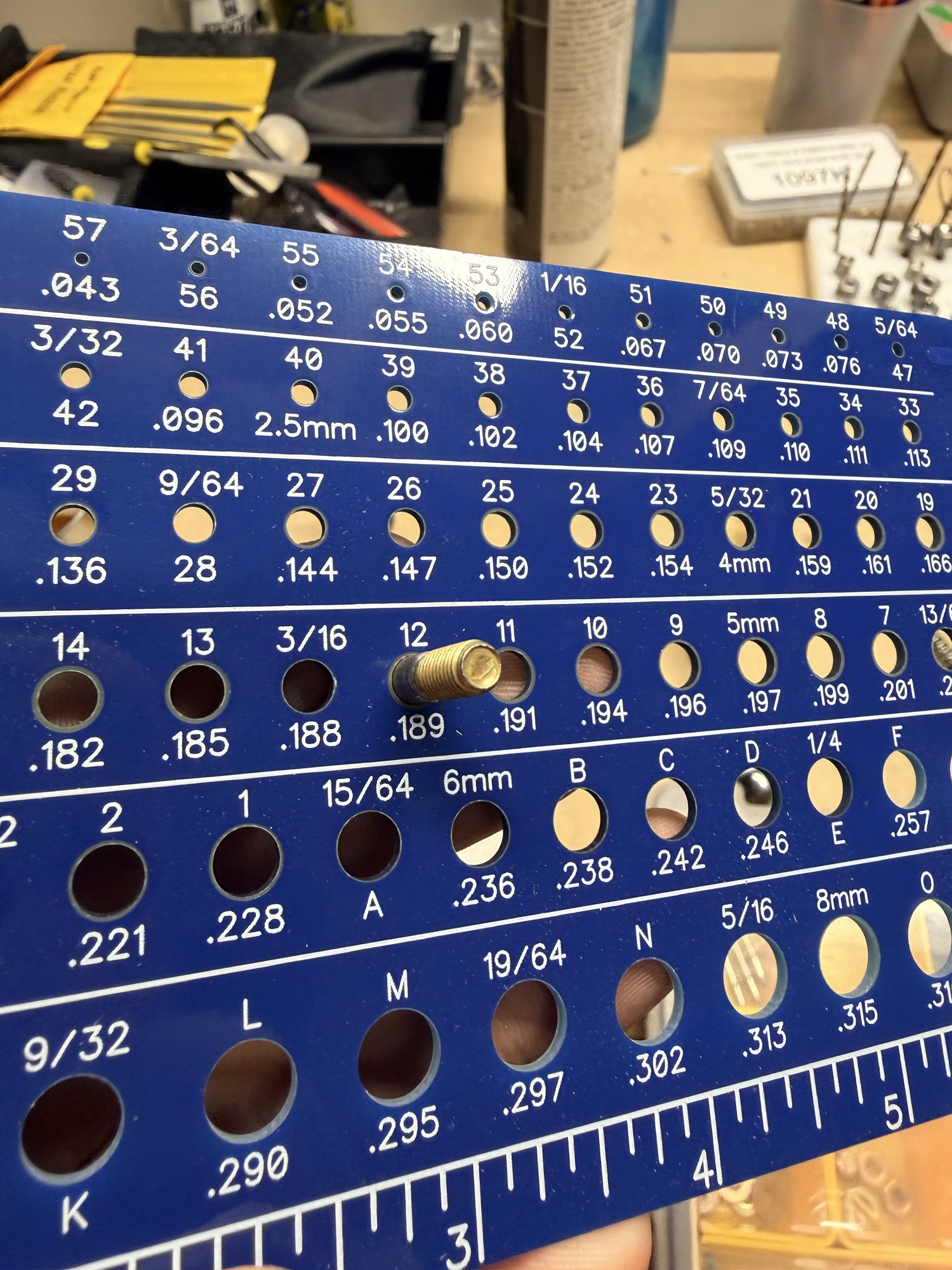
Finally, this is the only picture you get of me bolting the center hinge bracket to the HS rear spar. Here I am verifying that a #12 hole is correct for an AN3 bolt.

img_2159.jpg


Yup.

2.0 hours, 6 rivets.
 
April 8, 2026 - Fixed Elevator Trailing Edge Bends

Tonight, a quick night in the shop just to start knocking off last items off the empennage checklist.

I wasn't happy with the trailing edge bends on the elevator, so I fabricated a couple wooden blocks as Vans describes in section 5 of the manual, and squeezed very carefully to fix my in adequate trailing edge bends.

Before:

img_2165.jpg


See the fall-off before the radius? Bad.

After:

img_2166.jpg


Much better!

Happy about these now. What's next?

0.5 hours.
 
April 11, 2026 - Consoles and Panel Nutplates

Well, today I got an order from Van's that wasn't really part of the planned build process. A few weeks back I was dreaming about switch placement and panel layout and I decided to buy some of the actual cockpit parts to start getting a sense of scale and placement. The problem? I needed some #8 nutplates and screws to put them together enough to be useful.

Also, I needed a spare trim tab motor cover. Ugh.

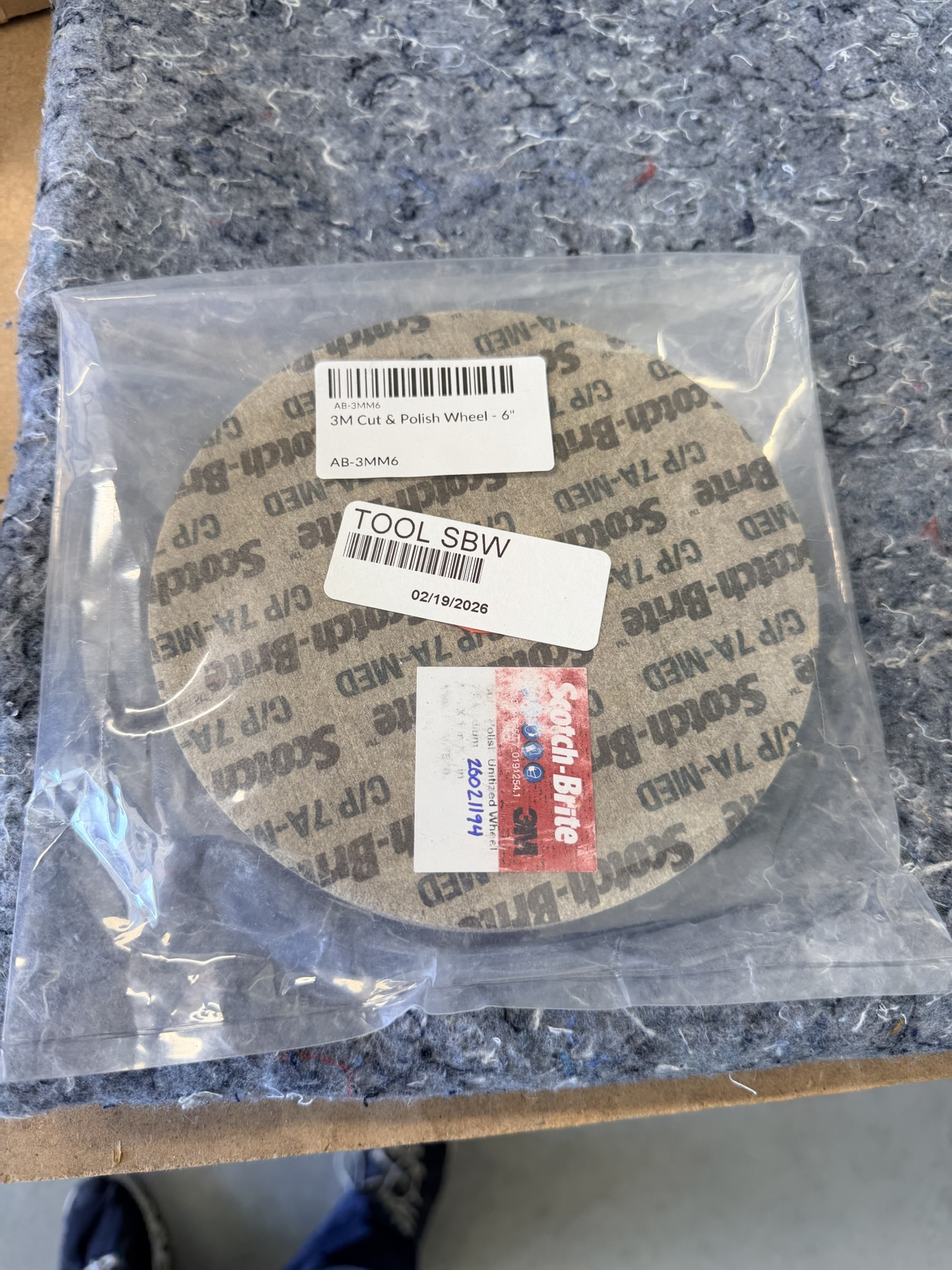
Well, shipping a few #8 nutplates across the country is expensive, so I added a scotchbrite wheel (a critical time-saving tool) to qualify for free shipping. Wuhooo.

img_2236.jpg


Scotchbrite wheel

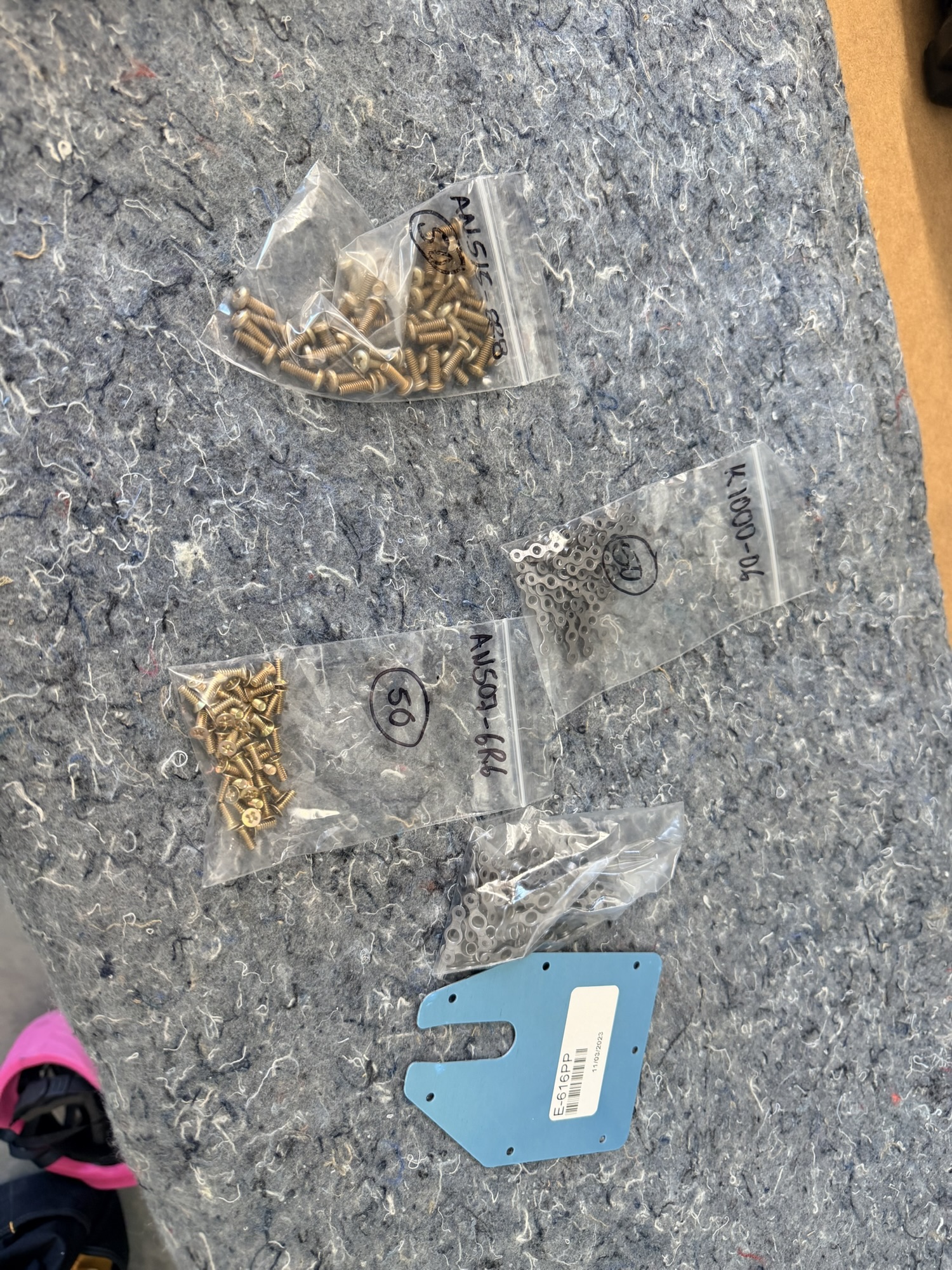
Here are some #6 and #8 nutplates and screws. (And the trim tab cover.)

img_2237.jpg


Parts!

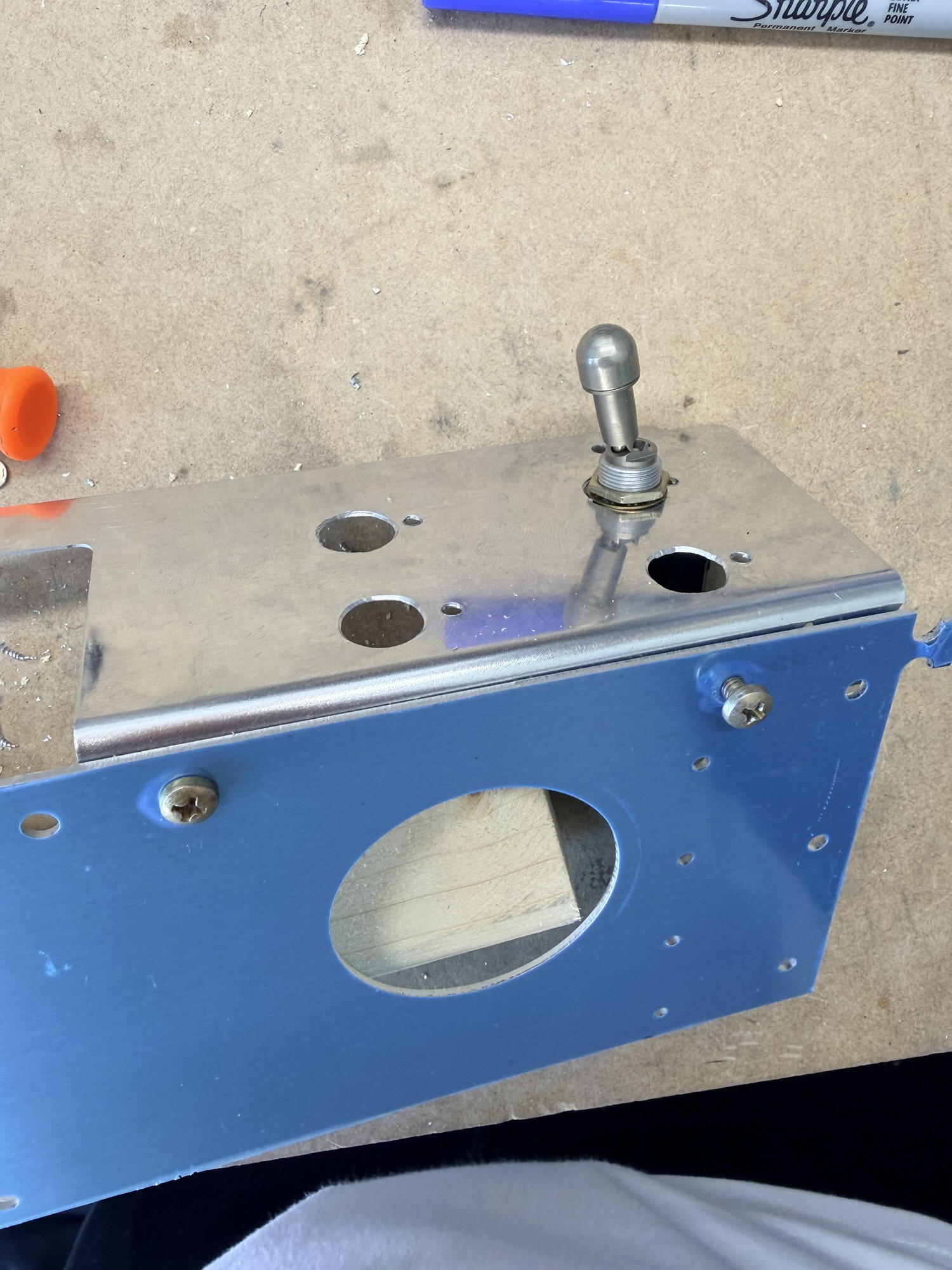
No in-progress shots today, but here's the right side console angle bracket.

img_2238.jpg


Right console bracket.

After screwing in the actual right console, tada!

img_2239.jpg


Right console.

Next, 8 more rivets in the 4 nutplates for the left side.

img_2240.jpg


Underside of left console

Here's the left side, complete.

img_2241.jpg


Left Console finished

Next, the panel screws into two "wings," each of which get 6 nutplates.

img_2242.jpg


Panel right side

Apparently I didn't take any pictures of the left side, but here's the panel screwed into the wings. Looking real, now.

img_2243.jpg


Panel!

1.0 hour, 40 rivets. And I'm counting this in the "panel" section of the build log.
 
April 12, 2026 - Electric Elevator Trim Tab Redux

With the spare trim cover arriving yesterday, I decided to get the tab motor (and brackets) installed correctly today. If you remember from this post, I had judiciously followed the plans...
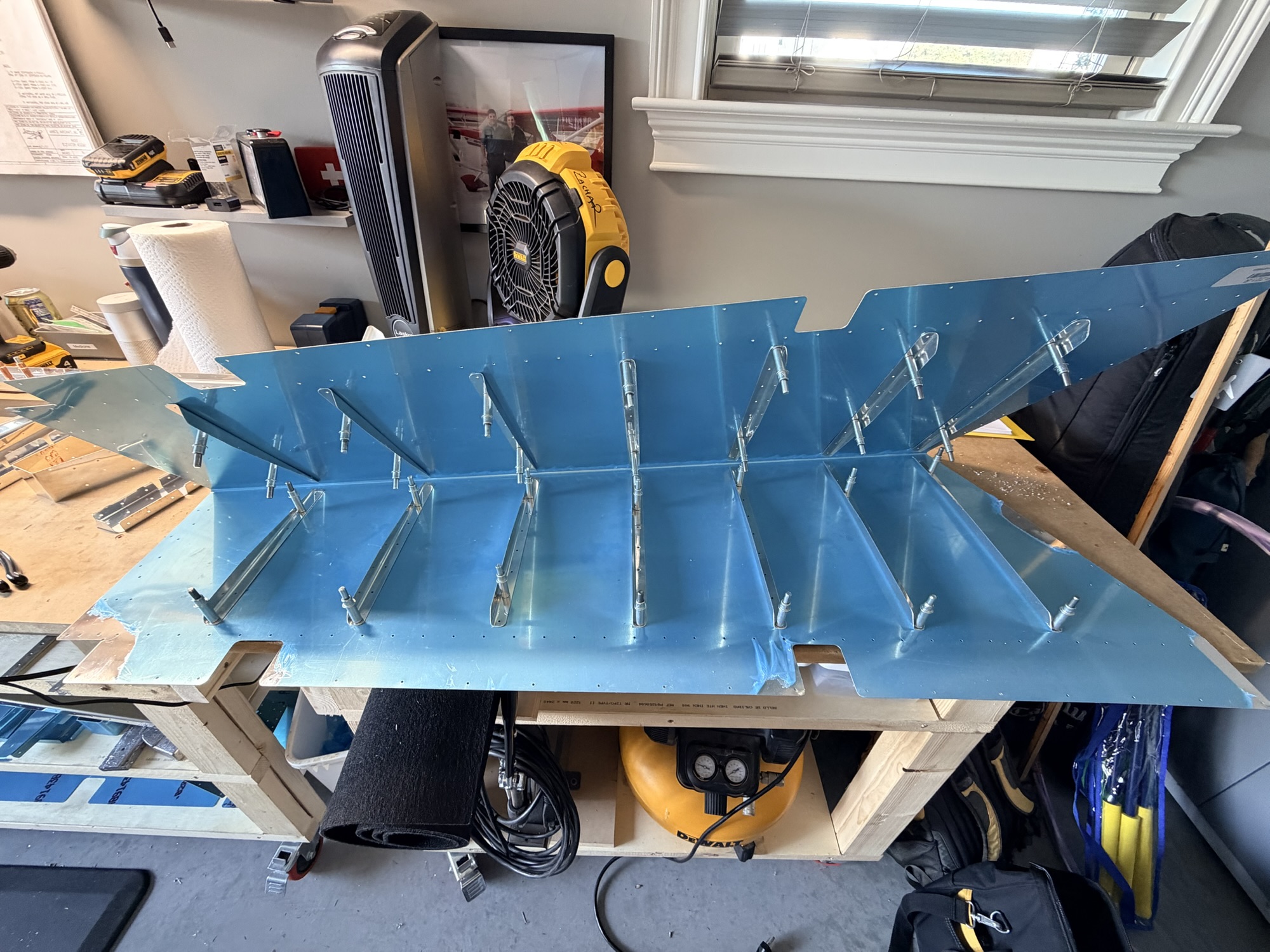
The other day, I laid out the brackets for the elevator trim tab servo. By “laid out” I mean I measured once, then drilled deburred and dimpled.

The problem is that once I did that, then held up the motor in its correct spot (like the picture below), none of the holes lined up.

Apparently everyone except me knows that the dimension on the plans are not correct. It’s better to eyeball it.
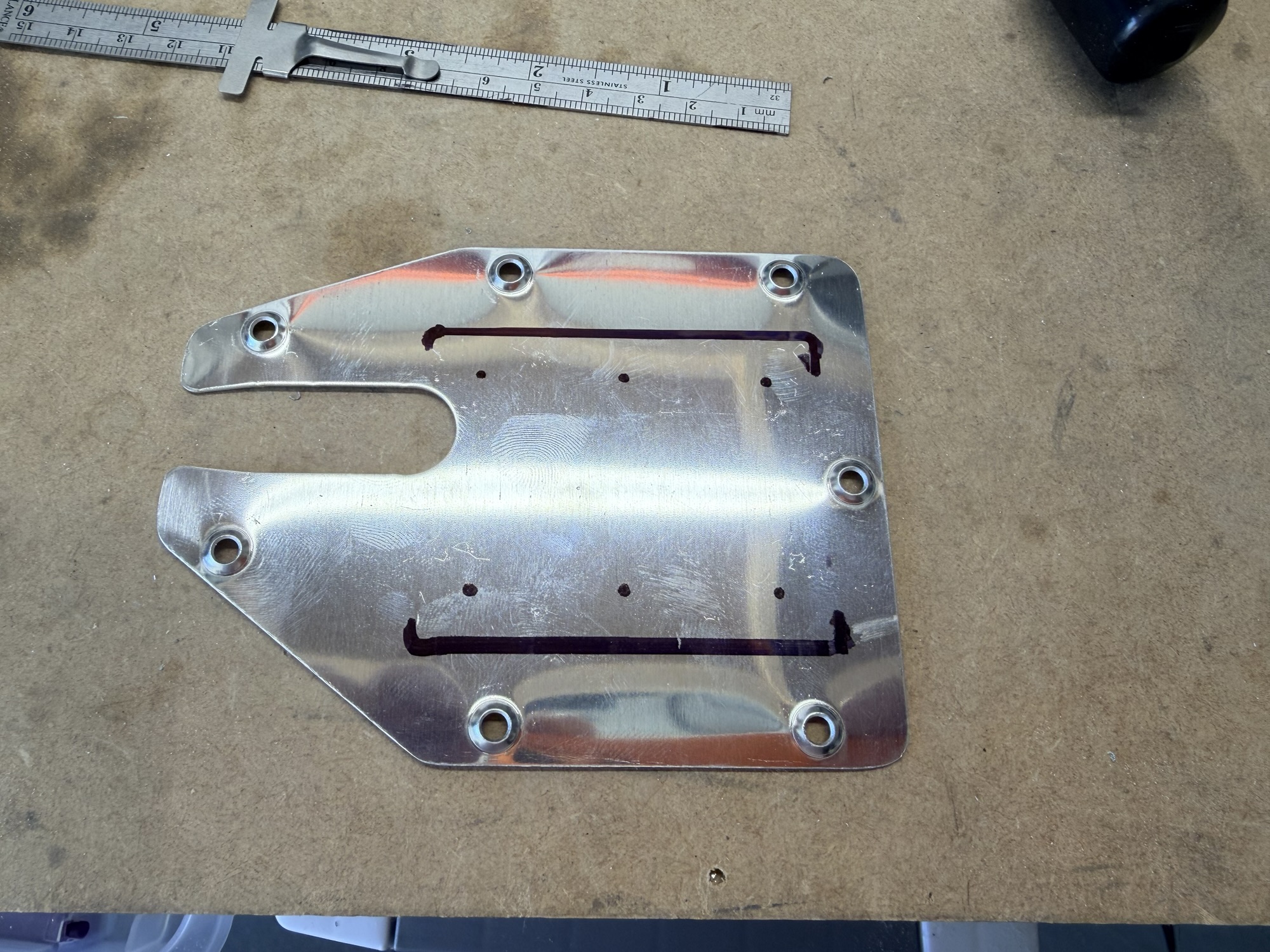
Anyway, I used the old eyeball alignment technique, then marked both the edges and the holes to my previously-prepared brackets.

img_2317.jpg


Sharpie's are great.

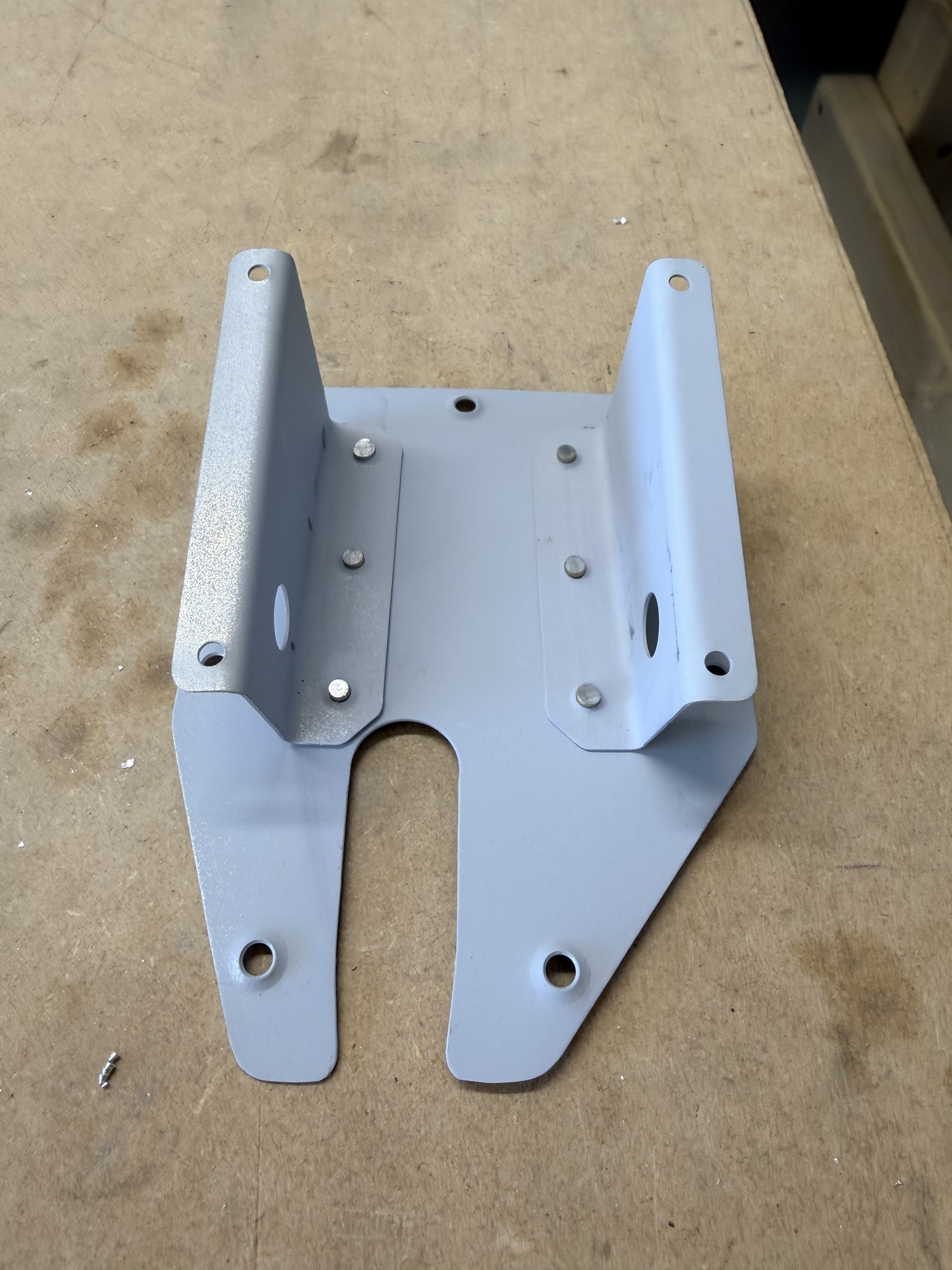
After some prep and priming, here's the assembly, ready for a motor.

img_2319.jpg


Those are nice shop heads, if I do say so myself.

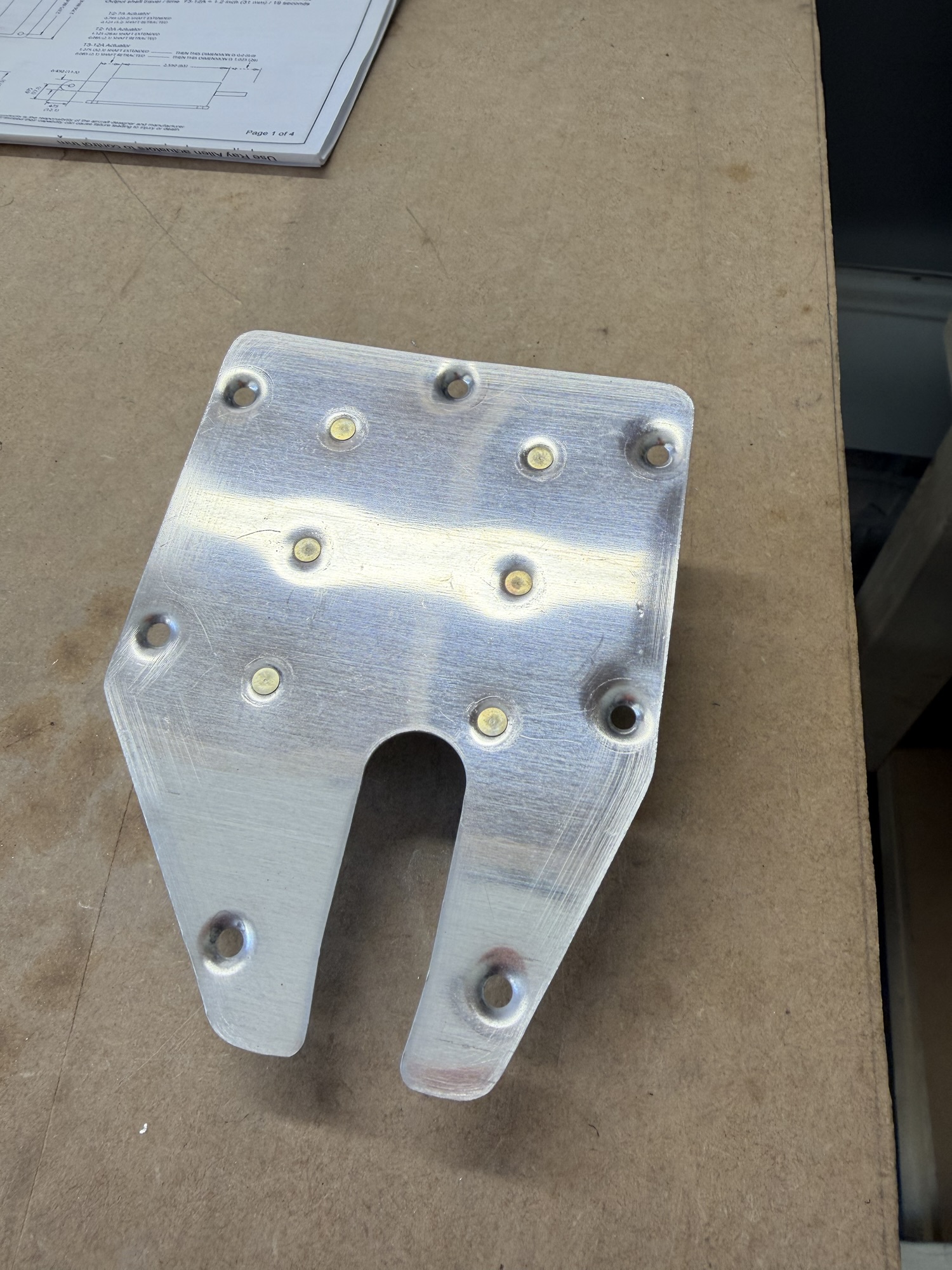
And the finished side, also looking quite pretty.

img_2318.jpg


That'll do.

Here's the funny part. I went to go fish out the electric trim tab motor and hardware and immediately dropped a few of the small pieces of hardware.

30 minutes later, I had vacuumed the whole shop, and found one of the two missing pieces on the ground (right where I dropped it).

The other lost piece was exactly where I left it in my hardware bin. Ugh. All's well that ends well, I guess.

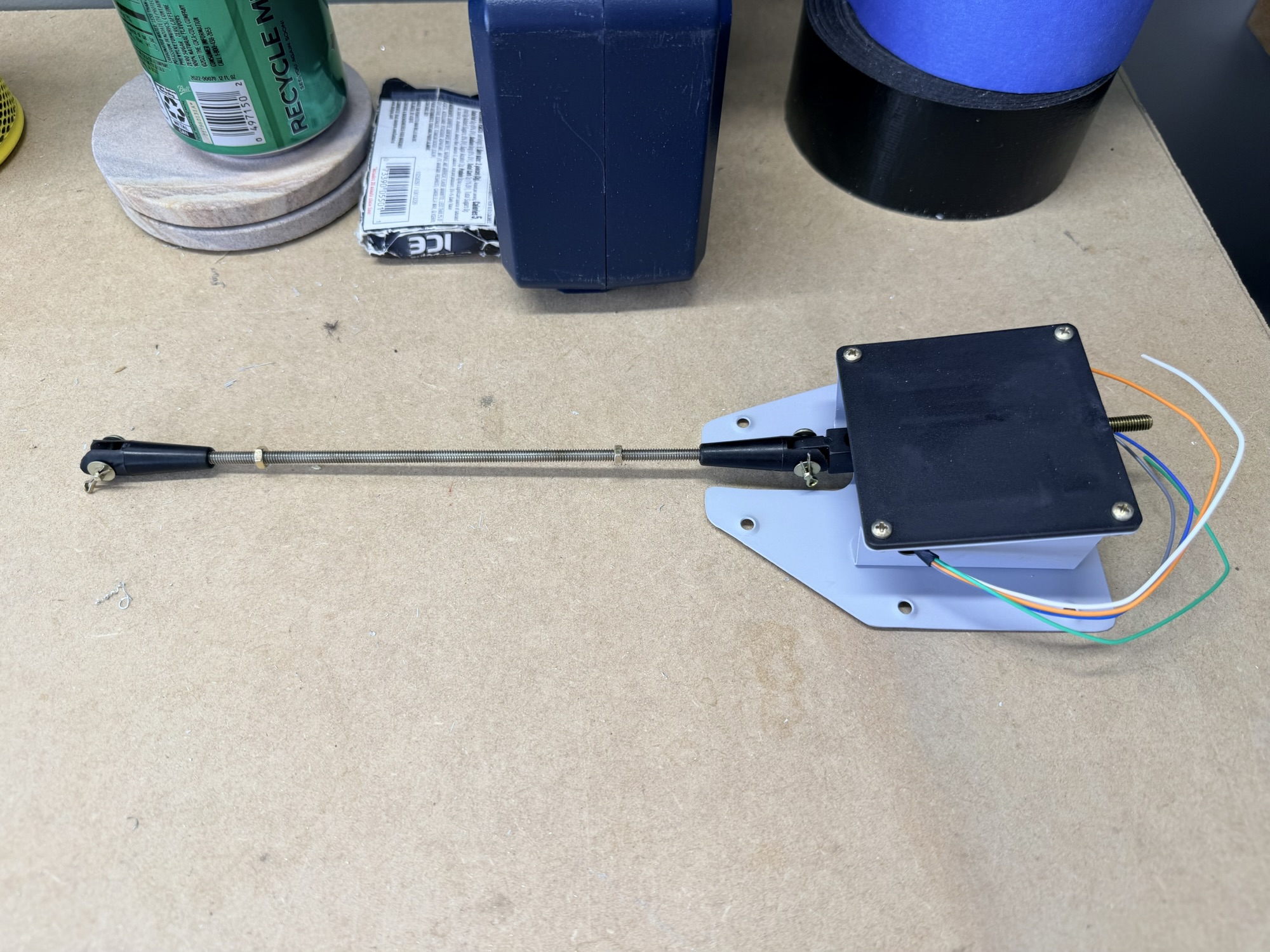
img_2320.jpg


Trim tab motor attached with the clevis temporarily installed.

6 rivets, 1.0 hour on the elevator trim tab.
 
April 18, 2026 - Elevator Trim Tab Rigging

After a long week at work and a busy saturday, it was a pleasure to get back to the airplane, especially since one of the last few items I can work on before the wing kit arrives is the trim tab motor.

Specifically, getting the motor (which is mounted to the access plate), mounted and rigged with the pushrod.

I haven't done as much research as I wanted, but I figured out that I should figure out where the motor's travel is centered, then size the pushrod to fit a faired trim tab.

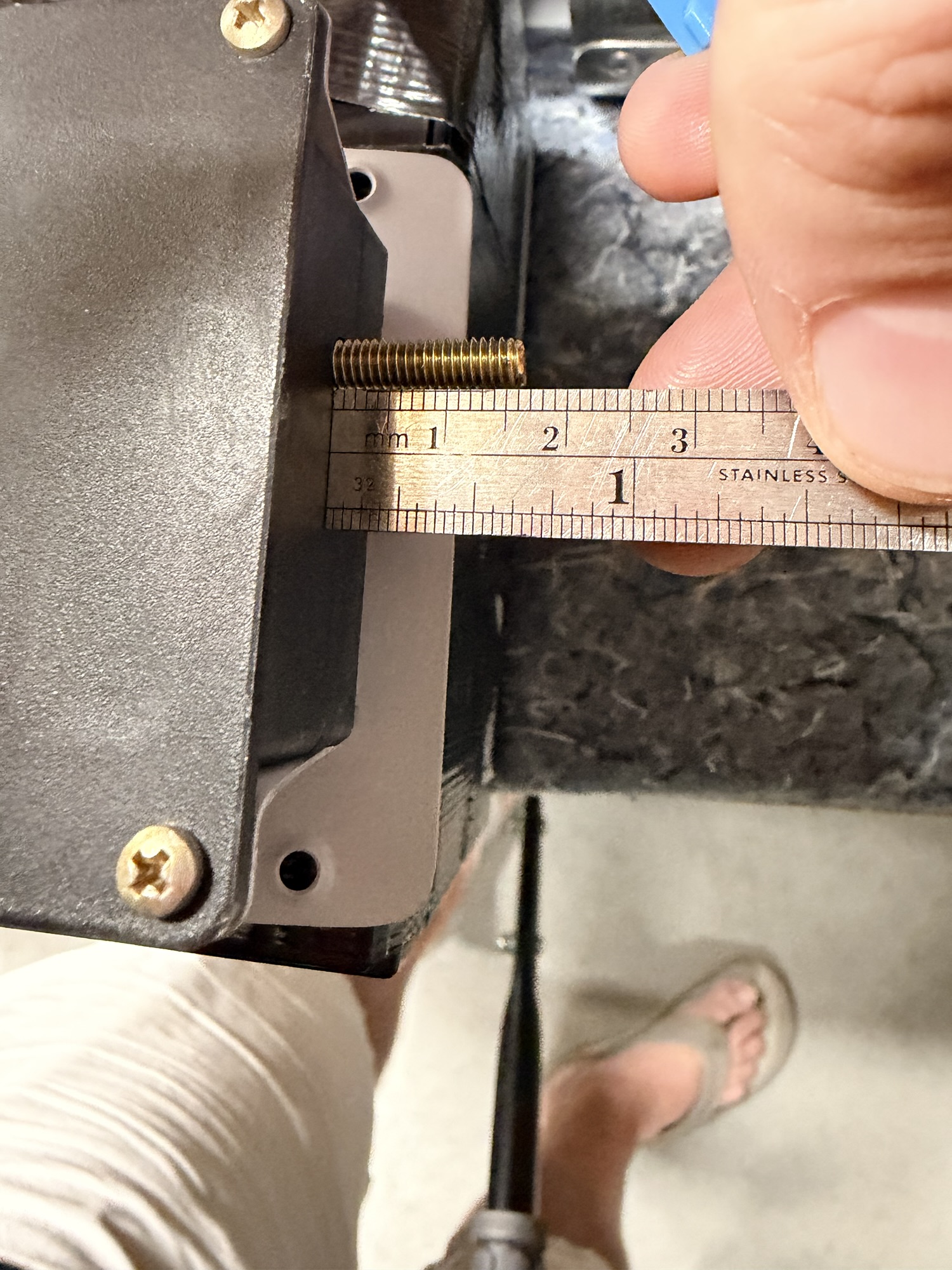
First, let's run the motor all the way up (jackscrew away from tab, tab goes down, forcing the elevator trailing-edge up) and measure.

img_2386.jpg


16 mm

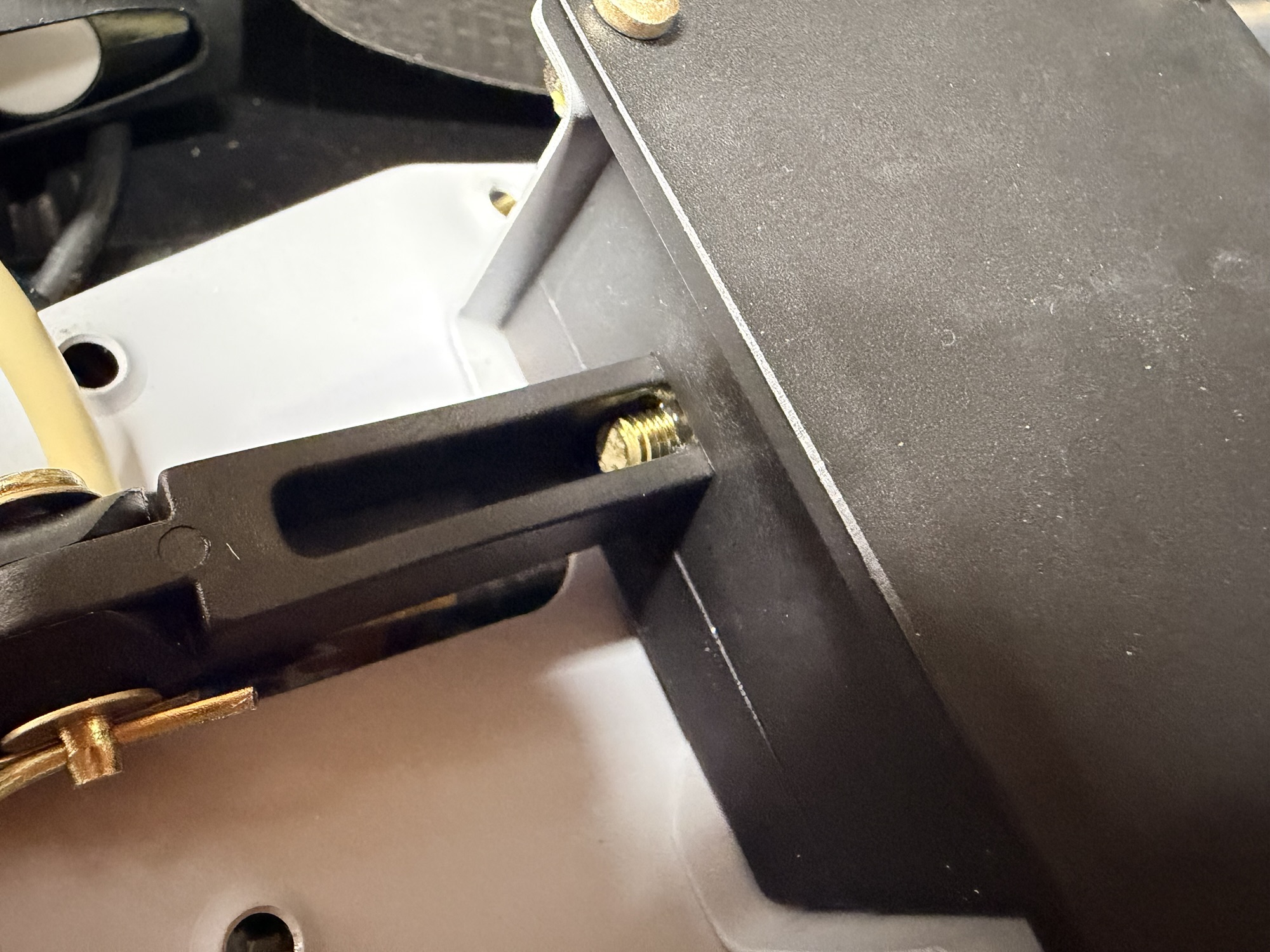
Then let's run it all the way down (jackscrew towards tab, tab goes up, forcing the elevator trailing-edge down) and measure.

Well, "measure" here meant estimating it's total travel once the side pictured above (not below) went sub-flush.

img_2387.jpg


I guessed another 4 mm.

So 20 mm of travel, so I want to rig when it's 10mm away from one of the stops. 16mm protruding, minus 10mm is 6mm.

I moved the motor using an old battery until the jackscrew was 6mm protruding, then screwed the clevises in both sides of the pushrod, then measured from the center of the tab hole to the center of the clevis hole.

It was 92mm too long.

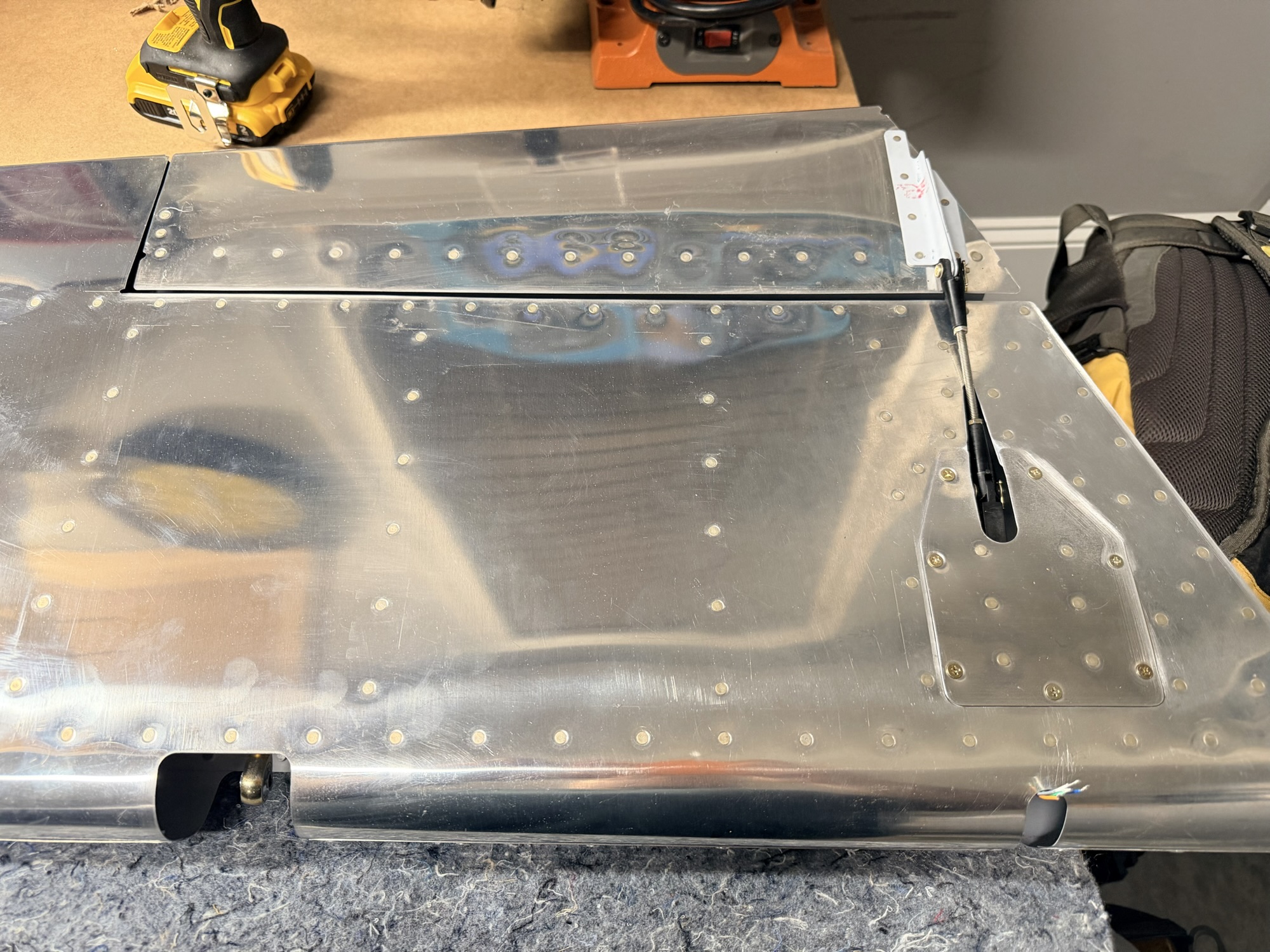
Removed the clevis, trimmed the pushrod by 92mm, reinstalled the clevis, used a small clamp to fair the tab, and attached.

img_2388.jpg


Looking good!

1.0 hour tonight. A fun hour.
 
April 20, 2026 - Started Fiberglass Elevator Tips

With not much left in the empennage, I decided to start in on the fiberglass tips. I skipped this part of the RV-7 build, so this was a little new for me.

First up, position the tips perfectly, then slowly matchdrill to #40.

img_2396.jpg


Matchdrilled.

Then, up-size to #30 (for a #6 screw). I know this should be a #28, but it's going to be dimpled, so it's close enough for now.

img_2398.jpg


Upsized.

Then, a duplicate picture!

img_2399.jpg


Another picture!

On the other elevator, I did the same thing. #40, then #30.

img_2397.jpg


Pretty colors.

0.5 quick hours tonight. But wading into the fiberglass wasn't as bad as I thought it was going to be.
 
April 21, 2026 - Attaching Some Empennage Tips with Screws

Whoa, today was a fun day in the shop. After yesterdays matchdrilling of the elevator tips to the elevators, I decided to keep pressing ahead with attaching nutplates to the tips to allow them to be screwed on.

After drilling, I used a throwaway K1000-06 nutplate to drill holes for flush rivets, then got them riveted in place. Here's an in-progress shot of some nutplate riveting.

img_2418.jpg


NO rivets yet, just showing you my setup.

After riveting, I used the nutplate as a guide for countersinking the tip.

img_2415.jpg


Nice countersinks here.

Then, I screwed the tip in place.

I am REALLY happy with how these turned out.

img_2416.jpg


I'm glad these are removable.

Here's the other side of that elevator.

img_2417.jpg


The in-progress picture above was of the left elevator, and this is clearly the right. I wonder if I mixed up the picture order...

More countersinks for you.

img_2419.jpg


These will accept the #6 dimples in the elevator skin nicely.

Oh shoot. I ordered fifty K1000-06 nutplates and #6 screws. That clearly wasn't enough.

e1776904042996-1024x768.jpg


Every other hole will have to do until I can get some more in stock.

Let's move on to the rudder and vertical.

First up, I need to attach some nutplates to this strap that will hold the rudder counterweight in place.

img_2421.jpg


NAS1097 rivets worked very nicely here.

With the counterweight in place (where's the picture, dude!?!?!), I moved on to trial-fitting the rudder tip.

img_2422.jpg


It's a little too long.

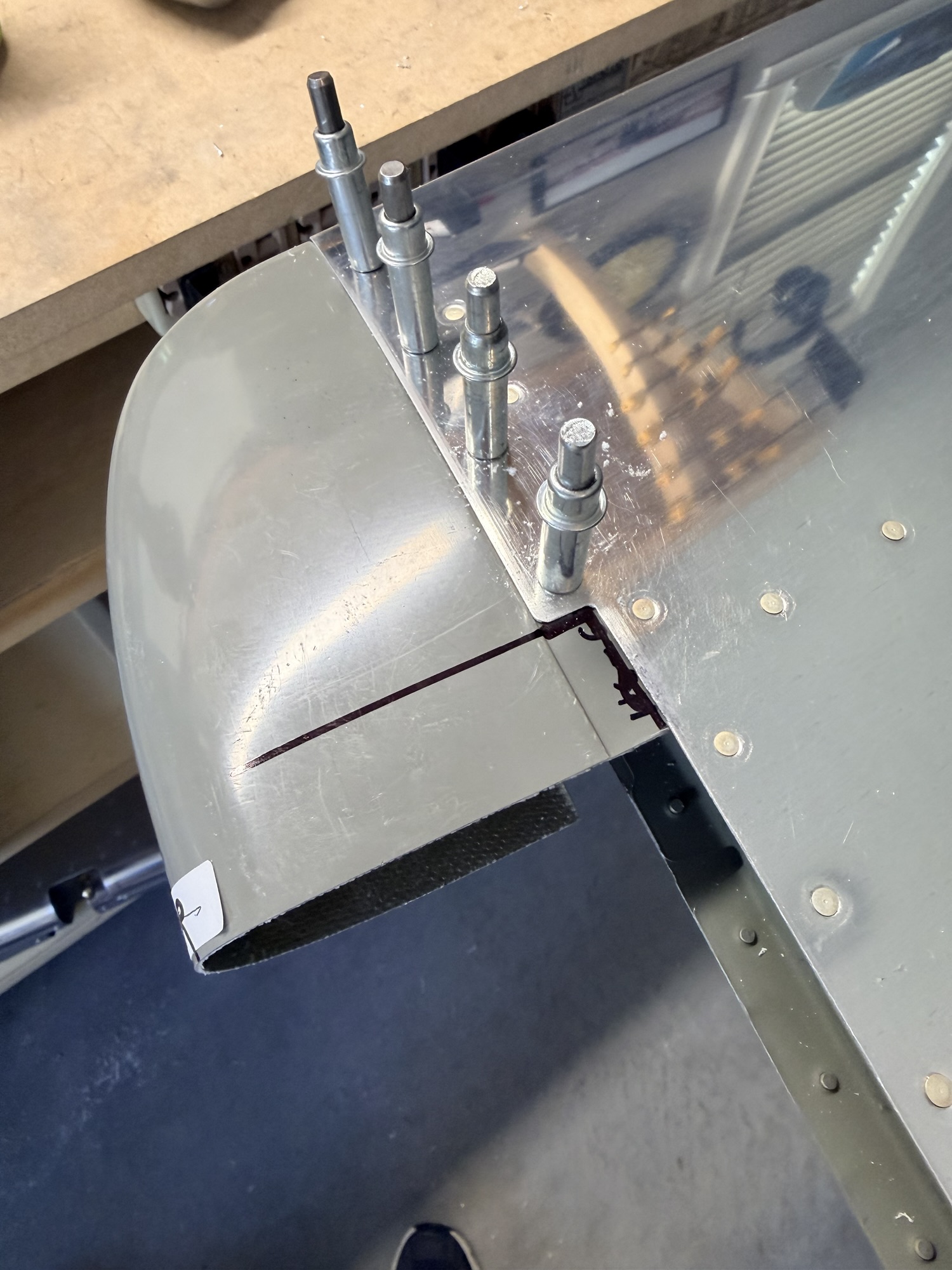
After some sanding and drilling, I got the vertical tip clecoed into place and the rudder tip at least nested.

There is quite a big difference in height here, but I hear a lot of people have to work additional layer of fiberglass to make them line up.

img_2423.jpg


The rudder tip is a little shorter than the vertical tip, but I'll add some layers of glass to even them out when I'm final-fitting to the airframe.

Let's do the nutplate trick on the vertical stabilizer (because that's exactly how may nutplates I had left.

img_2424.jpg


Nice countersinks again!

3.5 hours today. 1.0 against the vertical, 0.5 against the rudder, and 2.0 against the elevators. 36 rivets for each elevator tip, then 16 more for the vertical tip. 52 total. 2 drilled out.
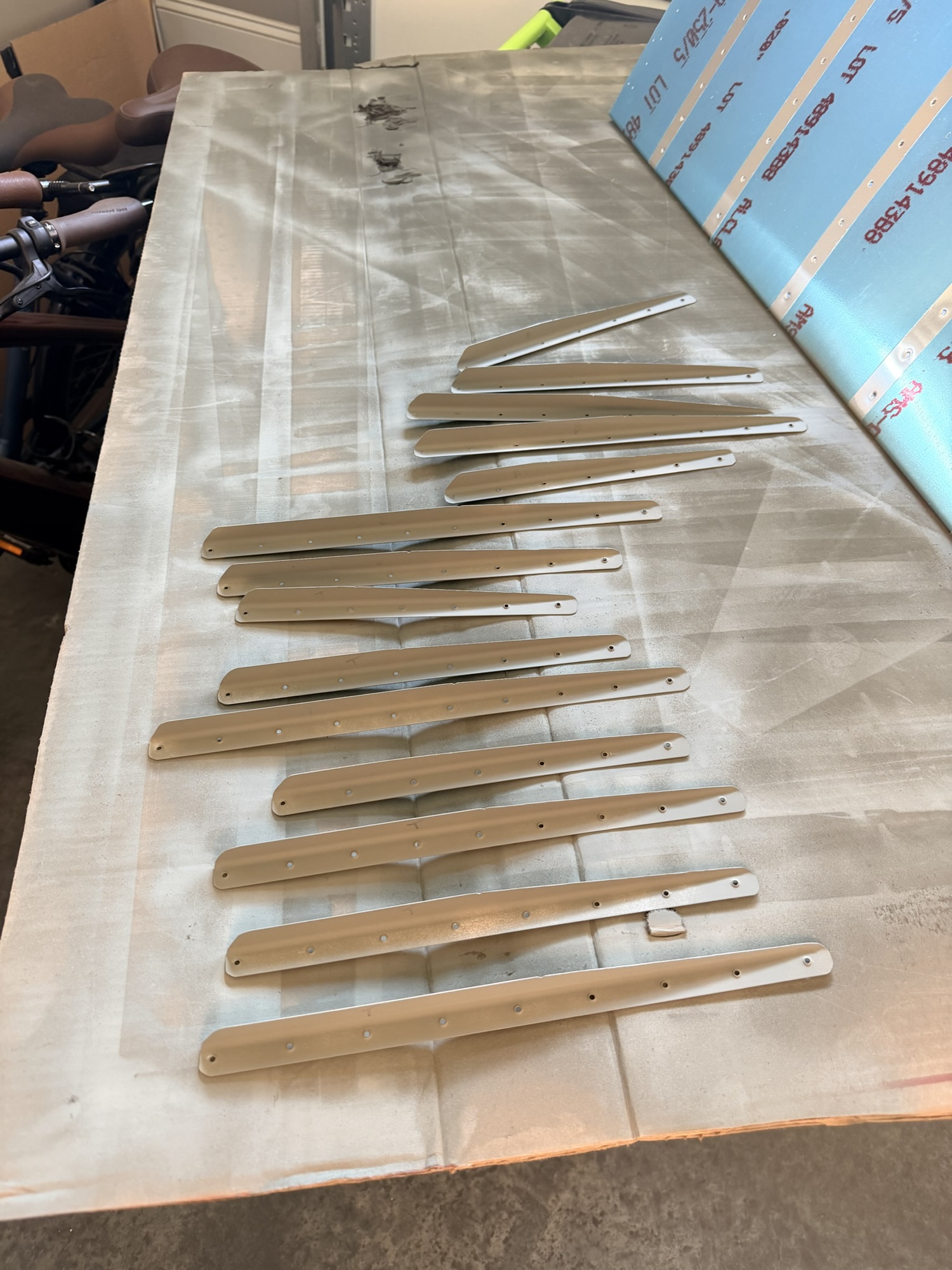
 
April 22, 2026 - Horizontal Stabilizer Tips and Travel

Another really fun night in the shop.

With the elevators, vertical, and rudder tips done (oops, not the rudder bottom), I decided to get the horizontal stabilizer off the wall and start on it's 2 tips.

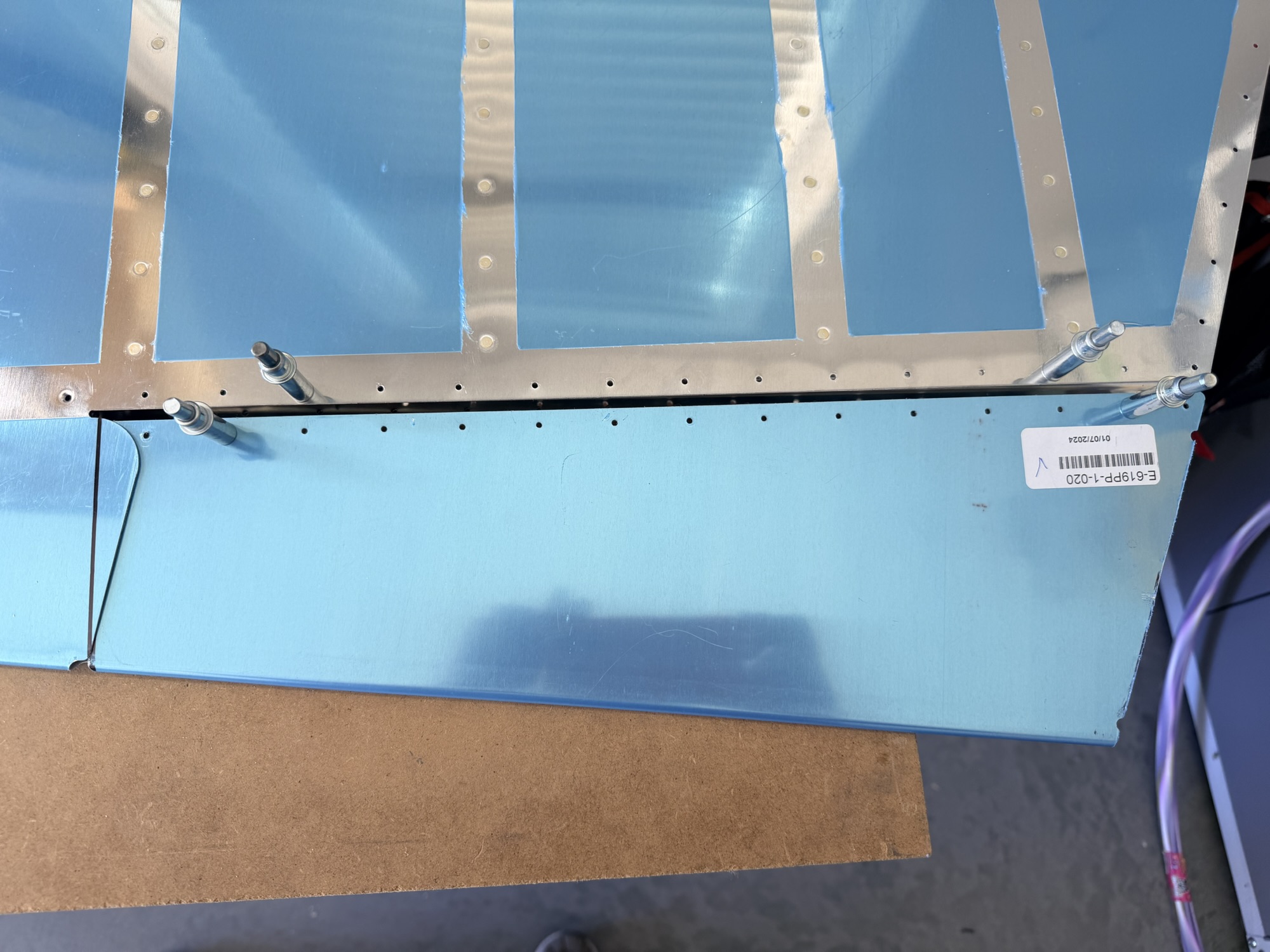
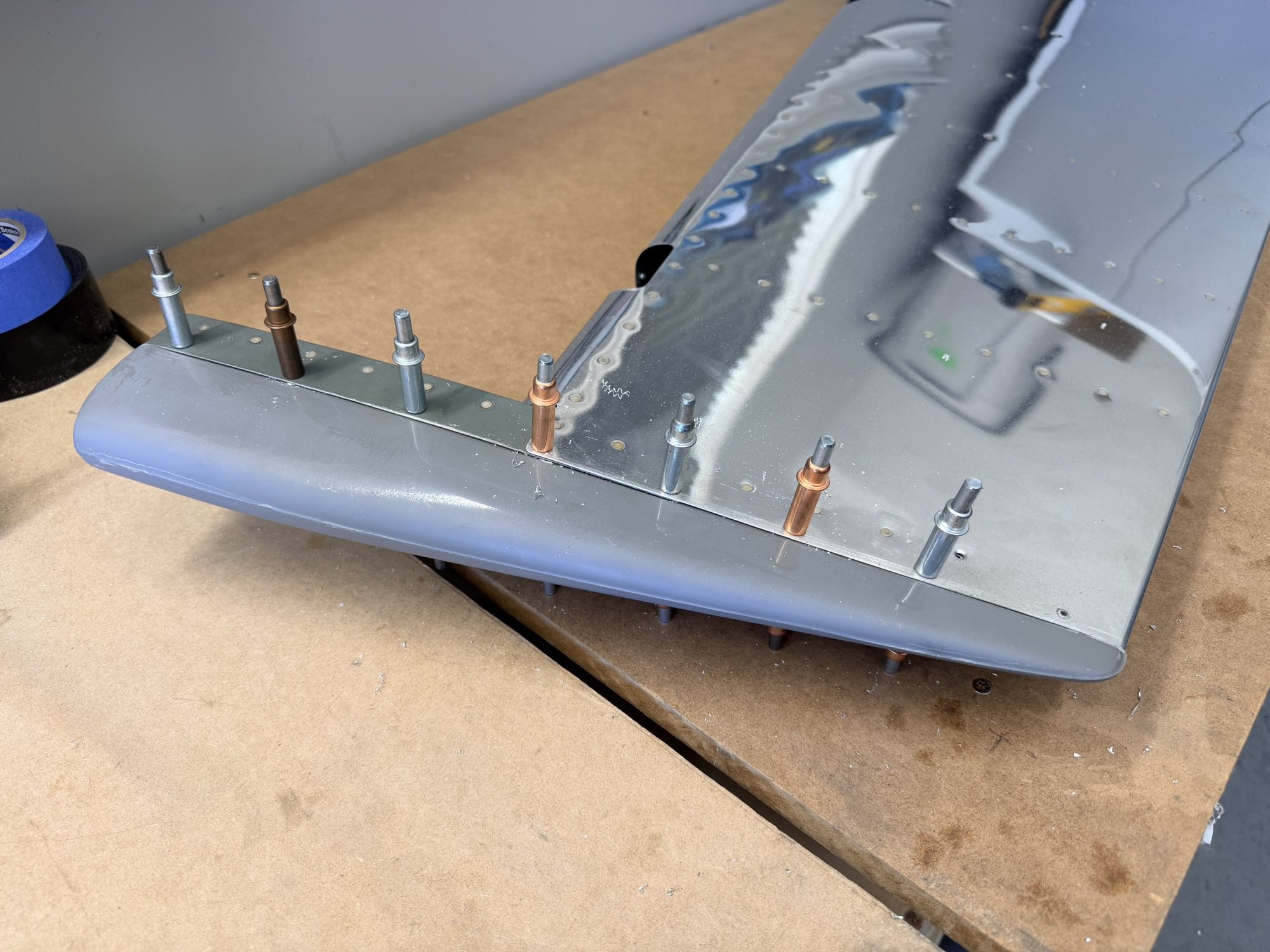
First up, you need to lay out and drill the horizontal for holes. Because this HS is used for both the -8 and -7, they have you trim the edge of the HS to allow for the elevators. Therefore, they can't pre-drill the holes and they leave it up to you to do.

I marked some edge distances, and used just shy of 1.5" for spacing.

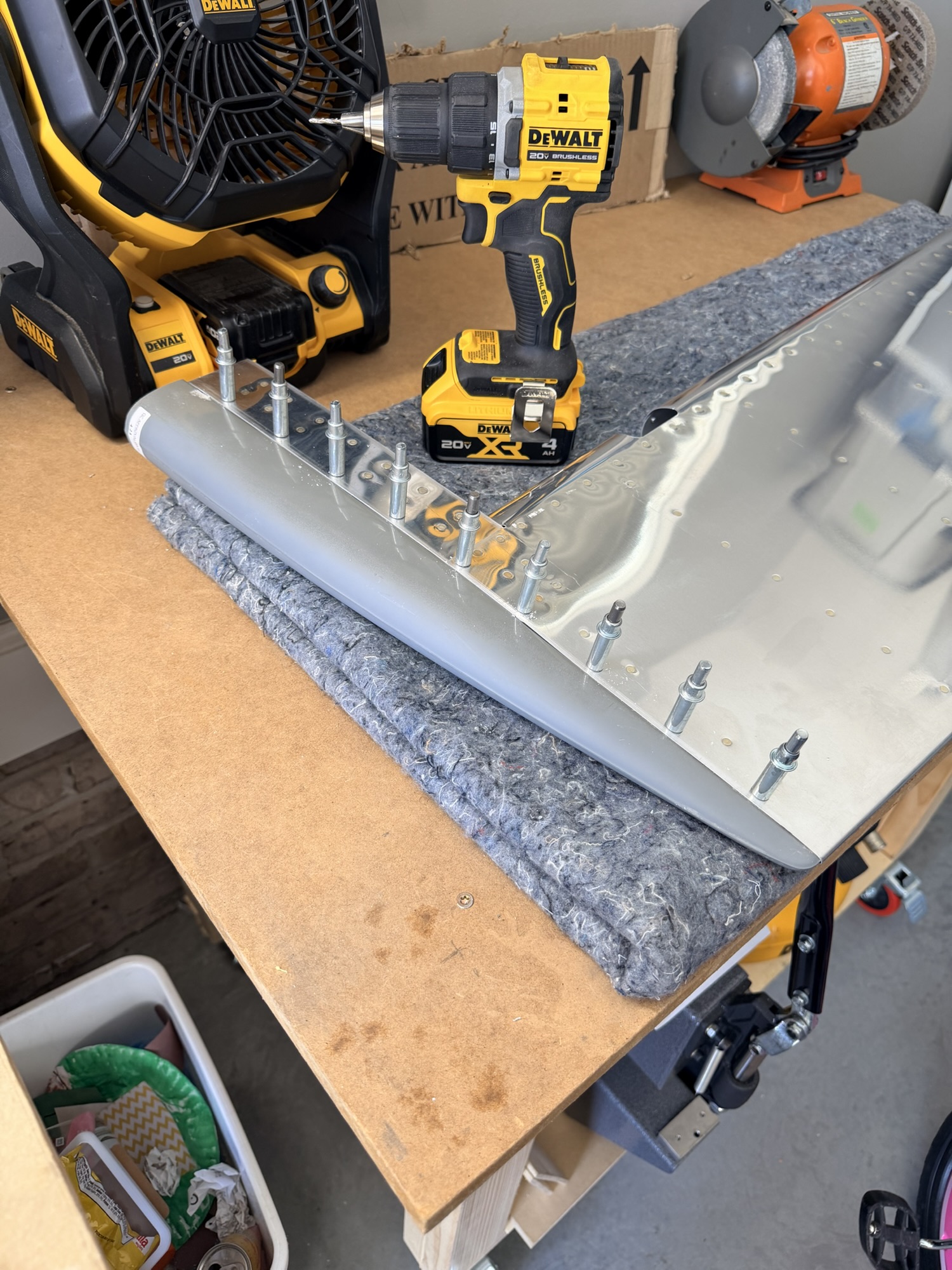
img_2430.jpg


I marked these with a fairly fat sharpie. Eh.

After drilling to #40...

img_2431.jpg


Ready for the tip!

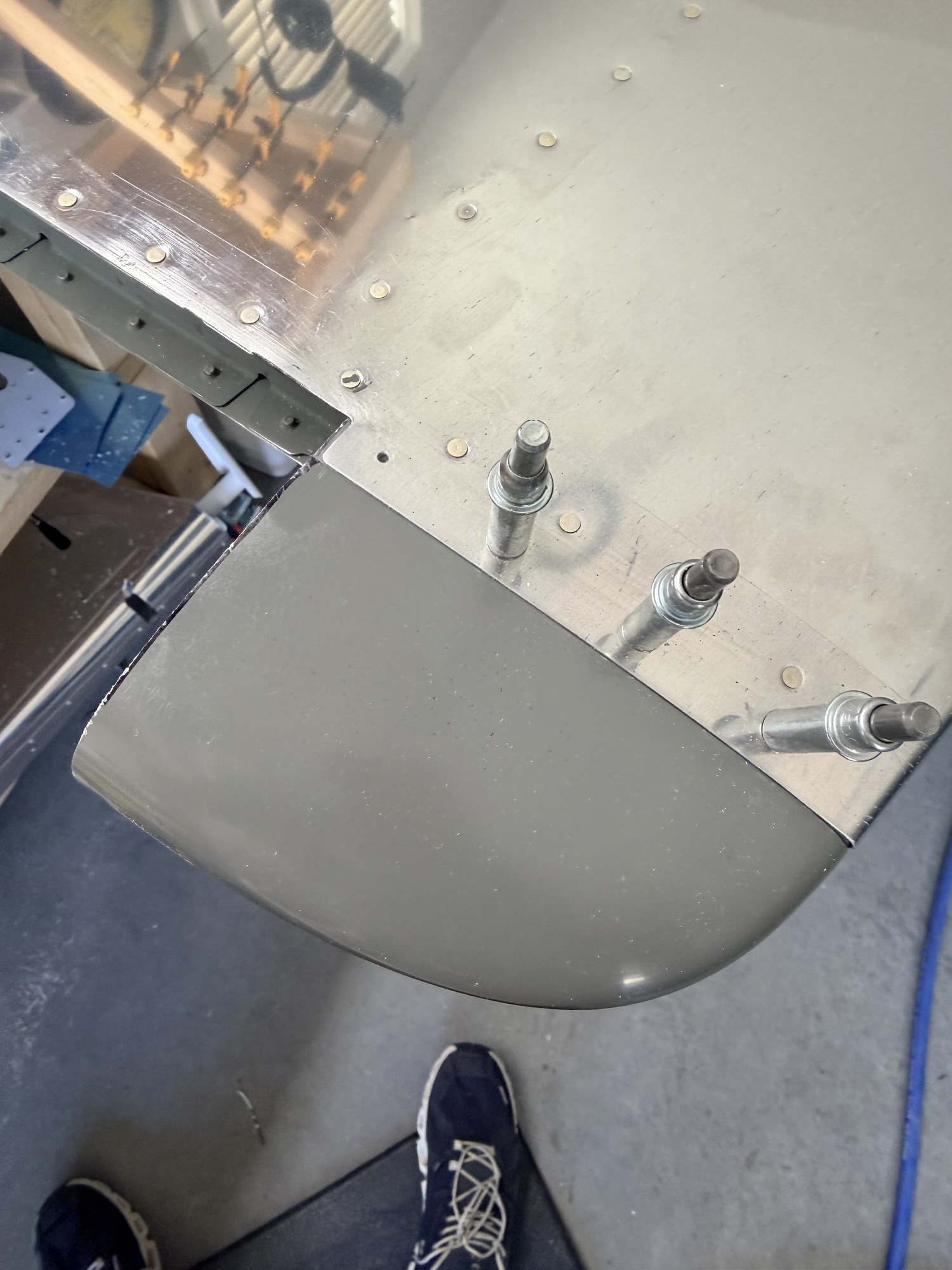
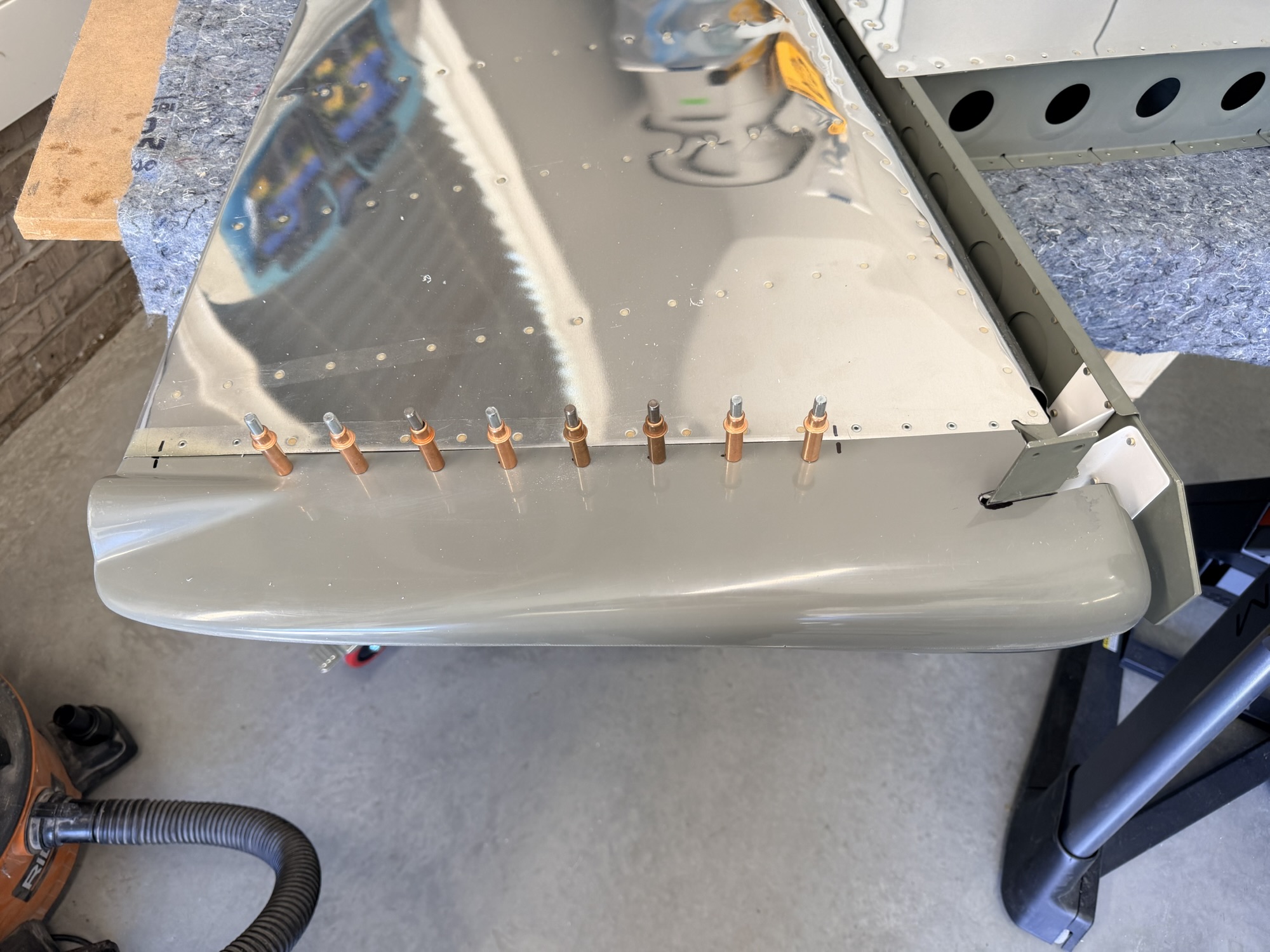
I then clamped the tip in place and drilled and clecoed to #40. (Apparently I also used a big square to mark a trim line on the tip.)

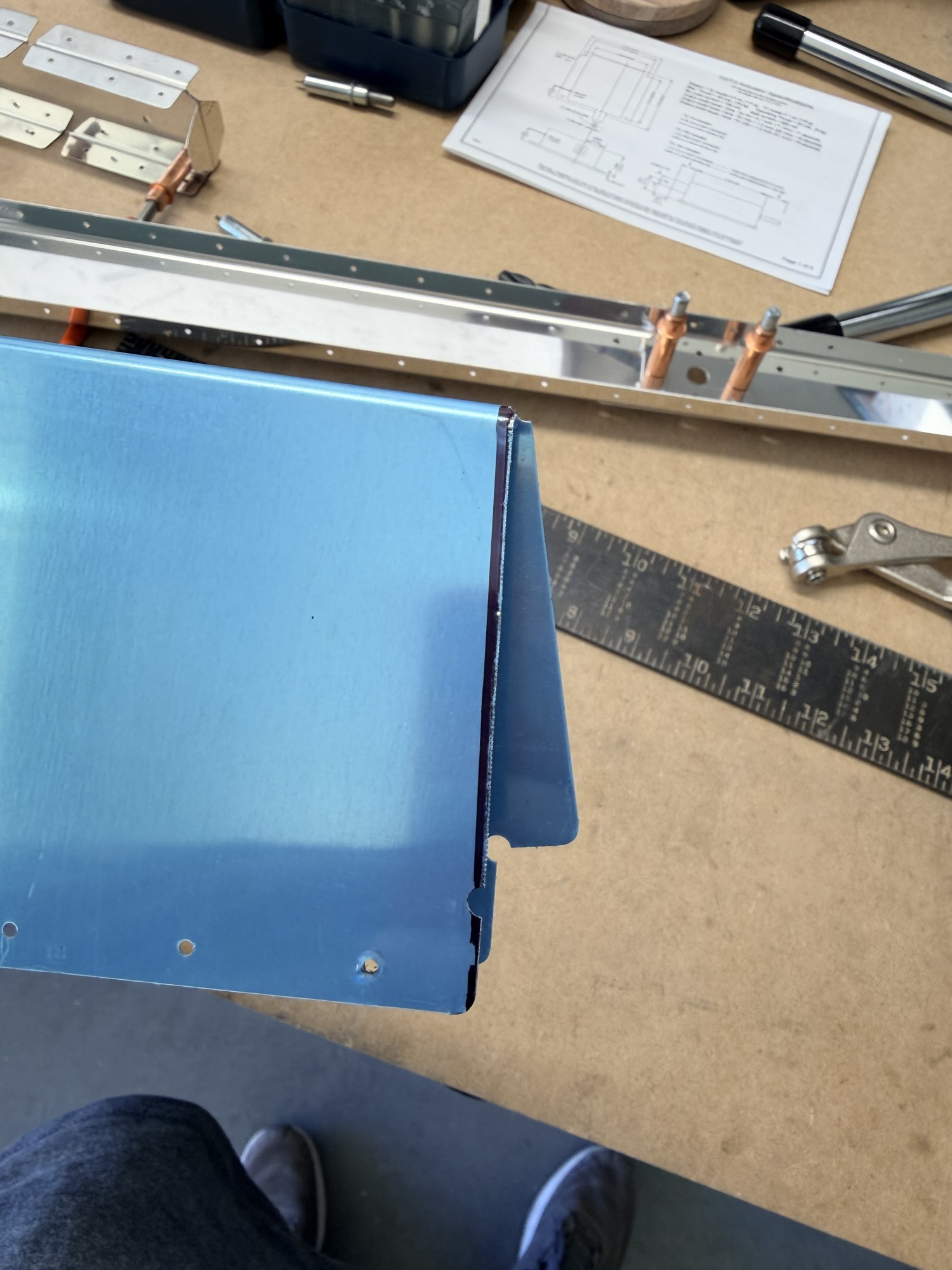
img_2432.jpg


Let's trim first, then drill to #30.

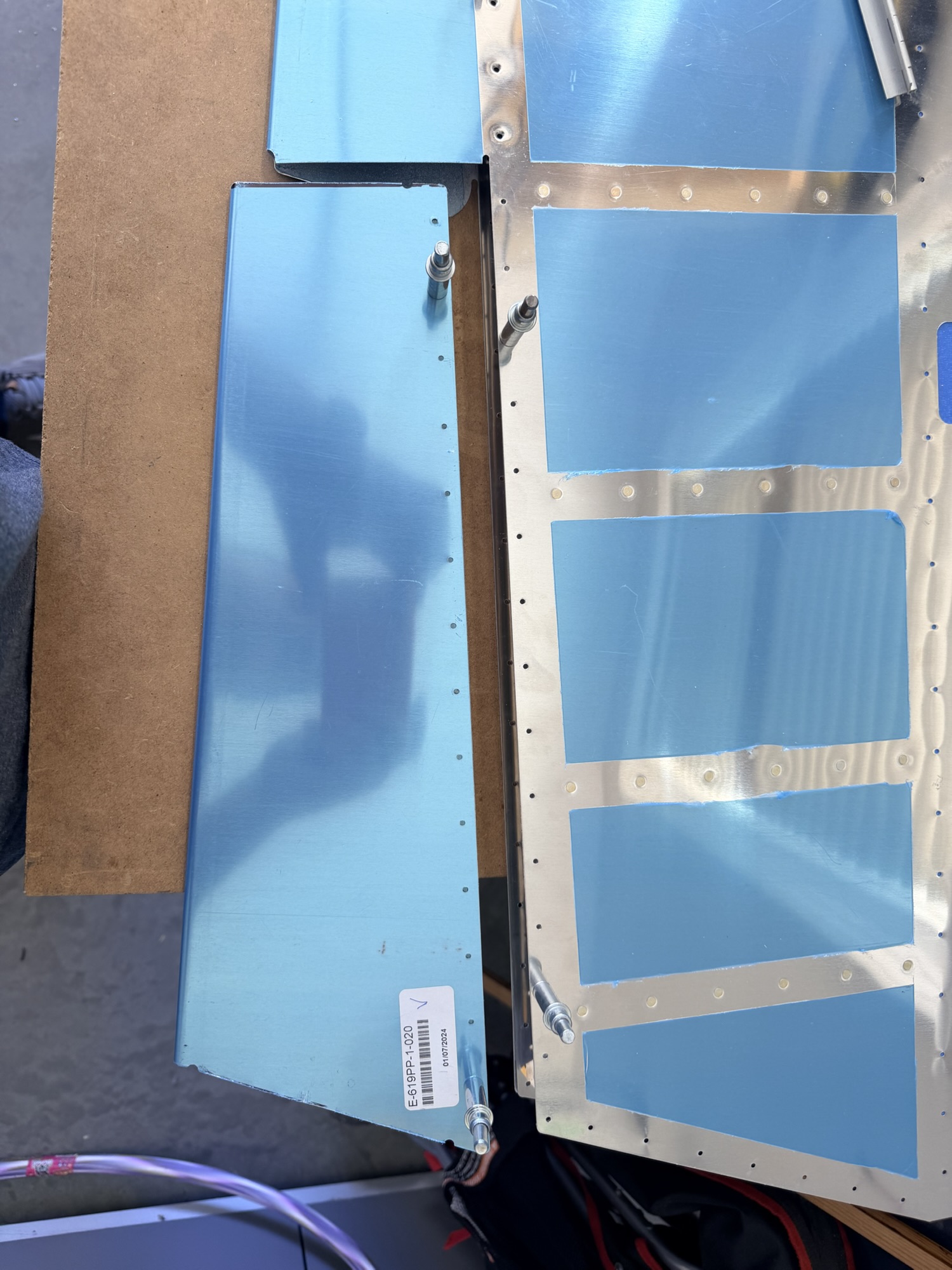
After some trimming and drilling of the other side...


Whose toes are those?
I guess we're back to the first side? Nope, this is the other tip.

Left tip this time.
Because I don't have the nutplates and #6 screws to finish that job, I moved on to mounting the elevators again to work on travel.

Here's the elevator clamped in trail (or "0" degrees).
A quick check on the manual tells me that I need somewhere between 20 and 25 degrees of down elevator.

No comment.
Okay. Brace yourself for some math.
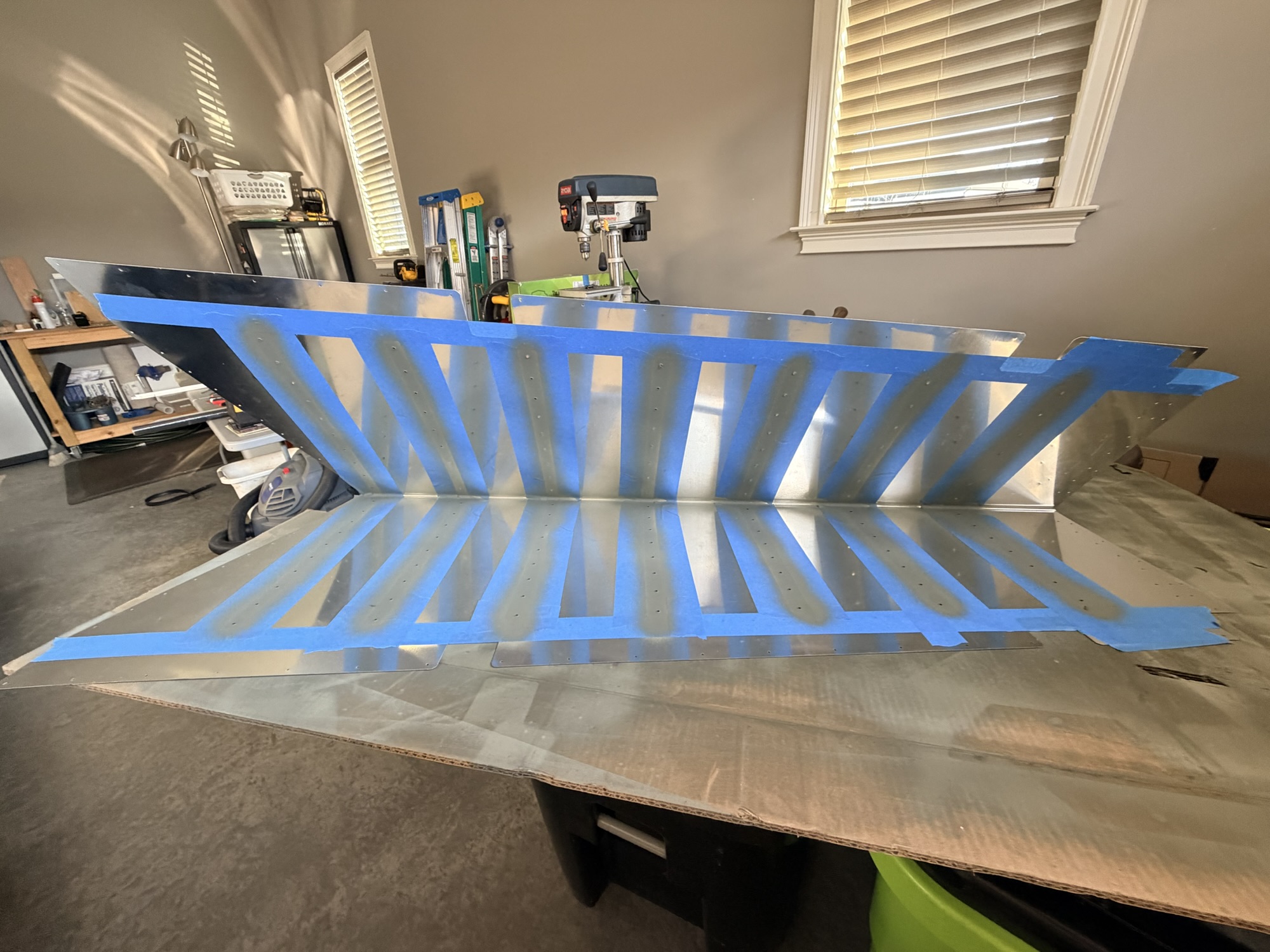
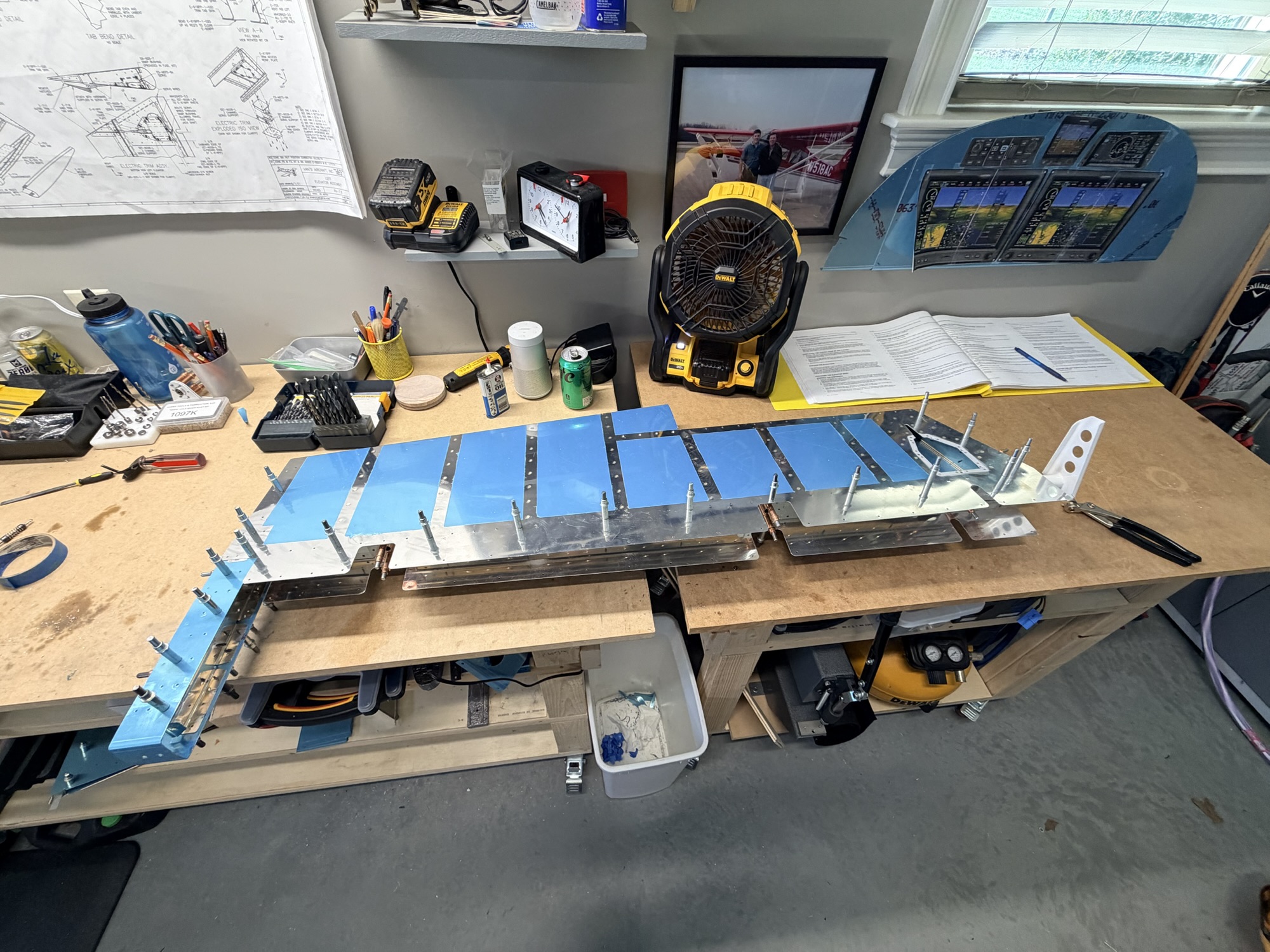
When the elevators were in trail (0deg travel), there was 7/16ths of space between the horn and the lower flange of the HS rear spar. My iphone measured this as -7deg.
When I let the horn touch the flange, my iphone read 10deg, which translates to 17deg of travel.
Because I am aiming for 25 degrees, I need (calculator sounds) to cut the flange back by 3.3/16ths.

Math!
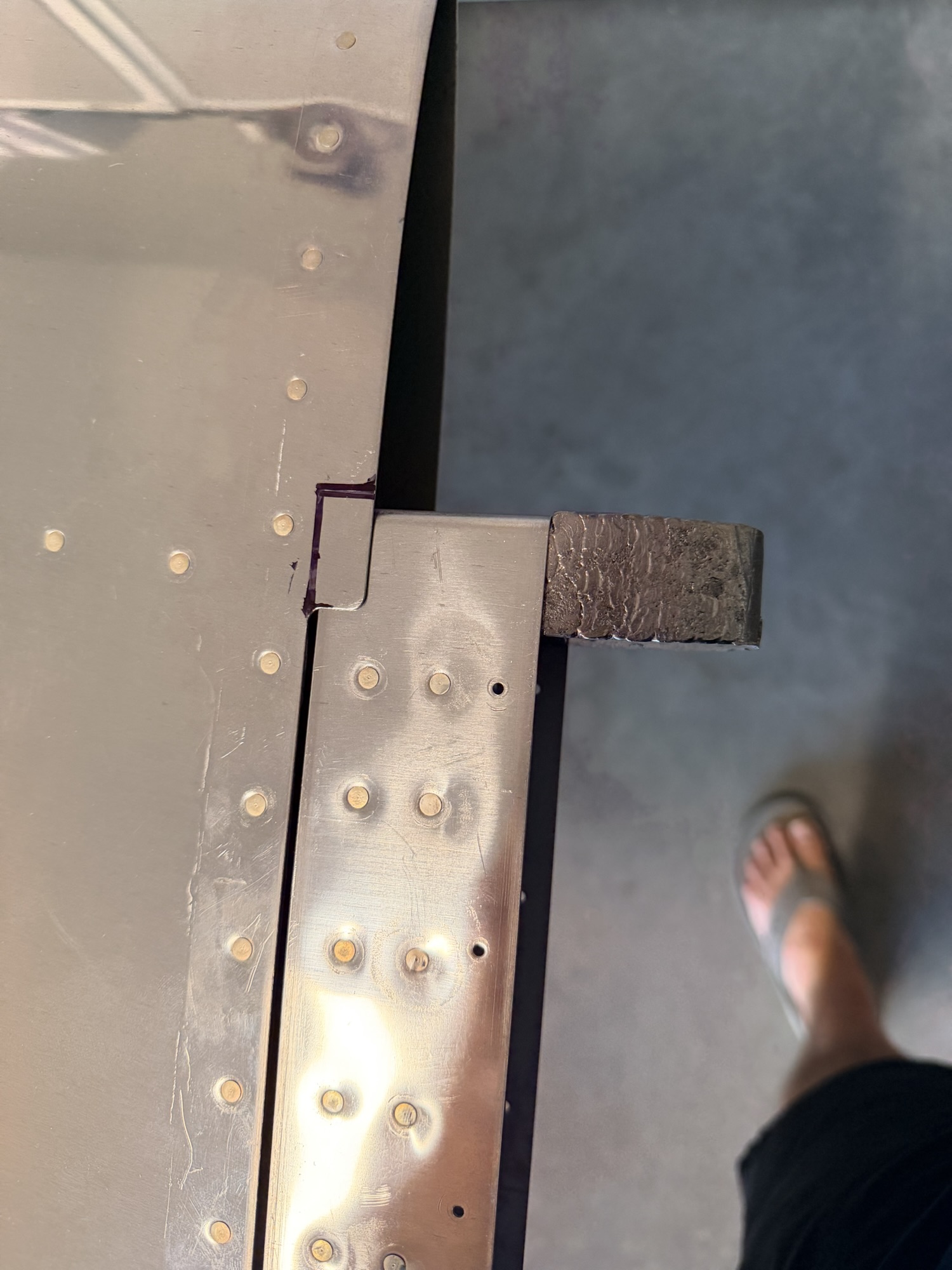
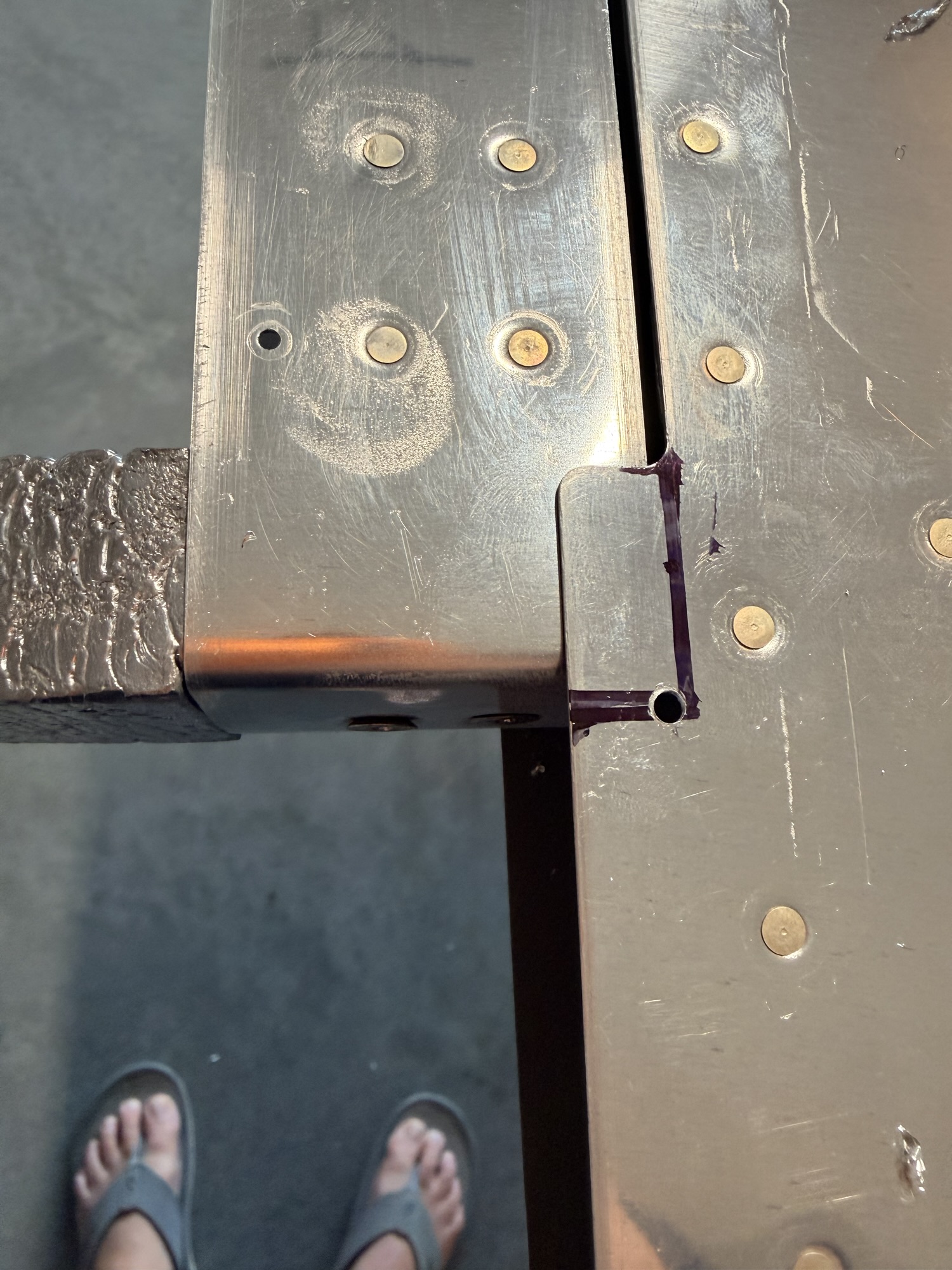
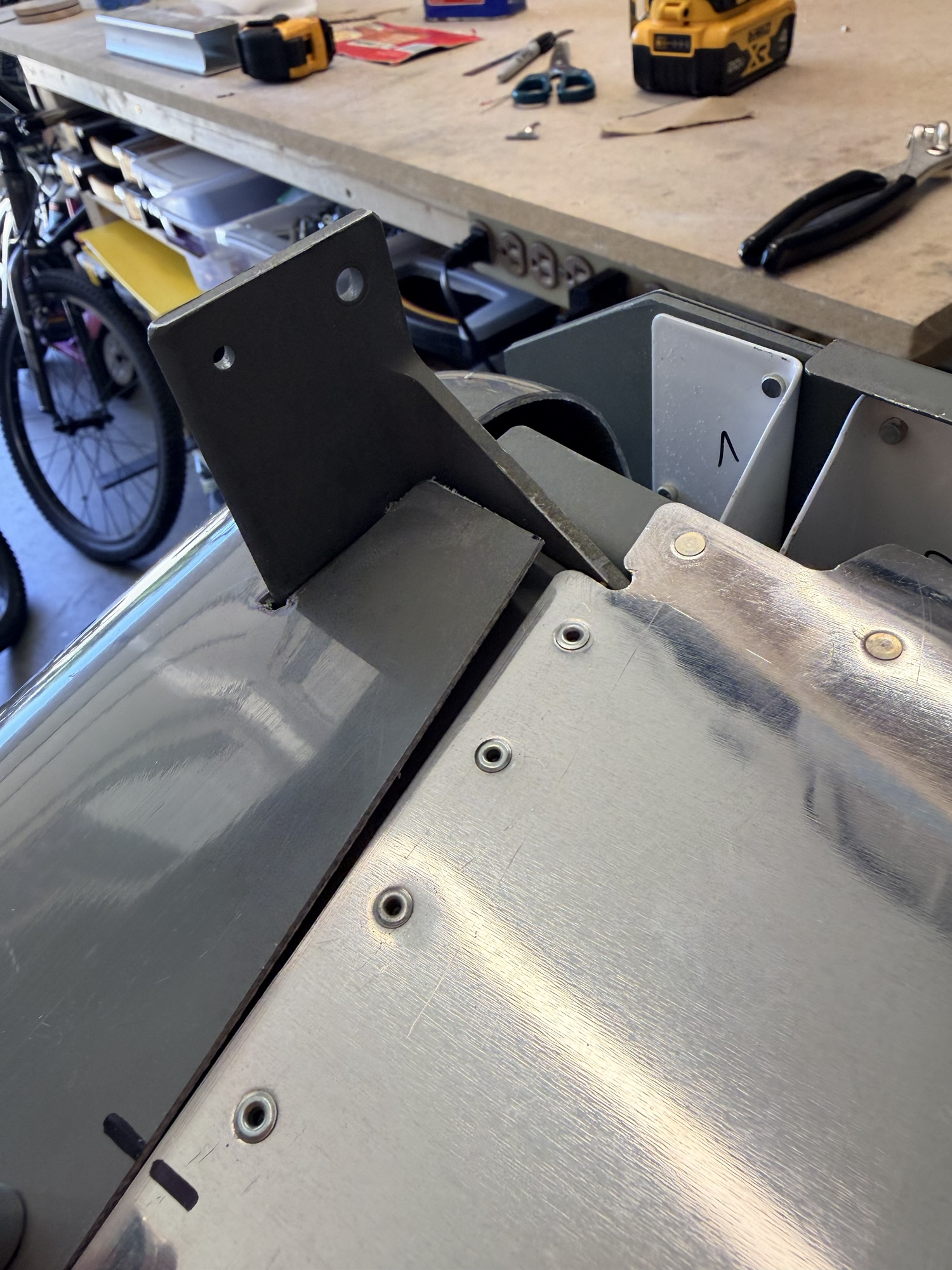
Fat sharpie marks on the flange let me drill some radii before making the cut.

Two holes. now where's that dremel!?
Then (holding breath), I used the dremel with a cutoff wheel to very carefully trim along my lines.
After a little cleanup with a file...

That looks pretty good.
Let's see how it looks in the elevator-down position.

Heck yeah!
Now for some more math. After repositioning the HS and elevators, I measured from in trail on both elevators (iphone measured -8deg), I let the horns rest against the new flange cutout, and the iphone read 16 deg on both elevators.
THAT'S 24 DEGREES OF TRAVEL!!!! Perfect!
I had to stand back and admire my work.

It looks pretty!
But it felt a little precarious on the bench, so I went ahead and got it up on the wall for safekeeping.

A WORK OF ART, if you ask me.
I'm kind of running out of stuff to do until the wing kit arrives.
I can finish the tip attachment when the new screws and nutplates come.
2.0 hours on the horizontal stabilizer. No rivets today.
 
Last edited:
Very nice. I'm thinking of rebuilding my elevators, the horns don't completely match the stab even though the elevator surfaces are aligned. I think it has to do with the attachment of the rib tip or a twist induced by riveting. I wasn't the builder so I think it would be a fun project.
 
Very nice. I'm thinking of rebuilding my elevators, the horns don't completely match the stab even though the elevator surfaces are aligned. I think it has to do with the attachment of the rib tip or a twist induced by riveting. I wasn't the builder so I think it would be a fun project.
I already know that feeling, but with my rudder. I’m already such a better builder today than I was when I built it that I’m thinking I’ll follow in some builders’ footsteps by rebuilding a control surface or two near the end of the project.
 
IMHO this super detailed build log is a gift to the community, as it gives a very good insight in what it takes to build such an "early" kit, thanks for that, and I will certainly direct the RV-8 builders around here to have a look, the more so if it's their first project.

On another note I'm surprised, given your experience, at the amount of rivets that would not pass muster during one of my inspection, mostly marked rivet heads. Admittedly I do have different views on quality than other people might have.
From a distance (quite a long one as it is 😅) it seems not enough pressure being applied to the gun side whilst riveting, and/or the set not being fully square to the piece/rivet head. Another cause might be air pressure not properly set. Also there are many kind of tape available to apply to the set's head, I just used painters tape, cheap, easy to tear off, replaced every 3rd rivet or so, to also prevent the set end to jump off its ideal position.

Anyway, hope that doesn't sound condescending as that is certainly not my intent, good continuation, and thanks for openly sharing your experiences whilst building yet another of those wonderful machines.
 
April 23, 2026 - Rudder Bottom Fiberglass

The only empennage fiberglass tip I haven't touched yet is the rudder bottom. Over lunch today, I snuck outside to make some dust.

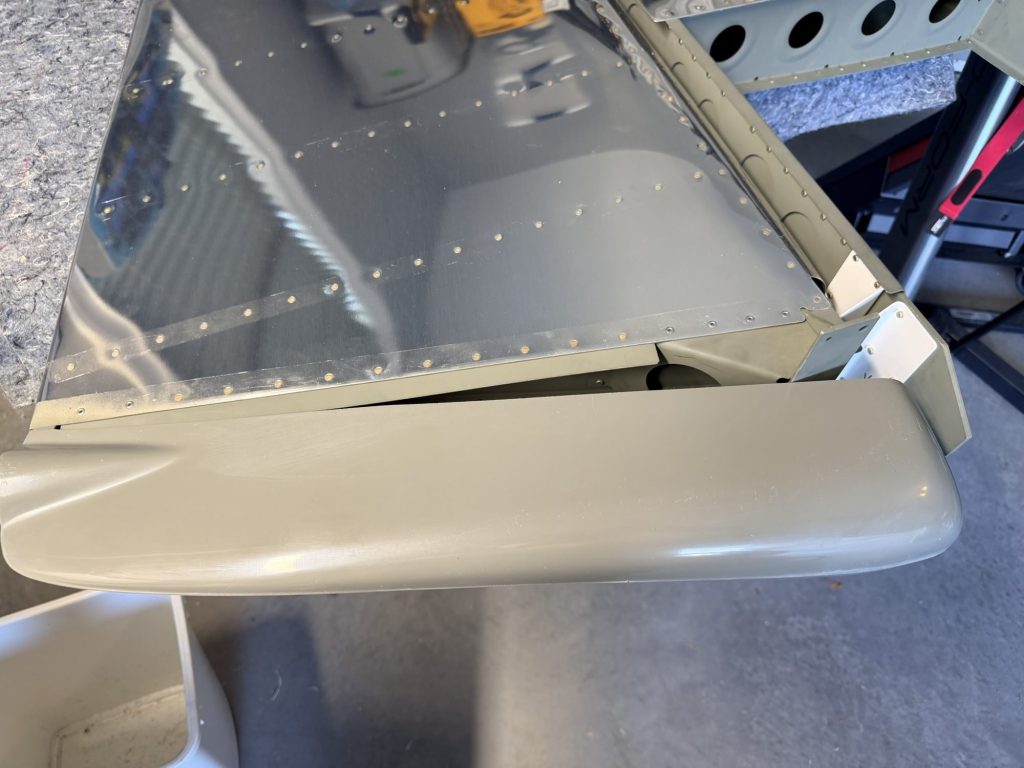
Out of the box, it looks like it's going to fit great, once I trim enough to fit around the rudder horn.

img_2447-e1776963264618-1024x768.jpg


It doesn't fit like a glove yet.

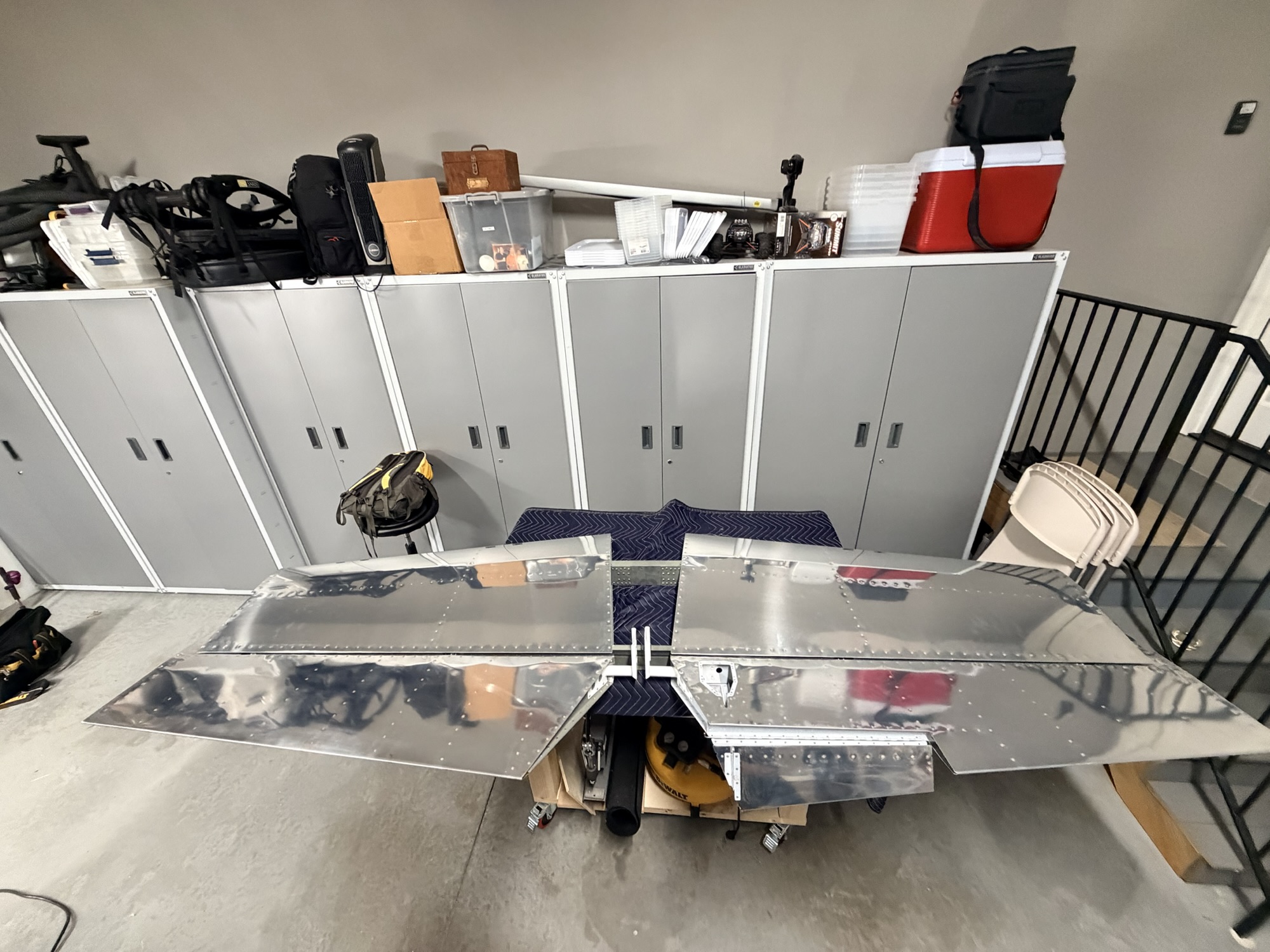
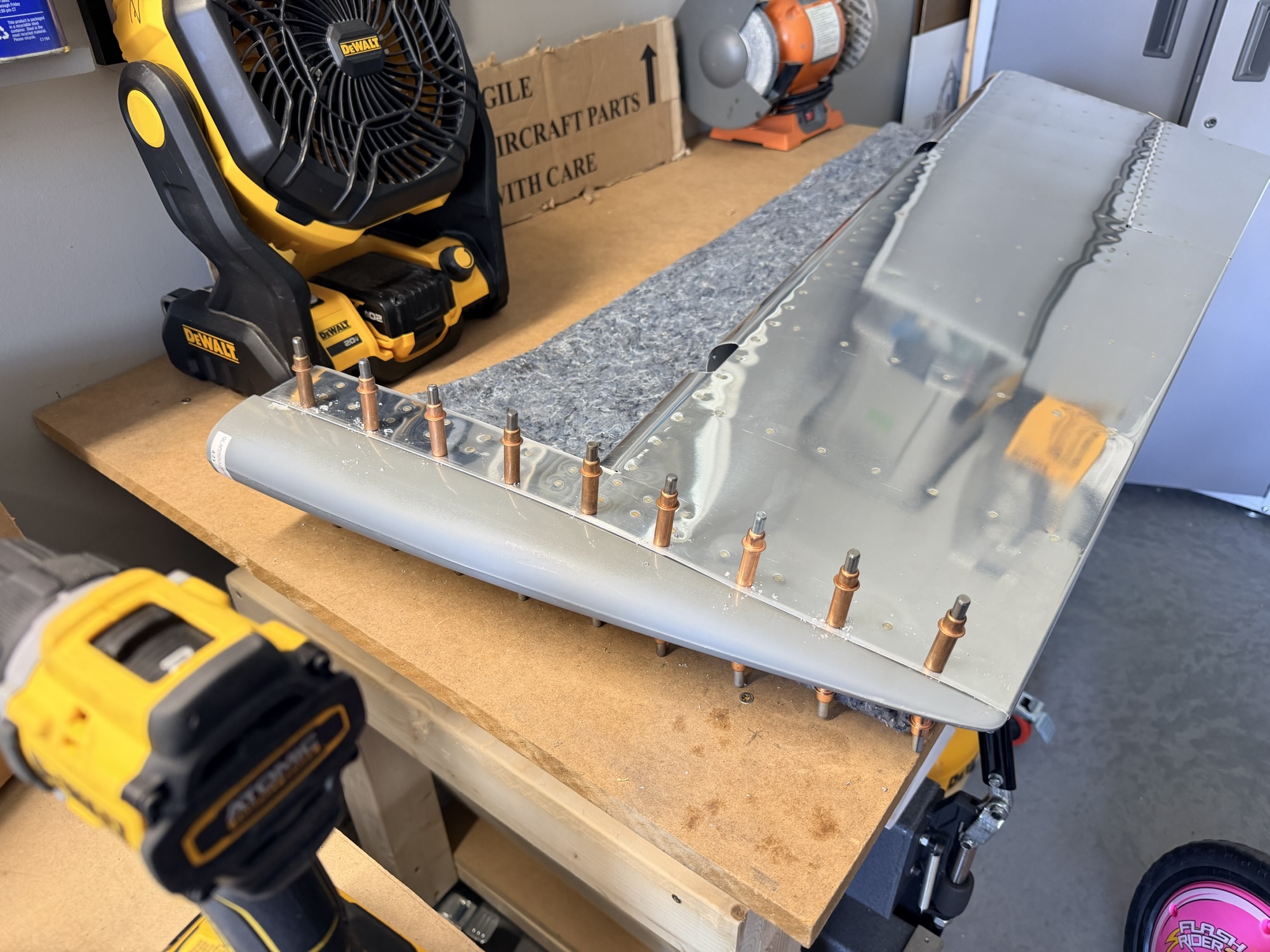
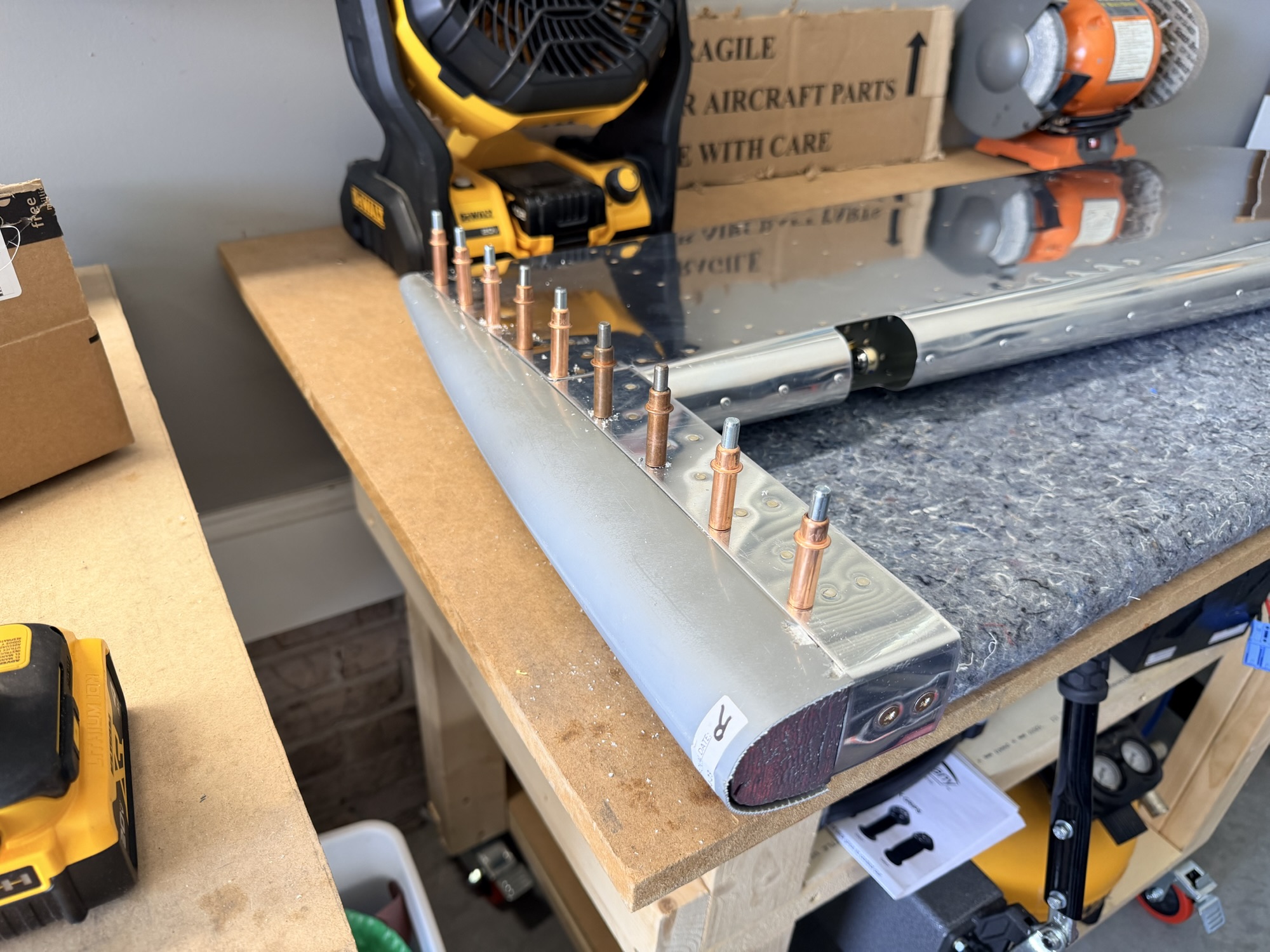
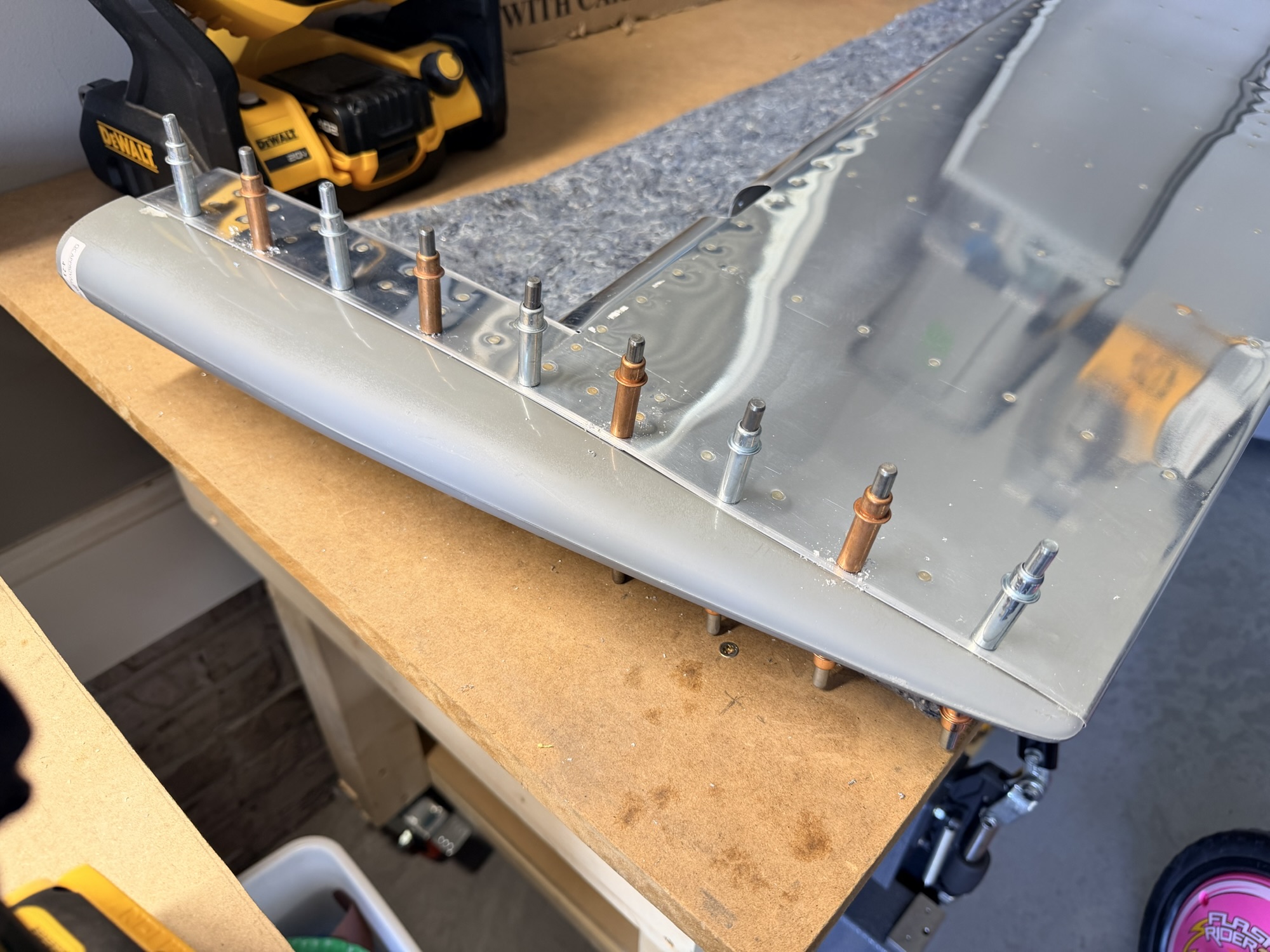
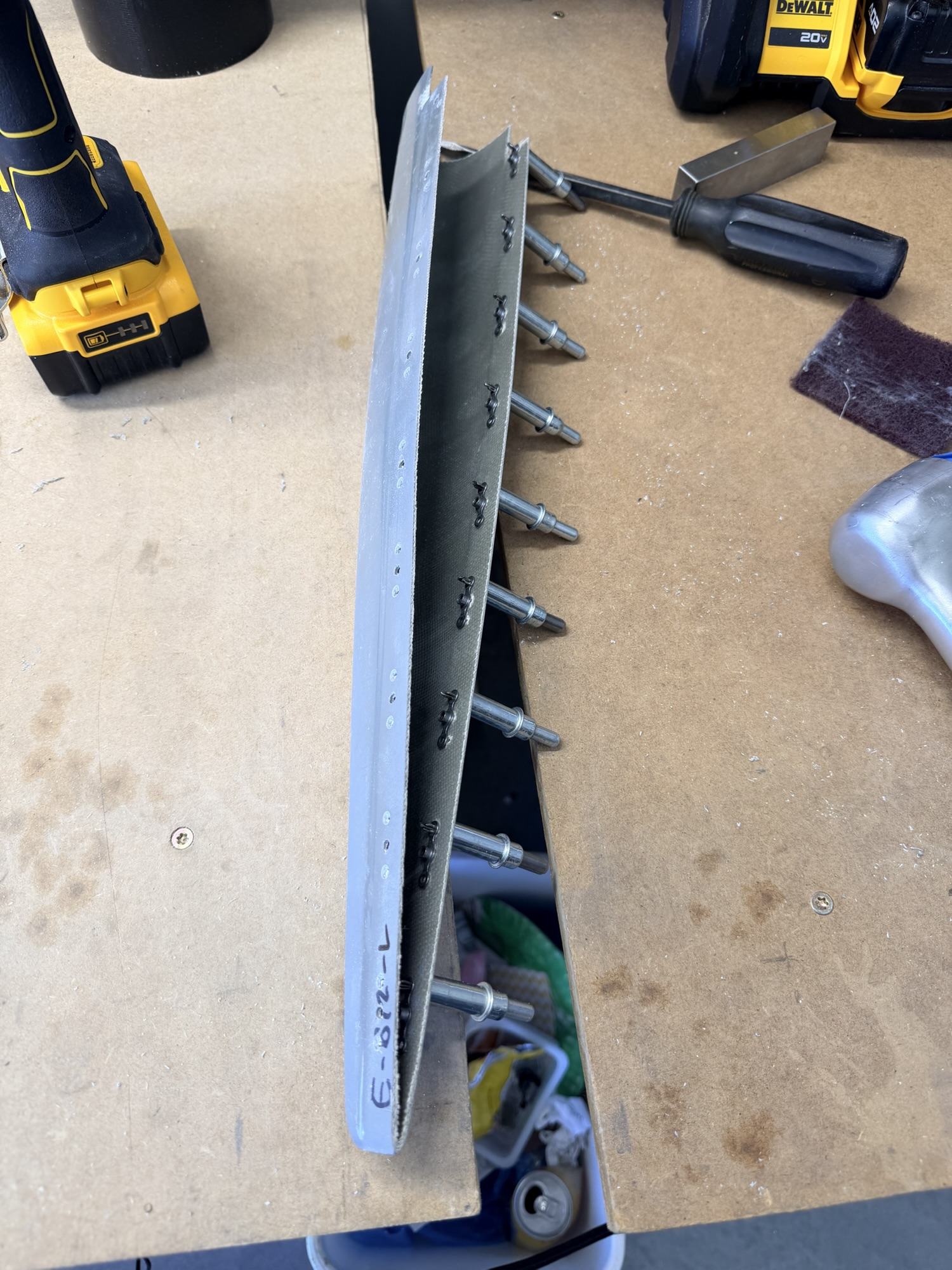
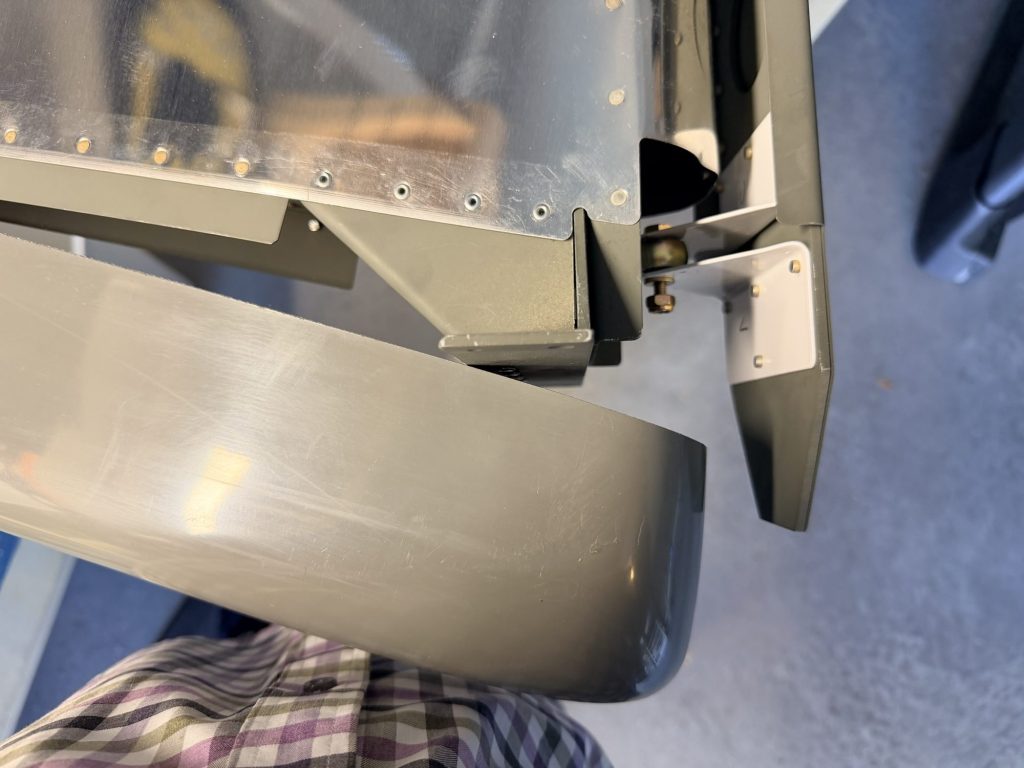
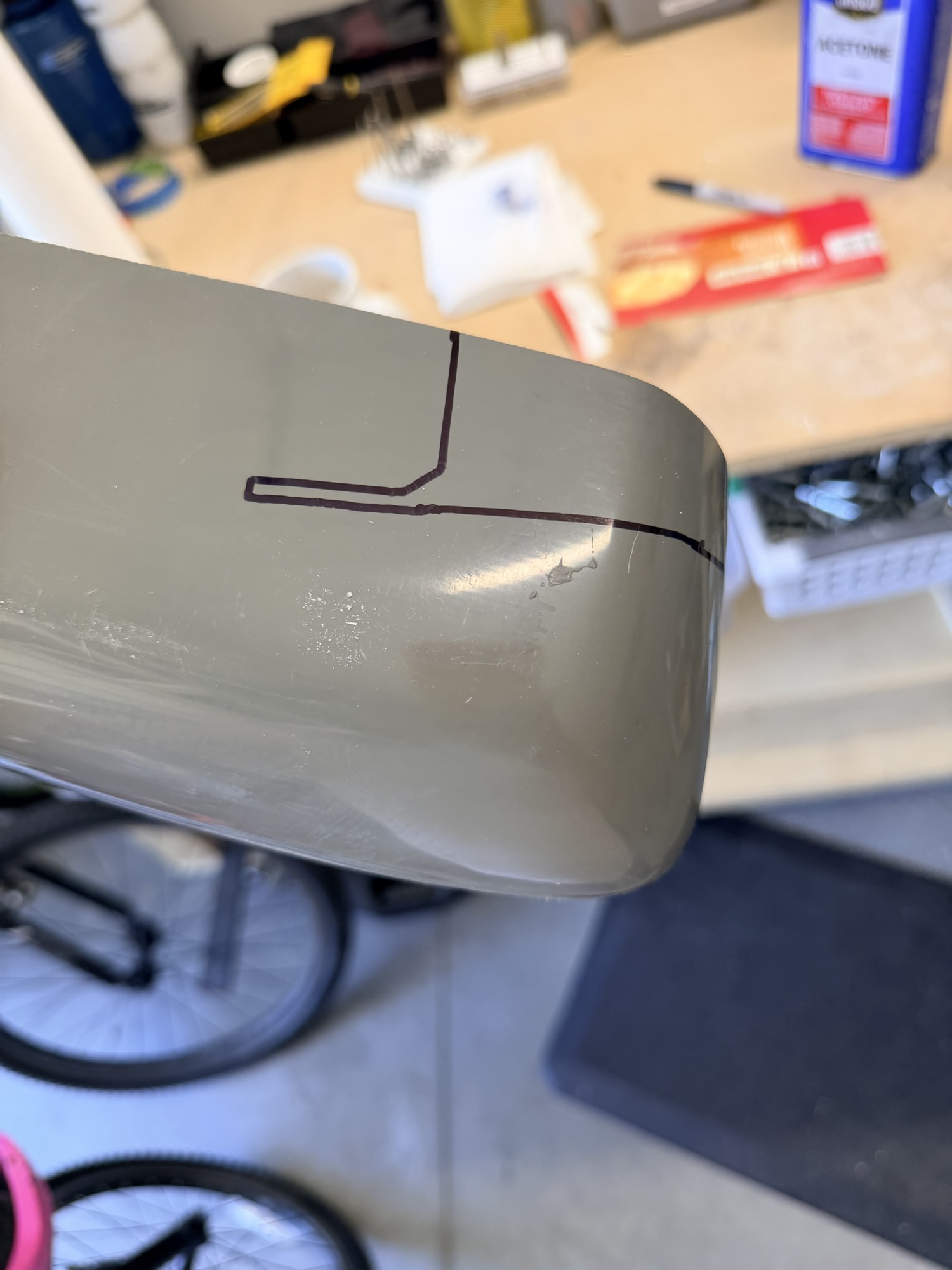
Here's a closeup of the angle I need to trim for.

img_2448-e1776963273609-1024x768.jpg


Where is that dremel tool?

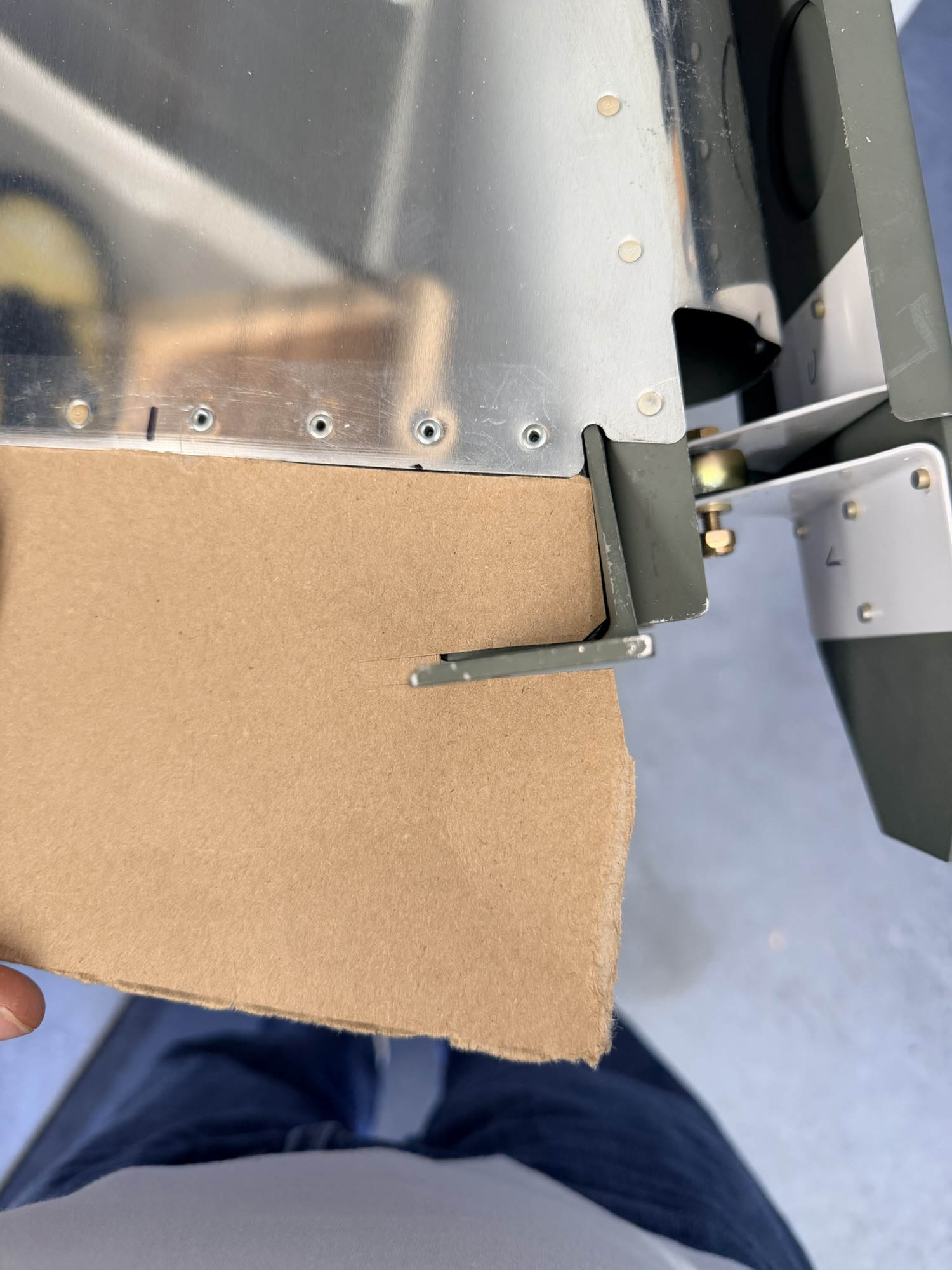
Let's make a cardboard template so I can transfer some cut lines.

img_2452.jpg


Close enough for the first cut.

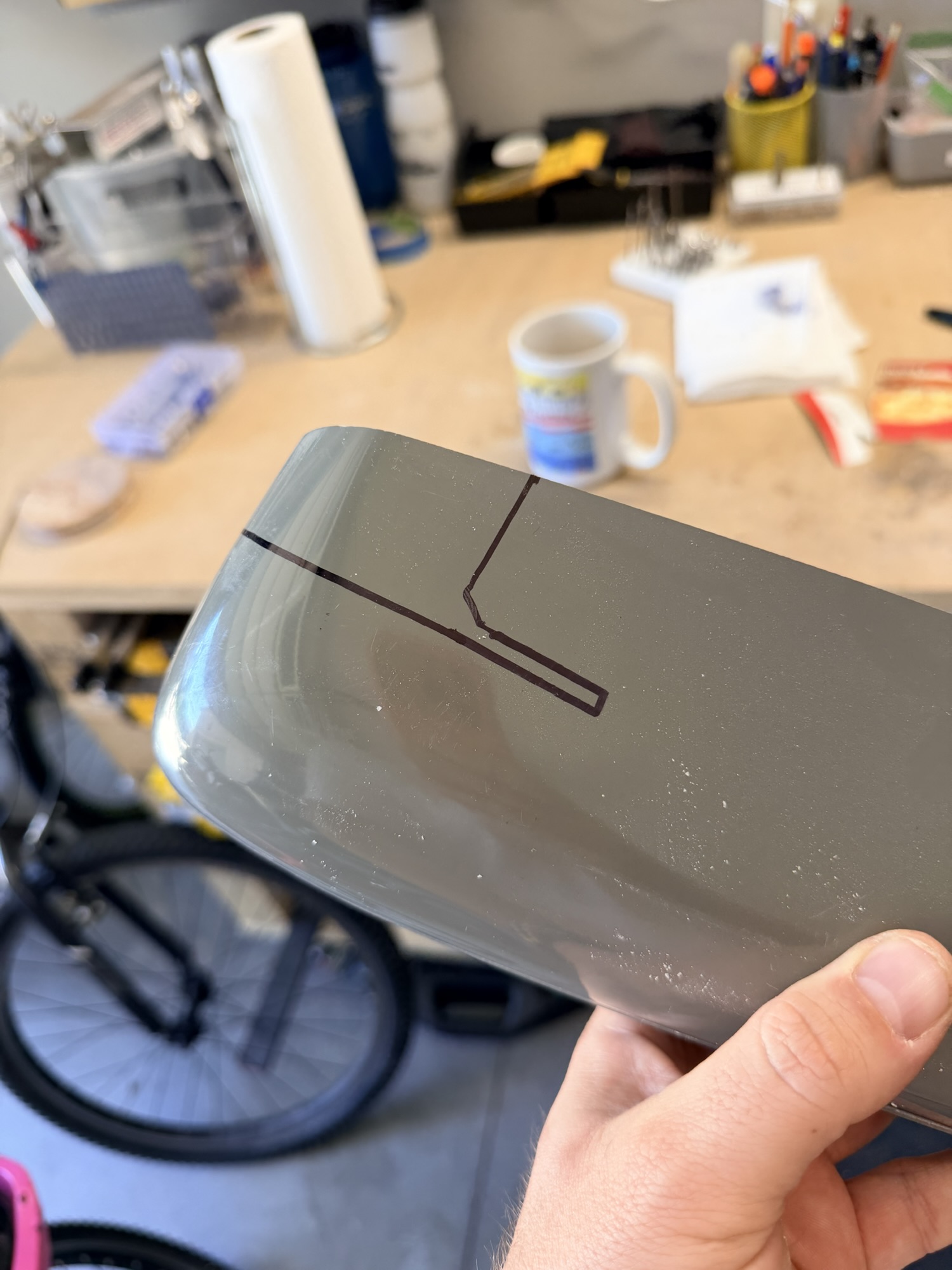
And here are two pictures of my template lines transferred to the fiberglass tip.

img_2453.jpg


Left side.

...and...

img_2454.jpg


Right side.

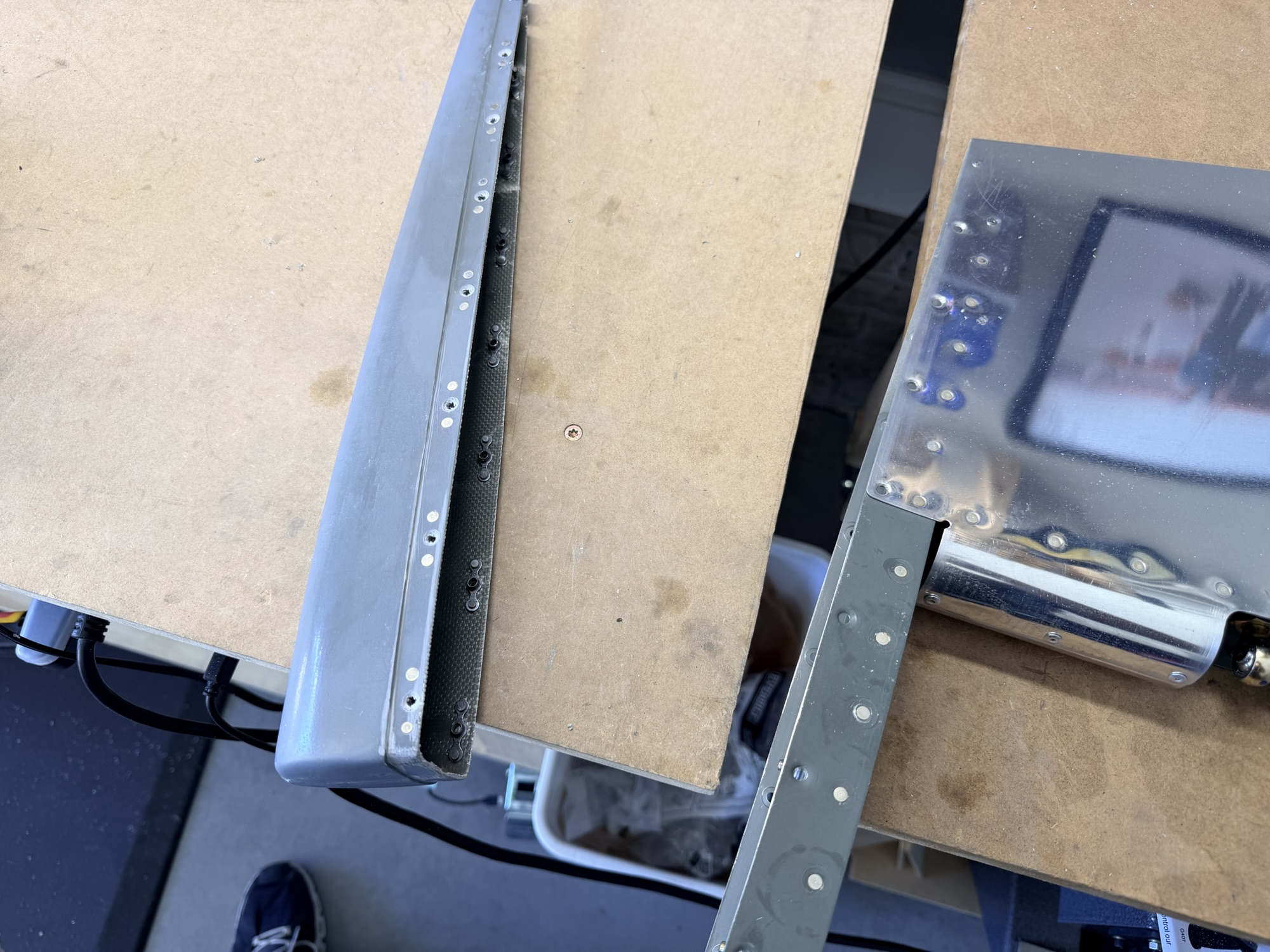
After trimming, it fit like a glove! Once in place, I spaced out 8 holes within the two black sharpie marks for the attach strip.

Here's the left side drilled.

e1776963290193-1024x768.jpg


Matchdrilled to #40

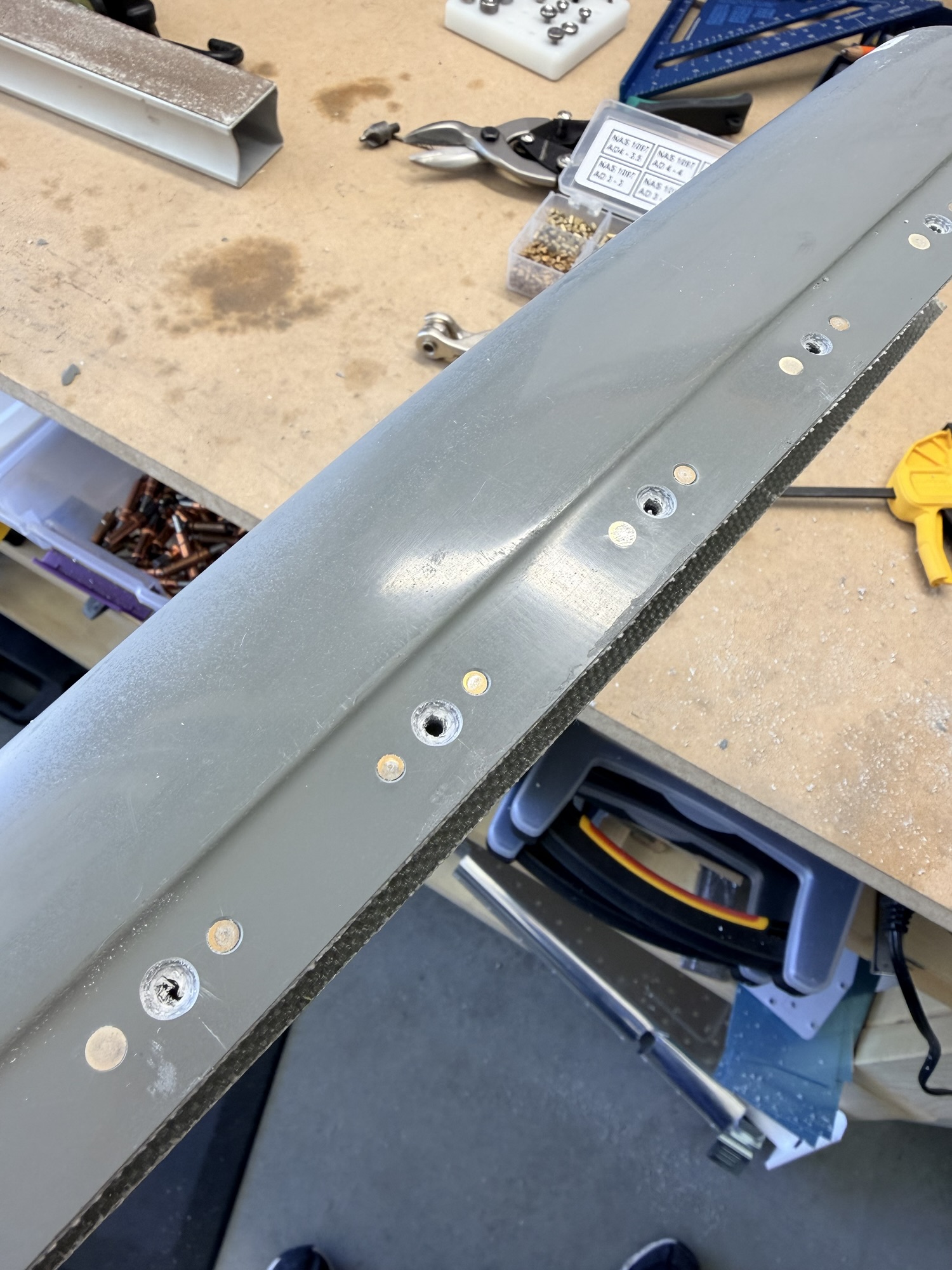
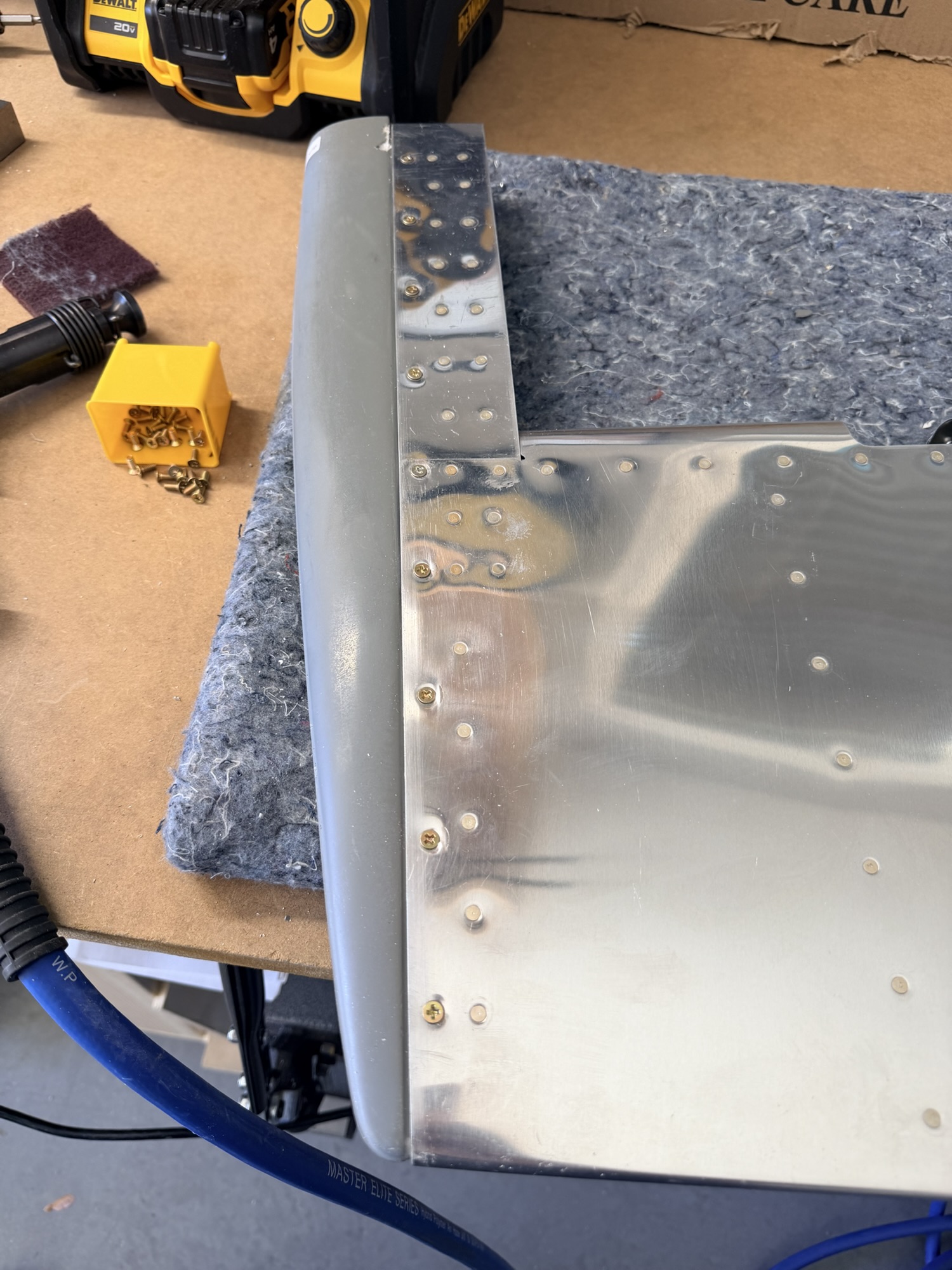
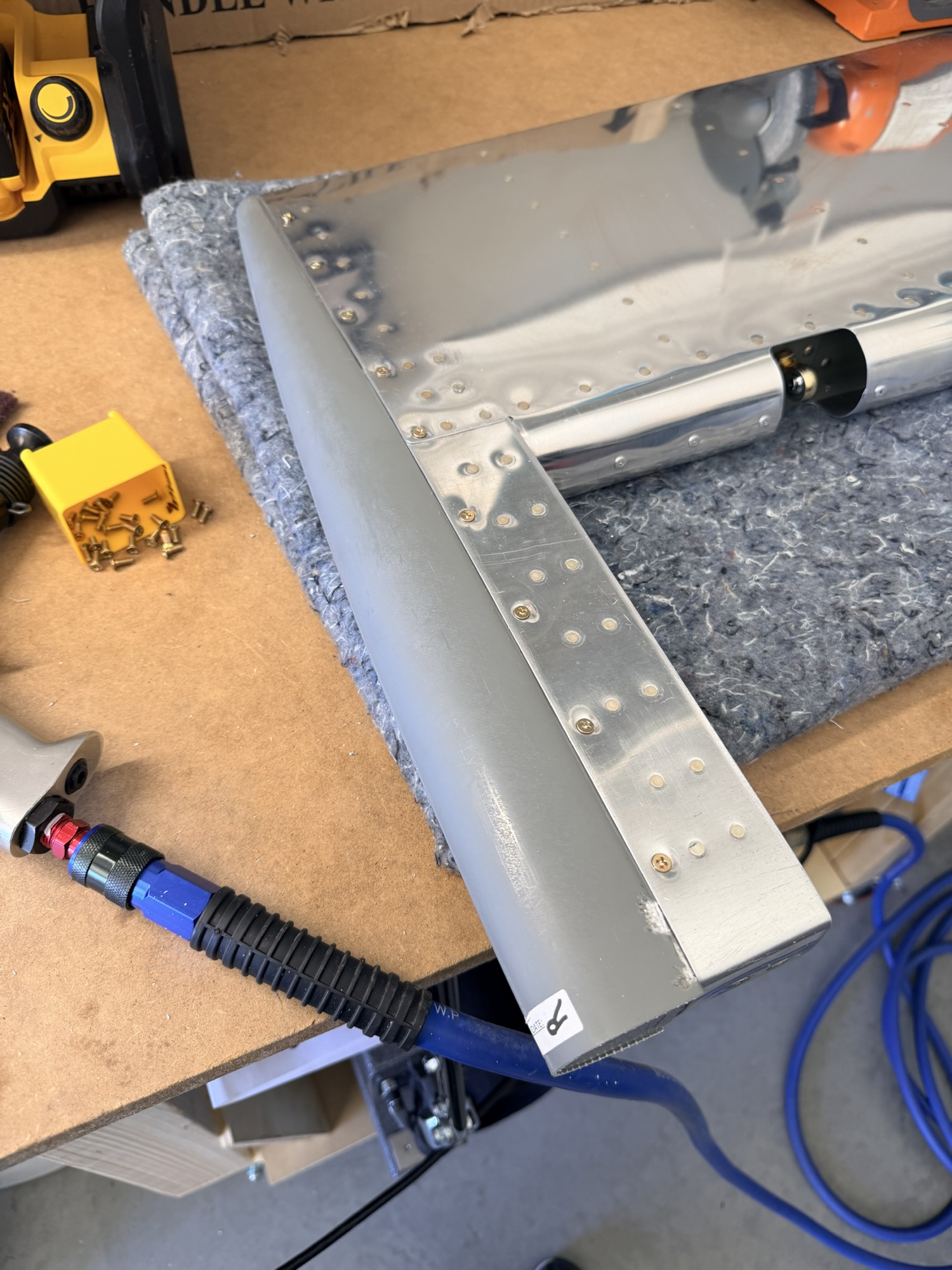
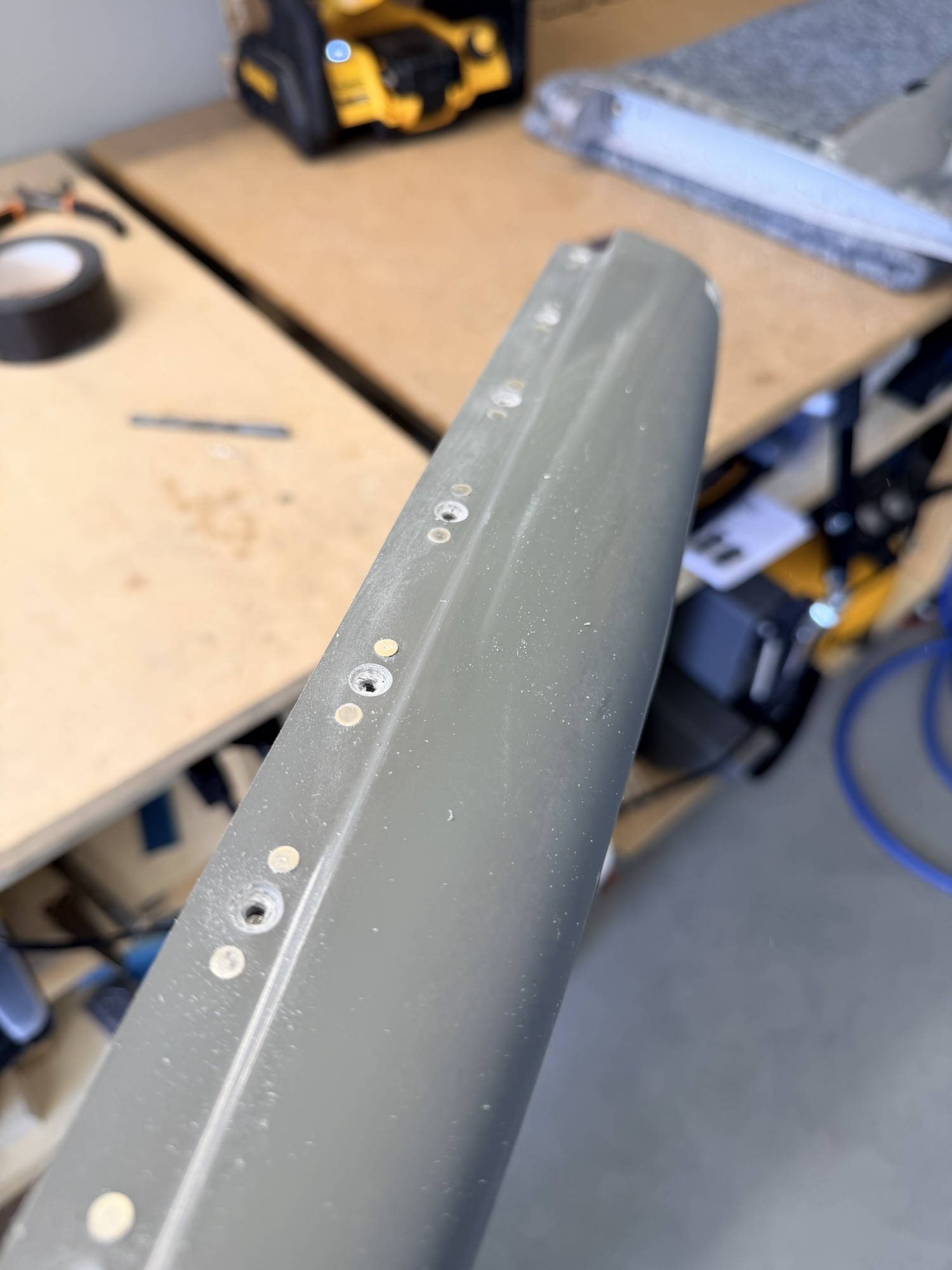
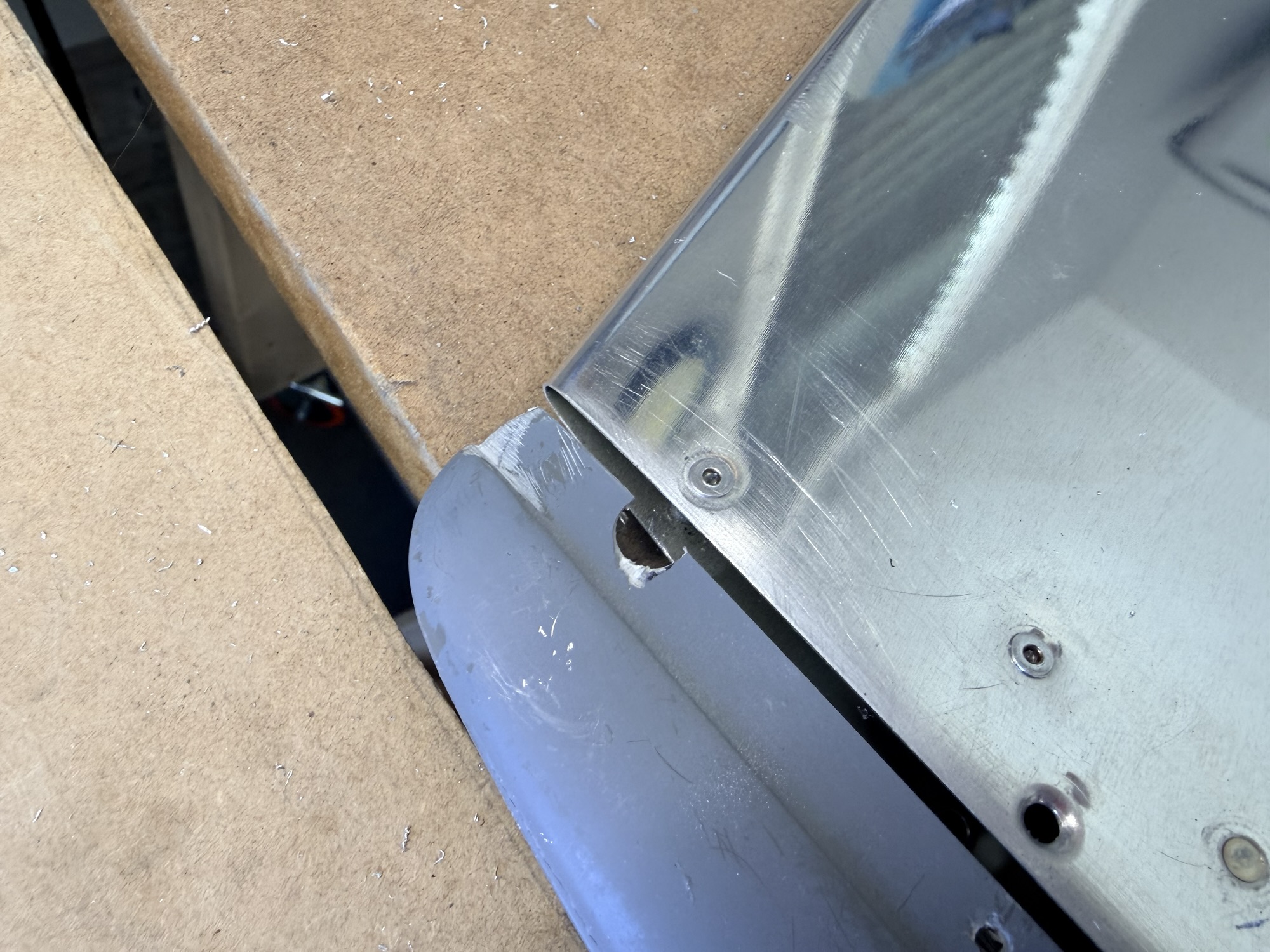
Yikes, this tab that fits over the horn is sitting a little proud.

img_2456.jpg


The forward edge of this is pulling up a little due to the rudder horn brace...this might need some work...

And the right side upsized to #30.

img_2458.jpg


Yes!

I really need those screws and nutplates to continue.

1.0 hour.
 
April 24, 2026 - Rudder Bottom Nutplates and Screws

3 whole days before my hardware package was even supposed to ship from Aircraft Spruce, the dang thing arrived.

What does that mean for me? A BUILD LUNCH!

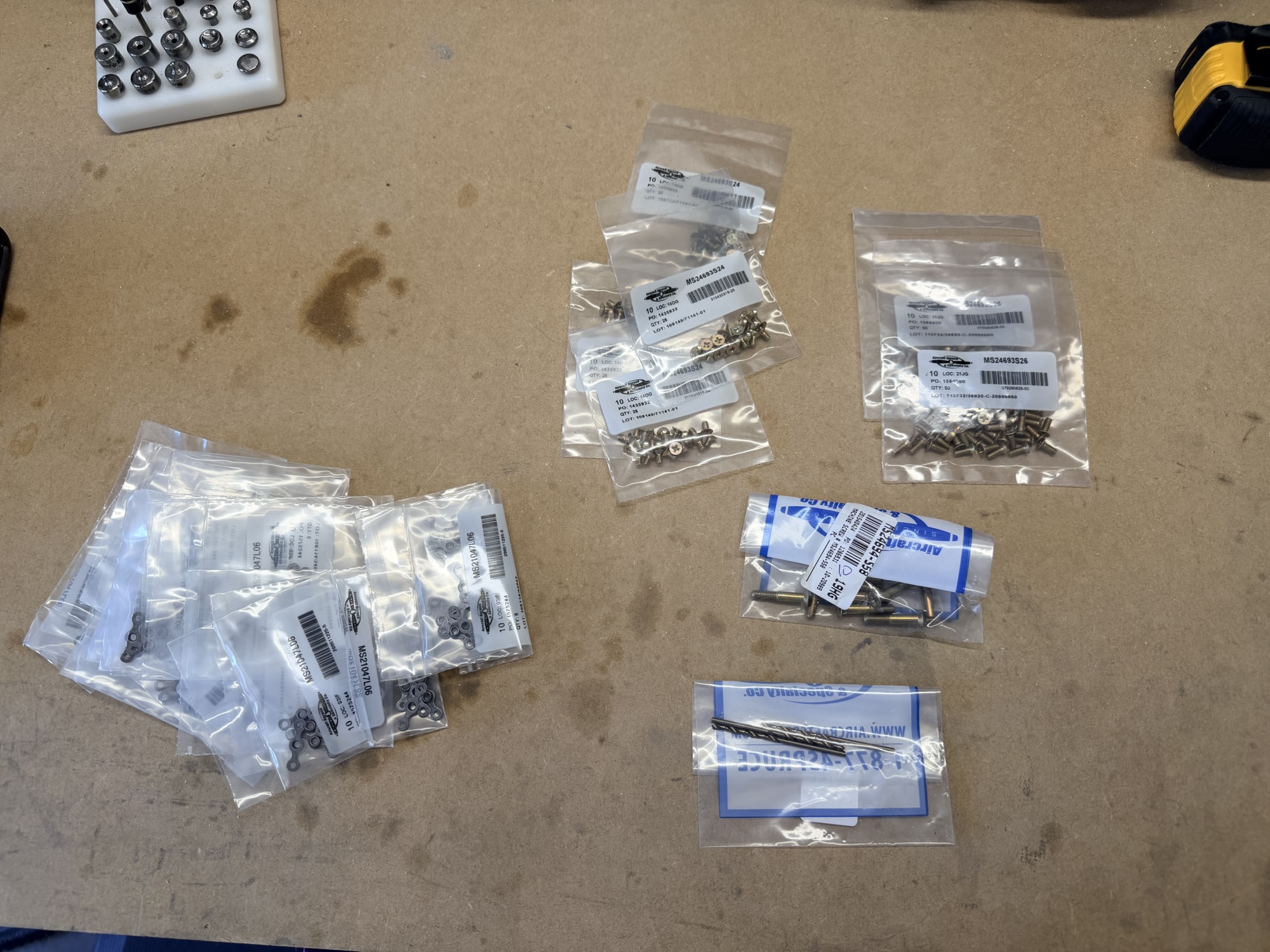
Over lunch today, I sorted the #6 screws and nutplates, along with some AN3 bolts and three #40 cobalt drill bits.

img_2461.jpg


Hardware arrived!

I immediately grabbed my nutplate "jig" and plopped it into one of the 9/64" holes I drilled for the #6 screws.

Then drill one ear to #40, cleco, then the other.

Here's an action shot!

img_2462.jpg


Nutplate ears drilled.

With all the holes drilled, I freehanded the countersink for 1097 rivets and got to riveting.

Lucky you, I paused about 3/4 the way through to grab this shot. The other side is complete, and here I am riveting half of every nutplate in.

img_2463.jpg


Good shop heads, and nice smooth attach flange.

Finally, after all the nutplates were installed, I grabbed the now plentiful stash of #6 screws and attached.

img_2464.jpg


Looks magnificent!

1.0 hour. 16 rivets per side, 32 rivets total.
 
May 02, 2026 - Internal Rudder Stop

So a few weeks ago I ordered the internal rudder stop from <a href="https://www.flyboyaccessories.com/shop/internal-rudder-stop-1683">Flyboys Accessories</a>, and it arrived this week. (Usually, one mounts external stops to the side of the fuselage, but this is an internal version that will help me not damage anything while mounting the rudder to the vertical stabilizer.)

I made the decision to order the one with predrilled holes, but that turns out to be a mistake.

Instead of having a blank stop to clamp in place, mark reasonable locations for holes, then drill both the hinge brackets and the stop together, I had to mark and measure the brackets for the existing holes in the stop (which were not symmetric, by the way).

After a lot of cursing, I finally got some pilot holes drilled, but not in a very straight line. I massaged and finessed (and cursed) the upsizing of the holes to #12 for AN3 bolts, and it worked out in the end.

img_2722.jpg


Internal stop installed.

0.5 hours on a Saturday is a bit low, but at least I got SOMETHING done.
 
May 03, 2026 - Wing Stands Part One

Well, with the wings ordered and supposedly arriving in early June, I got the itch to start thinking about my wing stands.

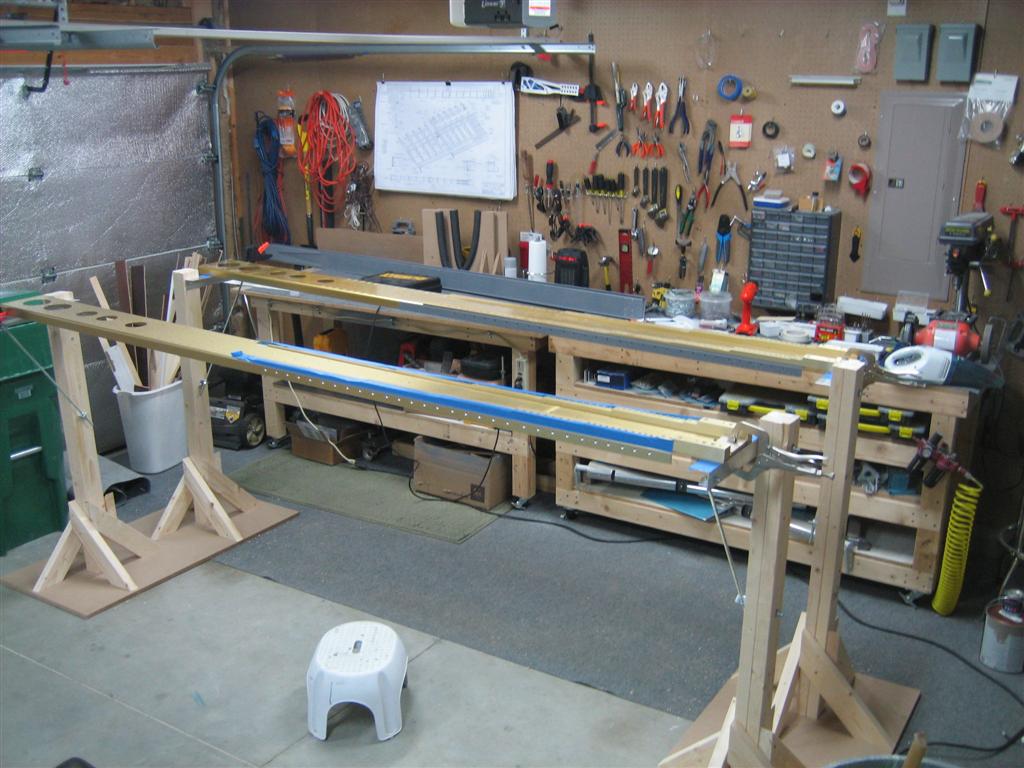
I've done this before here (https://rv7aerosports.com/2010/12/29/started-building-wing-stands/) and here (https://rv7aerosports.com/2010/12/30/finished-building-wing-stands/), so I had the general idea of what I want to do, but I'm thinking about some updates.

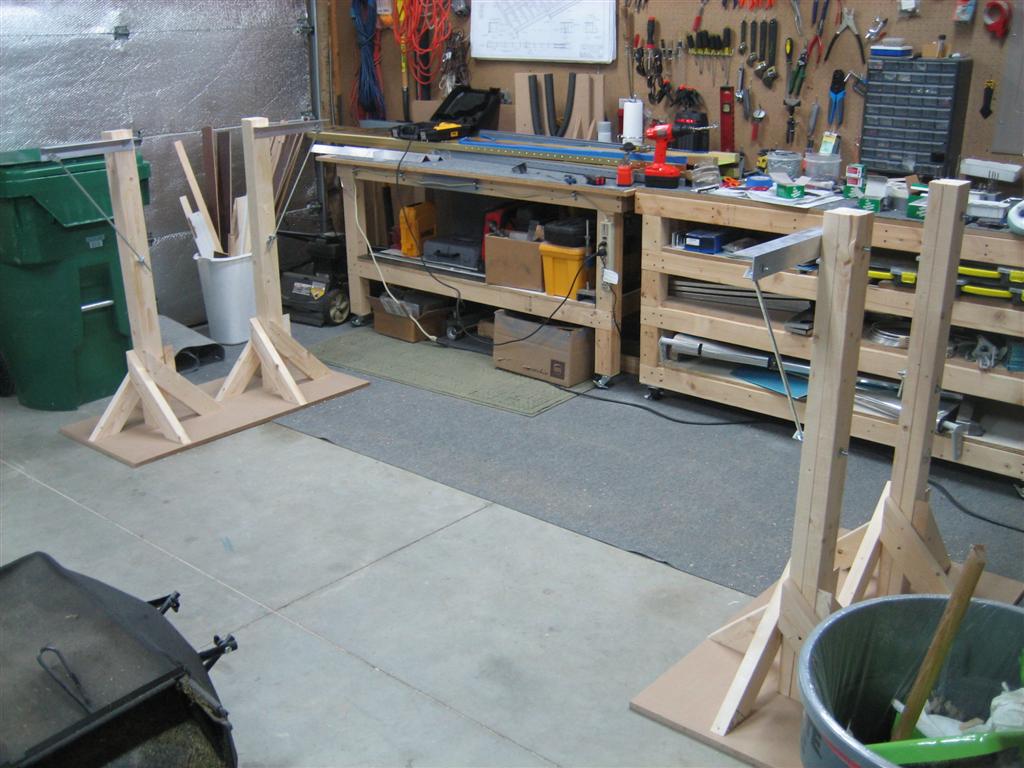
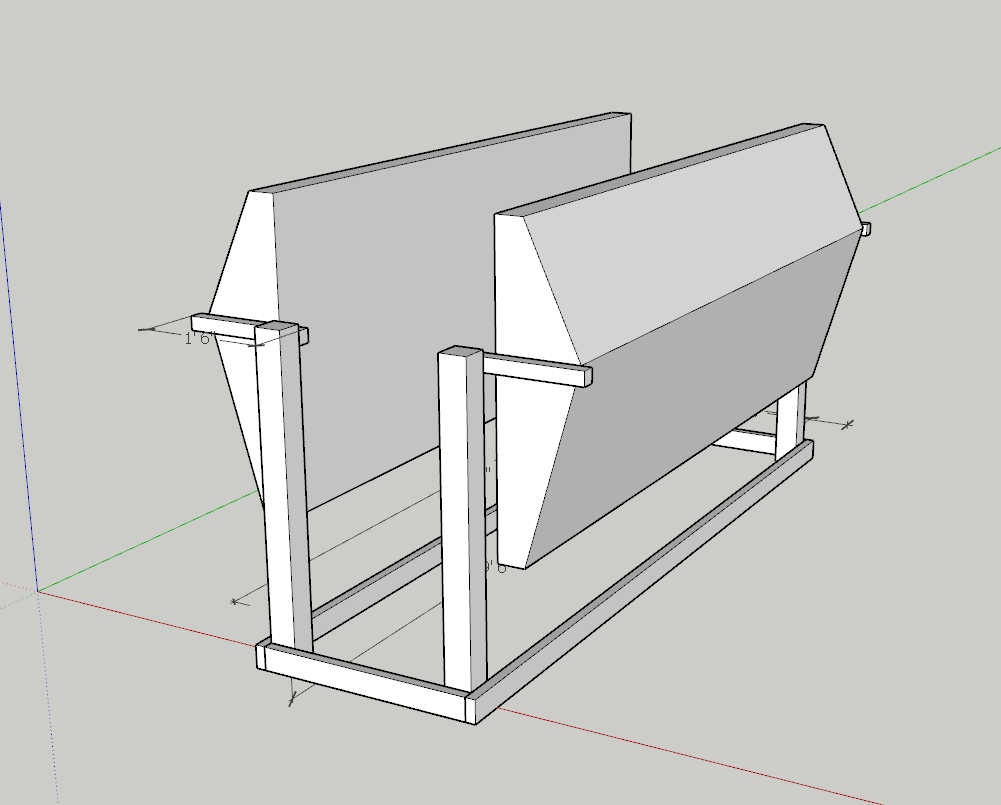
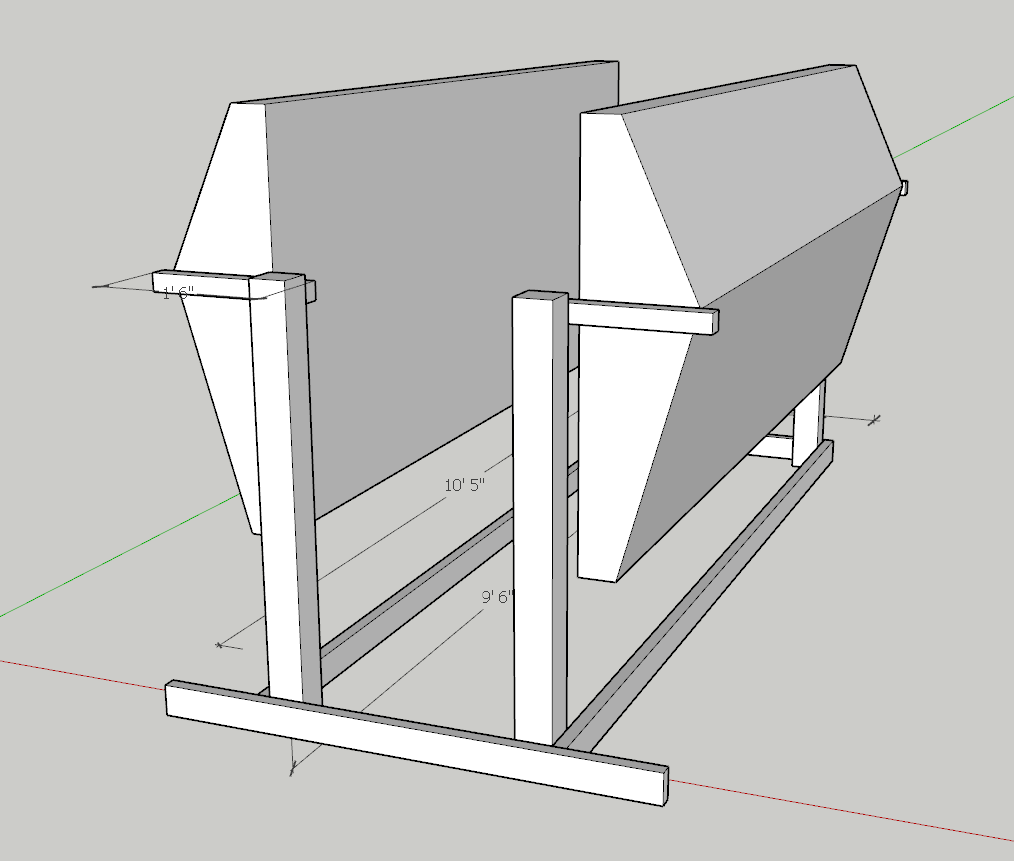
Here's a shot of what I had before and my sketchup model of what I'm going for this time:

20101230-010-large.jpg


I think this picture was from December 30th, 2010.

Screenshot-2026-05-03-205353.png


Here's the dream (but with smoother wings, of course.

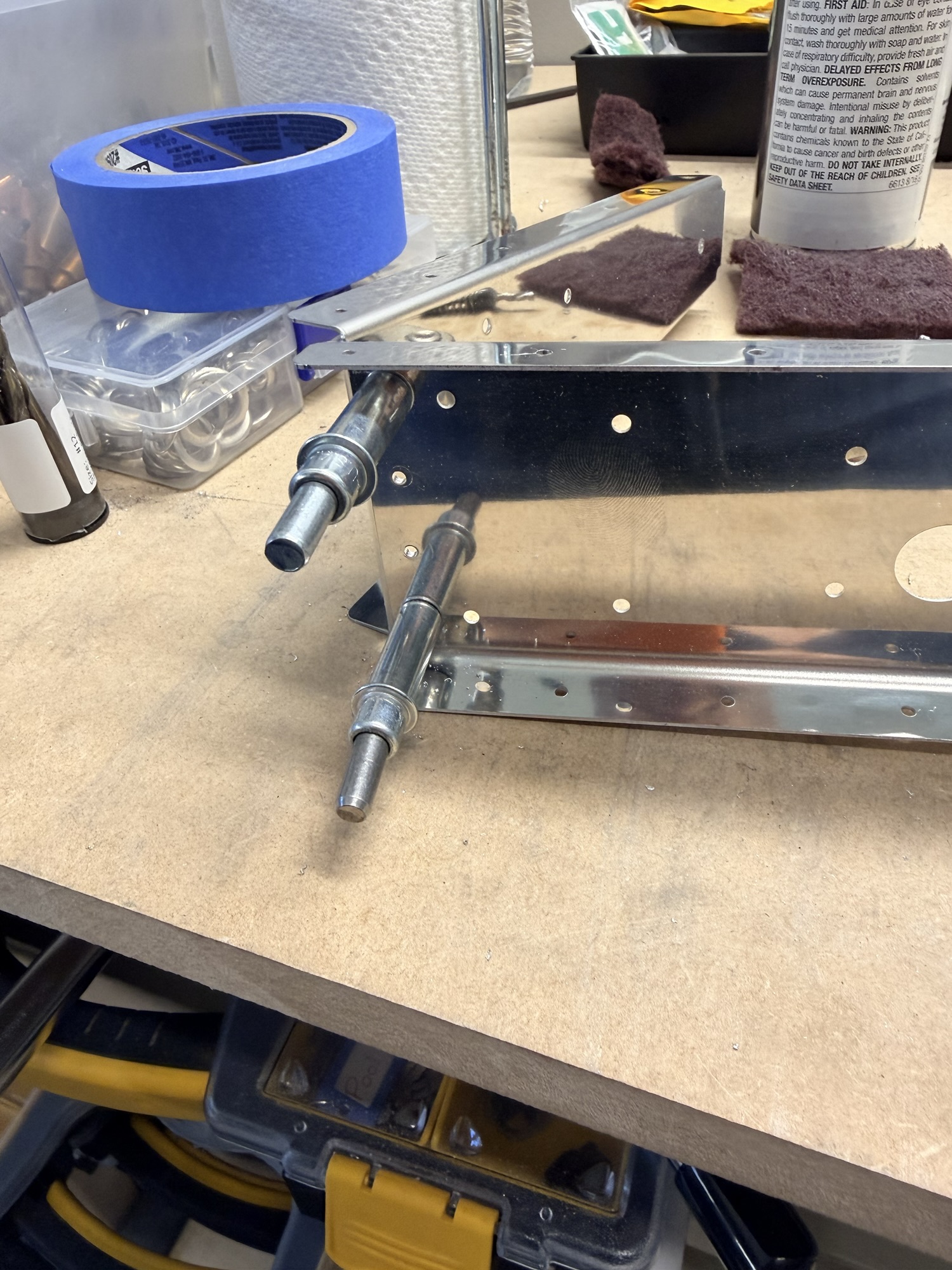
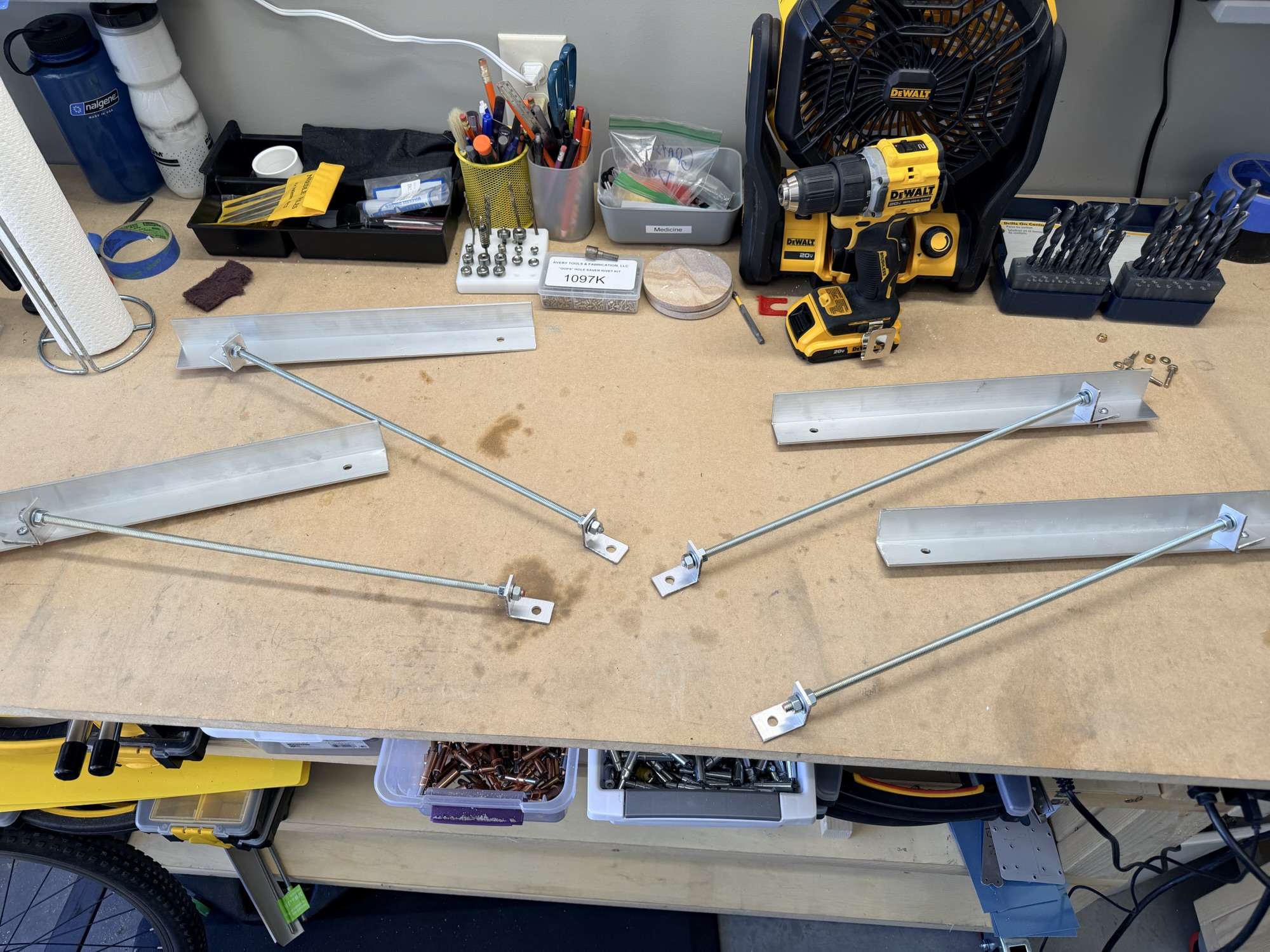
So I headed to the hardware store, bought some 5/16" threaded rod, nuts, washers, and lag bolts. Then got out the metal cutting blade and knocked out four 15" supports, then eight 1" pieces of angle.

Four of the small pieces got 5/16" holes for both sies, and some got a smaller hole to attach to the long angles. The result? Four ready-to go wing support brackets, highly adjustable for twist.

img_2723.jpg


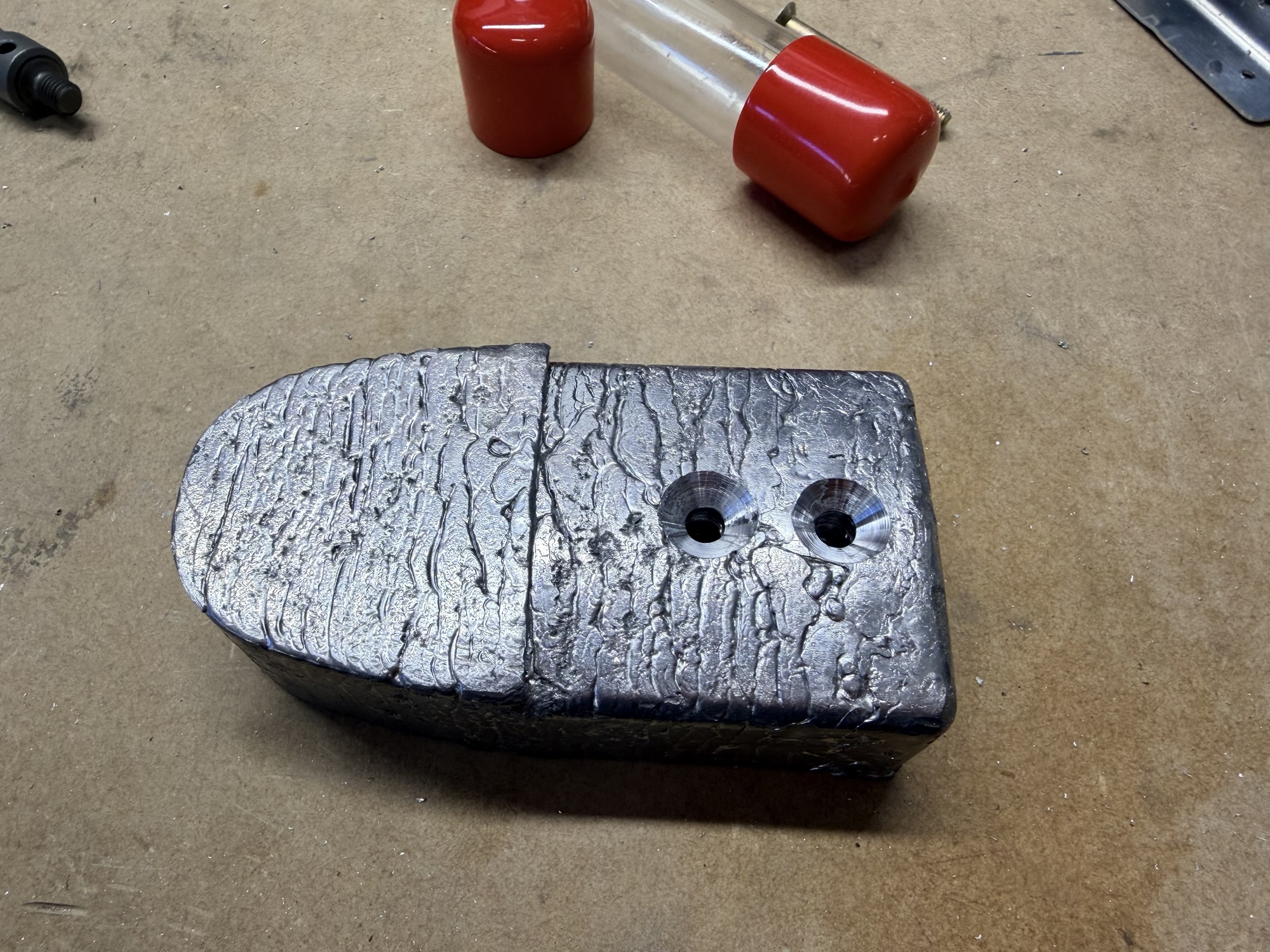
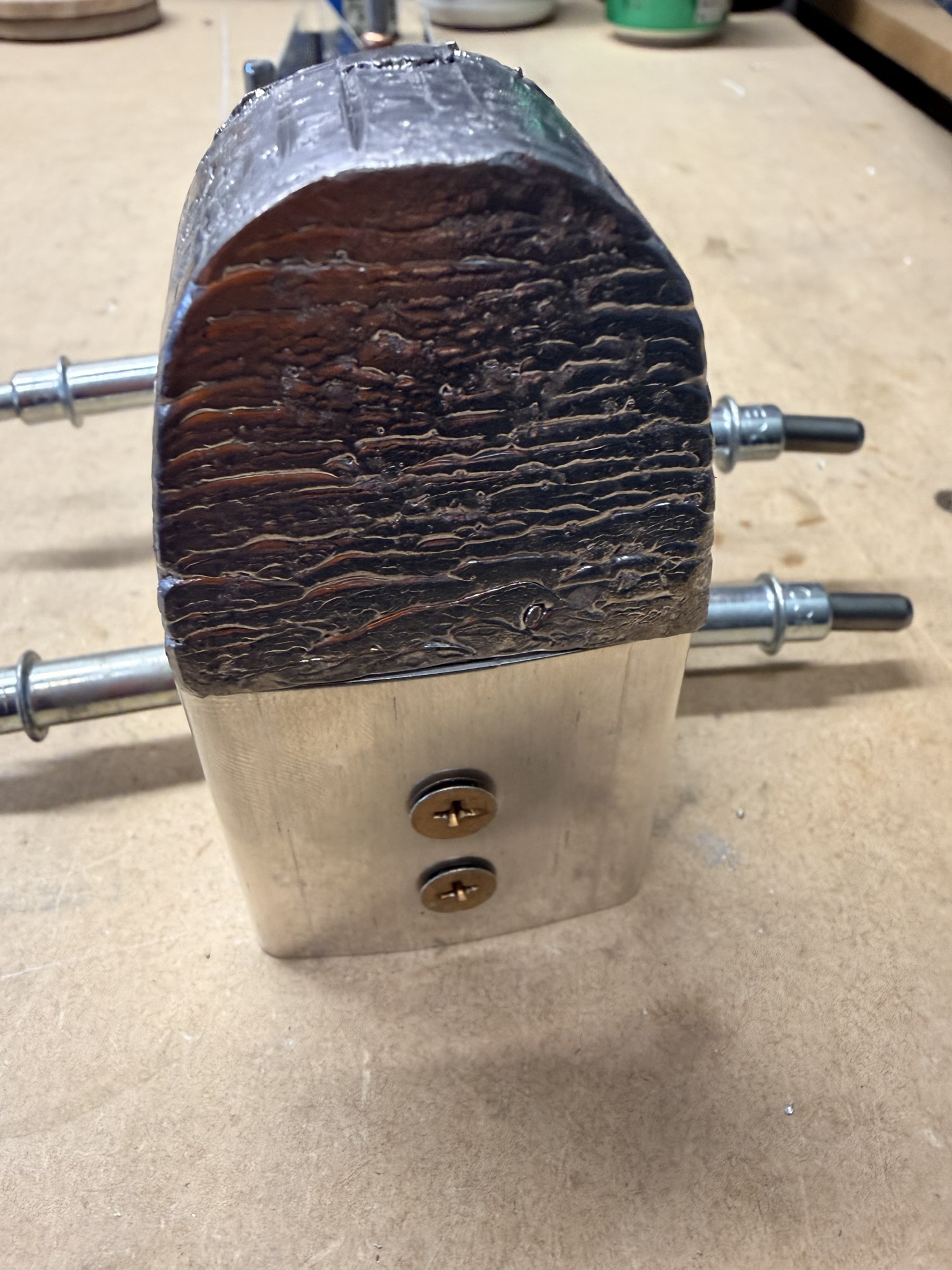
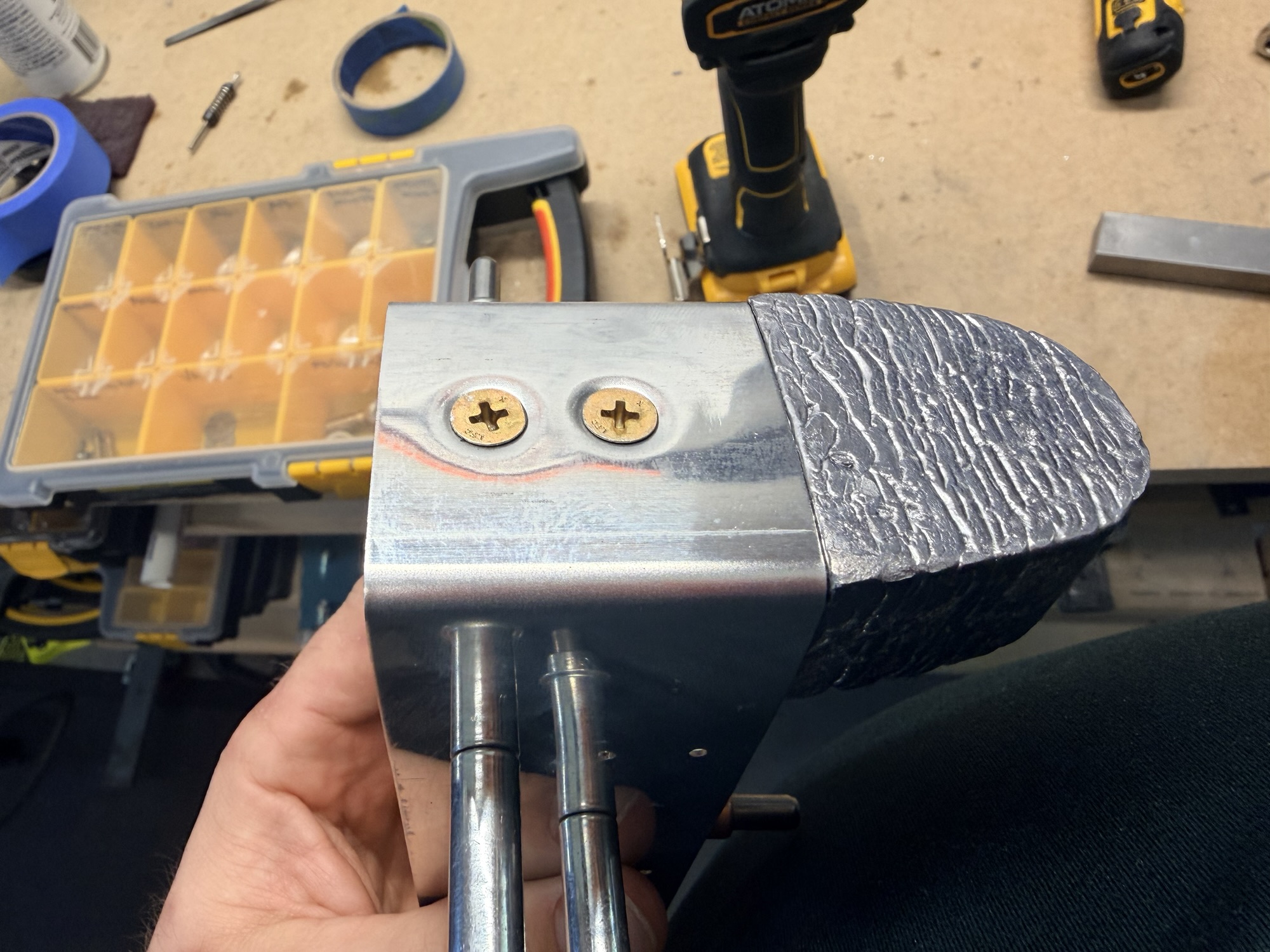
I had a heck of time with deburring after the metal cutting blade. I need a band saw.

When I can attach them to my currently-theoretical posts (on wheels, too!), it'll be obvious how much more sophisticated this build is than the last.

2.0 hours today, which seems like a lot. Last time, it took me 5.5 total hours to make the stands. I did the hard part in 2.0, so I'm hoping the final result occurs more quickly than 5.5. We'll see.
 
Might extend those wing stand legs a bit unless you are absolutely certain you can safely have one wing on with no danger of tipping.
 
Are they just "stands", or are you working on the wings in them? If just holding stands, a central vertical post with the spar supports (upper and lower spar) saves space . I put bolts through the spar ends and a simple angle on the O/B end. I did that while storing my RV-4 wings after building them. I also ran a longitudinal 2X6 in the center at the bottom, and put casters on the cross pieces so it could be rolled around as a unit. Unfortunately , I don't have a picture (pre-cell camera days)
 
Are they just "stands", or are you working on the wings in them? If just holding stands, a central vertical post with the spar supports (upper and lower spar) saves space . I put bolts through the spar ends and a simple angle on the O/B end. I did that while storing my RV-4 wings after building them. I also ran a longitudinal 2X6 in the center at the bottom, and put casters on the cross pieces so it could be rolled around as a unit. Unfortunately , I don't have a picture (pre-cell camera days)
They are going to be work stands.
I spaced them 2’ apart last time, and I think I’ll keep that spacing for the two sets of posts. (Oh man, this picture is from 12/30/2010. 15 years ago.)

20101230-016-large.jpg
 
Longer ago..1995, I used posts I glued to basement floor and screwed to rafters. overalped at the spar root to save space, but built both wings doing the same task on each is I went along. of course, the -4 had zero predrilled holes anywhere, and I needed to keep the plumb bob strings at each end perfect the entire build.
 

Attachments

  • Wing build.jpg
    Wing build.jpg
    1.7 MB · Views: 14
May 3, 2026 - Rudder Tip Work

I had a moment to sneak out to the garage over lunch today, and started the rudder tip.

I had previously matchdrilled the tip to #40, but needed to upsize it to 19/64" which is the right size for a #6 screw (and subsequent dimple or countersink).

Here I am halfway through the upsizing.

img_2724.jpg


It's a pattern!

This is a post-dimpled picture, but you can see the CS4-4 rivet I am using in the last aft-most hole of the rudder tip. There is no way to get nutplates in there, so I'm filling the hole with a pulled rivet.

Some builders will epoxy a #6 screw head in that dimple so it looks like the rest of the screws, but I'm afraid I would try to screw it out in a few years when I forgot what I did.

img_2725.jpg


Dimpled and riveted the last hole with a CS4-4.

To acommodate the shop head of the pulled rivet, I got the dremel out and notched the flange of the tip.

Please note, this was not enough of a notch, i needed to go another 1/8" deeper, but didn't take a picture.

img_2726.jpg


After the deeper notching, this worked great.

Only 0.5 hours today, but I managed to set FOUR rivets.
 
May 04, 2026 - Rudder Tip Attachment Finished

Well, another short trip to the shop today.
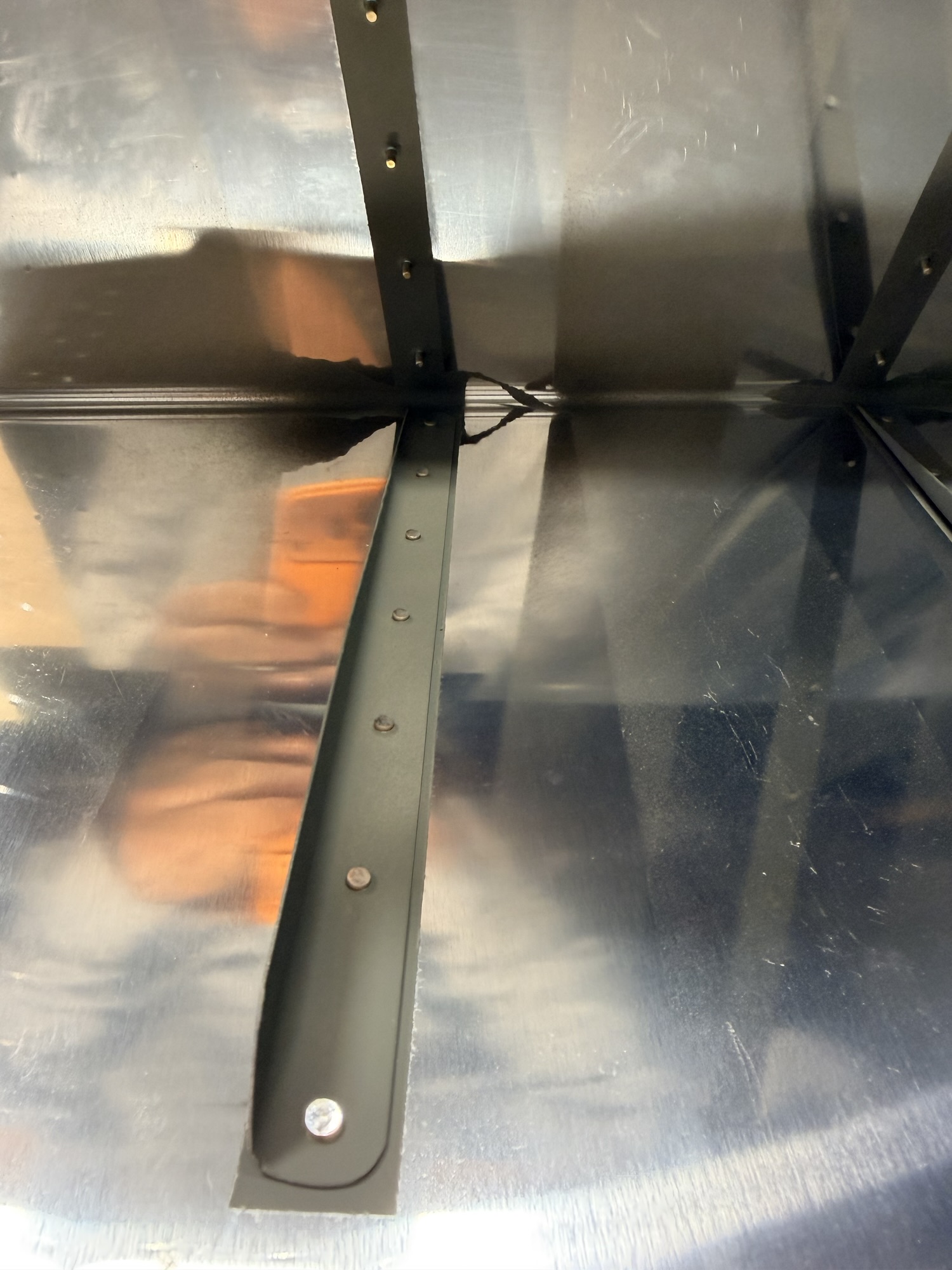
With my holes already drilled and the rudder side already dimpled, it was time to attach some nutplates to the rudder tip flange and then countersink the 19/64" holes for the dimpled rudder skin.
No action shots today, but here is the tip with the nutplates installed.

img_2733.jpg


After 28 rivets.

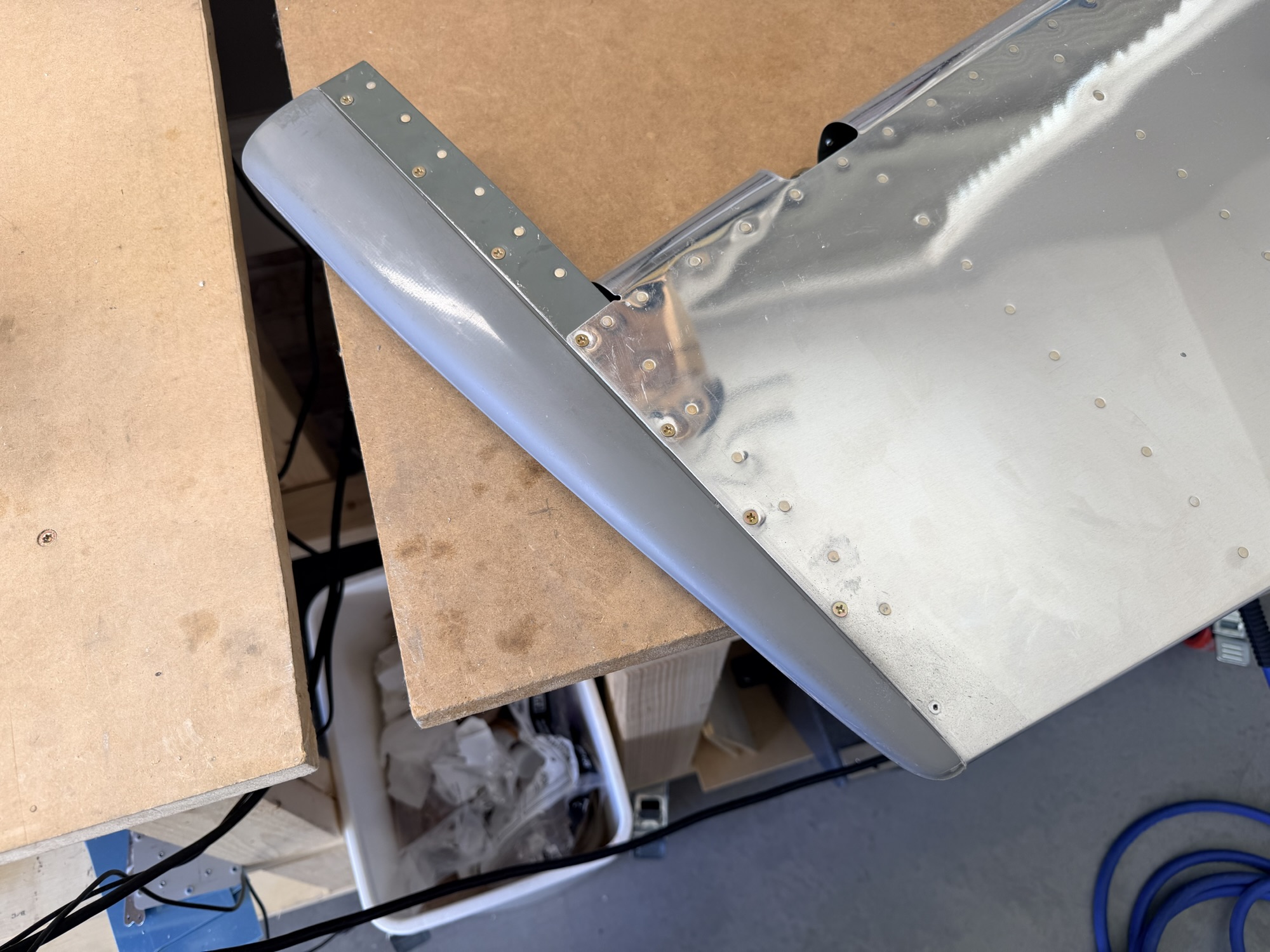
At a shot with the tip screwed into place.

img_2735.jpg


Still some work to do.

There is still quite a bit of fiberglass work to do, but I'm pretty happy with the initial fitting of these fiberglass tips. They're secure for now, and we're getting close to wing kit arrival.

I'm going to delay buying all the stuff needed to tackle the rest of the tip tasks until I need a break from the wings.

0.5 hours, 28 rivets.
 
Back
Top