

Van's Air Force

The definitive Van's Aircraft support community! Buying, building or flying an RV? Join our exclusive family of mentors and enthusiasts!

F1 Metal Gear Leg Dampers

Ironflight

VAF Moderator / Line Boy
Mentor
I have posted before about how I have not had great luck with wooden gear leg dampers on our RV-3, and replaced them with metal with better (but not perfect) results. My dislike of the wood/fiberglass method is because it is messy and somewhat permanent…and you really don’t know what you have until you have made it permanent and gotten all messy! The purpose of the stiffener/damper (no matter how you make it) is to damp the motion of the gear legs fore-and-aft to stop shimmy (while leaving the up and down flex relatively unchanged). I stole the work of others using an aluminum bar clamped to the gear leg on the aft side, and this appears to work about as well as the wood - and if you don’t get it right, you can remove it and change stuff much more easily than the glassed-on wood!

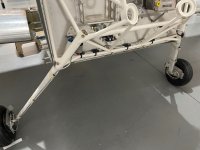
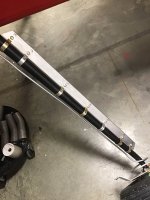
I decided to follow the same idea with the F1 project, and this week fabricated and installed some pretty substantial stiffeners to these extra-long spaghetti legs. The bar stock is 1/4” thick and 1-1/2” wide. The clamps are aluminum - all material sourced from McMaster except for the AN4 bolts/washers/nuts. The gear leg fairings cover all this up very nicely - use the shortest bolts that will work to make sure they don’t bump against the fiberglass. I had to add a .020 shim strip under each clamp to get them tight on the leg - McMaster only had 41 mm clamps, and I needed 40 mm…..

If you;re in to this kind of experimentation, this picture should be enough to kick off your thought process. The cheap black tie-wrap holding the brake line are temporary of course - they’ll be nice Grip-Locks when finished……
IMG_8143.jpeg
 
I bet Vince has a CAD drawing of those legs somewhere. It would be cool to machine some custom clamps down the length of the legs with a fitting on the front to integrate with the brake lines. Two birds, one stone. I’m interested to see how this works out!
 
I have posted before about how I have not had great luck with wooden gear leg dampers on our RV-3, and replaced them with metal with better (but not perfect) results. My dislike of the wood/fiberglass method is because it is messy and somewhat permanent…and you really don’t know what you have until you have made it permanent and gotten all messy! The purpose of the stiffener/damper (no matter how you make it) is to damp the motion of the gear legs fore-and-aft to stop shimmy (while leaving the up and down flex relatively unchanged). I stole the work of others using an aluminum bar clamped to the gear leg on the aft side, and this appears to work about as well as the wood - and if you don’t get it right, you can remove it and change stuff much more easily than the glassed-on wood!

I decided to follow the same idea with the F1 project, and this week fabricated and installed some pretty substantial stiffeners to these extra-long spaghetti legs. The bar stock is 1/4” thick and 1-1/2” wide. The clamps are aluminum - all material sourced from McMaster except for the AN4 bolts/washers/nuts. The gear leg fairings cover all this up very nicely - use the shortest bolts that will work to make sure they don’t bump against the fiberglass. I had to add a .020 shim strip under each clamp to get them tight on the leg - McMaster only had 41 mm clamps, and I needed 40 mm…..

If you;re in to this kind of experimentation, this picture should be enough to kick off your thought process. The cheap black tie-wrap holding the brake line are temporary of course - they’ll be nice Grip-Locks when finished……
View attachment 110591
Instead of AN3’s, use AN525’s
 
Instead of AN3’s, use AN525’s
Well they are AN4’s (to fit the holes in the clamps - otherwise you’ll get play instead of damping….), but yes - if I have clearance problems when I finalize the gear leg fairings, then a flatter, rounder bolt head is under consideration. I just had these on hand this week…..😉
 
I never thought the wood "dampener" bonded to the steel gear leg ever did much damping. Too much difference in modulus of elasticity. However, changing the moment of inertia in the fore/aft direction but not in the side/side direction will change the frequency. But again, big difference between modulus of elasticity between aluminum/steel or aluminum/titanium.
I wonder if measuring the frequency in the fore/aft direction and the side/side direction would give some clues about how much dampening an add on beam adds? I wonder if using the same kind of equipment as is used for ground flutter measurement would work (accellerometers and frequency generators)?
 
I bet Vince has a CAD drawing of those legs somewhere. It would be cool to machine some custom clamps down the length of the legs with a fitting on the front to integrate with the brake lines. Two birds, one stone. I’m interested to see how this works out!
Machining? Who does that when you could simply measure the thickness of the flat area where the clamp will be then 3-D print a suitable set of spacer blocks from a suitable material (i.e. not PLA... it'll melt!)?
 
The wood/fiberglass stiffeners might work for some. It did for me. My first RV6 didn’t have anything, and I had some shimmy during some phases. On my “new” RV6, I used the wood & fiberglass stiffeners, and there is no shimmy or vibration at all. Maybe the results would be the same without them, but I had these from the beginning, so I don’t know. When mine were done, I hadn’t yet heard about the metal stiffeners clamped to the leg, but the legacy remedy worked for me.
 

Attachments

  • 59A0B635-7D67-44CB-A281-24431B996B13.jpeg
    59A0B635-7D67-44CB-A281-24431B996B13.jpeg
    848 KB · Views: 139
  • F4244BC3-3161-47E9-8EF8-5EF508147375.jpeg
    F4244BC3-3161-47E9-8EF8-5EF508147375.jpeg
    918.8 KB · Views: 133
  • 85D22221-4C38-4C10-AD88-86731BC20C0A.jpeg
    85D22221-4C38-4C10-AD88-86731BC20C0A.jpeg
    725.5 KB · Views: 125
  • 021A4684-C878-4E9D-B4FA-B8C92D00C574.jpeg
    021A4684-C878-4E9D-B4FA-B8C92D00C574.jpeg
    422 KB · Views: 130
I have posted before about how I have not had great luck with wooden gear leg dampers on our RV-3, and replaced them with metal with better (but not perfect) results. My dislike of the wood/fiberglass method is because it is messy and somewhat permanent…and you really don’t know what you have until you have made it permanent and gotten all messy! The purpose of the stiffener/damper (no matter how you make it) is to damp the motion of the gear legs fore-and-aft to stop shimmy (while leaving the up and down flex relatively unchanged). I stole the work of others using an aluminum bar clamped to the gear leg on the aft side, and this appears to work about as well as the wood - and if you don’t get it right, you can remove it and change stuff much more easily than the glassed-on wood!

I decided to follow the same idea with the F1 project, and this week fabricated and installed some pretty substantial stiffeners to these extra-long spaghetti legs. The bar stock is 1/4” thick and 1-1/2” wide. The clamps are aluminum - all material sourced from McMaster except for the AN4 bolts/washers/nuts. The gear leg fairings cover all this up very nicely - use the shortest bolts that will work to make sure they don’t bump against the fiberglass. I had to add a .020 shim strip under each clamp to get them tight on the leg - McMaster only had 41 mm clamps, and I needed 40 mm…..

If you;re in to this kind of experimentation, this picture should be enough to kick off your thought process. The cheap black tie-wrap holding the brake line are temporary of course - they’ll be nice Grip-Locks when finished……
View attachment 110591
It's kinda a shame you will cover them up, there is a coolness to them that is worth the 5 knots of airspeed.
 
The wood/fiberglass stiffeners might work for some. It did for me. My first RV6 didn’t have anything, and I had some shimmy during some phases. On my “new” RV6, I used the wood & fiberglass stiffeners, and there is no shimmy or vibration at all. Maybe the results would be the same without them, but I had these from the beginning, so I don’t know. When mine were done, I hadn’t yet heard about the metal stiffeners clamped to the leg, but the legacy remedy worked for me.
Likewise, the wooden stiffeners have worked just fine on Louise’s RV-6 (kit #4, built by Mike Seager). They didn;t work so well on our -3, and the legs on the Rocket are so long that it looks like a stork! I’ve heard enough anecdotes from foklks with the stock (homemade wood) stiffeners on the Rocket that still have shimmy that I figure I might as well try the other solution. I can ALWAYS go back and make a mess with wood and glass - harder to go the other way (I know because we did it on the -3…..).

Bottom line is that the gear legs on the Rockets are very different from those on the shorter-legged RV’s, hence my post in the Rocket forum….😉
 
I can’t honestly see it working on the rocket gear. First off titanium has a very different natural frequency and isn’t known for its damping characteristics. Second the tapering of the titanium gear thins the section, making re-bound loads worse…third, mounting the aluminum directly in the center of the beam accomplishes very little damping…if you actually wanted damping…I’d have mounted an upper and lower section, separated by a bushing…so that you end up with an upper cap and lower cap…which might alternate loading through the phases of the bend and rebound cycle.

Fourth, the 6150 round gear ends up with much better torsional damping, being round, which the rocket gear more closely resembles a flat bar gear, like a 180 has…mostly due to the bent axle absorbing quite a bit of rebound tendency from physical drag of the tire and wheel and brake.,

I have found the wood…completely changes the damping frequency and amplitude and does an excellent job, given its natural frequency and how it does not offer much in the way of re-bound load.

Happy to be wrong…but having gone down this road many moons ago with Lancair…I’m pretty sure the wood dampers are worth the effort and mess.

My worthless two cents.
 
I can’t honestly see it working on the rocket gear. First off titanium has a very different natural frequency and isn’t known for its damping characteristics. Second the tapering of the titanium gear thins the section, making re-bound loads worse…third, mounting the aluminum directly in the center of the beam accomplishes very little damping…if you actually wanted damping…I’d have mounted an upper and lower section, separated by a bushing…so that you end up with an upper cap and lower cap…which might alternate loading through the phases of the bend and rebound cycle.

Fourth, the 6150 round gear ends up with much better torsional damping, being round, which the rocket gear more closely resembles a flat bar gear, like a 180 has…mostly due to the bent axle absorbing quite a bit of rebound tendency from physical drag of the tire and wheel and brake.,

I have found the wood…completely changes the damping frequency and amplitude and does an excellent job, given its natural frequency and how it does not offer much in the way of re-bound load.

Happy to be wrong…but having gone down this road many moons ago with Lancair…I’m pretty sure the wood dampers are worth the effort and mess.

My worthless two cents.
Oh, I’m sure that you’re right, but I think its worth the experiment…it worked fine on our RV-3. Much shorter gear of course.

Thing thing is, maybe I don’t understand what you wrote, but I am not trying to put any damping in the “up and down” direction. This design is, as you say, not optimized that way. I am trying to damp (or more correctly “alter the natural frequency of the gear leg”) in the fore and aft direction. That essentially makes the gear leg one of the I-beam “caps”, and the aluminum the other. Also, the Rocket gear is only round at the top and bottom, and has no taper - the middle portions are machined more flat (to make them lighter). Not the same as a fully round and tapered gear on an RV.

It’s an experiment, as I said…but an informed one based on previous experience.
 
Last edited:
Suggest you try fly it as designed first and see how it behaves. My Rocket has no dampeners and it is manageable. There are some conditions where I get some shimmy during taxi but that’s NBD. In any case, carrying extra weight in every moment of flight for 60 seconds of ground ops is a tough trade for this engineers brain to reconcile.
 
Suggest you try fly it as designed first and see how it behaves. My Rocket has no dampeners and it is manageable. There are some conditions where I get some shimmy during taxi but that’s NBD. In any case, carrying extra weight in every moment of flight for 60 seconds of ground ops is a tough trade for this engineers brain to reconcile.
Well we’ll see. The F1 “as designed” has wooden dampers with fiberglass wraps - I think you might have a Harmon Michael? I might have that wrong - but I agree that for the HR II any damping was an optional add-on (as it was for most early RV’s). In any case it took about two hours to fabricate and install these. Wood with glass takes a lot longer and it’s much harder to back out of (I’ve done it, as mentioned above….). I know a growing number of folks with various RV’s and Rockets where the metal versions (like these) have been working great - so I’m not really an early adopter of the technique.
 
As the leg bends, what prevents the leg from sliding toward the bar inside the U shaped clamp? It would seem that the clamps would only tranfer energy when pull on the clamp, but not when moving toward the bar. Maybe i missed something in the pic.
 
As the leg bends, what prevents the leg from sliding toward the bar inside the U shaped clamp? It would seem that the clamps would only tranfer energy when pull on the clamp, but not when moving toward the bar. Maybe i missed something in the pic.
They’re not U-shaped Larry- they are shaped like Adel’s, so pretty much circular. My only question on this setup is if I am goign to need some little arc-shaped “wedges” where the gear legs are machined somewhat flat (in the middle of the legs). That's part of the experiment - to see what is different between this and the good results I have had on the -3….
 
Oh, I’m sure that you’re right, but I think its worth the experiment…it worked fine on our RV-3. Much shorter gear of course.

Thing thing is, maybe I don’t understand what you wrote, but I am not trying to put any damping in the “up and down” direction. This design is, as you say, not optimized that way. I am trying to damp (or more correctly “alter the natural frequency of the gear leg”) in the fore and aft direction. That essentially makes the gear leg one of the I-beam “caps”, and the aluminum the other. Also, the Rocket gear is only round at the top and bottom, and has no taper - the middle portions are machined more flat (to make them lighter). Not the same as a fully round and tapered gear on an RV.

It’s an experiment, as I said…but an informed one based on previous experience.
Where the gear leg transitions from round at the top, it does so via tapering the thickness of the leg on the top and bottom. This creates a variable and progressive spring, which though titanium is great for lots of things…a dampening spring, is not one of them. The gear leg rebounds with a ton of dypnamic force in the up and down direction and because it is swept aft, and the primary load is aft (the wheel) you are definitely twisting the leg, resulting in a torsional load.

I’m not arguing that the experiment won’t be fun…just asserting that the leg needs to be damped primarily in the vertical direction, not longitudinal….the tires and brakes actually provide much better fore/ aft damping. The up and down direction is what causes the torsional loading through the axle, since it’s aft of the connecting point.

So..what you’ve done is stiffen the gear leg, which I’ve found will result in more bounces back into the air, which I don’t care for.

Since you’ve added an axle to the top and bottom of your doubler in the form of a bolt, it will allow movement, but won’t really induce much bending resistance. If you want it stiffened in the after direction primarily…then rather than putting your plate in compression, switch it to the front side, so it’s in tension, as it’s loaded.

My thoughts on either are that both options are wrong. The woods naturally tendency is to dampen inputs. Not sure what epoxy you’ve used when wrapping the wood, but I’d found that using a high modulus of elasticity epoxy makes a big difference…too brittle and it just cracks…but soft, allows flexing along the wood.

I prefer fitting wood on the front and back side and have used pine and bass wood.

I agree it’s a bit messy, but I roll out 3” tapes and fully wet them out on my glass table, then just wind them around the wood, after it’s been bonded to the leg. If you wet the leg with a brush, you can do a leg in 20 minutes, after the tape is wetted out.

I’ve done two HR 2’s that way and your gear leg is essentially the same. I’ve never had a shimmy…and landing on grass…I’ve never wanted a really stiff gear…cool experiment none the less…curious to see how it turns out.
 
They’re not U-shaped Larry- they are shaped like Adel’s, so pretty much circular. My only question on this setup is if I am goign to need some little arc-shaped “wedges” where the gear legs are machined somewhat flat (in the middle of the legs). That's part of the experiment - to see what is different between this and the good results I have had on the -3….
That makes more sense. Couldn't see that in the pics. Let us know how it works.
 
The woods naturally tendency is to dampen inputs. Not sure what epoxy you’ve used when wrapping the wood, but I’d found that using a high modulus of elasticity epoxy makes a big difference…too brittle and it just cracks…but soft, allows flexing along the wood.
I put wood dampers on my 6A and used Tie wraps to secure the wood. Yes, I put rubber under them to avoid abrasion and to help keep them tight. Used maybe 10 of them per leg. Surpisingly, the wood is still tight to the leg and never shifts. I believe it works well, but I installed them before first flight, so no idea how much or little they help. Have never had a shimmy or vibration in 1600, but that is not unique even without them.
 
....Since you’ve added an axle to the top and bottom of your doubler in the form of a bolt, it will allow movement, but won’t really induce much bending resistance. If you want it stiffened in the after direction primarily…then rather than putting your plate in compression, switch it to the front side, so it’s in tension, as it’s loaded....
Actually, the aluminum stiffener adds significantly to the fore-aft bending stiffness of the gear leg - I've done that analysis for a couple RVs (and reported the results on another VAF thread, which I don't recollect). Whether that's enough to decouple the vertical natural frequency from the longitudinal is something Paul will find out.

Note also that for stiffness and natural frequency at loads below buckling, it doesn't matter which side the stiffener is on. But the fore-aft dimension of the stiffener needs to be maximized for maximum benefit, and with the fairing, that suggests putting it on the aft side. Paul has it right.

Dave
 
I have posted before about how I have not had great luck with wooden gear leg dampers on our RV-3, and replaced them with metal with better (but not perfect) results. My dislike of the wood/fiberglass method is because it is messy and somewhat permanent…and you really don’t know what you have until you have made it permanent and gotten all messy! The purpose of the stiffener/damper (no matter how you make it) is to damp the motion of the gear legs fore-and-aft to stop shimmy (while leaving the up and down flex relatively unchanged). I stole the work of others using an aluminum bar clamped to the gear leg on the aft side, and this appears to work about as well as the wood - and if you don’t get it right, you can remove it and change stuff much more easily than the glassed-on wood!

I decided to follow the same idea with the F1 project, and this week fabricated and installed some pretty substantial stiffeners to these extra-long spaghetti legs. The bar stock is 1/4” thick and 1-1/2” wide. The clamps are aluminum - all material sourced from McMaster except for the AN4 bolts/washers/nuts. The gear leg fairings cover all this up very nicely - use the shortest bolts that will work to make sure they don’t bump against the fiberglass. I had to add a .020 shim strip under each clamp to get them tight on the leg - McMaster only had 41 mm clamps, and I needed 40 mm…..

If you;re in to this kind of experimentation, this picture should be enough to kick off your thought process. The cheap black tie-wrap holding the brake line are temporary of course - they’ll be nice Grip-Locks when finished……
View attachment 110591
I remember machining those flats for someone on a couple titanium gear legs back in the early nineties in Hillsboro OR.. I thought it was pretty crazy at that time. I guess it worked…
 
Paul, why'd you use aluminum clamps instead of cushioned steel Adels?
I want to tie the bar stock as tightly (with as little “give” to the gear leg so as not to introduce another degree of freedom. Don’t know if it makes a difference or not - on the -3, I used Adels but took the rubber cushioning off and just used the steel straps. Fo this one, I decided to try the aluminum becasue the right size was available with the right sized hole for a 1/4” bolt. The Adels in that size have a larger bolt hole, and I didn’t want to go bulkier, but wanted a tight fit. . The beauty of this experiment is that it is all reversible/changeable with a pair of wrenches.
 
I fabricated my clamps from larger stainless padded clamps for a couple reasons.
1. As Paul mentioned, the holes in adels.
2. The adels are not symmetrical. The bar ended up either off axis or off set from center. Neither would fit inside my leg fairing. The fabricated clamps positioned the bar centered on the aft side of the leg and neatly fit inside the fairing. So close I had to buy the right AN hardware to fit.
I never flew it without them so I don't know if there is any difference, but she lands with a tiny chirp and rolls smoothly.
 
Hiding in plain sight! Tom Martin fresh air inlets on leading edge of the wing/fuse fairing. They work if they’re big enough. Fuel tank vents with an AN fitting ground on an angle warm my old school cheap heart.
 
Actually, the aluminum stiffener adds significantly to the fore-aft bending stiffness of the gear leg - I've done that analysis for a couple RVs (and reported the results on another VAF thread, which I don't recollect). Whether that's enough to decouple the vertical natural frequency from the longitudinal is something Paul will find out.

Note also that for stiffness and natural frequency at loads below buckling, it doesn't matter which side the stiffener is on. But the fore-aft dimension of the stiffener needs to be maximized for maximum benefit, and with the fairing, that suggests putting it on the aft side. Paul has it right.

Dave
David, not arguing as to increasing the stiffness of the fore aft load…my assertion is twofold…first off stiffening a spring, particularly past its fulcrum tends only to increase the resulting rebound. And secondly…the natural frequency of the wood actually dampens the rebound load considerably.

Now, using aluminum and aluminum clamps…suggests to me that not much will be accomplished, other than yielding something much less structural than the titanium leg.

To me and my way of thinking…the fore and aft load isn’t much a problem.the vertical load and re-bound is.

Having tested my Rocket gear without wood, versus with wood…it’s very noticeable difference, particularly on grass and a bit bumpy…wing rock is much more quickly dampened with wood.

Given the Rockets higher approach speed, and certainly energy transferred at first contact, versus a 3…I’ll look forward to hearing the results.

On my next Rocket-like machine…I’m going with wood, fore and aft sides and a low modulus epoxy and wrapped top to bottom…we can share results later and see how they do. Again…for me on grass…I want soft legs with low rebound rates…not stiffness. Shimmy, I’ve found has always been a issue of toe-in or toe-out…

Slightly out will wear out tires faster on pavement, but handle much better and doesn’t shimmy. Toe-in…shimmies a lot.
 
Actually, the aluminum stiffener adds significantly to the fore-aft bending stiffness of the gear leg....Whether that's enough to decouple the vertical natural frequency from the longitudinal is something Paul will find out.

Wildcard being a pesky torsional frequency.

Paul and David understand the difference between changing a natural frequency and attempting to add damping, the former being practical and the latter being, in this case, futile.

Break.

I really like Larry's installation with symmetrical clamps, and a lot of them.
 
I'll be at this step hopefully one day. The OP got me to thinking; always dangerous.

Would this not to the Ideal application to utilize rivets (large Al, steel, or other zero tolerance fastener)? Changes in fastener-hole clearances over time via wear will change the dampening response and effectiveness. If the stiffeners are adding their intended benefit, the associated fasteners and related joint geometries would be experiencing a lot of cycles.

Is my thinking off?
 
I'll be at this step hopefully one day. The OP got me to thinking; always dangerous.

Would this not to the Ideal application to utilize rivets (large Al, steel, or other zero tolerance fastener)? Changes in fastener-hole clearances over time via wear will change the dampening response and effectiveness. If the stiffeners are adding their intended benefit, the associated fasteners and related joint geometries would be experiencing a lot of cycles.

Is my thinking off?
By my way of thinking…maybe. But as as been pointed out, this experiment could be a complete failure, in which case I’ll want to remove it and go with another option, so bolts are fine at this point. I’m optimistic because I (and others) have had good results with this method on other aircraft, but I had bolts in hand……😉
 
By my way of thinking…maybe. But as as been pointed out, this experiment could be a complete failure, in which case I’ll want to remove it and go with another option, so bolts are fine at this point. I’m optimistic because I (and others) have had good results with this method on other aircraft, but I had bolts in hand……😉
Good luck, Paul. Have a lot of experience. I can add a bunch but damaged hands make typing a PITA. Reach me direct if you want more info.
 
David, not arguing as to increasing the stiffness of the fore aft load…my assertion is twofold…first off stiffening a spring, particularly past its fulcrum tends only to increase the resulting rebound. And secondly…the natural frequency of the wood actually dampens the rebound load considerably.

Now, using aluminum and aluminum clamps…suggests to me that not much will be accomplished, other than yielding something much less structural than the titanium leg.

To me and my way of thinking…the fore and aft load isn’t much a problem. the vertical load and re-bound is.

Having tested my Rocket gear without wood, versus with wood…it’s very noticeable difference, particularly on grass and a bit bumpy…wing rock is much more quickly dampened with wood.

Given the Rockets higher approach speed, and certainly energy transferred at first contact, versus a 3…I’ll look forward to hearing the results.

On my next Rocket-like machine…I’m going with wood, fore and aft sides and a low modulus epoxy and wrapped top to bottom…we can share results later and see how they do. Again…for me on grass…I want soft legs with low rebound rates…not stiffness. Shimmy, I’ve found has always been a issue of toe-in or toe-out…

Slightly out will wear out tires faster on pavement, but handle much better and doesn’t shimmy. Toe-in…shimmies a lot.
I wouldn't sell the wood stiffeners if I didn't think that they are helpful to some. So I agree with justa6ereh regarding its damping qualities.

However, I recommend that builders fly WITHOUT any extra damping added initially. About 1/2 of our aircraft, by my best guess and unscientific polling, won't need any added dampers.

While alignment is important for tire wear, in my experience fixing alignment won't necessarily cure a shimmy problem. (It shouldn't hurt anything though!) I say this because it is impossible with this type of gear to ever keep a perfect alignment. By nature, the alignment on this type of gear changes anytime the load changes, or the position of the tail changes up or down, or when you apply the brakes, or when there is any other source of drag against the tires i.e mud, or any change in loading, i.e. wind, fuel burn, skinny passengers, fat passengers, etc.

If the tail is on the ground, most, if not all, loading changes will cause a toe-out condition, if you did the alignment per our procedures. That is why we suggest that it is best overall to align the tires with about 1600 pounds aircraft weight (add sand bags as needed!) with the tail on the ground. You can see our suggested alignment procedure here: http://f1aircraft.com/wp-content/uploads/2026/02/Using-the-gear-leg-socket-clamps.pdf. We feel that this process puts the alignment in its most central sweet spot relative to loading.

We've seen people have success with no stiffeners, wood stiffeners, fiberglass wrapped stiffeners, fiberglass only stiffeners, balanced wheel pants, alignment changes, brake changes, and on and on.

As my dad says: "Whatever it takes." Do whatever you need to do to minimize or eliminate the shimmy, otherwise you risk cracking your engine mount prematurely.

I hope that Paul's technique works for him. Of course, he'll have to remove those items to test without them to prove the concept. If they work, that's great! If not, that's OK too... that's why he used bolts instead of rivets or welds to install them! Paul is building a great plane and is very thoughtful in his decisions.

Build on!
 
I wouldn't sell the wood stiffeners if I didn't think that they are helpful to some. So I agree with justa6ereh regarding its damping qualities.

However, I recommend that builders fly WITHOUT any extra damping added initially. About 1/2 of our aircraft, by my best guess and unscientific polling, won't need any added dampers.

While alignment is important for tire wear, in my experience fixing alignment won't necessarily cure a shimmy problem. (It shouldn't hurt anything though!) I say this because it is impossible with this type of gear to ever keep a perfect alignment. By nature, the alignment on this type of gear changes anytime the load changes, or the position of the tail changes up or down, or when you apply the brakes, or when there is any other source of drag against the tires i.e mud, or any change in loading, i.e. wind, fuel burn, skinny passengers, fat passengers, etc.

If the tail is on the ground, most, if not all, loading changes will cause a toe-out condition, if you did the alignment per our procedures. That is why we suggest that it is best overall to align the tires with about 1600 pounds aircraft weight (add sand bags as needed!) with the tail on the ground. You can see our suggested alignment procedure here: http://f1aircraft.com/wp-content/uploads/2026/02/Using-the-gear-leg-socket-clamps.pdf. We feel that this process puts the alignment in its most central sweet spot relative to loading.

We've seen people have success with no stiffeners, wood stiffeners, fiberglass wrapped stiffeners, fiberglass only stiffeners, balanced wheel pants, alignment changes, brake changes, and on and on.

As my dad says: "Whatever it takes." Do whatever you need to do to minimize or eliminate the shimmy, otherwise you risk cracking your engine mount prematurely.

I hope that Paul's technique works for him. Of course, he'll have to remove those items to test without them to prove the concept. If they work, that's great! If not, that's OK too... that's why he used bolts instead of rivets or welds to install them! Paul is building a great plane and is very thoughtful in his decisions.

Build on!
All good thoughts Vince - and one reason to NOT follow Mark’s instructions to glue the back of the gear leg fairings together and fill them with foam (I am using the RV method of rear hinge pins so that they are removable). This is my real point - no one has a complete and total handle on why and when any particular airplane is (or isn’t) going to shimmy. Just becasue someone finds a solution that is perfect for one airframe doesn’t mean that is going to work for another.

I’ve played with numerous round-leg airframes in my own shop and what works for one won’t always work for another. So plan for change, don’t do anything that boxes you in from the start because if its too hard to try something else, you won’t - and you’ll live with less than ideal results until (as you say) you crack a motor mount or wear something else out.

The Vince method of aligning the gear legs on the F1’s is awesome - the clamps he has make it a piece of cake to adjust (drilling is still tedious with the Titanium….). Here’s our cockpit ballasted with enough weight to bring it up to a little above 1600 lbs - I used every heavy thing I had in the shop - some lead shot bags, free weights, diving weights, brick pavers, Oil….and my mill vise!

IMG_8083.jpeg
 
I documented my shimmy follies on here somewhere else.

I used the wood stiffeners. I routed the center of them to snake the steel braided brake lines down. I held one the stiffeners with some pretty badass zip ties. I still had shimmy, so I wrapped them in fiberglass. I still had shimmy. I cut the fiberglass off and wrapped them with carbon fiber. I still had shimmy. I changed my braked from Bringer's to Grove, I got no shimmy.
 
Have to agree with Paul and others on the wood stiffener, thought about them for a while and went with the metal. They still need to be finished up. I did modify the Adele’s so the alum bar is centered on the gear leg and have trial fit the fairings with no problems.Seems I might hav the wood ones for sale.
Chris Santschi EAA Tech Counselor
RV 4 #4633 N1212R
RV8 N627CS. Gone but not forgotten.
 

Attachments

  • IMG_2823.jpeg
    IMG_2823.jpeg
    1 MB · Views: 54
Last edited:
Just to close the loop on this thread, I’m quite happy at how the metal stiffeners have turned out. I have a very, very slight shimmy/shake at about 12-15 knots groundspeed while taxiing (which really isn’t a usual taxi speed, but you pass through it) - notjhing above or below that speed. This is way better than our RV-3 with wood, and a number of other RV’s i’ve flown with wood. I’ve also flown many with wood stiffeners that had no shimmy, so it works as well). 50 psi in the tires by the way.

Other’s mileage may well vary, and we did this with a bit of a “TLAR” approach - but I am happy with the metal on both our -3 and the F1.
 
Back
Top