Frog Hobson
Member
Trying to decide which one to get, I know there are limited rivets to drive so leaning towards the 3x. What say those who have built an RV or two?
Thanks,
Mike
Thanks,
Mike




I always recommend a 2X for 3/32 rivets. Since (likely) all of the driven rivets in the RV-15 will be 1/8, A 3X would be the best choice.Trying to decide which one to get, I know there are limited rivets to drive so leaning towards the 3x. What say those who have built an RV or two?
Thanks,
Mike


Same here, however not all rivet guns are created equal.Only 2X for me.
Carl


A larger gun offers more flexibility, but also requires more precise control of air volume and trigger control. I only have a 4x gun and built two planes with it. Not so good for the novice though. Still have a couple smilies from when i thought i could let my kids try the riveting vs bucking on the few occasions i had help. Things happen faster with the heavier guns.So far this turns out to be like a poll with no clear winner, few reasons given that people would prefer one over the other.
I was looking into the same question. Most of what I saw indicated that a 2X is easier to do quality work when being used for rivets up to 1/8. If you need to do 5/16 it would not work and a 3X would be more appropriate. Are there any comments on whether that is overstated? Is the difference in 'usability' so minor that it's better to just have the extra capacity of the 3X? If you knew for sure you would not need to do 5/16, would the 3X guys still say 3X? Is a 2X just barely sufficient for 1/8, and you better have a 'better' gun in that case?
The only experience I have is using an air hammer. I intend to upgrade that if/as necessary.
Great summary.The X rating on a rivet gun is an indication of how hard each gun will hit a rivet on each cycle with a given amount of air pressure and flow applied.
The hit is produced by a weighted piston that is cycling fore and aft in the barrel, and hitting on the aft face of the rivet set.
As the X rating of a gun gets higher, the barrel gets longer, which provides opportunity for it to get accelerated to a higher speed. This increase in acceleration increases the available, kinetic energy for the hit on the rivet set.
So if you would connect a 2X and then a 3X and then a 4X to a hose without changing the pressure the 4X will hit a lot harder than the 2X
The problem is there is no standard of how much the difference is because every brand is slightly different.
This means that there are two variables that you can apply to change how hard you are hitting a rivet. One is to select a rivet gun of a different X value, and the other is to adjust the air pressure up or down depending on what change is needed.
Higher quality guns can operate well at a wider range of air pressure, which is why some people say they use a ?x For all rivets on an RV. The lower price, consumer guns, which generally do a pretty good job, don’t tend to function well at as wide of a air pressure range.
Since a lot of of the RV builder community tends to use the more consumer grade rivet gun, that is why I always recommend a 2X for 3/32 rivets and a 3X for 1/8 inch.
If someone doesn’t have the luxury to have both then it is possible to get by with just a 2X but it can be a struggle on heavier substructure areas to set 1/8 inch rivets.
Personally, I prefer a 2X for any 3/32 rivets, regardless of how high quality the gun is. In my opinion, even a really high quality 3X still hits harder than is needed, even with the air pressure dialed back.


I found that little regulator to be pretty worthless. I removed it. Instead, I made a couple of mini in line regulators. I keep my system pressure constant and plug the inline regulator at the wall. Each regulator is set for the particular gun I am using so I don't have to reset every time I change tools. Believe it or not, the HF mini regulators work pretty well and the price is right especially if you get them on a coupon. Latest one was 30% off. They also have the Chief brand pneumatic pull riveter which was 20% off. Looks pretty nice but we will see...I have a 3X which came with my RV-14 tool kit. Didn't know the differences at the time. I did the entire aircraft with it. So I am good to go with it on the 15.
What I never did figure out was the small regulator on the gun. I eventually took it off and just controlled the pressure at the compressor to 42 - 43 PSI.
Is there any value to use the small regulator on the gun? If there is I would like to figure it out.

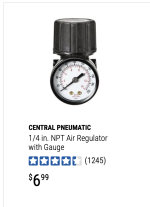
Could you post post pic of that regulator you got from HFI found that little regulator to be pretty worthless. I removed it. Instead, I made a couple of mini in line regulators. I keep my system pressure constant and plug the inline regulator at the wall. Each regulator is set for the particular gun I am using so I don't have to reset every time I change tools. Believe it or not, the HF mini regulators work pretty well and the price is right especially if you get them on a coupon. Latest one was 30% off. They also have the Chief brand pneumatic pull riveter which was 20% off. Looks pretty nice but we will see...
Could you post post pic of that regulator you got from HF

You had me questioning your up bringing before I read your last line.So I sold a rifle and used the money to buy a 3X rivet gun.
(Just kidding, you never sell a gun in Montana, you just buy more of them.”

We have this set up both in the hangar and the garage. 100% worth it as it provides much more precise and even metering of pressure compared to the regulator on the compressor.
I was skeptical but thought for that price I would try it. It worked great for my entire -10 build and is still working. I have hard plumbed air system in my shop. I keep the system at 140 psi and then use these smaller regulators at each outlet. If you shop the sales, the regulator and two fittings end up less than $10...
View attachment 106688
I have the McGraw and it's miles better than the old blue one they sold.They also have the Chief brand pneumatic pull riveter which was 20% off. Looks pretty nice but we will see...
I understand you’re thinking, but the reason you are wrong is because there is an additional factor we are wanting to control besides just how long it takes to set the rivet.Great summary.
Your last statement I would question with regard to a 3X gun hitting harder than needed, though. If you consider that the amount of energy that it takes to set a given rivet is independent of the gun used to set it, the difference then becomes how many times the 2X needs to hit the rivet to set it versus the 3X. The 3X, as you said, has more energy per stroke than the 2X and therefore will set the rivet in fewer strokes than the 2X (unless, of course, you dial the pressure down on the 3X). The amount of energy necessary to set the rivet remains the same, so I am not sure how the 3X hits harder than necessary. It's bbbrrrttt, bbbrrrttt with the 3X and bbbrrrttt, bbbrrrttt, bbbrrrttt with the 2X.
As a data point, I run my 3X gun at 40-45 psi; seems to work fine.
It still really comes down to personal preference (within the capabilities of the gun)...
Scott,I understand you’re thinking, but the reason you are wrong is because there is an additional factor we are wanting to control besides just how long it takes to set the rivet.
Someone else mentioned the analogy of the difference between a heavy hammer and a finish hammer. Using that analogy with a nail, someone that is skilled might be able to drive a 16 penny nail with just one hard hit using a sledgehammer, but a novice might take six hits with a light framing hammer. So with the heavy hammer, the nail went in quickly, but what do you suppose the surface of the board looks like where it was hit by the sledgehammer. Quite different than where the board was hit on the last hit by the light hammer.
The same thing comes into play on light Aircraft structure with different sized rivet guns. Sure, the higher X value will set the rivet quicker or with fewer hit cycles, but is that the only goal?
In my mind, no. We also want the nicest finish quality possible.
A lot of people are unable to detect the nuance difference, but using a rivet gun bigger than is necessary, does produce a difference in surface finish quality. Especially when we factor in lower skill level.
This is largely about what the substructure is like that the riveting is being done on.
Setting 3/32 inch rivets where skins attach to a 1/8 inch thick longeron can be done with a 4X gun with no noticeable difference in finish quality because we are riveting in very solid resilient structure. Use that same 4X gun to set rivets in your .025 wing skin attaching to .025 wing ribs, and you will definitely see a difference in flatness around each rivet. It is no different between a 2X and a 3X gun on light structure, it just isn’t as dramatic of a difference.
So my recommendation of a 2X rivet gun for 3/32 inch rivets is for the purpose of trying to help less experienced people get the best finish quality possible.
I have been riveting on light aircraft structure for a long time and can get by with a 3X gun for most riveting, but I will still always grab a 2X when riveting 3/32 inch rivets on external skins.
As for people removing and throwing away the brass control valve that came with the rivet gun…. Comments like that just further reinforce how many people just never learn to detect the nuance differences that have an influence on riveting performance and finish quality.
I guess people don’t think about why a highly respected tool supply company would supply something with a tool they sell, when it is pointless to have?
I have one of those valves on every rivet gun I own. I say valve, because it is not a regulator. It is a needle valve that has a high level of very fine adjustment. It controls the hit rate of the gun by controlling the flow of air at the inlet.
Because of how a rivet gun works, if you vary the pressure and airflow at the gun inlet, you are also regulating how hard it hits versus just what X value of gun you have chosen. This allows someone skilled with riveting to vary how hard the gun hits, depending on what structure they are riveting on. I am constantly changing the setting on that valve as I move between heavier structure, such as a spar flange versus moving off the flange onto ribs out in the middle field of a skin.
So that little valve provides two benefits
All of my air lines are always at max system pressure (100 psi) and control of the rivet gun is done right at the gun itself. If ever any adjustment is needed, I can do it right there at the gun without going anywhere else in the shop. This also allows any air line to be used for any other tool such as a air drill or die grinder, without having to readjust the line pressure.
A secondary benefit to this is I know the gun is going to hit exactly the same as it did the last time I used it. If you are using a remote regulator to adjust your gun it is very difficult to get it set exactly the same each time.
As mentioned previously, this valve has a very fine adjustment. So if someone turns it just a couple of clicks and expects a big change, it’s understandable that they think it doesn’t do much. I think the other mistake is people attempt to use the valve with a line pressure set close to what they think would be the proper pressure for the rivet gun such as as 35 to 40 psi. In that case, since the pressure is already about what the gun should run at, you won’t see much change by adjusting the valve. If the line pressure is left at 100 psi you get the benefit of reduced influence of flow resistance through your system by supplying full system pressure right up to the gun inlet, and then control the gun with the valve.
BTW, this how the prototype shop has always been set up at Vans Aircraft.
I understand you’re thinking, but the reason you are wrong is because there is an additional factor we are wanting to control besides just how long it takes to set the rivet.
Someone else mentioned the analogy of the difference between a heavy hammer and a finish hammer. Using that analogy with a nail, someone that is skilled might be able to drive a 16 penny nail with just one hard hit using a sledgehammer, but a novice might take six hits with a light framing hammer. So with the heavy hammer, the nail went in quickly, but what do you suppose the surface of the board looks like where it was hit by the sledgehammer. Quite different than where the board was hit on the last hit by the light hammer.
The same thing comes into play on light Aircraft structure with different sized rivet guns. Sure, the higher X value will set the rivet quicker or with fewer hit cycles, but is that the only goal?
In my mind, no. We also want the nicest finish quality possible.
A lot of people are unable to detect the nuance difference, but using a rivet gun bigger than is necessary, does produce a difference in surface finish quality. Especially when we factor in lower skill level.
This is largely about what the substructure is like that the riveting is being done on.
Setting 3/32 inch rivets where skins attach to a 1/8 inch thick longeron can be done with a 4X gun with no noticeable difference in finish quality because we are riveting in very solid resilient structure. Use that same 4X gun to set rivets in your .025 wing skin attaching to .025 wing ribs, and you will definitely see a difference in flatness around each rivet. It is no different between a 2X and a 3X gun on light structure, it just isn’t as dramatic of a difference.
So my recommendation of a 2X rivet gun for 3/32 inch rivets is for the purpose of trying to help less experienced people get the best finish quality possible.
I have been riveting on light aircraft structure for a long time and can get by with a 3X gun for most riveting, but I will still always grab a 2X when riveting 3/32 inch rivets on external skins.
As for people removing and throwing away the brass control valve that came with the rivet gun…. Comments like that just further reinforce how many people just never learn to detect the nuance differences that have an influence on riveting performance and finish quality.
I guess people don’t think about why a highly respected tool supply company would supply something with a tool they sell, when it is pointless to have?
I have one of those valves on every rivet gun I own. I say valve, because it is not a regulator. It is a needle valve that has a high level of very fine adjustment. It controls the hit rate of the gun by controlling the flow of air at the inlet.
Because of how a rivet gun works, if you vary the pressure and airflow at the gun inlet, you are also regulating how hard it hits versus just what X value of gun you have chosen. This allows someone skilled with riveting to vary how hard the gun hits, depending on what structure they are riveting on. I am constantly changing the setting on that valve as I move between heavier structure, such as a spar flange versus moving off the flange onto ribs out in the middle field of a skin.
So that little valve provides two benefits
All of my air lines are always at max system pressure (100 psi) and control of the rivet gun is done right at the gun itself. If ever any adjustment is needed, I can do it right there at the gun without going anywhere else in the shop. This also allows any air line to be used for any other tool such as a air drill or die grinder, without having to readjust the line pressure.
A secondary benefit to this is I know the gun is going to hit exactly the same as it did the last time I used it. If you are using a remote regulator to adjust your gun it is very difficult to get it set exactly the same each time.
As mentioned previously, this valve has a very fine adjustment. So if someone turns it just a couple of clicks and expects a big change, it’s understandable that they think it doesn’t do much. I think the other mistake is people attempt to use the valve with a line pressure set close to what they think would be the proper pressure for the rivet gun such as as 35 to 40 psi. In that case, since the pressure is already about what the gun should run at, you won’t see much change by adjusting the valve. If the line pressure is left at 100 psi you get the benefit of reduced influence of flow resistance through your system by supplying full system pressure right up to the gun inlet, and then control the gun with the valve.
BTW, this how the prototype shop has always been set up at Vans Aircraft.
As always, your input is valued.I understand you’re thinking, but the reason you are wrong is because there is an additional factor we are wanting to control besides just how long it takes to set the rivet.
Someone else mentioned the analogy of the difference between a heavy hammer and a finish hammer. Using that analogy with a nail, someone that is skilled might be able to drive a 16 penny nail with just one hard hit using a sledgehammer, but a novice might take six hits with a light framing hammer. So with the heavy hammer, the nail went in quickly, but what do you suppose the surface of the board looks like where it was hit by the sledgehammer. Quite different than where the board was hit on the last hit by the light hammer.
The same thing comes into play on light Aircraft structure with different sized rivet guns. Sure, the higher X value will set the rivet quicker or with fewer hit cycles, but is that the only goal?
In my mind, no. We also want the nicest finish quality possible.
A lot of people are unable to detect the nuance difference, but using a rivet gun bigger than is necessary, does produce a difference in surface finish quality. Especially when we factor in lower skill level.
This is largely about what the substructure is like that the riveting is being done on.
Setting 3/32 inch rivets where skins attach to a 1/8 inch thick longeron can be done with a 4X gun with no noticeable difference in finish quality because we are riveting in very solid resilient structure. Use that same 4X gun to set rivets in your .025 wing skin attaching to .025 wing ribs, and you will definitely see a difference in flatness around each rivet. It is no different between a 2X and a 3X gun on light structure, it just isn’t as dramatic of a difference.
So my recommendation of a 2X rivet gun for 3/32 inch rivets is for the purpose of trying to help less experienced people get the best finish quality possible.
I have been riveting on light aircraft structure for a long time and can get by with a 3X gun for most riveting, but I will still always grab a 2X when riveting 3/32 inch rivets on external skins.
As for people removing and throwing away the brass control valve that came with the rivet gun…. Comments like that just further reinforce how many people just never learn to detect the nuance differences that have an influence on riveting performance and finish quality.
I guess people don’t think about why a highly respected tool supply company would supply something with a tool they sell, when it is pointless to have?
I have one of those valves on every rivet gun I own. I say valve, because it is not a regulator. It is a needle valve that has a high level of very fine adjustment. It controls the hit rate of the gun by controlling the flow of air at the inlet.
Because of how a rivet gun works, if you vary the pressure and airflow at the gun inlet, you are also regulating how hard it hits versus just what X value of gun you have chosen. This allows someone skilled with riveting to vary how hard the gun hits, depending on what structure they are riveting on. I am constantly changing the setting on that valve as I move between heavier structure, such as a spar flange versus moving off the flange onto ribs out in the middle field of a skin.
So that little valve provides two benefits
All of my air lines are always at max system pressure (100 psi) and control of the rivet gun is done right at the gun itself. If ever any adjustment is needed, I can do it right there at the gun without going anywhere else in the shop. This also allows any air line to be used for any other tool such as a air drill or die grinder, without having to readjust the line pressure.
A secondary benefit to this is I know the gun is going to hit exactly the same as it did the last time I used it. If you are using a remote regulator to adjust your gun it is very difficult to get it set exactly the same each time.
As mentioned previously, this valve has a very fine adjustment. So if someone turns it just a couple of clicks and expects a big change, it’s understandable that they think it doesn’t do much. I think the other mistake is people attempt to use the valve with a line pressure set close to what they think would be the proper pressure for the rivet gun such as as 35 to 40 psi. In that case, since the pressure is already about what the gun should run at, you won’t see much change by adjusting the valve. If the line pressure is left at 100 psi you get the benefit of reduced influence of flow resistance through your system by supplying full system pressure right up to the gun inlet, and then control the gun with the valve.
BTW, this how the prototype shop has always been set up at Vans Aircraft.
As always, your input is valued.
Great discussion, though…always more than one way to do things.

I would add a few nuances to Scott's well laid out comments.I understand you’re thinking, but the reason you are wrong is because there is an additional factor we are wanting to control besides just how long it takes to set the rivet.
Someone else mentioned the analogy of the difference between a heavy hammer and a finish hammer. Using that analogy with a nail, someone that is skilled might be able to drive a 16 penny nail with just one hard hit using a sledgehammer, but a novice might take six hits with a light framing hammer. So with the heavy hammer, the nail went in quickly, but what do you suppose the surface of the board looks like where it was hit by the sledgehammer. Quite different than where the board was hit on the last hit by the light hammer.
The same thing comes into play on light Aircraft structure with different sized rivet guns. Sure, the higher X value will set the rivet quicker or with fewer hit cycles, but is that the only goal?
In my mind, no. We also want the nicest finish quality possible.
A lot of people are unable to detect the nuance difference, but using a rivet gun bigger than is necessary, does produce a difference in surface finish quality. Especially when we factor in lower skill level.
This is largely about what the substructure is like that the riveting is being done on.
Setting 3/32 inch rivets where skins attach to a 1/8 inch thick longeron can be done with a 4X gun with no noticeable difference in finish quality because we are riveting in very solid resilient structure. Use that same 4X gun to set rivets in your .025 wing skin attaching to .025 wing ribs, and you will definitely see a difference in flatness around each rivet. It is no different between a 2X and a 3X gun on light structure, it just isn’t as dramatic of a difference.
So my recommendation of a 2X rivet gun for 3/32 inch rivets is for the purpose of trying to help less experienced people get the best finish quality possible.
I have been riveting on light aircraft structure for a long time and can get by with a 3X gun for most riveting, but I will still always grab a 2X when riveting 3/32 inch rivets on external skins.
As for people removing and throwing away the brass control valve that came with the rivet gun…. Comments like that just further reinforce how many people just never learn to detect the nuance differences that have an influence on riveting performance and finish quality.
I guess people don’t think about why a highly respected tool supply company would supply something with a tool they sell, when it is pointless to have?
I have one of those valves on every rivet gun I own. I say valve, because it is not a regulator. It is a needle valve that has a high level of very fine adjustment. It controls the hit rate of the gun by controlling the flow of air at the inlet.
Because of how a rivet gun works, if you vary the pressure and airflow at the gun inlet, you are also regulating how hard it hits versus just what X value of gun you have chosen. This allows someone skilled with riveting to vary how hard the gun hits, depending on what structure they are riveting on. I am constantly changing the setting on that valve as I move between heavier structure, such as a spar flange versus moving off the flange onto ribs out in the middle field of a skin.
So that little valve provides two benefits
All of my air lines are always at max system pressure (100 psi) and control of the rivet gun is done right at the gun itself. If ever any adjustment is needed, I can do it right there at the gun without going anywhere else in the shop. This also allows any air line to be used for any other tool such as a air drill or die grinder, without having to readjust the line pressure.
A secondary benefit to this is I know the gun is going to hit exactly the same as it did the last time I used it. If you are using a remote regulator to adjust your gun it is very difficult to get it set exactly the same each time.
As mentioned previously, this valve has a very fine adjustment. So if someone turns it just a couple of clicks and expects a big change, it’s understandable that they think it doesn’t do much. I think the other mistake is people attempt to use the valve with a line pressure set close to what they think would be the proper pressure for the rivet gun such as as 35 to 40 psi. In that case, since the pressure is already about what the gun should run at, you won’t see much change by adjusting the valve. If the line pressure is left at 100 psi you get the benefit of reduced influence of flow resistance through your system by supplying full system pressure right up to the gun inlet, and then control the gun with the valve.
BTW, this how the prototype shop has always been set up at Vans Aircraft.

Not good advice…. I drove a lot of the 470 rivets that are visible in the fwd upper fuselage…. They would have been impossible using a 2x gun.Guys, we're not going to Mars in this vehicle. Get a 2X, get a 3X, they will both be satisfactory tools for the relatively limited number of AN470's that were visible on the test article at OSH.
To be fair, I advised a 3X gun a few days ago on this thread, but it feels like things have gone into the weeds with over-analysis. Failure to practice and develop a good technique will likely be more detrimental to the project than the particular rivet gun selection.Not good advice…. I drove a lot of the 470 rivets that are visible in the fwd upper fuselage…. They would have been impossible using a 2x gun.
If a 15 builder has no rivet gun and has to go out and buy one, getting a 2x instead of a 3x would make no sense.

So far, Sections 22 and 23 of the -15, I think I have installed more solid rivets than pulled. Just guessing but maybe 60 each? We have options and I have shot about half and squeezed about half. Used a 3X. Working on the spar, there are plenty of solid rivets and only two so far have been for a nut plate. Quite a few would have been difficult/impossible to reach with a squeezer.
Yeah, sorry. I want to build the thing and have a life. The worse thing I can imagine would be folks calling me a U-Tube "influencer".I'm sure Louise will be super busy this weekend editing all the Youtube videos she is going to post so we all can see what we are missing out on, right?
Thanks for the info, this is great!




