Van's Air Force

The definitive Van's Aircraft support community! Buying, building or flying an RV? Join our exclusive family of mentors and enthusiasts!

Did I Just Experience a Stuck Exhaust Valve? Confirmed!

Jetmart

Well Known Member
Friend
Patron
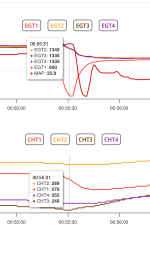
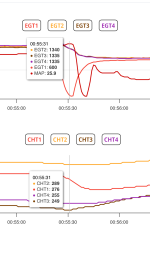
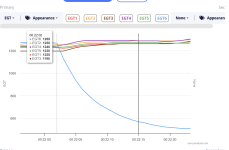
390 with 290 hrs on it. Never had morning sickness. I look for it on every start. After about a 40 minute formation flight running between 55-65 % power LOP #1 Cylinder EGT dropped out for 30 seconds along with a pretty good vibration. Since initial break in I have always used Phillips 20W50 and Camguard. Strange it is not the more common #2. I plan on confirming cylinder # 1 is in fact # 1, Borescope, and wobble test.


Screenshot 2025-12-12 at 3.38.14 PM.png
 
390 with 290 hrs on it. Never had morning sickness. I look for it on every start. After about a 40 minute formation flight running between 55-65 % power LOP #1 Cylinder EGT dropped out for 30 seconds along with a pretty good vibration. Since initial break in I have always used Phillips 20W50 and Camguard. Strange it is not the more common #2. I plan on confirming cylinder # 1 is in fact # 1, Borescope, and wobble test.


View attachment 104566
Although #2 is typically the one that becomes stuck it's not 100%. #1 and #2 are typically the hottest of the 4 so #1 can obviously has and can occur. Phillips 20W50 does seem to be a common element? BTW unless your CHT is also backwards (possible) # 1 is # 1.
 
If they pass the wobble test, you’re good
+1
And really no reason to ream a guide which is good, unless interested in accelerating its wear.
Also not sure about your experience on the matter, but the wobble test is one thing, dropping the valve into the cylinder/reaming/fishing for/reinstalling the valve another.

Good luck!
 
Don’t fix what isn’t broken. If they pass the wobble test, you’re good. There are lots of reasons a cylinder can temporarily go dead.
Sure, Wobble test first. I open to hearing what else could make a cylinder go completely dead.
 
Sure, Wobble test first. I open to hearing what else could make a cylinder go completely dead.
Spark, air, fuel. Take any one away and the cylinder goes cold.

Examples:
- Back when Champion made only bad spark plugs I had 5 of 12 plugs fail on high resistance in short order. Each to check plugs good or bad with a $5 Harbor Freight multi meter.
- What ignition system do you have? Are the plug wires and caps good? Verify with by check condition and resistance.
-Any maintenance done on the spider or injectors?

Carl
 
Quite a few have posted about intermittent problems that turned out to be contamination in the spider. Small piece of crap floats around and blocks an orifice. This problem usually presents itself in different cylinders from time to time and usually on lower hour engines.
I wouldn’t tear into the spider unless I saw this symptom repeat itself specifically on a different cylinder.
 
Spark, air, fuel. Take any one away and the cylinder goes cold.

Examples:
- Back when Champion made only bad spark plugs I had 5 of 12 plugs fail on high resistance in short order. Each to check plugs good or bad with a $5 Harbor Freight multi meter.
- What ignition system do you have? Are the plug wires and caps good? Verify with by check condition and resistance.
-Any maintenance done on the spider or injectors?

Carl

I have one conventional mag with aviation plugs and one emag with automotive plugs. Plugs and wires are good shape. Will be testing next week.
I kind of ruled out spark as hard to imagine cylinder would go cold that quickly because one of two plugs/ignition failed.
I ruled out air as induction system looked fine after flight and likely not affect only one cylinder.
It could be fuel at the spider or downstream. Fuel pressure and flow looks to have been good to the servo.
The incidence of stuck exhaust valves on newer 390's is quite high. I have been waiting for something like this to happen. Honestly thought I would get hints of it with morning sickness. I will be checking plugs, ignition wires, borescope, and doing a wobble test before doing anything too intrusive.
Thanks for the suggestions.
 
I have one conventional mag with aviation plugs and one emag with automotive plugs. Plugs and wires are good shape. Will be testing next week.
I kind of ruled out spark as hard to imagine cylinder would go cold that quickly because one of two plugs/ignition failed.
I ruled out air as induction system looked fine after flight and likely not affect only one cylinder.
It could be fuel at the spider or downstream. Fuel pressure and flow looks to have been good to the servo.
The incidence of stuck exhaust valves on newer 390's is quite high. I have been waiting for something like this to happen. Honestly thought I would get hints of it with morning sickness. I will be checking plugs, ignition wires, borescope, and doing a wobble test before doing anything too intrusive.
Thanks for the suggestions.
It is far more common for valves to stick when the guides are cold vs hot. Of course, the latter can happen, but I would not rush to assume a sticking valve. Many other things can create similar symptoms. This bears repeating, DO NOT ream a guide until you have confirmed too small of a clearance.
 
I have one conventional mag with aviation plugs and one emag with automotive plugs. Plugs and wires are good shape. Will be testing next week.
I kind of ruled out spark as hard to imagine cylinder would go cold that quickly because one of two plugs/ignition failed.
I ruled out air as induction system looked fine after flight and likely not affect only one cylinder.
It could be fuel at the spider or downstream. Fuel pressure and flow looks to have been good to the servo.
The incidence of stuck exhaust valves on newer 390's is quite high. I have been waiting for something like this to happen. Honestly thought I would get hints of it with morning sickness. I will be checking plugs, ignition wires, borescope, and doing a wobble test before doing anything too intrusive.
Thanks for the suggestions.
Need adequate airflow, proper fuel quantity, compression, and spark. A piece of carbon can break off and get stuck between valve and seat, preventing compression, just like a stuck valve. These also clear quickly and resolve as stuck valves often do. If a valve sticks when at peak temperature, it is far less likely to release itself, as it does when cold. Typical presentation is guide shrinks when cold and valve sticks. As the guide warms up,m it expands and releases the valve. Not universal, but typical.

While a stuck E valve is certainly possible here, it is far from the only possibility.
 
I believe that is his MAP, maybe a picture that doesn’t cut off the moment he looses the cylinder transition would help.

Correct there is a 2nd red line that is MP. MP goes up slightly as the cylinder goes cold and then I pull back MP.

Screenshot 2025-12-12 at 3.38.14 PM 2.png
 
A temporary partial blockage of the injector when LOP will do that. But the Angle valves do have a good history of sticky valves.
 
A temporary partial blockage of the injector when LOP will do that. But the Angle valves do have a good history of sticky valves.
Especially when running Phillips 20W50 it seems. I switched to Aero-Shell 15-50 that contains Lycoming LW 16702 antiwear additive already for my IO390 about 400 hrs. ago and the surfaces around the valves seem to be cleaner now with less signs of black specs. The Phillips oil seemed to stay "cleaner" longer but made me wonder where the dark deposits are going if not in the oil. The 390 I have a very difficult time seeing down into the valve stem guides. My PV 540 is much easier. I also have and continue to change the oil every 25 to 30 hrs.

Someone made the comment that a partial blockage should make the cylinder go lean for at least a few seconds. With out modern instrumentation recording data every second I would think one would see this in the EGT temp graph, at least for a few seconds?

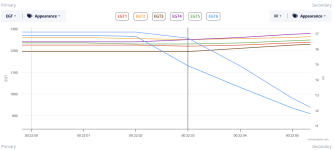
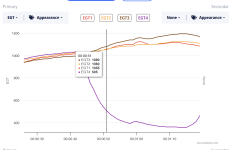
I would love to see the OPS actually point in time where the cylinder dropped off, this is what it looks like when fuel is stopped 100% from going into the cylinder broken down into 1 sec intervals.

Screenshot 2025-12-14 191108.png
 
Last edited:
I would love to see the OPS actually point in time where the cylinder dropped off, this is what it looks like when fuel is stopped 100% from going into the cylinder broken down into 1 sec intervals.

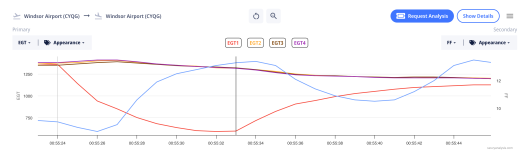
Does this help. 2 second sis the best I can do.


Screenshot 2025-12-14 at 7.17.06 PM.png
 
Does this help. 2 second sis the best I can do.


View attachment 104746
Looks like you experienced a 100% power stoppage in that cylinder and slight fuel flow decline followed by an increase in MAP and FF to the other cylinders? There are other more experienced than me but if it was a fuel issue your spider would need to clog almost 100% immediately to do this and then 9 secs later cleared the clog and return to normal fuel delivery? The graph above (my previous post) represents an injector malfunction that essentially stopped fuel from entering the cylinder and thus the cylinder immediately went dead and stayed dead the remainder of the flight.
 
Last edited:
Someone made the comment that a partial blockage should make the cylinder go lean for at least a few seconds. With out modern instrumentation recording data every second I would think one would see this in the EGT temp graph, at least for a few seconds?
When one of 4 injectors becomes restricted, the other three get the extra fuel and they go rich. OP was lop at the time and at the event, the other three egts rose, indicating enrichment. This adds support to the possibility that fuel flow was the culprit. Far from definitive, but plausible. A stuck exhaust valve creates a new source of air for all cylinders on the intake stroke. This air does not go past the servo, so no additional fuel added for that airflow. This should cause leaning on the other three cylinders, yet they got richer. This would also raise map, which we saw in first graph, but could also be caused be various other thing triggered at that time. This somewhat points away from a valve issue. Again, not definitive.
 
Last edited:
Looks like you experienced a 100% power stoppage in that cylinder and slight fuel flow decline followed by an increase in MAP and FF to the other cylinders? There are other more experienced than me but if it was a fuel issue your spider would need to clog almost 100% immediately to do this and then 9 secs later cleared the clog and return to normal fuel delivery? The graph above (my previous post) represents an injector malfunction that essentially stopped fuel from entering the cylinder and thus the cylinder immediately went dead and stayed dead the remainder of the flight.
.
I disagree. Very slow egt decline and very slow recovery. This was not a stuck now release later event, as you would see sharper lines. Egt also only dropped to 600, so some combustion still occurring.
 
I disagree. Very slow egt decline and very slow recovery. This was not a stuck now release later event, as you would see sharper lines. Egt also only dropped to 600, so some combustion still occurring.
It looks to me his EGT took 9 secs to fall below 600 F. Mine took 11 secs to fall below 600 F after a confirmed stopped injector. These cylinders don't cool off that quickly given others are producing power and heat. You have data that supports one cylinder can cool quicker (or heat) faster than these?

Screenshot 2025-12-15 063905.pngScreenshot 2025-12-15 064515.png

Screenshot 2025-12-15 065710.pngScreenshot 2025-12-15 065847.png

Here is a confirmed stuck valve that took 9 secs to fall a little over 500 F in a 4 banger.

Once a wobble test is performed, we will know more.
 
It looks to me his EGT took 9 secs to fall below 600 F. Mine took 11 secs to fall below 600 F after a confirmed stopped injector. These cylinders don't cool off that quickly given others are producing power and heat. You have data that supports one cylinder can cool quicker (or heat) faster than these?

View attachment 104769View attachment 104771

View attachment 104772View attachment 104773

Here is a confirmed stuck valve that took 9 secs to fall a little over 500 F in a 4 banger.

Once a wobble test is performed, we will know more.
Your right. As I look at the data again I see a rapid drop. I was looking at a different chart and must have misinterpreted the numbers as I thought I saw 20+ seconds.

That said, It only went cold for about 8 seconds. That just seems very irregular to me for a sticking valve on an engine at full operating temp. I am certainly not saying it isn't a stuck valve, but this just doesn't feel like that to me and warrants other diagnostic considerations. OP can get his fingers on that valve with 30 minutes of work and will know definitively, even without the wobble tester. If it stuck at full operating temp, it should be almost immovable now that it is cold.
 
Last edited:
Especially when running Phillips 20W50 it seems. I switched to Aero-Shell 15-50 that contains Lycoming LW 16702 antiwear additive already for my IO390 about 400 hrs. ago and the surfaces around the valves seem to be cleaner now with less signs of black specs. The Phillips oil seemed to stay "cleaner" longer but made me wonder where the dark deposits are going if not in the oil.
Note that Phillips AW 20W-50 has the LW 16702 additive, X/C 20W-50 does not.
 
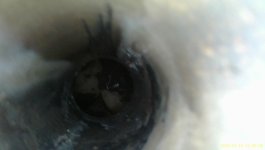
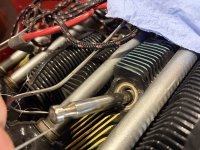
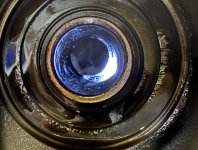
Valve stem is clean however guide has gunk in it. Very tight to push and turn. Will be doing the reaming process. Pics are not the greatest.


Why is this so prevalent on low time 390's?

IMG_0022.JPGIMG_4308.jpegIMG_4306.jpeg
 
Thanks for the return Glenn.

It could still have been, very small chance, something else, but the valve sure is binding and the guide needs cleaning.
We're all surprised as to why so many IO390 are affected, the more so that it is considered as pretty recent in design. Also it should be equipped with the better material guides, as all Lycos since 2004 have been.

Compared to say the ubiquitous O-360:
  • are the guides made out of the same material
  • are the guides getting hotter
  • are the valves also sodium filled, probably as I suspect they are the same valves
  • is the heat dissipation of the head poor(er)
  • influence (or not) of oil used (here I go again, but no Phillips in my engines, thanks)
It sure is surprising, proof the many threads we already had on this very subject.
 
We're all surprised as to why so many IO390 are affected, the more so that it is considered as pretty recent in design.

I'm not convinced this is a unique 390 problem, or specific to a 390's #2 cylinder. There simply isn't any reliable data comparing the 390 (or 580, same cylinder) to any other engine.

The issue is material deposit, not galling or wear, so guide material has nothing to do with it. The 390 and all the wide flange angle valve 360's (like the IO-360-A3B6D in a Mooney) use the same seat, valve, and rotator cap, so nothing special there. The angle valve engines run low CHT, again same for 360 and 360.
 
I think what is more pronounced on the 390s is that those seem to happen on engines with pretty low hours. At least the ones we had locally, and most I've been reading thru here. Quite a few with <100 hours running...

Yes, we should have a better understanding of the reasons for the problem considering all the options we've already bee thru, Mogas vs Avgas, LOP, Camguard, oil brand or grade, CHTs, oil Ts, snake oil in the gas or the oil, mood of the gods, etc.

Here's a selection of the threads we've had:
excitement-on-climb-out-rough-running-engine

poll-sticking-valves-vs-oil-brand

another-sticky-valve-question

2-ex-valve-sticking-no-surprise

stuck-exhaust-valve-resulting-in-bent-pushrod-and-shroud-tube

sticky-valve-on-a-thunderbolt-io390

stuck-valves-on-angle-heads-epidemic-or-isolated

lop-causing-sticky-exhaust-valve


starting-data-collection-on-sticking-valves-participants-needed

And one which really underlines the dangers of inflight valve sticking:
sticking-exhaust-valve-during-flight
 
Would love to gather data that helps us understand why Phillips 66 20-50 both X/C and Victory SEEM to have a higher incident rate of sticky valves than other oils for the I/O-390. I ran this oil up from ~200 hrs. - ~400 hrs. but changed the oil every 25-30 hrs. I did this because I found running Aeroshell 100W looked very dirty after same amount of time. The Phillips Victory (In my case) always looked very clean but wondered where the black soot went? At ~400 hrs. I switched to Aeroshell 15-50 and the area around my valves SEEMED to look cleaner. (Words with caps are pure speculation) I've known users of the I/O 390 have multiple incidents of sticky or stuck valves. Maybe someone develop a poll that would give us some analytical data to this now very well-known issue. There must be on a % basis more builders using a PV engine, but these angle valves do seem to have a DECENT number of issues? These are really nice high output engines, but the incidence of stuck valves SEEMS disproportional.

What is also interesting and MAYBE related is the number of I/O390's that develop a stuck valve not at start-up (when cold) but 3 to 5 mins AFTER start-up with this one occurring almost an hour after start-up?
 
Last edited:
I was hesitant publishing my "research", but @dmattmul's post above kinda prompts me into it...
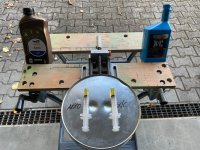
The idea came thru a friend of mine, and I just put this into practice recently. Yes, I do realise that the level of scientific means used for this experiment bears no commonality with what we're used to on this channel, as demonstrated many times by @DanH and others, thanks to them.

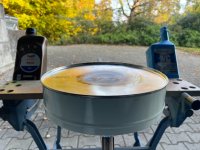
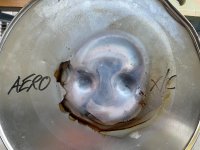
I took a sample, same quantity of brand new oil, 2 different oils. Those were poured in their respective cavities I had crudely hammered into the bottom of a cookie's box. The bottom of that tin surface was then, again very crudely, heated with a simple blowtorch... and it didn't take very long, and both sample, almost at the same instant, let go of a puff of smoke whilst a white flame was spewed, and that was it.
Let it cool off, inspected the results, rubbed my finger in each cavity... and?
I was expecting more residue from one oil than from the other, and was disappointed. No difference. Rubbing that finger in and it didn't get black, nothing to feel, no soot, nothing but the color you can see here. So, not a very conclusive result... though comparing the flame point of both sample oils show very similar levels.
Now go figure...

t1.jpgt2.jpgt3.jpg
 
I was hesitant publishing my "research", but @dmattmul's post above kinda prompts me into it...
The idea came thru a friend of mine, and I just put this into practice recently. Yes, I do realise that the level of scientific means used for this experiment bears no commonality with what we're used to on this channel, as demonstrated many times by @DanH and others, thanks to them.

I took a sample, same quantity of brand new oil, 2 different oils. Those were poured in their respective cavities I had crudely hammered into the bottom of a cookie's box. The bottom of that tin surface was then, again very crudely, heated with a simple blowtorch... and it didn't take very long, and both sample, almost at the same instant, let go of a puff of smoke whilst a white flame was spewed, and that was it.
Let it cool off, inspected the results, rubbed my finger in each cavity... and?
I was expecting more residue from one oil than from the other, and was disappointed. No difference. Rubbing that finger in and it didn't get black, nothing to feel, no soot, nothing but the color you can see here. So, not a very conclusive result... though comparing the flame point of both sample oils show very similar levels.
Now go figure...

View attachment 104912View attachment 104913View attachment 104914

Most modern oil starts to break down and oxidize around 260. Unsure at what temp it becomes coke, but suspect 350+. A better experiment is to heat the pan to 350 or 400/and let it cook for a while. Suspect you will find a hard blacl layer of coke on the bottom after some time.

I remain convinced this is purely a heat issue and doubt one oil behaves any differently than any other when it comes to producing coke at the critical temperature. The big question is why this cylinder and not that cylinder. The only thing that makes logical sense is varying cooling efficiencies based upon unique airflows around the portion of the head near the exh seat. Sadly the temp probe is not that close to that area so not really a true representation.

A great experiment would be to put temp sensors on the portion of the head right next to the exh guides.
 
Last edited:
Usually cold is when morning sickness occurs.
sorry for the ignorance but what does morning sickness feel like? i can’t say my engine idles smoothly when it’s in the 40 or 50s oat until it warms up. but it’s not OMG-something-must-be-wrong rough. at about 1000 rpm it runs normal. is this considered “morning sickness”?
 
sorry for the ignorance but what does morning sickness feel like? i can’t say my engine idles smoothly when it’s in the 40 or 50s oat until it warms up. but it’s not OMG-something-must-be-wrong rough. at about 1000 rpm it runs normal. is this considered “morning sickness”?
No. More likely too lean on idle mixture if it doesn’t do that in warmer temps. Morning sickness involve one of the cylinders going totally or partially cold. Running on three cylinders is rough and can’t mistake it for unsmooth idle. It is theOMG thing. However, sometimes it sticks in a position where things can combust a bit creating variability in the roughness. I don't believe the symptoms will be the same in every case.
 
Last edited:
I have never had the OMG shaking….what I sense is an engine that runs smooth thru the taxi and takeoff and maybe 5-10 minutes into a flight as the engine heats up, you feel a stumble…like just not quite right…as you reduce power the roughness gets more pronounced, particularly with a light wood prop.

That’s when I address it.
 
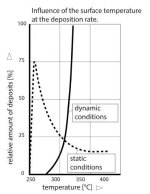
Sooo, does that diagram now explains it all?
It is true that the stuck valves I experienced on my own aircraft were as I was still flying those with much higher power settings than I do now.
That would correlate with this graph... higher Ts = higher coke deposits... is it that simple?
 
So, if I am reading this correctly, the stem of a sodium filled valve is over twice as efficient in transferring heat out of the stem and leaves the middle portion of the stem hotter than a traditional valve. so, am I correct in assuming this would in theory transfer more heat to the guides and make the guides hotter and therefore more likely to coke or am I misreading this? If we are more efficient in transferring heat to the guides, then the guides must also be more efficient in shedding tha heat.
 
So, if I am reading this correctly, the stem of a sodium filled valve is over twice as efficient in transferring heat out of the stem and leaves the middle portion of the stem hotter than a traditional valve. so, am I correct in assuming this would in theory transfer more heat to the guides and make the guides hotter and therefore more likely to coke or am I misreading this? If we are more efficient in transferring heat to the guides, then the guides must also be more efficient in shedding tha heat.
That's correct. I think the big picture theory is that you can run hotter/harder without melting the valve. But that assumes sufficient cooling available in the head. I don't have direct experience with these engines, but I gather from reading that oil flow in the head is rather anemic. Sufficient for lubrication, but perhaps not enough volume to do any significant cooling work.
 
Sooo, does that diagram now explains it all?

Likely not all, but they illustrate facts with a high probability of being part of the puzzle.

Assume for a moment the data in the illustrations is generally correct. I say "generally" because we probably can't depend on any of the given values being precise. However, I think we can assume they represent reality...sodium stems move a lot of heat energy up the stem, and the resulting temperatures in the stem-to-guide interface can exceed coking limits.

We are in fact seeing a buildup of what looks like coked oil, so further assume it is coked oil.

So, consider...

A petroleum base oil will have a lower coking temperature as compared to a synthetic base oil. A switch to synthetic with a coking temperature higher than the stem and guide temperatures would end the problem. We could approach this possibility statistically, with a poll, but so far the forum's poll function appears to remain inoperative. Anecdotally, I do not recall ever seeing a stuck valve report from a user running Aeroshell 15W-50 for the long term, the only (part) synthetic currently available to us.

Reducing the temperature of the stem and guide below the coking point would also cure the problem. Reduced long term power settings is one approach, but the result would be entirely anecdotal. Increasing the valve-to-seat contact, so more heat follows that path, is another. A careful examination of seat contact width might shed some light; a stuck valve with a narrow contact band would be a fair clue. Better cooling, possibly to a specific area of the head, might also fix the problem. Application of thermocouples to the exhaust side of the cylinder heads, as close to the guides as possible, might be illustrative....in particular on a cylinder which has already been stuck at least once.

A solvent additive capable of dissolving coked oil might be helpful, but it would do little about the underlying cause.
 
Reducing the temperature of the stem and guide below the coking point would also cure the problem. Reduced long term power settings is one approach, but the result would be entirely anecdotal.

IIRC Embry Riddle stopped leaning aggressively to reduce the stuck valve problem, i.e. they are using the Avgas for valve cooling since they haven't found a better solution. 🤷‍♂️
 
That's correct. I think the big picture theory is that you can run hotter/harder without melting the valve. But that assumes sufficient cooling available in the head. I don't have direct experience with these engines, but I gather from reading that oil flow in the head is rather anemic. Sufficient for lubrication, but perhaps not enough volume to do any significant cooling work.
That has been my theory for years and have pontificated on that here several times. Oil is a great heat shedding tool and most engines shed 25-30% of their combustion heat via oil. Most every auto engine sends a good quantity of oil via the pushrods to cools the valves, yet lycoming does not. Still believe this is why sticking valves are seen frequently on lycomings, but never on the thousands of other engine types. However, maybe it is not that alone causing the problem. Dans post here has me wondering if lycoming made the problem worse with these sodium filled valves. We are already struggling with too much heat around the guides and here we more than double the heat load. We all look at chts to determine how hot the head is, but unsure if that heat is uniform. The temp probe sits in the center of a large mass of metal, yet the guides are in very thin metal offset from that mass. What if things are much hotter in the metal surrounding the guides. Maybe that area relies more on nearby cooling fins to shed heat. Now imagine each plane with unique baffling setups with all different kinds of turbulence in that area and it possibly begins to explain why two identical engines have such different sticking problems.

Just theorizing here, but one has to wonder.
 
Larry, you outlined a mod for adding oil increases to this area…would love to hear more on that…
I started designing one but never had the problem, so never implemented. Basically creating squirters in the rocker box pointed at the exhaust valve. Can easily tap in to the two main oil gallies via the fwd 1/8” plugs. Never did the engineering to determine orifice size, but would guess something around.020” would be fine. You could take the orifice size of the std lyc piston squirters and reduce by about 30-50%. Don’t need a huge amount of oil here.

The easy implementation is to weld 1/16” npt bungs onto the rocker covers. More elegant would be to tap a hole in the head just inside of the cover flange, but need to turn 90*. Then just an3 hose to move the oil.

This mod would require greater diligence in insuring the drain tubes do not become clogged though.
 
Oil is a great heat shedding tool and most engines shed 25-30% of their combustion heat via oil
+1 on that.
And one of the reasons I've increased my oil pressure, easy thing to do, as to somehow maybe hopefully increase flow to the heads as well.

It really doesn't look like Lyco is interested in alleviating or resolving the problem, wonder about the clones out there (Titan, Aerosport, etc) as well as rebuilders (Lycon and all)... are they implementing a valve cooling mod?

Everybody seems happy to just just live with this problem, which when it happens in flight can have dire consequences...
 
+1 on that.
And one of the reasons I've increased my oil pressure, easy thing to do, as to somehow maybe hopefully increase flow to the heads as well.

It really doesn't look like Lyco is interested in alleviating or resolving the problem, wonder about the clones out there (Titan, Aerosport, etc) as well as rebuilders (Lycon and all)... are they implementing a valve cooling mod?

Everybody seems happy to just just live with this problem, which when it happens in flight can have dire consequences...
agree that lyc could care less. Possibly not a total lack of concern but more about the liability consequences of making changes to design.

We should probably research the negative consequences of upping oil pressure though. Remember many years ago that small block ford hot rodders were installing high pressure oil pumps as an "upgrade" under the assumption that more is better. Back then, the SBF drove the oil pump from the distributor shaft. Guys started breaking dist shafts from the increased load that they weren't designed for. Not saying there are potential issues here, but one must consider things like this.
 
agree that lyc could care less. Possibly not a total lack of concern but more about the liability consequences of making changes to design.

We should probably research the negative consequences of upping oil pressure though. Remember many years ago that small block ford hot rodders were installing high pressure oil pumps as an "upgrade" under the assumption that more is better. Back then, the SBF drove the oil pump from the distributor shaft. Guys started breaking dist shafts from the increased load that they weren't designed for. Not saying there are potential issues here, but one must consider things like this.
We dont have a dog in this hunt, but surely seems like its time for a new design engine.
 
Back
Top