

Van's Air Force

The definitive Van's Aircraft support community! Buying, building or flying an RV? Join our exclusive family of mentors and enthusiasts!

How reasonable is this anti-chafing cap for nutplate?

idubrov

Well Known Member
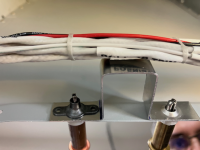
Do you think this is a reasonable protection against chafing? My wire bundle is about ~1/2" from the tip of the access plate screws. In case the wire bundle flops around, I printed these caps from TPU (which is a soft plastic).

P.S. Caps have TLAR retention mechanism -- the hole narrows such that sticking threads of a screw grab it (when specified AN509-8R8 screws are used).
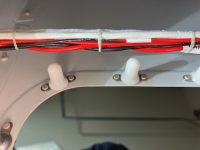
1760467134602.png
 
Last edited:
Do you think this is a reasonable protection against chafing? My wire bundle is about ~1/2" from the tip of the access plate screws. In case the wire bundle flops around, I printed these caps from TPU (which is a soft plastic).

View attachment 99499
Those caps look nice. But...I would be concerned about any of them eventually becoming loose after the associated vibration of taxiing and flight. Wouldn't want any of those floating around and getting stuck in a bell-crank or similar for your flight controls. Why not just add a few standoffs, or similar, to support the wiring in these areas? Conduit is also a nice solution.
 
I don't know why Van's suggested that wire bundle routing for the RV7. I noticed the same exact thing i.e. the wire bundle is pretty close to the business end of those inspection panel screws.

Personally, I'm with the other commenters. The chances of those caps coming loose and finding their way into the aileron linkage probably isn't great, but it isn't zero either. A better solution would be to add a riveted standoff and an adel clamp.

You could also use a shorter screw. There's no reason that you need to have a bunch of extra threads sticking out through the back side of that nut-plate.
 
Personally, I'm with the other commenters. The chances of those caps coming loose and finding their way into the aileron linkage probably isn't great, but it isn't zero either. A better solution would be to add a riveted standoff and an adel clamp.
Maybe, something like this then. With some proper interface between the "shelf" and the bundle (maybe, a cable tie mount). It's a bit inconvenient for an adel clamp, though, because wires are almost directly over the nutplates...

1760476040638.png
 
Dosent really help or answer your question I know, but why not just use the vans conduit? Cheap, light, easy.
If you ever need to do any maintenance, tinkering, improvement or trouble shooting - and I guarantee you will - you will curse having inaccessible tied bundles through your wing.
All that said, I like the standoff 🙂
 
Aesthetic reasons, honestly. Objectively, conduit seems to be a solid solution.
A bit off subject, but the -7 that I bought as a previously flying project, was built as a day VFR only aircraft. No lights, and no wiring for lights. It was suggested to me to rivet in a couple standoffs and run a length of 1/2” PVC pipe secured with adel clamps to run the wiring in the wings. Not exactly AC 43.13, but easy to pull wires and no chance of the wires chaffing. I punched an extra hole for the wires to the heated AOA/Pitot tube.
 
If the screw threads hold on the caps, what happens to the caps when you remove the screws at CI time?
They are held by friction. Since nutplates are not exactly round, and TPU is rubber-like, they are pretty tight even without the screws. This additional retention mechanism is just so when screws are installed, they "screw" into this smaller hole and make it impossible to remove the cap without tearing the plastic. In theory.
 
They are held by friction. Since nutplates are not exactly round, and TPU is rubber-like, they are pretty tight even without the screws. This additional retention mechanism is just so when screws are installed, they "screw" into this smaller hole and make it impossible to remove the cap without tearing the plastic. In theory.
Cool, sounds well thought out. Just trying to point out gotchas.
 
Maybe, something like this then. With some proper interface between the "shelf" and the bundle (maybe, a cable tie mount). It's a bit inconvenient for an adel clamp, though, because wires are almost directly over the nutplates...

View attachment 99526
Not a bad idea, but why make it out of metal, which conducts electricity? 3D print the same piece out of plastic. Or do you plan to attach an Adel clamp to the stand off?
 
Aesthetic reasons, honestly. Objectively, conduit seems to be a solid solution.
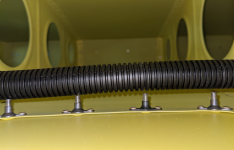
I had the same sort of problem, even using conduit installed in accordance with Van's "Wing Wiring" pdf instructions.

wings_2021-01-03_02.png

I sent this picture off to Van's tech support, and had the following response:

I would suggest slicing another piece of 5/8 conduit and wrapping it around the section that is likely to become affected by possible chafing. Monitor whether this chafing is a problem when you do inspections. I would also consider using shorter screws here as those installed are longer than necessary (even though they may be the specified length).

So, I reduced the screw lengths to a single thread protruding through the plate nuts, which helped a lot. I haven't added another wrap yet, will monitor what happens after flying.

In your case, maybe some spiral wrap around the wire bundle would be a good idea?
 
Not a bad idea, but why make it out of metal, which conducts electricity? 3D print the same piece out of plastic. Or do you plan to attach an Adel clamp to the stand off?
Needs to be attached somewhere and somehow -- this standoff attaches nicely under the nutplates. And yes, I was planning to add cable tie mount at the top and use zip-tie.

I think I'm going back to my original solution , though,-- I played a bit with these "caps" and they are pretty solid. I think, the only concern I have is how robust TPU is over the time -- does it become brittle? less springy?
 
I had another thought. I don't know how much it costs you to print out those caps, but if youre stuck on that idea as the best solution, there's already a domed nut plate that does basically the same thing. In industry they're use instead of the open ended ones to hold on fuel panels because the back side of them is inside the wet wing and if traditional nut plates were used you'd have fuel leaks at every screw hole.

The part number for a #8 screw is NAS1473A08
 
I had the same sort of problem, even using conduit installed in accordance with Van's "Wing Wiring" pdf instructions.

View attachment 99620

I sent this picture off to Van's tech support, and had the following response:

I would suggest slicing another piece of 5/8 conduit and wrapping it around the section that is likely to become affected by possible chafing. Monitor whether this chafing is a problem when you do inspections. I would also consider using shorter screws here as those installed are longer than necessary (even though they may be the specified length).

So, I reduced the screw lengths to a single thread protruding through the plate nuts, which helped a lot. I haven't added another wrap yet, will monitor what happens after flying.

In your case, maybe some spiral wrap around the wire bundle would be a good idea?
Why not use something to nail it down?


IMG_8162.png
 
Put me in the "use a clamp or zip tie" camp. And, think of the next person who might own this airplane... if I had to repair this area on an airplane I'd purchased, I'd pull those things off and replace them with something more "aircrafty", simply because I don't have a 3D printer!
 
Here is another solution that I used on my 9A since first flight in 2009. Go to the "Click Bond" website and search under studs & standoffs. I used one similar to the CB4505 (Composite Base Standoff Stud). Bond it to the skin, attach an adel clap with nut and run your wire bundle through the Adel. It has not loosed up in over 1100 hrs of flight. I used it mainly in my tail cone when I ran wire bundles from the rear to the front and kept the wires from rubbing/bouncing on the bottom skin. Good luck!
 
You are probably having fun, but if one of them comes off, it will be a bear to locate and remove.
I agree about wrapping the bundle. Buy some split corrugated conduit. Slip it on. Zip tie. Monitor at Condition Inspection.
 
I had another thought. I don't know how much it costs you to print out those caps, but if you're stuck on that idea as the best solution, there's already a domed nut plate that does basically the same thing. In industry they're used instead of the open ended ones to hold on fuel panels because the back side of them is inside the wet wing and if traditional nut plates were used you'd have fuel leaks at every screw hole.

The part number for a #8 screw is NAS1473A08
Terry, I'm a fan of the NAS1473-A08 nut-plates for fuel tank use. While they are smooth, and thus less likely to chafe, they are still steel [conductive] and pricey. He could simply print out 3 times as many of those covers as he needs. Then he has a lifetime supply of replacements.
 
Terry, I'm a fan of the NAS1473-A08 nut-plates for fuel tank use. While they are smooth, and thus less likely to chafe, they are still steel [conductive] and pricey. He could simply print out 3 times as many of those covers as he needs. Then he has a lifetime supply of replacements.
Sorry, I should have specified: I realize they're conductive, I was thinking along the lines of sticking the wire bundle to them with a glop of RTV or pro seal and not having to worry about the end of a screw chewing into that wire bundle.

I also think that the level of protection required is largely dependent on what you've got going on with that bundle. If you've got AHARS or canbus wiring going through there, it's a whole different ballgame than if it's just wiring for nav lights or whatever. In my plane, there's nothing in that bundle that would cause a catastrophe if the breaker popped, plus it's inside a corrugated conduit. I used 3/8 screws there instead of 1/2" and called it good. After I flew for a while I pulled those panels off with the intent to build a standoff if it looked like they were rubbing, but nothing was.

If it ever does, my personal plan will be to build some L shaped standoffs, sandwich the short leg under the nut plate and put an adel clamp on the long leg to support the wire. The only thing that scares me more than the idea of fire in a plane is the idea of having a flight control lock up, so I'm not about sticking plastic bits in there and hope they don't come off and go somewhere they shouldn't.

Interesting side note- This exact wire chaffing on a screw tail scenario was theorized to have killed a guy in an F16 back in the 80's. His wife initially won a multimillion dollar judgment against General Dynamics, but it got overturned on the basis of their protected status as a defense contractor.
 
Back
Top