


Van's Air Force

The definitive Van's Aircraft support community! Buying, building or flying an RV? Join our exclusive family of mentors and enthusiasts!

Sky-Tech starter ... destroied

lucaperazzolli

Well Known Member
Patron
Last saturday a friend of mine asked for help, he was not able to start up the engine; checked the battery first, the starter relay and followed the well documented Sky_tec website throubleshooting research. At the end the starter was broken as expected.

Seems like the (part of) starter solenoid stuck with the pin outside (melted). That condition left the starter pinion engaged leaving the starter itself running too fast, until he melted from the inside. A lot of different metal chips were found into the starter motor.

A safety question could be "what if the flight was more than 20 minutes as it was ?" and "could the starter burn or it's case protected ?"

No CB Starter popped out, a little smell after the take off was perceived, reported a noise into the headsets. Airplane has 100 hours, starter comes from FFW kit in 2018, it has 300 cycles circa. Last three flights the starter procedure was not so smart as usual.

I would appreciate your opinion and considerations about.

;)

IMG_1110.jpg
 
Those are lightweight but not known for being heavy duty. I got one and don't crank for more than 6 seconds. Also give long cooling pause between cranking. So far no issues here, where's a piece of wood to knock on
 
Last saturday a friend of mine asked for help, he was not able to start up the engine; checked the battery first, the starter relay and followed the well documented Sky_tec website throubleshooting research. At the end the starter was broken as expected.

Seems like the (part of) starter solenoid stuck with the pin outside (melted). That condition left the starter pinion engaged leaving the starter itself running too fast, until he melted from the inside. A lot of different metal chips were found into the starter motor.

A safety question could be "what if the flight was more than 20 minutes as it was ?" and "could the starter burn or it's case protected ?"

No CB Starter popped out, a little smell after the take off was perceived, reported a noise into the headsets. Airplane has 100 hours, starter comes from FFW kit in 2018, it has 300 cycles circa. Last three flights the starter procedure was not so smart as usual.

I would appreciate your opinion and considerations about.
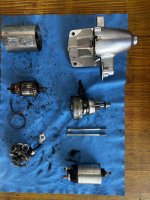
;)

View attachment 90842
I agree with others comments on the subject. One thing I haven't seen mentioned is the possibility of wiring an alert signal / light to indicate a stuck solenoid. Of course the starter would likely be ruined but at least you'd know about it.
 
I agree with others comments on the subject. One thing I haven't seen mentioned is the possibility of wiring an alert signal / light to indicate a stuck solenoid. Of course the starter would likely be ruined but at least you'd know about it.

After starting, I look at the engine oil pressure first, and then the voltage and ammeter next. A stuck starter might manifest as an atypically high draw on the electrical system. Of course, a partially discharged battery would look the same, so I usually check after a few minutes. If it's still high, I shut down to investigate.
 
I agree with others comments on the subject. One thing I haven't seen mentioned is the possibility of wiring an alert signal / light to indicate a stuck solenoid. Of course the starter would likely be ruined but at least you'd know about

A number of folks instrument the "I" terminal from the Starter Relay -- if there is voltage present at "I" it can be inferred that the starter solenoid is at least energized, if not extended/engaged.

Thinking out loud for a moment:
With a PM type starter, you could connect a wire to the starter relay (not the solenoid) output terminal along with a 100K or so resistor to your EFIS/EIS. When the starter relay is energized, there would be voltage present on this output, and the EFIS configured to display a message in that event. When the starter relay is de-energized and there still was voltage present at the output terminal, this would indicate that the starter motor was still engaged. The PM starter motor becomes a generator when turning, thus producing a voltage at the output terminal.

Similarly, this is the "run-on" effect which occurs with PM starters. This is why Van's has you remove the jumper on the Starter Solenoid/Motor and wire the starter solenoid back to the "I" terminal on the starter relay.

This is NOT the same thing/effect for wound field, inline starters.
 
After starting, I look at the engine oil pressure first, and then the voltage and ammeter next. A stuck starter might manifest as an atypically high draw on the electrical system. Of course, a partially discharged battery would look the same, so I usually check after a few minutes. If it's still high, I shut down to investigate.
To all EE's out there. If the starter was to stick with the engine running how much power would it use? Seems it would be just going along for the ride but not my expertise? I do the same as above.
 
To all EE's out there. If the starter was to stick with the engine running how much power would it use? Seems it would be just going along for the ride but not my expertise? I do the same as above.

I had a stuck solenoid and the starter stayed engaged. My amp draw was pegged at 60 amps, the output of the alternator.
 
I had a stuck solenoid and the starter stayed engaged. My amp draw was pegged at 60 amps, the output of the alternator.
Only the bendix drive free wheels, that motor isn't dragged along with it. The motor is still actively spinning and drawing power to do so. It will draw much less current than the typical 2-300 amps, as the load is low, but still will draw a lot, as the motor is designed to do so.
 
Back
Top