

Van's Air Force

The definitive Van's Aircraft support community! Buying, building or flying an RV? Join our exclusive family of mentors and enthusiasts!

Nose Gear Spacer

skelrad

Well Known Member
Friend
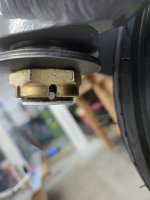
When I set the breakout force on my nose wheel, the nut is a little too far past the pre-drilled cotter pin hole for comfort. I've searched high and low for a washer that will work to take up the extra space, but anything that has a large enough ID is much thicker than I need. McMaster does have 1/16" thrust bearings in sizes that would work. I know nothing about the properties of these - they are either listed as "oil-embedded" or "dry-running " bearings. Is there any reason one of these wouldn't work for this application? Or any other ideas of what I can search on to find something that would fit the 1 1/4" gear and be about 1/16" thick?

https://www.mcmaster.com/products/b...-type~thrust/thickness~1-16/thickness~0-0625/
1744040886928.jpeg
 
Seems like there are a couple of options, but others may have better ideas. One would be a simple shim. If you know someone with a punch, they could perhaps punch one out of aluminum for you. alternatively, you DIY one with simpler tools. You could approximate the stock thickness by tightening the nut to give the appropriate breakout force, then estimating the thickness needed based on the number of degrees that a castle slot is past the hole and the thread pitch. Start a little heavy and take it down a little at a time by trial and error. Another approach would be to start with a second washer (or a heavy shim) and use a surface grinder to get to the correct thickness. Not sure how common surface grinders are in home shops, but a local machine shop would presumably have one. If you use aluminum, there is the potential for differential metal corrosion ovrer time (somewhat dependent on the alloy and if Alclad whether or not a "stock" thickness did the trick), but that would be easy to monitor. Drilling a new hole is of course also an option, but that wouldn't be my first choice. Just my $0.02.
 
Seems like there are a couple of options, but others may have better ideas. One would be a simple shim. If you know someone with a punch, they could perhaps punch one out of aluminum for you. alternatively, you DIY one with simpler tools. You could approximate the stock thickness by tightening the nut to give the appropriate breakout force, then estimating the thickness needed based on the number of degrees that a castle slot is past the hole and the thread pitch. Start a little heavy and take it down a little at a time by trial and error. Another approach would be to start with a second washer (or a heavy shim) and use a surface grinder to get to the correct thickness. Not sure how common surface grinders are in home shops, but a local machine shop would presumably have one. If you use aluminum, there is the potential for differential metal corrosion ovrer time (somewhat dependent on the alloy and if Alclad whether or not a "stock" thickness did the trick), but that would be easy to monitor. Drilling a new hole is of course also an option, but that wouldn't be my first choice. Just my $0.02.
I initially thought of just making a shim out of aluminum since that would be very easy to do, but I wasn't sure if the fact that aluminum is such a soft material would make it less than ideal to use.
 
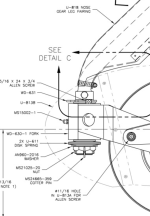
Thank you Butch! I'm not sure how I missed that callout on the plans! It looks like I didn't put that washer under the belleville washer. That would account for the space issue. I'll dig through my hardware and see where that puppy went to. Appreciate it.
 
Thank you Butch! I'm not sure how I missed that callout on the plans! It looks like I didn't put that washer under the belleville washer. That would account for the space issue. I'll dig through my hardware and see where that puppy went to. Appreciate it.
Good catch on the missing washer--I should have looked more closely at the pic. That said, adding the washer may or may not make the cotter pin hole and castle nut slot line up at the proper breakout force, so you may still have a bit of work to do.--either adding a shim or reducing the washer thickness a bit. Good luck.
 
Good catch on the missing washer--I should have looked more closely at the pic. That said, adding the washer may or may not make the cotter pin hole and castle nut slot line up at the proper breakout force, so you may still have a bit of work to do.--either adding a shim or reducing the washer thickness a bit. Good luck.
Breakout changes with very little rotation, putting the washer in will be all thats needed.
 
If shims are needed for nose or mains, Arbor shims are what you are looking for at McMaster or Grainger. Do not use thrust bearings.

The above picture looks to be a new build. If so, there will be a few more adjustments as the U-611's settle in.
 
Breakout changes with very little rotation, putting the washer in will be all thats needed.
Agree that breakout force changes dramatically with just a few degrees movement of the nut. Given how close the holes are to lining up now, my concern wouild be that adding the washer that should be there per plans may be enough to cause breakout to be significantly greater than called for when tightened enough to line up. The only way to know is to put it in and check. If breakout is "right", then happy days. If still off when aligned with a castel slot, there are ways to fix it. I faced this with my plane a few years ago. If memory serves, when aligned with one castel slot breakout was ~19 (v. target of 26). If tightened to align with the next slot, it was somewhere in the upper 30s.
 
I finally found the washer (the one that I embarrassingly just omitted even though it is plain as day on the plans...) and put it in place. The breakout force hit 23 lbs once the holes were lined up. I'm calling that good for now and will recheck after there's been some movement of the fork. I'm sure it will settle in a little bit.
 
Back
Top