

Van's Air Force

The definitive Van's Aircraft support community! Buying, building or flying an RV? Join our exclusive family of mentors and enthusiasts!

RV-10 First Flight!

Tweetr

Well Known Member
Announcing the first flight of my RV-10 project, Plans # 41819!

I'm now halfway through Phase I flight testing, and highly pleased. Performance numbers so far:

Empty weight WITH paint and interior: 1615 pounds (dual Plasma III ignitions, dual Horizon 10.1 EFIS)
24-squared cruise (75% power): 176 KTAS
Cruise at 12,500 ft and max weight: 172 KTAS @ 11 gph. (2400 rpm, 60% power)
Stalls are all benign without wing drop, mostly characterized by mild buffet and nose stagnation. No significant nose-drop.
Flutter testing complete, purely deadbeat response.

The RV-10 is a simply wonderful airplane!
(I flew the first 10 hours with gear and wheel fairings off for engine break-in. They're installed now.)

Tom Stearman
Flying RV-10 since Mar 29, 2025
Flying RV-4 since June 2000 (1610 hrs)1000013292.jpg
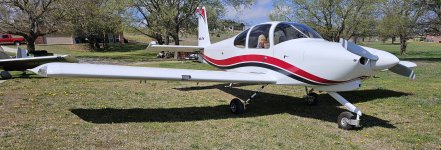
 
Announcing the first flight of my RV-10 project, Plans # 41819!

I'm now halfway through Phase I flight testing, and highly pleased. Performance numbers so far:

Empty weight WITH paint and interior: 1615 pounds (dual Plasma III ignitions, dual Horizon 10.1 EFIS)
24-squared cruise (75% power): 176 KTAS
Cruise at 12,500 ft and max weight: 172 KTAS @ 11 gph. (2400 rpm, 60% power)
Stalls are all benign without wing drop, mostly characterized by mild buffet and nose stagnation. No significant nose-drop.
Flutter testing complete, purely deadbeat response.

The RV-10 is a simply wonderful airplane!
(I flew the first 10 hours with gear and wheel fairings off for engine break-in. They're installed now.)

Tom Stearman
Flying RV-10 since Mar 29, 2025
Flying RV-4 since June 2000 (1610 hrs)View attachment 84520
Tom,
What a feeling.
You go.
Daddyman58
 
Congratulations. Nice looking bird.

Suggest you check your TAS for accuracy. 174 kts on 11 gph without wheel pants seems unlikely. Most of us get around 165 kts at 10 gph at that altitude and that is with wheel pants.
 
Congratulations. Nice looking bird.

Suggest you check your TAS for accuracy. 174 kts on 11 gph without wheel pants seems unlikely. Most of us get around 165 kts at 10 gph at that altitude and that is with wheel pants.
The red stripes make it go faster! That's my mistake, mine's painted blue.

But seriously, do a run flying a square in smooth air AFTER you do a pitot-static calibration to find any leaks. Check out this kitplanes article: https://www.kitplanes.com/flight-testing-static-system-error-theory-and-practice/
 
Congratulations. Nice looking bird.

Suggest you check your TAS for accuracy. 174 kts on 11 gph without wheel pants seems unlikely. Most of us get around 165 kts at 10 gph at that altitude and that is with wheel pants.
Yes, that would be!
Those numbers are from the first flight after installing gear leg fairings and wheel pants. GPS average groundspeed matched those numbers.

Without fairings, running at 75% power and best power mixture, I saw 164 KTAS at Lycoming's recommended 5500 feet break-in altitude. Hellacious fuel flow! But seeing 164 without the fairings gave me high expectations for when I put 'em back on! They account for about 10 knots, which is in keeping with Van's published testing.
 
Congratulations. Nice looking bird.

Suggest you check your TAS for accuracy. 174 kts on 11 gph without wheel pants seems unlikely. Most of us get around 165 kts at 10 gph at that altitude and that is with wheel pants.
Here you go:
This is a shot testing downwind at 13,500. Upwind was 106 GS.
(239 + 106)/2 = 172.5!
Yay!
(If you're wondering, I LOVE this airplane!)

1000013372.jpg
 
Here you go:
This is a shot testing downwind at 13,500. Upwind was 106 GS.
(239 + 106)/2 = 172.5!
Yay!
(If you're wondering, I LOVE this airplane!)

View attachment 84558
I don't think you get accurate results from that method. You need to get the NTPS spreadsheet and do 3 or 4 leg tests. A user here posted that SS. I am not saying that your plane isn't faster than mine, just encouraging you to validate. That said, from my time here, I have not seen many outliers on speed. Most all do about the same. Those that have tuned injector nozzles and have EI tend to do a bit better in efficiency. Pretty rare for someone to tell us they are doing 174 @ 11 gph. Most say 165 @ 10.5-11 gph around 8-10K.
 
I don't think you get accurate results from that method. You need to get the NTPS spreadsheet and do 3 or 4 leg tests. A user here posted that SS. I am not saying that your plane isn't faster than mine, just encouraging you to validate. That said, from my time here, I have not seen many outliers on speed. Most all do about the same. Those that have tuned injector nozzles and have EI tend to do a bit better in efficiency. Pretty rare for someone to tell us they are doing 174 @ 11 gph.
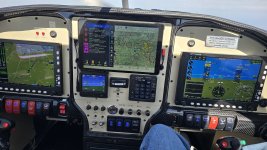
Well, sure, these are the first test numbers. (172 KTAS at 11 gph.) Detailed testing will follow in the next 20 hours with multiple runs at each altitude. Not to worry. You can't quite see the BSFC readout on the left screen, but it shows 0.43 pounds of fuel per horsepower hour, right in line with the Lycoming charts at best efficiency mixture. Over there on the left screen you can just see the 6 EGTs are very close, even without tuned injectors! It's a very nice engine.

Bill Wagner of Skyboss Aviation in TUL built my engine to IO-540-C4B5 specs, but with dual Plasma IIIs, Millenium cylinders, and piston oilers as in its original -J4A5 configuration. Thus it's now an IO-540-X. Bill does absolutely beautiful work. I've seen others of his engines and been impressed, which is why I selected him.

Build 'em straight, build 'em light. Pay attention to sealing the pressure plenum, as the majority of drag in air-cooled piston-powered airplanes is cooling drag.
 
Last edited:
Here you go:
This is a shot testing downwind at 13,500. Upwind was 106 GS.
(239 + 106)/2 = 172.5!
Yay!
(If you're wondering, I LOVE this airplane!)
Of further interest:
At 29 degrees F, I had the front seat heat, rear seat heat, and defrost just cracked open to stay toasty warm. Those heaters are highly effective! They are just the stock Van's firewall heat valves and plumbing, but electrically operated. The center tunnel is just slightly warm to the touch (with no insulation at all), not hot as I've experienced in other RV-10s I've flown. That suggests I did a good job sealing the valves closed with a film of cured sealant under the valve doors. I also used sealant between the valve flanges and the firewall, and between the firewall and the tunnel flanges on the aft side during installation, to reduce conductive heat transfer. Looks like it worked!
 
Well, sure, these are the first test numbers. (172 KTAS at 11 gph.) Detailed testing will follow in the next 20 hours with multiple runs at each altitude. Not to worry. You can't quite see the BSFC readout on the left screen, but it shows 0.43 pounds of fuel per horsepower hour, right in line with the Lycoming charts at best efficiency mixture. Over there on the left screen you can just see the 6 EGTs are very close, even without tuned injectors! It's a very nice engine.

Bill Wagner of Skyboss Aviation in TUL built my engine to IO-540-C4B5 specs, but with dual Plasma IIIs, Millenium cylinders, and piston oilers as in its original -J4B5 configuration. Thus it's now an IO-540-X. Bill does absolutely beautiful work. I've seen others of his engines and been impressed, which is why I selected him.

Build 'em straight, build 'em light. Pay attention to sealing the pressure plenum, as the majority of drag in air-cooled piston-powered airplanes is cooling drag.
By the way:
Imagine what this thing could do with a tailwheel, instead of that excrescence of a nosewheel hanging under its nose!
This RV-10 is the first nose-dragger we've ever owned. When I carried the nose strut down from storage to install it on the fuselage, I was offended at how much that thing weighs, to say nothing of the added drag! Put a tailwheel on that airplane as God intended all airplanes to fly!

Are you listening, Van's? Make me a tailwheel RV-10 kit and I'll build it and fly it! Whaddaya say?
 
The secret to Tom's speed is clearly flying from the right seat. Counters the torque/P without the need for aileron input and the associated drag.


Or not.


:LOL:
 
The secret to Tom's speed is clearly flying from the right seat. Counters the torque/P without the need for aileron input and the associated drag.

I built the cockpit completely symmetrically, with all the engine systems in the middle panel and Aerosport quadrant armrest. You can fly it with equal ease from either seat. An ex-USAF pilot, I prefer the stick in my right hand and throttle in my left, so the right seat will normally be mine. If this rain will ever stop, my next test flight will be from the left seat to verify autopilot control and such from the left.

I'll report back on any speed difference!
😁
 
Last edited:
Never understood the sinister desire to commit the left hand to manipulating the avionics knobs and buttons by devoting the right hand to the stick, but to each his own.
 
Never understood the sinister desire to commit the left hand to manipulating the avionics knobs and buttons by devoting the right hand to the stick, but to each his own.

Well naturally I want the dextral on the stick and the sinistral on the throttle and switches!
:)
 
Yes, naturally - if you're a southpaw. I've operated a lot of radio for a lot of years, and never found myself twisting knobs (or sending code) with my non-dominant hand. It just don't fly. 🤷‍♂️

I have no doubt that right hand on joystick would be an easy transition for me, but left-handed button-ology would present a bridge too far.

Let us know if the left of centerline seating gains or costs you a fractional knot, though. That's a very fast -10 you have :)
 
Yes, naturally - if you're a southpaw. I've operated a lot of radio for a lot of years, and never found myself twisting knobs (or sending code) with my non-dominant hand. It just don't fly. 🤷‍♂️

I have no doubt that right hand on joystick would be an easy transition for me, but left-handed button-ology would present a bridge too far.

Let us know if the left of centerline seating gains or costs you a fractional knot, though. That's a very fast -10 you have :)
+1. As a cfi I frequently find myself in the right seat, and I’m very much right handed. Operating touch screens with my left hand, I must hit the wrong spot 50% of the time! Fortunately I’m rarely actually doing the flying from the right seat so I reach across my body and use my right hand for the screens/knobs. My real problem is with center mounted manual trim. My right hand very quickly gets it ‘just right’. My left hand gets it close, but it seems to take forever to be ‘just right’.
 
Well, sure, these are the first test numbers. (172 KTAS at 11 gph.) Detailed testing will follow in the next 20 hours with multiple runs at each altitude. Not to worry. You can't quite see the BSFC readout on the left screen, but it shows 0.43 pounds of fuel per horsepower hour, right in line with the Lycoming charts at best efficiency mixture. Over there on the left screen you can just see the 6 EGTs are very close, even without tuned injectors! It's a very nice engine.

Bill Wagner of Skyboss Aviation in TUL built my engine to IO-540-C4B5 specs, but with dual Plasma IIIs, Millenium cylinders, and piston oilers as in its original -J4A5 configuration. Thus it's now an IO-540-X. Bill does absolutely beautiful work. I've seen others of his engines and been impressed, which is why I selected him.

Build 'em straight, build 'em light. Pay attention to sealing the pressure plenum, as the majority of drag in air-cooled piston-powered airplanes is cooling drag.
Okay, all you nay-sayers! I'm crunching reams of data from over 7 hours of flight test yesterday in mostly smooth air and less wild wind at altitude, and I can confirm: True airspeed is within 1 to 2 kts of average groundspeed at all data points from 2000 ft to 17,500 in 1000-ft increments.

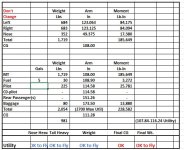
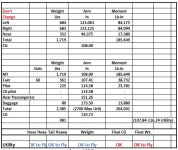
Then I ran two long, sustained box patterns at 12,500 where I will normally cruise the airplane. Yesterday's test was ballasted to max gross weight and CG at Van's aft limit in the landing condition (limiting condition). The results are in!

12,500, alt 30.14, 18 deg F, 18.2" MP, 2400 rpm, 11.1 gph, 61% power, 0.42 BSFC, 15.0 air nm/gal, autopilot on hdg/alt hold:

N: 169 TAS/161 GS
E: 170 TAS/174 GS
S: 168 TAS/181 GS
W: 170 TAS/168 GS

Avg TAS = (169+170+168+170)/4 = 677/4 = 169.25 KTAS
Avg GS = (161+174+181+168)/4 = 684/4 = 171 Kts GS

And then I ran it again at 29.92 for confirmation with the same results.

The gross weight was substaintially higher at this test than the first one reported above. In my testing the additional weight costs 1 to 2 KTAS at altitude. At 6500 MSL (the fastest case tested) I got 176 KTAS on 13.5 gph, 23.5 MP, 2400 rpm, 75% power.

The difference I calculated at each altitude was very consistent. More than 60 data points taken at 1000-ft intervals, done twice each. I'm actually flying 1 to 2 knots faster than the TAS displays. ;-)

But, nay-sayers gon' say nay!

(I'm just kidding. I don't mind. All suggestions are welcome!)
 
Last edited:
At 6500 MSL (the fastest case tested) I got 176 KTAS on 13.5 gph, 23.5 MP, 2400 rpm, 75% power.

Oh, by the way, you can file this under "Why the RV-10 is a better airplane than the SR-22!"

I flew a dealer CFI demo in a Cirrus SR-22 at KHQZ. The demo pilot was very pleased to show me the 180 KTAS cruise at 6500 at 75% power. We were burning 18 gph! Compare that to my 176 KTAS at 13.5 gph!

I attribute the difference to weight. As we know, weight is the REALLY bad number. If you're familiar with John Boyd's elegant specific excess power formula (which quantifies the ability to turn, climb, or accelerate at a given flight condition):

P-sub-s = (T-D)*V/W

Thus thrust and velocity are the good numbers; drag is a bad number; and weight is the REALLY bad number.

That SR-22 that he demoed had an empty weight (if memory serves) of 2350 lbs! Compare that to my 1615 empty. Thus my normal cruise weight is comparable to the SR-22 empty weight! Weight costs money and speed.
 
Yesterday's test was ballasted to max gross weight and CG at Van's aft limit in the landing condition (limiting condition).
You want to be careful with this. The -10 has the slightly unusual quirk that if you take off very close to the cg limit (either fore or aft) then as you burn fuel the cg moves toward that limit. e.g., if you took off right at the aft cg limit, by the time you landed you would have been beyond the aft limit, unless you were able to move ballast forward before landing.
Like many others, I have a spreadsheet program on my iPad for weight and balance. But my program also automatically calculates cg at zero fuel, and issues a warning if it’s going to be out of limits. I recall one xc trip where I knew I had to land with no less than 20 gal of gas remaining (or have the aft seat passengers move some luggage to their feet!).
 
P-sub-s = (T-D)*V/W
The physicist in me cannot let this go. The above equation is not dimensionally correct. The left hand side is not excess power, but excess power divided by weight, which is equal to the rate of climb. Which is what you wrote about.
 
The physicist in me cannot let this go. The above equation is not dimensionally correct. The left hand side is not excess power, but excess power divided by weight, which is equal to the rate of climb. Which is what you wrote about.

Correct. The above formula is for "specific" excess power. Specific to weight. Very elegant formula for which Boyd's derivation was highly complex, but the result very easy to quantify, compare among dissimilar fighters, and understand. "Had to make it so simple even a general could understand it," was Boyd's remark.
 
Last edited:
You want to be careful with this. The -10 has the slightly unusual quirk that if you take off very close to the cg limit (either fore or aft) then as you burn fuel the cg moves toward that limit. e.g., if you took off right at the aft cg limit, by the time you landed you would have been beyond the aft limit, unless you were able to move ballast forward before landing.
Like many others, I have a spreadsheet program on my iPad for weight and balance. But my program also automatically calculates cg at zero fuel, and issues a warning if it’s going to be out of limits. I recall one xc trip where I knew I had to land with no less than 20 gal of gas remaining (or have the aft seat passengers move some luggage to their feet!).

Absolutely correct.
In my CG spreadsheet, oil and fuel move the CG forward, while everything else moves it aft.
Thus the limiting condition for aft CG is the landing condition, not the takeoff condition. I start my calculation with desired landing fuel (usually 12 gallons), and check CG, then load fuel up to the necessary gross weight. In some loading scenarios (lots of baggage) it is desirable to land with ballast fuel, as that keeps the CG in limits.

Yes, that could be a gotcha in the RV-10.
 
Last edited:
Absolutely correct.
In my CG spreadsheet, oil and fuel move the CG forward, while everything else moves it aft.
Thus the limiting condition for aft CG is the landing condition, not the takeoff condition. I start my calculation with desired landing fuel (usually 12 gallons), and check CG, then load it up to the necessary gross weight. In some loading scenarios (lots of baggage) it is desirable to land with ballast fuel, as that keeps the CG in limits.

Yes, that could be a gotcha in the RV-10.
Burning fuel changes the CG a little less than 1/2 inch. (note: arm moves as fuel is burned) whereas 40 lbs. in the baggage area moves it over twice that. I never load within 1.00 in. either side.

Screenshot 2025-04-07 201309.jpgScreenshot 2025-04-07 201226.jpg
 
Back
Top