


Van's Air Force

The definitive Van's Aircraft support community! Buying, building or flying an RV? Join our exclusive family of mentors and enthusiasts!

Avionics/Engine Ground Advice

kirkbauer

Well Known Member
My apologies for a question similar to a previous question I posted, but this time I'm going to try to make it more specific. I am working on my RV-10 build and I'm using the chassis for ground and I have my batteries in the tailcone. Below I have a picture of my avionics grounding block installed in my avionics bay. I have removed the primer and used alodine under this ground block. My resistance is zero ohms back to the batteries and I haven't even riveted the forward fuselage into place yet -- I assume it is going through the clecos. But without buying or creating a milliohm meter I can't be sure of just how well this is connected to the tailcone.

I also will need a small grounding block for the engine compartment, which I assume I will mount on the firewall. I know that stainless steel is not a great conductor.

My thought was -- do I want to consider mounting a grounding block on the firewall, and then attaching a grounding strap from that to somewhere with thicker aluminum (perhaps down in the tunnel?). If so, should I consider placing a grounding strap from the avionics ground in the photo below to that grounding block on the firewall? Or should I just skip all of the grounding straps and just rely on the metal to do the work for me? There are certainly a lot of paths from the current avionics ground to the chassis. For the grounding block on the firewall, I'm not sure what will be attached there yet but I don't think it will be anything with substantial current or where resistance will be critical. I'm assuming here that the starter will be grounded to the engine mounts via the engine block.
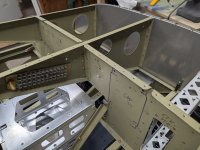

2025-03-01 11.36.26.jpg
 
I suggest:
- Take the huge Forest of Tabs block and cut it in half
- Mount the half with the big bolt on the firewall (yes, stainless steel is a very good conductor). Mount with the tabs on the cabin side of the firewall. Ground all you other runs beside avionics here (like NAV/Strobe/LL, Pitot heat, autopilot servos and such).
- Ground the engine (the big fat wire) to the bolt that is now on the engine side.
- Run a #10 wire from the cabin side of that big bolt to the other half of the forest of tabs - perhaps located where you have it now.

Note - I never mount anything between the firewall and the first aft bulkhead. This makes maintenance a PITA. I find in even the RV-8 there is plenty of room to mount remote stuff like XPDR and Comm #2 on the bulkhead just forward of the panel.

Carl
 
Last edited:
- Take the huge Forest of Tabs block and cut it in half

I assume this is just to reduce the size and weight since I don't need nearly that many tabs on the firewall?

Note - I never mount anything between the firewall and the first aft bulkhead. This makes maintenance a PITA. I find in even the RV-8 there is plenty of room to mount remote stuff like XPDR and Comm #2 on the bulkhead just forward of the panel.

It's probably hard to tell in the photo, but the only thing I have in the "forward avionics bay" is the GTX 45R, but it can be removed easily from its mounting tray -- if I remove my MFD I can pull the transponder directly out through the screen opening. I think it is a good solution since the "front" of the transponder needs to point towards the front seats for Bluetooth connectivity. The only time I would need to access the forward avionics bay is if I needed to remove the connectors from that mounting tray. I figure as long as the service loop is long enough it won't be hard to work on those connectors, but it may be a pain to get them removed and re-installed.

In any case, yes I agree with this advice and I was able to fit everything else fully in the aft avionics bay. All of my chicken scratch shows the mounting locations. I have installed nutplates on the forward side of that center bulkhead.
 
Do NOT use the engine mount for grounding. Run a separate braided strap or other conductor from the engine to the firewall.
 
I completely agree with the sentiment expressed by Carl, but I do not like a forest of tabs on the firewall. It's too far from the panel and too inflexible. I build small, insulated, tab blocks or lines of ground studs taking a thick ground wire back to one point on the firewall. Avoiding ground loops is essential for a quiet intercom.
 
Do NOT use the engine mount for grounding. Run a separate braided strap or other conductor from the engine to the firewall.

OK, good to know. I'm pretty firewall-forward ignorant at this point so I think I had just heard that and didn't ask any questions. My understanding, is that the starter does use the engine block for its ground, so then I'd want to really make sure the engine is grounded well to the airframe so that it doesn't introduce unnecessary resistance into the starting circuit. Given that stainless steel has ~half the conductivity (in other words, twice the resistance) of aluminum, is it really best practice to rely on the firewall as part of the path to ground for the starter?
 
is it really best practice to rely on the firewall as part of the path to ground for the starter?
Yes.
Stainless steel might not be the best conductor. But electricity flows in all directions (360 degrees) from the attachment point. All of those parallel paths reduce the resistance to very little. Think of it like this: Suppose you cut 1000 pieces of stainless steel wire each 18 inches long. Connect one end of each wire to the starter motor frame. You connect the other end of each wire to the battery negative terminal. The starter motor will run like normal. Even though each stainless steel wire has resistance, there are so many of them in parallel that the total resistance is very low.
If you are still concerned, run two ground straps from the engine block to the firewall, one on the left side and one on the right side. There will be a backup in case one fails.
 
Back
Top