

Van's Air Force

The definitive Van's Aircraft support community! Buying, building or flying an RV? Join our exclusive family of mentors and enthusiasts!

„Optimizing Induction Air“ - I‘ve questions

Hi Guys,

I have read the article by Dave Anders “optimizing induction air”.
However, I have a question of understanding regarding my application (RV-4, O-320, Marvel Schebler UPDRFAFT Carb).

It is clear that a conical airbox can increase the pressure by using the Venturi-/Bernoulli-effect. But due to, the updraft construction the airbox cannot be directly in front of the carburetor/throttle body. This is why at the end of the airbox a pipe the carburetor inlet is required. This pipe has a smaller diameter than the airbox.
I wonder whether this pipe will cancel the pressure increase generated in the airbox due to the smaler diameter.

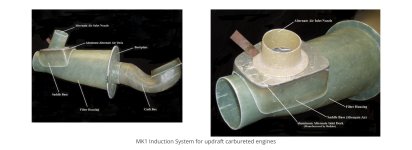
Example pictures are from jamesaircraft.com
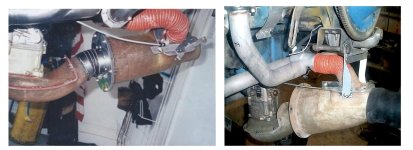
IMG_1586.jpeg
IMG_1588.jpeg
 
Last edited:
also have a rv6 with updraft carb setup. I would love to know how the above compares to the stock vans airbox. I was told the stock airbox required lots of tweaking to get the flow to balance correctly to all cylinders and its best not to mess with it. Would be great to see a before and after of the james aircraft setup with egt, map, etc
 
In an ideal flow with no losses of "total pressure", each time you speed flow up, the local pressure goes down. Each time you slow the flow down, the local pressure goes up. But (in an ideal flow) the total pressure will be constant. You can not magically create more total pressure, other than by tapping into a flow source that already has a higher total pressure (a ram-air intake). It doesn't matter what you do to repeatedly slow flow down and speed flow up, you will still end up with the same pressure at the throttle plate.
It is, however, pretty easy to LOSE total pressure by slowing flow down inefficiently - that is - with local flow separation that dissipates energy. Every time you try to slow flow down in a duct or chamber, you run the risk of losing some of your total pressure. The best thing you can do is slow the flow down externally by using a large inlet scoop. The external deceleration (diffusion) is essentially loss-free. Now, once you take that low-velocity, high pressure air onboard, the best thing you can do is keep it slow by keeping the ducts big. It will eventually have to speed up and slow down through the carburetor venturi and throttle -- not much you can do about that. But there is no good reason to take that ram air on board, speed it up and then slow it down again if you don't have to.

Folks will be quick to point out that the induction system is not a constant flow system. The pressure waves bounding back and forth in the induction tubes (and in the intake plenum) can be timed to provide locally higher pressure at the intake valves, and lower pressure at other times that may not matter. The pressure fluctuations are supposed to be averaged out in the intake plenum/manifold. But usually the intake plenum is not really big enough. It may not be a reservoir of air that can supply the flow demanded by each cylinder when its intake valve opens. But, the combination of the plenum and the other induction tubes does have just about enough volume (depending on the engine). Also -bear in mind that each of the four intake valves is open for about 180 degrees of engine rotation, and over the course of two engine revolutions, all four cylinders intake for about 1/4 of that time. So on average, there is always an intake stroke going on among the four. So the flow in the air box and through the carburetor/throttle body is fairly constant, with only modest pressure fluctuations.

Thinking back to my sports car days, it was not uncommon to have an intake manifold with too short a runner length (insufficient plenum volume) and multiple carburetors - often one carburetor for every two cylinders. In that kind of induction system, there is an intake stroke going on only about half the time for each carburetor's flow path. The flow in the intake runners have to keep starting and stopping. With insufficient manifold runner length, it would be common to see a fuel mist cloud pulsing in and out of the mouth of each carburetor. This would all be even worse if you had one carburetor per cylinder, as many did. But those observations are not really applicable to a single carburetor induction system where, as I said, on average there is always an intake stroke going on and so the flow through the throttle plate is more nearly constant.
 
Last edited:
All that being said, the example shown above from jamesaircraft.com is not just expanding and contracting the duct area for the heck of it. There is a conical air filter inside there, and the large filter canister is just trying to keep the velocities low while flowing through the filter to reduce the pressure losses through the filter. This is much the same objective as Rod Bower's filter canister, and mine (see hpaircraft.com ram-air intake). If you want full-time filtered intake air (like my Type 3 Intake), this is the way to do it. If you are willing to intake unfiltered air while 'up and away' (not usually much dust up at cruise altitude), then the best thing is to go straight down through the center of that filter canister and keep the full ram pressure all the way through to the carburetor/throttle body face.
 
All that being said, the example shown above from jamesaircraft.com is not just expanding and contracting the duct area for the heck of it. There is a conical air filter inside there, and the large filter canister is just trying to keep the velocities low while flowing through the filter to reduce the pressure losses through the filter. This is much the same objective as Rod Bower's filter canister, and mine (see hpaircraft.com ram-air intake). If you want full-time filtered intake air (like my Type 3 Intake), this is the way to do it. If you are willing to intake unfiltered air while 'up and away' (not usually much dust up at cruise altitude), then the best thing is to go straight down through the center of that filter canister and keep the full ram pressure all the way through to the carburetor/throttle body face.
can your version be adapted for updraft carburetor setup? or is it only for fuel injection horizontal intake?
 
can your version be adapted for updraft carburetor setup? or is it only for fuel injection horizontal intake?
It is designed for forward (horizontal) induction. Conceivably a transition elbow could be used to adapt to an up-draft carb set up. You could even buy the transition adapter from James Aircraft that is pictured here, and then fit one of our ram-air intakes to it. That might be pretty straightforward and work quite well. I would think some kind of support bracket would be needed to help carry the weight of the filter canister and ram-air butterfly. And of course, with any intake, you will need to make the inlet scoop in the cowl - which is not hard at all.
 
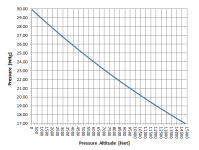
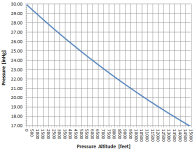
If I look at this chart, am I correct in saying that my induction losses are offset by the ram air pressure in my system?

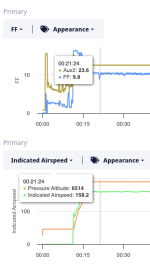
The chart shows that at 6500ft Pressure Altitude the theoretical MP would be about 23.5", and when I look at my actual MAP I see about 23.6".

1750101116521.png


1750100945805.png
 

Attachments

  • 1750100892929.png
    1750100892929.png
    24.2 KB · Views: 1
Hi Guys,

I have read the article by Dave Anders “optimizing induction air”.
However, I have a question of understanding regarding my application (RV-4, O-320, Marvel Schebler UPDRFAFT Carb).

It is clear that a conical airbox can increase the pressure by using the Venturi-/Bernoulli-effect. But due to, the updraft construction the airbox cannot be directly in front of the carburetor/throttle body. This is why at the end of the airbox a pipe the carburetor inlet is required. This pipe has a smaller diameter than the airbox.
I wonder whether this pipe will cancel the pressure increase generated in the airbox due to the smaler diameter.
As I chase this same issue for a CAS IO-540, I reflect back on bad ideas that that others have tried. In short, for an updraft engine there are few, if any setups better than the standard FAB for MP recovery. You can expect at least a 0.5” MP bump using that.

For me I’ll make a filter box for a flat filter along the lines Dan Horton’s. For my engine 70 sq-in is what K&N recommends.

Carl
 
Back
Top