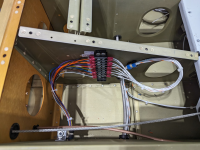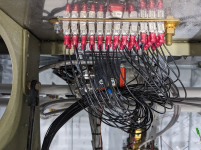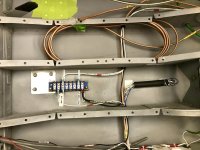


Won't debate the use of the block but connector(s) would have been easier IMO. If you stick with this approach, the screws should have some locking device as they are in blind holes.I put terminal blocks in place for my connection between the wing and fuselage wiring. Do I need to use Loctite on these screws? The terminals seemed like a very straight forward solution to making the connection from the wings, but if I'm wrong and it's a terrible idea, I'm all ears.
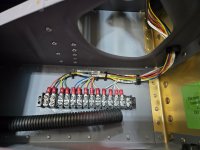
View attachment 75701
I don't have space to attach the wings and leave them on before I haul everything to the airport. I wanted to be able to finish as much wiring as possible at home and not have to pull wire down the road. That's the only reason I'm using a connection point. I thought about using butt splices or solder sleeves. I can't say that I had any strong rationale for choosing terminal blocks over them - I just had a few spare blocks sitting around and figured they would work fine.Do we need a removable connection for the wing wiring? If you need to terminate them at the root solder sleeves or high quality butt splices are pretty easy and reliable. If you have to take them apart it means you are removing the wings and reworking a couple dozen little wires that will pale in comparison to the rest of the job.
I put terminal blocks in place for my connection between the wing and fuselage wiring. Do I need to use Loctite on these screws? The terminals seemed like a very straight forward solution to making the connection from the wings, but if I'm wrong and it's a terrible idea, I'm all ears.
View attachment 75701
Spade connectors are quicker and make a superior mechanical and conductive connection.Do we need a removable connection for the wing wiring? If you need to terminate them at the root solder sleeves or high quality butt splices are pretty easy and reliable. If you have to take them apart it means you are removing the wings and reworking a couple dozen little wires that will pale in comparison to the rest of the job.
I used Goop: https://www.amazon.com/gp/product/B000CCID28/ref=ppx_yo_dt_b_search_asin_image?ie=UTF8&psc=1Did you use epoxy to attached the terminal blocks to the skin? Just curious b/c I'm thinking of doing the same thing.
I’ve used lots of these terminal blocks in my wiring setup over the years with no problems. However, putting that small screw and lock washer through a ring terminal in a difficult to reach area can be a challenge. Then I discovered these (below). Make sure you connect the spade ‘Wing’ with lock washers to the terminal block (before installing the terminal block where you want it.Spade connectors are quicker and make a superior mechanical and conductive connection.
I agree, terminal blocks are fine for lights and misc stuff, stick switches etc. but never for 'signal' or low-level stuff though.As long as there's a lock washer under the screw heads I don't see why you would need lock-tite. Industry wide there are jillions of switches and breakers that have ring terminals screwed down that way.
I personally wouldn't do this for something like can bus wiring but that's a different topic and just my opinion.
Can you elaborate for me just so I understand the rationale of why they may not be okay for signal wires (ex: using it for ALL wiring coming from the wings, which would include the autopilot servo). If it's that bad, I could pull those wires from the terminal block and just throw on a dsub connector for the AP.I agree, terminal blocks are fine for lights and misc stuff, stick switches etc. but never for 'signal' or low-level stuff though.
Of course, nothing is better than none.
Because even small amounts of resistance from connections can cause problemsCan you elaborate for me just so I understand the rationale of why they may not be okay for signal wires (ex: using it for ALL wiring coming from the wings, which would include the autopilot servo). If it's that bad, I could pull those wires from the terminal block and just throw on a dsub connector for the AP.
That may be the case on a new aircraft. However the practice would be considered unprofessional. You don't see this on a certified aircraft.Im pretty sure the discontinuity caused by the addition of the terminal block and the ohmic loss of the screw connectors on a typical 500 kbps serial buss would be negligible. Same for the 0-5 v analog signals.
I have seen MANY spade connectors that had corrosion, and the contact force from a terminal connection can easily exceed that of a traditional spade connection.The contact surface on an eye to washer is huge compared to a spade connection.
The spade connection actually scratches into the face of the spade. The eye connection with a screw will not produce the contact force that the spade will. And will leave a surface that is subject to corrosion and increased resistance.
There're lots of good comments and discussion above and the only additional thought is to ensure that there are drain holes in the belly at appropriate locations and also to seal the seam within the wing root area where the fuselage sides and belly skin meet up. Water can otherwise leak in past the wing root fairings and run into the cockpit floor and the terminal block should naturally be kept dry.I put terminal blocks in place for my connection between the wing and fuselage wiring. Do I need to use Loctite on these screws? The terminals seemed like a very straight forward solution to making the connection from the wings, but if I'm wrong and it's a terrible idea, I'm all ears.
View attachment 75701
I have kind of debated this with myself. On the one hand it is nice for a wire not to flop around. On the other hand I like things to fail in an clearly obvious fashion. A loose screw on a ring terminal could be hard to find. Sometimes the circuit works, sometimes it doesn't. With a fork style terminal when it falls out it will be obvious. I still haven't decided which is better.I'd suggest using ring terminals instead of forks. Dune buggy folks learned this lesson with forks slipping off of a loose screw and stranding them in the dunes for lack of a screwdriver lol.
I did the same. Pre-wiring all the possible stick button functions I could think of (10) on the terminal block allows me to easily change a button function (4). I’ve done it twice.We used terminal blocks for the stick wiring connections. They should have lock washers for the screws.
View attachment 75729
Agree 100% with the pain and frustration of trying to troubleshoot intermittent electrical problems. I blame most of my alcoholism on it!I have kind of debated this with myself. On the one hand it is nice for a wire not to flop around. On the other hand I like things to fail in an clearly obvious fashion. A loose screw on a ring terminal could be hard to find. Sometimes the circuit works, sometimes it doesn't. With a fork style terminal when it falls out it will be obvious. I still haven't decided which is better.