

Van's Air Force

The definitive Van's Aircraft support community! Buying, building or flying an RV? Join our exclusive family of mentors and enthusiasts!

RV-7 Gear leg fairing help

Non-builder and RV-7 owner here looking for some help.

We found some chafing in the rigid brake lines where they had come in contact with the fiberglass and each base of the gear leg. And so, I had to remove the fairings to remove the brake lines. My original gear leg fairings were affixed to the gear legs with window seal foam and no clamps at all. Bad for all sorts of reasons, to include moisture. Aside from stripping (it’s powdercoat, so not going well) and painting the gear legs (because the powdercoat has failed and you guessed it, corrosion) before I install some pre-made brake lines I’m trying to figure out the final step of installing new gear leg fairings.

You might ask: “Why don’t you just install the old fairings?” Well, I’m not sure it’s possible to remove all the old foam and epoxy from inside the fairing to then get a good fit again on the gear leg.

So that leads me to two options:
1) buy the kit from Van’s and re-install them the correct way I’ve seen on the plans and within this forum and spend a ton of time AND/OR
2) Get the airplane flyable and fly it to one of you experts to help me or do it for me and save some time but spend some more money

I’m a fairly busy Air Force guy working full-time with some trips coming up soon and am curious how much of a process this is before I dive in. I’m not against doing this project on my own but cutting, fitting, priming and painting these things after an already long CI seems somewhat unfeasible for me right now.

If any of you have some insight or are willing to help close to the state of Virginia, I’d love to hear your thoughts and insights.

Thanks,
Ryan
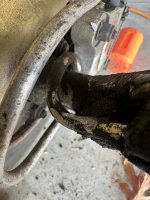
 
The original issue that opened this can of worms for anyone curious. The chafing was so close to the wall that when I moved the brake line to spin it around to remove it, it ripped like a thin piece of paper.
 

Attachments

  • IMG_4922.jpeg
    IMG_4922.jpeg
    1.4 MB · Views: 130
The inner surface of the fiberglass fairings are like sandpaper becuse they are unfinished low resin glass fiber. I sanded ,filled and painted the inner surfaces of mine with teflon infused urethane. They need to be sealed and painted or layered with robust tape at a minimum. The gear leg and anything that comes in contact should be tape wrapped or protected by some means. Securing them is also important, and there is a ton of movement going on, so the top is secured and the bottom "floats" in the wheel pant fairing.
 
If you are not the builder, and/or not familiar with the actual process, there is more to mounting the fairings than might meet the eye. Especially since you’d be doing it in reverse order (i.e. after upper/lower fairings already fitted).

Getting them “faired” - aligned with the airstream, to reduce drag/asymmetric drag can be an issue all by itself.

It is a “project”, and finding help would help …

I’m sure others will chime in about how easy this is to do, so take this as a single “point” response …

HFS
 
Surely there have to be some other RV builder/owners in the Fort Walton Beach or Pensacola area that could help. Since this isn't a one-afternoon project, going to them probably isn't your best bet. But maybe they'll be willing to come help you get started in your hangar. The gear leg fairings aren't that hard, but there are some important points that you need to work through. If it was flying straight and true before, then maybe you can use the upper and lower intersection fairings as alignment points and save a lot of work. If the ball wasn't centered and you're wanting to correct that, you may have a good chunk of work ahead of you. It's doable, just don't convince yourself you'll be back flying in a few days.
 
Thanks for all the replies. I’m hoping to get it sorted using the pre-existing pants and intersection fairings. I may give the fuel truck a try and see if I can clean these up enough to re-install.

The original fairings were streamlined and no yaw issues. I live in Virginia now, no longer in Florida
 
Hey! I grew up in Virginia...I miss it.

There are some videos out there on installing gear leg fairings, and a whole bunch of websites where people discuss the trials and tribulations of these fairings. If you can clean up and salvage your existing parts, you'll save yourself a lot of time. BTW, it looks like the brake tubing got scuffed pretty badly--that likely needs to be replaced. I used the pre-made Teflon brake hoses from TS Flightlines and they fit and work great. Just an option to save some time.
 
Nice! Hopefully you lived in a nicer part of VA than I do.

I bought the TS flight lines brake lines, just waiting on a bunch of ADEL clamps to install. I’ll see how the fuel trick works on the existing fairings for the foam then go from there. I’ve seen some mods to the mounting parts that looks like a good addition, may go that route.

Thanks!
 
Thanks for all the replies. I’m hoping to get it sorted using the pre-existing pants and intersection fairings. I may give the fuel truck a try and see if I can clean these up enough to re-install.

The original fairings were streamlined and no yaw issues. I live in Virginia now, no longer in Florida
ON MY rv7, I installed teflon lined stainless steel braided #4 lines and used teflon tape where attached to the gear leg. Purchased from Summit Racing down in McDonnough GA. They were sized from chart online and wrapped at attach points with teflon tape. Also used in the interior for peddle connections to master cylinders. Very durable and a lot less expensive at the time than ACS or other vendors.
Just a thought.
 
The original issue that opened this can of worms for anyone curious. The chafing was so close to the wall that when I moved the brake line to spin it around to remove it, it ripped like a thin piece of paper.
Flexible lines like TS Flightlines as an off the shelf product is relatively new and a great option.
The original hard lines have to be protected as they exit the fairing. I used nylon spiral wrap and they have withstood the test of time.
Regardless, I would suggest you pull the wheel pants every once in a while and clean everything up so you can properly inspect this area. There is a lot of crud built up. There are a lot of folks that don’t do this, judging by responses in the “how do I check the tire pressure without removing the pants” threads.
Good catch before things went really bad.
The only time I have seen gear leg corrosion is where someone thought it was a good idea to use foam. Yours isn’t the first.
 
Recently I replaced the wheel pants and leg fairings (from Van's), wheels/brakes and intersection fairings on my old -6 with modern parts. The two new leg fairings were not even identical to each other (different contour), so I doubt you'll have success with replacing those and expecting your intersection fairings to work.

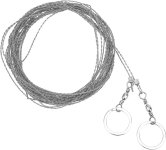
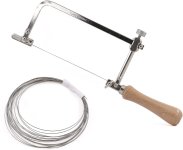
I think a better way (if solvent won't remove the foam) is to use a wire saw to cut out as much of the foam as possible. The leg fairings are a 2-dimensional shape (lengthwise), so the wire saw should work well. It will take 3 people to do that unless you build a jig to hold the fairings, and then it'll take 2 people. You could also build a frame to hold the wire saw to turn this into a 1-man operation. See handle below as inspiration to build a bigger one. No need to remove ALL of the foam; if a thin film remains, that's OK.

1732036929168.jpeg1732037027094.jpeg
 
Getting them “faired” - aligned with the airstream, to reduce drag/asymmetric drag can be an issue all by itself.
That might not be too bad, if the new fairings are "close" to the shape of the old ones the intersection fairings should make good alignment jigs to hold them in the right position for airflow. At least, they shouldn't be significantly worse than the fairings he removed?
 
  • Like
Reactions: HFS
How about a solder gun hot knife? No idea what thickness would work, but it won't take much trial and error to figure out. Make a loop shaped to fit.

I also wrapped my lines with that spiral stuff.
 
If you end up having to make new leg fairings it really isn't that hard. Plus, if you're using the existing intersection fairings they should help clock the new ones appropriately. About the only thing that could go wrong is that if you get the piano hinges in a different location and alter the cross sectional shape.

What I mean by that is that the further fwd you install the hinges from the trailing edges the more teardrop shaped the cross section becomes when installed.
 
Back
Top