

Van's Air Force

The definitive Van's Aircraft support community! Buying, building or flying an RV? Join our exclusive family of mentors and enthusiasts!

Tapered Washer Ideas?

Ironflight

VAF Moderator / Line Boy
Mentor
I’ll throw this in the General forum since it might be of interest to both Rocket and RV-4 builders….

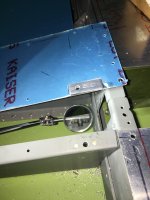
I matched-drilled the motor mount on our F1 Rocket project to the firewall today - a really easy fit with the four corners perfectly aligned to the pilot holes in the fuselage. Likewise, the two middle holes on the lower crossbar ended up right in the center of the structural pads built into the fuselage structure. Teh only issue to a perfect fit is that the slope of the firewall bump-out is not a perfect match to the engine mount bushings for the two center holes. I always expected to have to put a shim washer (or two) in there to take up and fitting tolerances - but the top of the 1.25” diameter “pad” on the mount is about 1/8” out from the firewall, while the bottom is more like 1/16”. Sure, I could crank down on the bolt and deform things a little - but that’s not the rut way to do it. What I need is a 3/8” (hole) washer with an OD of 1.25” and a taper int eh thickness. A little perusing of machinist sites didn’t have any clever ways to make one….so I’ll throw it out to the RV world - anyone got a neat trick for this? I am pretty sure I can “trial and error” a way to an answer - but I’ll take any ideas from someone who’s been there before….


(Note: The gap looks twice as wide as it actually is because of the firewall’s mirror shine….)
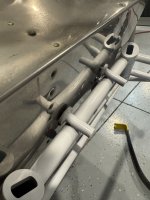
IMG_5258.jpeg
 
I’ll throw this in the General forum since it might be of interest to both Rocket and RV-4 builders….

I matched-drilled the motor mount on our F1 Rocket project to the firewall today - a really easy fit with the four corners perfectly aligned to the pilot holes in the fuselage. Likewise, the two middle holes on the lower crossbar ended up right in the center of the structural pads built into the fuselage structure. Teh only issue to a perfect fit is that the slope of the firewall bump-out is not a perfect match to the engine mount bushings for the two center holes. I always expected to have to put a shim washer (or two) in there to take up and fitting tolerances - but the top of the 1.25” diameter “pad” on the mount is about 1/8” out from the firewall, while the bottom is more like 1/16”. Sure, I could crank down on the bolt and deform things a little - but that’s not the rut way to do it. What I need is a 3/8” (hole) washer with an OD of 1.25” and a taper int eh thickness. A little perusing of machinist sites didn’t have any clever ways to make one….so I’ll throw it out to the RV world - anyone got a neat trick for this? I am pretty sure I can “trial and error” a way to an answer - but I’ll take any ideas from someone who’s been there before….


(Note: The gap looks twice as wide as it actually is because of the firewall’s mirror shine….)
View attachment 72702
Are they both the same and when do you need them?
 
Take an aluminum round stock the diameter that you need for a spacer, and cut the spacer to the angle needed.
And then drill out the center.
 
Last edited:
Take an aluminum round stock the diameter that you need for a spacer, and cut the spacer to the angle needed.
And then drill out the center.

Yep.

I have two 5-axis CNC machines in my garage, and the aforementioned method would still be my approach to this.
 
You could do it the old-fashioned way with a Bridgeport (or a fancy CNC) and modify a steel washer by machining a taper into it... and I would definitely use steel instead of aluminum in this application.

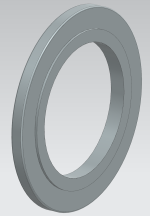
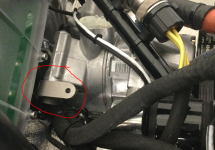
Or, provided you can reasonably accurately measure the gap top and bottom, you could 3d print in 316L stainless for about $40 for the two shims/washers that you need. I used that approach for the Sling A/C project. I was amazed at the dimensional accuracy of the parts. I had stepped washers made to adapt refrigerant bulkhead connectors to existing (bigger) holes in the firewall, and also compressor triangulation braces. It was cheaper to 3d print than having them machined from billet.

1729657748158.png1729658119790.png1729658399971.png
 
Last edited:
If you don't have a mill, or lathe... a 2" wide belt sander works wonders on things like this. Many times I have 5 minute epoxied a shim or washer I want tapered onto the end of a piece of round bar a bit smaller than the piece you're working. You can eyeball pretty easily the angle you need and it's easy to sand, measure, sand, measure...

the epoxy pops off pretty easily when you're done and is easy to knock off excess with the sander. I usually glue up and let sit an hour, while doing something else.

For what it's worth, I'd stick with a piece of 4130, rather than aluminum and when sanding, dunk in cold water A LOT...you don't want it turning colors. Light sanding, and dunk ever 20 seconds or so.

Steve.
 
It has not been mentioned yet but I will throw out what I would not do. I would not use any kind of liquid shim on this application with the vibration of an engine mount.
 
Last edited:
You could start with tapered wedges and slip it in to where it has to go. Then cut off most of the excess and mill, sand or grind it to a proper fit. Google Tapered Wedges and you find numerous options in including the Amaz...one below.
  • 31qyjPaQzqL._SX38_SY50_CR,0,0,38,50_.jpg
  • 41BbpvU7Y5L._SX38_SY50_CR,0,0,38,50_.jpg

2 PCS Flange Wedge 4 x 2 Inch Beveled Washers Right Angle Wedges Steel Silvery Spreading Flanges Triangle Tool Welding Wedge Metal Shims Underpinning Wedges Tapered Wedges for Lathe Machine Equipment​

 
I have a whole slew of tapered material from Boeing production (aluminum) with various tapers. I wouldn't necessarily worry about the round finished product, as much as the taper. Any machine shop should be able to make a simple tapered strip 1" X 12" with .001-.125" short dimension taper(example guess) and you cut to size and drill wedges. It's loaded in more tension than shear, so a perfect hole need not be. If you make from steel, prime well or have Cad plated (unless made from Cres). As also mentioned, skip the fancy machining and sand a washer down...then prime or plate.
 
Thanks for all the ideas folks….traveling today, but I’ll attack it with the tools tomorrow. And yup Dan, Bob’s place is a short walk away….we were using his CNC plasma cutter table yesterday to make some steel gussets for a tail jig I’m building. If I didn’t have Bob handy, I’d have to get me one of those devices….
 
Kidding aside, I'll play...

I would grab a length of square tube from the junk bin, draw the appropriate angle on one end, and cut it to that angle on the bandsaw. Then I'd tack the washer material to the cut end with the TIG, and run it against the belt sander with the "handle" flat on the table. Cut the little tack welds, buff the edges a little, and paint.
 
Last time I needed tapered washers I took standard steel tubing, set the miter gage on my disk sander, then cut off with band saw.
Many ways to skin this…..
 
Short length of round steel bar stock, machine the angle in a mill, then with a lathe drill the hole and use a cutoff blade to cut off the washer.
 
I have taken an existing washer, pressed it into a piece of wood at a bit of an angle so one side sits a little higher, then used a random orbital sander to sand the washer flush with the block of wood. Might take a little trial an error to get the right angle.
A belt sander would work as well but can take off too much material too fast. Hand sanding also worked for me.
 
You could do it the old-fashioned way with a Bridgeport (or a fancy CNC) and modify a steel washer by machining a taper into it... and I would definitely use steel instead of aluminum in this application.

Or, provided you can reasonably accurately measure the gap top and bottom, you could 3d print in 316L stainless for about $40 for the two shims/washers that you need. I used that approach for the Sling A/C project. I was amazed at the dimensional accuracy of the parts. I had stepped washers made to adapt refrigerant bulkhead connectors to existing (bigger) holes in the firewall, and also compressor triangulation braces. It was cheaper to 3d print than having them machined from billet.

View attachment 72705View attachment 72707View attachment 72708
This would seem to open up a lot of possibilities for many items. Can you tell us a vendor that would do such a small job as a couple of washers? Would they be able to make the CAD model from a simple engineering drawing? For tapered, I'd probably spend the time on a belt sander instead, but for more complex shapes, but similarly small production runs, this would be great.
 
This is a very timely thread. I need to do exactly the same thing on my Hatz project. I was thinking about using a high-strength metal-filled epoxy, like Bipax, as a liquid shim. The bearing loads under the large pad of a motor mount are within the material allowables. Vibration? That's what preloads are for. Still......for something so thick (> 1/8") I'm not sure if it would hold up. grinding it from a standard washer crossed my mind, but I had not thought about the availability of steel wedges. The problem there is that you can't select different wedge angles/thicknesses.
 
Paul, Sounds like you have a lot of good ideas. Can you describe what's on the other side? Is it also at an angle like this, or perhaps a complementary angle? Or is it completely flush with the firewall? Seems like the engine mount welder needs a slight change in their jig.
 
This is a very timely thread. I need to do exactly the same thing on my Hatz project. I was thinking about using a high-strength metal-filled epoxy, like Bipax, as a liquid shim. The bearing loads under the large pad of a motor mount are within the material allowables. Vibration? That's what preloads are for. Still......for something so thick (> 1/8") I'm not sure if it would hold up. grinding it from a standard washer crossed my mind, but I had not thought about the availability of steel wedges. The problem there is that you can't select different wedge angles/thicknesses.
Don't use any kind of fill epoxy or liquid shim period. This joint needs to be 100% contact and will be transmitting all the loads from the engine to the airframe. Tapered shims / washers are not that difficult and are a must if the surfaces are not parallel.
 
This is a very timely thread. I need to do exactly the same thing on my Hatz project. I was thinking about using a high-strength metal-filled epoxy, like Bipax, as a liquid shim. The bearing loads under the large pad of a motor mount are within the material allowables. Vibration? That's what preloads are for. Still......for something so thick (> 1/8") I'm not sure if it would hold up. grinding it from a standard washer crossed my mind, but I had not thought about the availability of steel wedges. The problem there is that you can't select different wedge angles/thicknesses.
Don't use any kind of fill epoxy or liquid shim period. This joint needs to be 100% contact and will be transmitting all the loads from the engine to the airframe. Tapered shims / washers are not that difficult and are a must if the surfaces are not parallel.
 
This would seem to open up a lot of possibilities for many items. Can you tell us a vendor that would do such a small job as a couple of washers? Would they be able to make the CAD model from a simple engineering drawing? For tapered, I'd probably spend the time on a belt sander instead, but for more complex shapes, but similarly small production runs, this would be great.
Indeed it does open possibilities! I used Craftcloud for this order, but there are lots of metal-printing vendors nowadays. Typically you get the parts in about a week, even the offshore ones. Seems they figured out that to get around the tariffs, they 2nd day air the parts to you.

...able to make the CAD model from a simple engineering drawing?
Some could, but they'd charge you more than you'd be willing to pay. Better if you spend some time to learn one of the "cheap" CAD programs out there and create your own STEP or STL files. Think of the possibilities that would open to you!

I used to think like DanH et al and just fabricate something like this. But I don't have room in the hangar for a mill. Well, I would if I sold the GTO... Yeah, could bandsaw or weld and grind and in a couple hours have parts. But to me it's easier to spend 20 min on CAD and order it and have it in a week with no rework required. Especially if it's only $40 to have two made. Even better, they're 316 stainless and won't need paint.

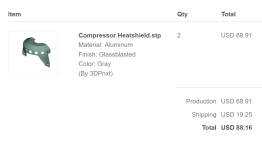
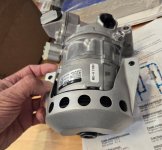
Here's a far more complex part; a compressor heatshield printed in aluminum which I used on that Sling, which cost $88 to have two made. That would be several hours on a CNC for each part to make from billet.

1729716047017.png1729716271985.jpeg
 
If you don't have a mill, or lathe... a 2" wide belt sander works wonders on things like this. Many times I have 5 minute epoxied a shim or washer I want tapered onto the end of a piece of round bar a bit smaller than the piece you're working. You can eyeball pretty easily the angle you need and it's easy to sand, measure, sand, measure...

the epoxy pops off pretty easily when you're done and is easy to knock off excess with the sander. I usually glue up and let sit an hour, while doing something else.

For what it's worth, I'd stick with a piece of 4130, rather than aluminum and when sanding, dunk in cold water A LOT...you don't want it turning colors. Light sanding, and dunk ever 20 seconds or so.

Steve.
Or your fingers!
 
A magnetic chuck on either a mill or a surface grinder should hold some washers and let you cut the angle on them in short order.
 
Paul, Sounds like you have a lot of good ideas. Can you describe what's on the other side? Is it also at an angle like this, or perhaps a complementary angle? Or is it completely flush with the firewall? Seems like the engine mount welder needs a slight change in their jig.
Mikey,
Good questions. Since the bolt angle will be defined by the bolt sleeves in the mount, beveled washers may be needed on the cockpit side as well.
 
"A simpler way
And a better plan,
Is to have it done
By another man."
-- Scott Gassawy, about 1967

Turns out that McMaster.com sells something that might work, called leveling washers. These are sets of a matched pair that has a spherical interface. They can be adjusted up to 3 degrees. Here's the link: Leveling Washers

The downside is that they have a minimum thickness that might be too much for you. Also they aren't cheap.

Dave
 
"A simpler way
And a better plan,
Is to have it done
By another man."
-- Scott Gassawy, about 1967

Turns out that McMaster.com sells something that might work, called leveling washers. These are sets of a matched pair that has a spherical interface. They can be adjusted up to 3 degrees. Here's the link: Leveling Washers

The downside is that they have a minimum thickness that might be too much for you. Also they aren't cheap.

Dave
McMaster was the first place I went and found those….but yup - too thick.

and for those asking about the back side, yes tapered washers really need to be used behind the firewall as well to keep things square. I’ll be back in the shop to make stuff in the next couple of days and will dole around with these ideas.

The best thing about this thread is the numerous ideas and techniques that will be in the archives!
 
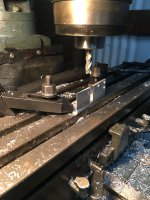
I really don’t think these need to be anything other than aluminum… And I’d stick with the 5 minute angle-sawn solution. BUT, for those asking, here’s one way I’ve made some matched shims in the past (in this case to hold the nutplate level with the bearing block for the flap weldement in a 6.)

Just clamped a piece of Aluminum angle in the mill (though you could also just push a piece of angle into the belt/disk sander) to get whatever angle you want. Then push it through the band saw to liberate your shims from the rest of the stock.
 

Attachments

  • IMG_9230.jpeg
    IMG_9230.jpeg
    1.8 MB · Views: 61
  • IMG_9237.jpeg
    IMG_9237.jpeg
    1.5 MB · Views: 63
I think you mentioned the motor mount is currently only held on with the four corner bolts and was easily installed. Could you not fabricate the shim out of any easily worked material, remove the motor mount, cut the current angle ends off and weld on new ends at the correct angle? This would also eliminate the shims on the interior.
 
I think you mentioned the motor mount is currently only held on with the four corner bolts and was easily installed. Could you not fabricate the shim out of any easily worked material, remove the motor mount, cut the current angle ends off and weld on new ends at the correct angle? This would also eliminate the shims on the interior.
Well if I was a welder with skills equivalent to the guy that built this mount (which is incredibly well done!) I could…..but I’m not, and make shims is a whole lot easier than that process….which would be a good solution if one has the skills and time!

Paul
 
I really don’t think these need to be anything other than aluminum… And I’d stick with the 5 minute angle-sawn solution.
I agree that aluminum is fine, and angle sawn is the way to go. My contribution here is that I would use square stock to help with indexing the angle. The corners can be dealt with later in the process.
 
I ran into the same thing on my RV-4 mount, I whittled out some washers/spacers from 2024T3 sheet stock of the appropriate thickness. Drill press, die grinder, hand file, belt sander, leather gloves etc. they turned out nice,
 
Well if I was a welder with skills equivalent to the guy that built this mount (which is incredibly well done!) I could…..but I’m not, and make shims is a whole lot easier than that process….which would be a good solution if one has the skills and time!

Paul
Anyone rememer the oldd Upper control arm alignment shims for Fords and Chevys? Some were tapered/angle cut
 
To thick unfortunately.

So yesterday afternoon I grabbed a one foot chuck of 1.25” diameter aluminum, set the fence on my disk sander to three degrees, and sanded a bevel on teh end of the stick. Cut it iff about 2” from the end of the bevel, and chucked that up in the lathe - then used the parting tool to cut it to the necessary thickness (1/16 at the thin end, 1/8 at the tick). Repeated e more times, and they worked great! Why aluminum? It’s easy to work, and the big pad the bolt goes through on the inside of the firewall is aluminum, so there is already Al in the stack-up.

I now have four “slightly shorter than 2 inch” chunks of 1.25” diameter aluminum sitting around, but its good practice material for when people want to come by and play with the lathe…..

As I said before - lots of really good and useful ideas in this thread for folks coming on behind, so thanks to everyone for helping build the archives!

Paul
 
That’s what I would have done with the exception that I would have used the bandsaw and sliced off to the thickness needed. However, you need a really good bandsaw to cut 1/16” slice. It would have been faster and you could have done it from one piece of stock. Sand, slice, repeat.
No matter. Lathe work is fun and making chips is great therapy.
 
Had a thought... Older Cessna landing gears, and other aircraft, use tapered axle shims for correct alignment. Perhaps you can find something that you can adapt.

Dave
 
Wow. I came late to the beveled washer party. Sorry!! However there is another way..... with no machining required.

The THICK washers that are welded on the engine mount are thick for a reason. They allow modest adjustments to be made directly on their face... with a belt sander, or similar metal removing tool. Do a careful job, and once you get the face of the freshly ground washer to match the firewall, then fill the gap with a regular washer.

Obviously, don't grind the washer so much that it's integrity is in question.

Primitive Pete signing off.....
 
Take an aluminum round stock the diameter that you need for a spacer, and cut the spacer to the angle needed.
And then drill out the center.
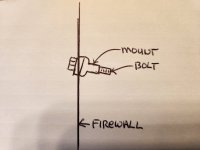
To get the bolt to grip properly, you will need two wedges for each location. The second wedge is for the back side
where the head will apply pressure at an angle if not wedged also...... see pic.

The line is the firewall with a wedge on both sides.
 

Attachments

  • 20241025_171035.jpg
    20241025_171035.jpg
    1 MB · Views: 17
Last edited:
Wow. I came late to the beveled washer party. Sorry!! However there is another way..... with no machining required.

The THICK washers that are welded on the engine mount are thick for a reason. They allow modest adjustments to be made directly on their face... with a belt sander, or similar metal removing tool. Do a careful job, and once you get the face of the freshly ground washer to match the firewall, then fill the gap with a regular washer.

Obviously, don't grind the washer so much that it's integrity is in question.

Primitive Pete signing off.....
well duh!! I was flying home from a trip this afternoon and saw your message that you’d posted a solution on VAF….but I can;t do VAF with the minimal internet you get from ground antennas, so I was wondering what you came up with - and I figured this was it when I thought about it! I solved it with the tapered washers I made, but when (if?) the mount comes off again, I might just do what you suggested Vince.

Paul
 
i think the angle is more critical than the thickness. i would start by figuring the angle in degrees, than cutting that on the end of appropiate alum. stock . trial and error with a belt sander and file until the angle is perfect. then cut off the right thickness using a table saw set at 90 deg.
if you have access to the exotic tools that will work too!
 
Back
Top