A few comments following on to some of the above comments...hope it adds value to the discussion.
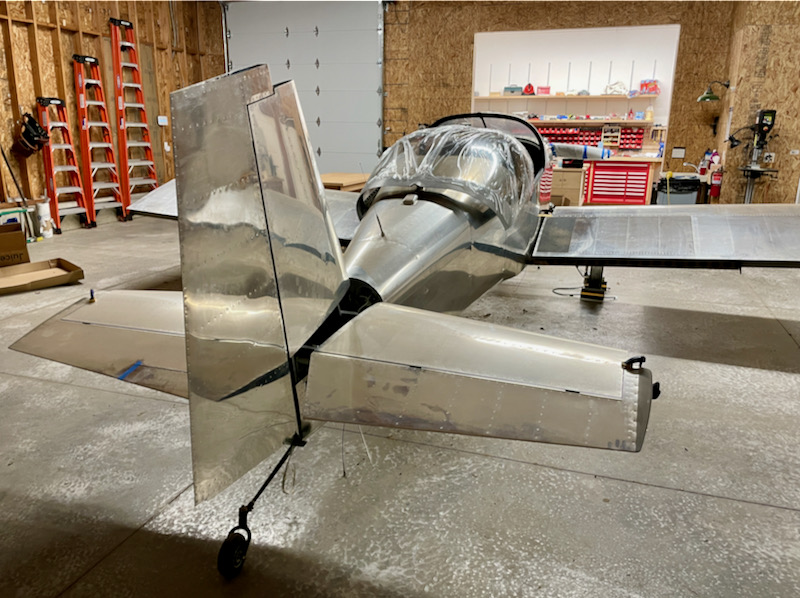
@ BillL: Brian confirmed what was my experience in changing (in my case) from a 6 VS and rudder to an 8 VS and rudder. No changes in landing characteristics noted. Interestingly, I did note a slight increase in right rudder requirements in climb and cruise, even though the same slight VS offset was present. I attribute that to the slight geometry change in the shape of the VS and rudder...but that is a SWAG, versus shown with wind tunnel evaluation, etc

. Overall, I'd say expect very similar handling, with slight trim changes to be noted...albeit very slight.
@ bjdecker and plehrke: concur with your thoughts on free stick vs some control pressure with respect to flutter margin. Steve Smith and I have discussed it as well, and that has always been my technique, whether descending from altitude or racing or test flying...actually in all phases. I keep my feet on the rudder pedals (and similar to Brian, on the outer uprights of the suspended pedals). I also added the rudder trim system with cables and springs, and that keeps a little tension on the rudder cables too...just a little side benefit.
@ jrs14855: I figure you'd agree that the HRII pilot that bragged about 300 indicated (and I'll risk assuming that means MPH), may or may not understand that that doesn't mean they just proved a 300 MPH Vne. Smooth air? Non-maneuvering? No gust loads? (kinda the same thing as smooth air, but they could be induced by the pilot, intentionally, as in flight test, or just inadvertently), etc. If it was a stock HRII, it would mean it was probably done with a 4 tail, with no counterbalance. In any case, while I agree that construction and balance of the 7 rudder is important, the HRII speed doesn't really relate to a 7 with a 7/9 tail, as the entire aft fuselage and empennage system is different. I'll develop that thought a bit more below.
@ jrs14855: it would be interesting to talk to Dick Keyt, who owned and SARL-raced the Polen Special, about that carbon rudder. Knowing Dick's meticulous approach, I bet he did some keen structural analysis as he did the mod, and may have modified other parts of the structure to balance the load paths. I'll develop that thought a bit more below too.
In general, it seems a common thread among the failures has been the specific tail type, and an exceedence of one or more parameters of airspeed, g and/or maneuvering envelope(s). In more discussions with Steve Smith, a key take-away has been to avoid just changing one component without evaluating the load paths and the impact the change may have on surrounding structure. Just changing the 7 rudder design partially, or making a 7 tail with a folded trailing edge, or making a carbon rudder, or making small changes to the internal structure of the rudder (strengthening specific parts without evaluating changes to overall structure or center of mass, aero center, etc)...all theoretical things mentioned in posts above...may or may not do more harm than good (Steve has shared specific examples in our discussions). Since the 7 empennage can be built with the 8 rudder fairly seamlessly, that would seem a good course of action, but I don't want to condemn the 7 rudder outright, and would just encourage anyone considering a change, however simple or complex, to ask for some guidance and expertise in doing so safely. Not intended as preachy...I just listen closely when the smart aero and structural guys are talkin'.
Cheers,
Bob