Changing the mechanical fuel pump by yourself
(mechanical fuel pump failure circumstance listed at the end of this post)
I found this thread very helpful in changing my mechanical fuel pump. Read all the other posts above.
I also found this video very helpful:
Here are some more helpful tips.
Engine is an ECI 0-360 A1A. 800 hours. I installed a new Tempest AF-15472 pump (which comes with gasket).
Total time to change pump: ~6 hours.
Removed all associated pump connections and also removed oil line to oil cooler since it was in the way.
I did NOT remove any Mag's. Note that you need to completely remove the safety wire from both allen screws as the wire passes through the allen slot (so you will only be partial in getting a tool in). A mirror helps.
I had to cut a 5/16 allen wrench since the inboard screw was difficult to reach. I used a 5/16 socket to get leverage on the allen wrench. And, the round allen head is important as it allows flexible access.
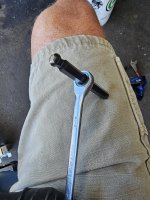
Take photos of the pump and attachment orientation for later re-installation.
Take your time removing items and work back/forth on removing the (2) allen heads.
Once the pump is removed, clean the pump area, and stick your finger inside of the engine, where the pump is attached.
You will feel a rod, hanging down. Rotate the prop so you get the hanging rod in the uppermost position.
Take some long safety wire, make a "U" and lasso the hanging rod. Pull both safety wires firm and secure upwards. Push the rod up so it is out of the way (safety wire holding it in place).
Use sealants on gaskets and bolts as mentioned in other posts (Permatex #2, Permatex gasket sealer). Angle the pump in, below the rod. Install allen bolts, alternate screwing in both at the same time.
It is very important NOT to force these bolts in. If you do, you are not aligned properly. I was not aligned (2) times and had to start over.
Tighten the pump down and with ~1/8-1/4" left, remove the safety wire. I found this difficult as there was a lot of tension on the safety wire. Torque as required. Install safety wire (see methodology in other posts). Install hoses, etc. torquing as appropriate. I hand spun the prop twice to make sure everything was smooth.
First engine start was easy as I put the boost pump on for 5 seconds. Two pumps of the throttle and it started up. Ran it for a couple minutes, and shut-off to inspect any leaks. Put it all together and did a couple laps around the pattern. Woo-hoo, a steady 4.6 PSI! Success.
Mechanical pump failure
800 hour RV7a, 0-360 A1A engine. 10 year old with the last (3) years of my ownership, putting on 600 hours.
In my case, I was going for a scenic spin out of Telluride, CO. Runway is at 9,000'. Took off, climbed 1,000' AGL and turned the boost pump off. The fuel PSI (normally around 2.6-2.8 PSI) dropped, and kept going to zero. I was briefly warned by my G3X and the engine started to quit. I quickly turned the boost pump on and regained fuel pressure.

Climbed to 14,500' and needed to have the boost pump on, otherwise the pressure would drop. Once the climbing was done and the plane was leaned and level, the fuel pressure (with no boost pump on) would hold 2.3-2.8 PSI. Fluctuating up/down.
Couple days later I flew back to California, using the boost pump on climb-out. Level, it maintained 2.2-3.1 PSI, fluctuating up and down. Then, after crossing the Sierra, it jump and stayed at 5.3 PSI. After changing the pump out, the pressure is now holding at 4.6 PSI. Good luck.