rocketbob
Well Known Member
corrected my post, meant to say xylene not toluene.

corrected my post, meant to say xylene not toluene.
Is Xylene likely to cause damage to O-rings and/or Proseal?corrected my post, meant to say xylene not toluene.

there are xylenes and toluene in 100LLIs Xylene likely to cause damage to O-rings and/or Proseal?
What's enough to cause staining? By significantly increasing the concentrations of these chemicals over whats in 100LL, what will the effect be on paint?there are xylenes and toluene in 100LL
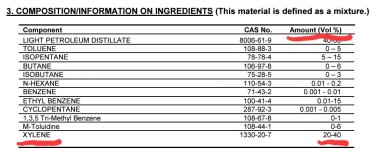
Look at the Phillips 66 MSDS for 100LL, section 3
AVGAS 100LL $4.96/gal at KFFZ ... guess I won't be flying to CA to buy G100UL gas on the return trip.$6.99/gallon.
What’s unclear is whether this is some sort of subsidized price.
I'm less concerned about its effect on paint than I am on the fuel system, but your concerns are valid. Xylene is used as adhesive remover and I'm not sure what else. A jump from 15% to 40% Xylene from 100LL to G100UL is concerning to me, although I do trust that GAMI has tested extensively. Are some varieties of ProSeal susceptible to damage by higher Xylene concentration? Viton? Buna-N? Silicones?What's enough to cause staining? By significantly increasing the concentrations of these chemicals over whats in 100LL, what will the effect be on paint?
I believe that the staining is caused by the aromatic amine in the formula. Amines are not typically found in fuels. They are reactive and likely more aggressive than typical fuel components.What's enough to cause staining? By significantly increasing the concentrations of these chemicals over whats in 100LL, what will the effect be on paint?

GAMI's explanation on the staining cause, and how to prevent it:I believe that the staining is caused by the aromatic amine in the formula. Amines are not typically found in fuels. They are reactive and likely more aggressive than typical fuel components.
I just read the explanation. They didn’t specify what component is the cause but I suspect that it is the meta toluidine (aromatic amine). Amines are generally not found in fuels.GAMI's explanation on the staining cause, and how to prevent it:

The jury is still out on that question, especially since the info thus far (UND) has been in relation to the Swift fuel UL94, not G100UL. But yeah...worth paying attention to as the whole unleaded saga unfolds.Cleaner and healthier except for the valves. The valves like the lead.

 www.avweb.com

If the people running G100UL are anything like me, running unleaded mogas or unleaded UL91, it will be a while before anyone has the opportunity to run only unleaded fuel during a full oil change interval. For me, the main difference is the amount of lead reported in the oil analysis. At the home base I have UL91, but when traveling I burn what's available.OK It has been a few months now since G100UL became available in California.
Has anyone done their first oil change on the new fuel? Did you notice anything different?
Can't speak to southern CA, but in northern CA.....it hasn't really been that long since the fuel was really truly available, meaning in the airport storage tank and ready to pump into your airplane.....press releases saying it "is commercially available" don't really count. It's been maybe 6-8 weeks, depending on the airport. I know it is actually for sale at Watsonville (KWVI) and Reid Hillview (KRHV).OK It has been a few months now since G100UL became available in California.
Has anyone done their first oil change on the new fuel? Did you notice anything different?


 www.avweb.com

fascinating research. Thank you for posting links to the videos!A local pilot who is also an A&P (and has a day job as a Flight Test Engineer) did what appears to be independent testing of G100UL and recorded these three videos which definitely raise some concerns about material compatibility:

Weird to the eye sort on the MSDS, NOT ranked by %. 20-40% Xylene.
I agree. But, if I ran Flame Master, I would have started testing G100UL ten years ago.What we need to do is get Flame Master and other similar companies to do interaction testing with their products.
A local pilot who is also an A&P (and has a day job as a Flight Test Engineer) did what appears to be independent testing of G100UL and recorded these three videos which definitely raise some concerns about material compatibility:
My RV-10 is based out of KRHV (one of the CA airports where G100UL is available - we don't have 100LL). I put in 5 gallons a side a couple of months ago soon after it was made available and didn't see any negative effects but for now, I am waiting till the dust settles before going all in on G100UL.

Neat idea but I'm doubtful it'll ever happen. Equipment costs plus TEL is liquid concentrated brain damage and is extremely difficult to transport and handle safely.Dial-A-TEL dispensing
I am surprise GAMI doesn't allow Lycoming to officially test its fuel, and doesn't provide the technical information of the fuel to Lycoming.
Lycoming publishes specifications for approved fuels in Service Instruction 1070. G100UL is not listed as an approved fuel in Service Instruction 1070.
Learn More About Lycoming’s Efforts Around Unleaded Fuels
Lycoming Engines has been producing piston aviation engines for over 95 years, and we “build every engine as though we were going to fly it ourself!” Safety is an utmost priority, and we strongly support efforts to eliminate lead from aviation fuels. For this reason, Lycoming has been...www.lycoming.com
Not really surprifing IF they already suspect compatibility issues. Better to release it into the wild and then blame age and poor maintenance practicesI am surprise GAMI doesn't allow Lycoming to officially test its fuel, and doesn't provide the technical information of the fuel to Lycoming.
 After all these years of testing, I find it hard to believe that GAMI doesn't know about the affect on paint and proseal. Not throwing stones at GAMI, but one has to wonder. The fact that they immediately blame the owners and mechanics vs saying "good catch" and testing is highly suspicious behavior. A top flite outfit would undergo independant lab testing to prove that it is not their fuel causing issues. The videos in this thread give some clues as to why that may not be happening.
PPG Aerospace likely sells way more fuel tank sealant than FM.I agree. But, if I ran Flame Master, I would have started testing G100UL ten years ago.

I really wanted G100UL to work out. But I've been concerned for a long time that the octane enhancing chemistry of an alternative might be just as bad or worse than lead for people to be around. Aromatic hydrocarbons - benzene, xylene, toluene, etc are really really nasty chemicals that cause cancer and other problems if you just look at them sideways. I suppose the environmental impacts are less because they get burned up. But really not safe to handle or be around. So I was resigned to the idea that some degree of PPE and care in dispensing would be needed as an acceptable trade-off for eliminating the lead. The big payoff is that our engines would be so much happier.PPG Aerospace likely sells way more fuel tank sealant than FM.


Also frustratingly, there may not be a feasible solution -- it may be that any/all organic octane-enhancing chemicals will be incompatible with traditional elastomers used in aircraft systems.
Would the aircraft have these issues with 100LL? If yes then fine, if no then that’s a problem for “aircraft age” . The majority of the fleet are aging aircraft.GAMI Chief of Engineering George Braly has said the issues with some aircraft can be traced to maintenance or aircraft age issues.
 but only good if your aircraft is brand new
Yeah it is really sad how the faa has dealt with this. Swift 94 is a viable solution for a very large chunk of the fleet. Force the fbos to offer it and put a $2 premium on 100ll. Majority of problem solved. Jusy follow the cigarette model. Raise the taxes high enough and nobody uses it anymore. We can use sharp minds like braly to develop knock sensing technology to more safely use these fuels.The solution is long, slow, and painful. Tradition (and regulatory capture) is the problem.
High compression and turbocharged engines that run on less problematic unleaded fuels exist in just about every other application of the ICE and are gaining ground in aviation.

the ELI5 version (hopefully not too messed up by the AI):

How about keeping 100LL the same price & discount the new non-lead blends.Swift 94 is a viable solution for a very large chunk of the fleet. Force the fbos to offer it and put a $2 premium on 100ll.
Sadly, whatever we get is going to be more expensive than 100LL and due to the lead, we are living on borrowed time IMHO. The california stuff is just the tip of the iceberg. I really wish we could also get access to Mogas, even with ethanol. Would be more than happy to retrofit for compatability. It is way cheaper and a MUCH better long term option. Just too many issues for wide spread usage. The reality is that we would be far better off in the long run doing what was necessary to equip and relearn to use lower octane fuels. However, too many will complain and you end up with what is going on with G100.How about keeping 100LL the same price & discount the new non-lead blends.
A few years ago I was willing to try swift. It was offered at Lakeland. It was a higher price than LL.
Try a new blend with unknown results at a higher price? I don’t think so. No Thanks.
Wish I could do that with my ordered IO-390 but Lycoming does not recommend any unleaded auto gas for the 390-I chose 8.5:1 So I can run 93 per Lycoming, Never saw the benefit of hi comp just to get a few HP.
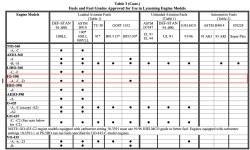

You could have done it. 8.5:1 gives a safe margin for detonation. Lycoming won't recommend it, but its fine.Wish I could do that with my ordered IO-390 but Lycoming does not recommend any unleaded auto gas for the 390-
There's basically 2 problems to solve.Sadly, whatever we get is going to be more expensive than 100LL and due to the lead, we are living on borrowed time IMHO. The california stuff is just the tip of the iceberg. I really wish we could also get access to Mogas, even with ethanol.
On a side note, this whole issue really makes me question whether we can ever find a suitable 100 octane replacement.