

Van's Air Force

The definitive Van's Aircraft support community! Buying, building or flying an RV? Join our exclusive family of mentors and enthusiasts!

Alternator identification / voltage regulator

Ron Earp

Member
Patron
I've got a new-to-me RV6 (built in 1995) that I've been carrying out transition training in with my instructor. A couple of days ago while in the pattern our voltage spiked up to around 15.5V and stayed there. We did a bit of troubleshooting and parked the plane. I removed the voltage gauge and with a variable power supply verified it is indeed correct, and if anything reads about 0.3 V low.

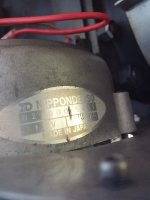
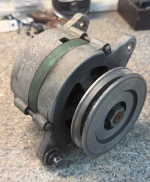
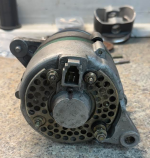
Yesterday I removed the cowl so I could have a look at the alternator. I don't recognize the alternator and none of the RVs nearby at my field have this type either, they all have a B&C unit. Here are a couple of pics, Google suggests a 1978 Land Cruiser but I checked that and it isn't a match. I suspect this is a common car alternator pre-1995, as this thing looks like it has been on the plane for a long time. Anyone recognize it and can ID the car year/model?
1783856637031.png

1783856655909.png

1783856673748.png

I might have it rebuilt locally or possibly source a new one. In hindsight, I probably didn't need to remove it at all as I think this system is externally regulated and the failure mode points toward the regulator, but I don't think it'd be a bad idea to replace this one. I think it's got 1500+ hours on it.

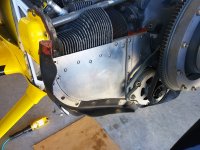
I think the picture I took below is the voltage regulator but I have yet to remove it and ID it. Again, none of the other RVs I'm connected to have this sort of regulator, if that is what it is. Anyone have any insight on it?

1783856702737.png

Sorry for the ill-informed questions here. I only had time to remove the alternator yesterday and am headed back to the field today to discover more.

Thanks,
Ron
 
Last edited:
I've got a new-to-me RV6 (built in 1995) that I've been carrying out transition training in with my instructor. A couple of days ago while in the pattern our voltage spiked up to around 15.5V and stayed there. We did a bit of troubleshooting and parked the plane. I removed the voltage gauge and with a variable power supply verified it is indeed correct, and if anything reads about 0.3 V low.

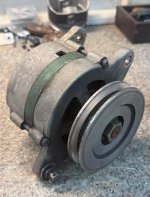
Yesterday I removed the cowl so I could have a look at the alternator. I don't recognize the alternator and none of the RVs nearby at my field have this type either, they all have a B&C unit. Here are a couple of pics, Google suggests a 1978 Land Cruiser but I checked that and it isn't a match. I suspect this is a common car alternator pre-1995, as this thing looks like it has been on the plane for a long time. Anyone recognize it and can ID the car year/model?
View attachment 122882

View attachment 122883

View attachment 122884

I might have it rebuilt locally or possibly source a new one. In hindsight, I probably didn't need to remove it at all as I think this system is externally regulated and the failure mode points toward the regulator, but I don't think it'd be a bad idea to replace this one. I think it's got 1500+ hours on it.

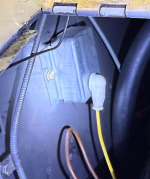
I think the picture I took below is the voltage regulator but I have yet to remove it and ID it. Again, none of the other RVs I'm connected to have this sort of regulator, if that is what it is. Anyone have any insight on it?
View attachment 122885

Sorry for the ill-informed questions here. I only had time to remove the alternator yesterday and am headed back to the field today to discover more.

Thanks,
Ron
1001171215.jpg1012171601.jpg
Looks like the Denso which is probably the original alternator on my 1980 RV-3 with about 1500 hours now. I went through a number of controllers before I finally installed a Ford regulator from a 70's Crown Vic; no more problems for years.
 
The 1980's called -- they want their alternator & regulator back.

Ancient ND -- 20000 - 21000 series, and someone removed the fan from the front of it. Plug code is PL-3601, Top is "E", Left is "F", Right is "N" --- "E" goes to a Lamp, "F" is the field supply -- the yellow wire back to the regulator, and "N" is the center tap of the stator windings. But I could be wrong.

Buy a B&C LX60 alternator and LR3E regulator and go fly.
 
Most likely the 35a alternator Vans sold for many years. You can replace it with the following alternator:

1978 Honda Civic CVCC, no air conditioning; common number is 14184

The replacement will most likely have a fan that rotates backwards on the Lycoming but it will cool just fine. A blast tube directed at the rear of the alternator is worth installing.

A good regulator is the VR166 from a mid-70's Ford LTD.

I've been flying this combination on the RV-6 since 1999.
 
The 1980's called -- they want their alternator & regulator back.

Ancient ND -- 20000 - 21000 series, and someone removed the fan from the front of it. Plug code is PL-3601, Top is "E", Left is "F", Right is "N" --- "E" goes to a Lamp, "F" is the field supply -- the yellow wire back to the regulator, and "N" is the center tap of the stator windings. But I could be wrong.

Buy a B&C LX60 alternator and LR3E regulator and go fly.
E is a ground (E = earth), F is the field. I always run the E lead to a grd point for security. Unsure, but think N is a stator tap, but I never connect to it.
 
Last edited:
E is a ground, F is the field. I always run the E lead to a grd point for security. Unsure, but think N is a stator tap, but I never connect to it.
On second thought, I did connect N to the stator feed on my transpo when troubleshooting an issue. It worked fine, so assumed it must be a stator tap. possible it was a lamp drain, just didn't create an issue for me. i always thought the logic for a warning lamp came from the reg, not the alt.
 
I've got a new-to-me RV6 (built in 1995) that I've been carrying out transition training in with my instructor. A couple of days ago while in the pattern our voltage spiked up to around 15.5V and stayed there. We did a bit of troubleshooting and parked the plane. I removed the voltage gauge and with a variable power supply verified it is indeed correct, and if anything reads about 0.3 V low.

Yesterday I removed the cowl so I could have a look at the alternator. I don't recognize the alternator and none of the RVs nearby at my field have this type either, they all have a B&C unit. Here are a couple of pics, Google suggests a 1978 Land Cruiser but I checked that and it isn't a match. I suspect this is a common car alternator pre-1995, as this thing looks like it has been on the plane for a long time. Anyone recognize it and can ID the car year/model?

View attachment 122882

View attachment 122883

View attachment 122884

I might have it rebuilt locally or possibly source a new one. In hindsight, I probably didn't need to remove it at all as I think this system is externally regulated and the failure mode points toward the regulator, but I don't think it'd be a bad idea to replace this one. I think it's got 1500+ hours on it.

I think the picture I took below is the voltage regulator but I have yet to remove it and ID it. Again, none of the other RVs I'm connected to have this sort of regulator, if that is what it is. Anyone have any insight on it?

View attachment 122885

Sorry for the ill-informed questions here. I only had time to remove the alternator yesterday and am headed back to the field today to discover more.

Thanks,
Ron
From an older post. That looks like the 35amp 14184 alternator that Vans sold for many years back in the day, it is externally regulated. I have been flying this alternator on mt RV-6 since 1999. Use the 14184 number at any auto parts store to find a replacement, they were originally on a 1978 Honda Civic CVCC, no air conditioning. A regulator for a 1975 Ford LTD works nicely with this alternator, generic number is VR166.

Vans sold these with the fan removed as in your picture. The one pictured appears to have a larger diameter pulley to slow down the RPM. Now it is often replaced with new Part Number 14684N Vehicle Fitment Make Model Years CHEVROLET SPRINT 1987-1988 GEO METRO 1989-1993 SUZUKI SAMURAI 1986-1995 SUZUKI SIDEKICK 1989 internally regulated so the external VR is not used. The pulley is smaller than the one pictured so a different belt will be required or the larger pulley moved to replacement alternator. The Lester part number 14684N is available online and at many local auto parts stores. Lots of references to both these alternators if searched on this forum.
 
E is a ground (E = earth), F is the field. I always run the E lead to a grd point for security. Unsure, but think N is a stator tap, but I never connect to it.
E is also "Exciter"
N is stator central tap
On second thought, I did connect N to the stator feed on my transpo when troubleshooting an issue. It worked fine, so assumed it must be a stator tap. possible it was a lamp drain, just didn't create an issue for me. i always thought the logic for a warning lamp came from the reg, not the alt.

The 14184 is an ND 121000 series (internal fans). The 14184 has the newer style case/fins to accommodate internal fans on the rotor.
 
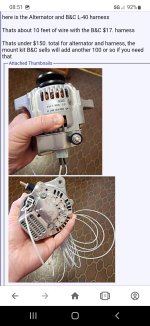
Holysmokes that 60 amp is not cheap. In my 12th year with the $140. Denso
 

Attachments

  • Screenshot_20230215-085158_Opera.jpg
    Screenshot_20230215-085158_Opera.jpg
    177.7 KB · Views: 4
Back
Top