Van's Air Force

The definitive Van's Aircraft support community! Buying, building or flying an RV? Join our exclusive family of mentors and enthusiasts!

What you should know about the moisture in your engine that causes corrosion on your tappets and cam lobes

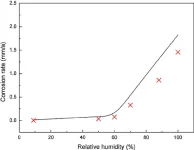
Fully agree, most of the water ends up at the bottom of the pan. The problem here is a bit different and can lead to corossion in certain cases. If you do a bunch of short engine runs where a lot of this water collects in the pan over time and the oil doesn't got warm enough for enough time to evaporate it out, problems occur. It does not need to boil, but the warmer it gets, the faster it evaporates out, hence the lyc oil temp recommendations. All that water at the bottom gets mixed in with the oil via the pump. It is like a blender and creates a mixture of oil and tiny water droplets. This oil / water mix then sits on the metal parts after shut down for weeks. This will allow a tiny water droplet to be held against a metal surface with no ability to evaporate (water trapped between metal and oil film), creating agressive corrosion in that spot and there are tons of those tiny droplets.

The other problem is that this water mixes with combustion byproducts and forms acids. Have seen this many times in cars that only get driven to the grocery store. Accumulations of white gunk that collects in the rocker covers and why MANY people without dehydrators do not get lifter spalling.

Very relevant to this discussion, as purging all that moisture after shut down will prevent the whole cycle. However, if every engine run gets warm enough, long enough to evaporate off all the water, you get the same result and why the majority of engines do not get lifter spalling even though they don't use dehydrators.
Some good points here. The key takeaways IMHO...
  • Mike Busch and several others have emphasized the harm that can be done by intermittent short engine runs that don't allow enough heat for enough time to evaporate whatever water has accumulated in the oil sump. It's often recommended (hotly contested) that the engine should run at operating temp for 30- 60 minutes to get rid of accumulated water.
  • The water in the oil sump, although not available for evaporation, is available for interaction with combustion byproducts to form harmful acids. IMHO, a good argument for shorter oil change intervals in an engine that may not run frequently. I change my oil and filter every 25 hours for that reason despite Lycoming's 50-hour recommendation.
  • It's also a good argument for immediate post-flight purging of the air in the engine that has a lot of moisture from the combustion and from the condensation that can occur as the engine cools. I don't think we need leaf-blower velocities or volumes but some amount of positive pressure air flow, preferably with dry air, is probably a reasonable idea.
 
I change my oil and filter every 25 hours for that reason despite Lycoming's 50-hour recommendation.
same here, 25 hrs or about 4 months whichever comes first. Lyc recommends 4 months regardless of hours for "idle" planes. It feels wasteful to drain oil with only a few hours on it but i'd rather error on the safe side.

Interesting that Lycoming is silent about opening the oil cap and purging after the flight. May be they have no evidence that this helps at all.
 
Last edited:
Interesting that Lycoming is silent about opening the oil cap and purging after the flight. May be they have no evidence that this helps at all.
And auto manufacturers are the same. 100+ years and 100's of millions of examples of engine use has shown that purging the vapor from an engine is not necessary for long term health, though there are exceptions as mentioned above. Certainly nothing wrong with it, but a whole bunch of hstorical data tells us it is not necessary. The lifter spalling problem is mostly unique to the lyc and dictates that greater attention be applied, but without an identified root cause, how do you do it. As a hint, Lyc is pretty specific about timelines for using corrosion preventative oil protection, but silent on vapor evacuation. All this would seem to imply that lyc thinks that sitting idle too long is a problem and shut down vapor is not.

I am pretty confident that if lyc thought that shut down vapor was a problem, they would dictate steps to mitigate it, just like they provide guidance on minimum oil temps to help with water evaporation from the oil. Opening the oil cap doesn't really offer much help, as there is already a 5/8 or 3/4" opening to evacuate the vapor. We have all witnessed the steam coming out of the opening and there is no reason to think the same thing is not happening at the breather tube.
 
Last edited:
Playing devils advocate, with roller lifters that come with engines like the IO360 M1B that Vans sells liter/cam wear is a thing of the past.
 
Playing devils advocate, with roller lifters that come with engines like the IO360 M1B that Vans sells liter/cam wear is a thing of the past.
good point. The DLC lifters offer the same benefit and are available without case modification, so can easilly be swapped at overhaul.
 
... This oil / water mix then sits on the metal parts after shut down for weeks. This will allow a tiny water droplet to be held against a metal surface with no ability to evaporate (water trapped between metal and oil film), creating agressive corrosion in that spot and there are tons of those tiny droplets.
The corrosion process also needs oxygen. I think minute water droplets embedded in a film of oil can not produce corrosion, unless there is also dissolved oxygen available at the potential corrosion site?
Edit: Given that water will rust out the bottom of a steel carb float bowl or a Jerry can, I guess there must be some dissolved oxygen available. Given the thrashing the oil takes through the system, I imagine a bit of foaming and aeration is to be expected.
 
Last edited:
if the droplets are acidic they won't necessarily need oxygen to react with the metal. pure H2O - yes :)
Yes. Acid etching is an oxidation reaction but the oxidizing agent isn’t oxygen, it’s the hydrogen ions from the acid. Oxygen isn’t necessary. Classic rusting is an oxidation reaction that uses oxygen as the oxidizer.

The upshot is that water in the engine is bad, either from its direct participation in the oxidation reaction (rust), or its creation of acids which in turn can etch metal parts.
 
Last edited:
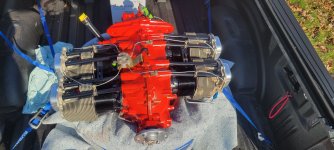
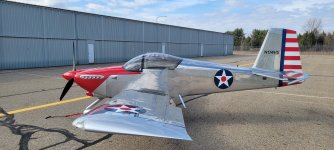
I have been a recent victim of corrosion on the cam and lifters. My engine (Eagle Extreme XIO-360 B1A2) from Redding, CA lasted 680 hours before producing metal and needing to be rebuilt. For the first 14 years the plane was in a heated and air conditioned hangar (605 hours) attached to the home. Since April of 2021 the plane has been in an insulated but unheated or air conditioned hangar with a Reiff Engine Heater with cylinder bands.

My rebuilt engine now has about 14 hours on it and is still in the unheated hangar. I'm seriously considering some type of moisture management. This problem is much more common than you think. After nearly 1 year of not flying she is flying better than ever!
 

Attachments

  • 1000007523.jpg
    1000007523.jpg
    1.2 MB · Views: 33
  • 1000008637.jpg
    1000008637.jpg
    1.4 MB · Views: 33
The corrosion process also needs oxygen. I think minute water droplets embedded in a film of oil can not produce corrosion, unless there is also dissolved oxygen available at the potential corrosion site?
Edit: Given that water will rust out the bottom of a steel carb float bowl or a Jerry can, I guess there must be some dissolved oxygen available. Given the thrashing the oil takes through the system, I imagine a bit of foaming and aeration is to be expected.
Yes, i have seen it many times on cranks and cams. The pitting is microscopic, but is corrosion. Not a big deal on cylinder walls and other parts but a huge deal on lifters.

I understand oxidation requires oxygen, but not a chemist. Just assumed it is stealing oxygen molecules from other water droplets. I just know that if you pour water in a steel can, you will get corrosion on the bottom where there is no air. I just don’t understand the chemistry behind it.
 
I have been a recent victim of corrosion on the cam and lifters. My engine (Eagle Extreme XIO-360 B1A2) from Redding, CA lasted 680 hours before producing metal and needing to be rebuilt. For the first 14 years the plane was in a heated and air conditioned hangar (605 hours) attached to the home. Since April of 2021 the plane has been in an insulated but unheated or air conditioned hangar with a Reiff Engine Heater with cylinder bands.

My rebuilt engine now has about 14 hours on it and is still in the unheated hangar. I'm seriously considering some type of moisture management. This problem is much more common than you think. After nearly 1 year of not flying she is flying better than ever!
Environmental controlled environments make a huge difference. You don’t get the large temp swings that create small dew point spreads (i.e. high relative humidity) or even condensation. Your experience tracks directly with my feelings on how this corrosion occurs, but still believe the engine is immune to it for a week or two after a shut down, while the oil film is there to protect the metal.
 
We have all witnessed the steam coming out of the opening and there is no reason to think the same thing is not happening at the breather tube.
Except... Heat rises, and it can rise out of the oil filler but can't rise out of a breather tube that points down below the engine.
 
Except... Heat rises, and it can rise out of the oil filler but can't rise out of a breather tube that points down below the


Except... Heat rises, and it can rise out of the oil filler but can't rise out of a breather tube that points down below the engine.
I am no chemist or engineer, But, at 75 and still alive, I have done and seen a thing or two. I was basically forced to work on cars, tractors and trucks by the time I was 15 years old. Been turning wrenches since.
Heat doesn't actually rise. It is the warm air that is rising, Because colder air is pushing it up. Heat in a vacuum is equal in all directions.
Water vapor on the other hand has a lot of pressure and will seek to equalize. If one opens the fill tube and leaves it open the moisture will equalize quite quickly to ambient and the problem of condensation is mostly dissipated . Until there are temperature swings to cause condensation.
""All bets"" are off if you ground run or short flight an engine and get milky oil, Because that moisture and acid is trapped in the emulsified oil.
AND milky oil costs you money.
I have an assembled 0-360 "Lycoming" engine that was open to ambient air and sat in my shop/hangar for 32 years and has never rusted cam or cylinders. I installed that engine in my RV-6A 1 1/2 years ago and it is still running 200 hours later with no metal.
I don't purge my engines, But, I do pull the dipstick and hold it up with a rag. AND I keep my plane in a fully sheet rocked insulated hangar with weather stripped doors.
Parking them outside gives you wide temperature swings and hence condensation and some lovely corrosion.
Just fly that engine and it is cheaper than an overhaul.
My luck varies FIXIT
 
moist air in the crank case needs to find its way down to the sump to be able to exit through the oil filler. I think the vapor we are seeing through oil cap is from the sump but not so much tapped air from the crank case. the oil breather may be an easier path to take for the crankcase venting .
 
moist air in the crank case needs to find its way down to the sump to be able to exit through the oil filler. I think the vapor we are seeing through oil cap is from the sump but not so much tapped air from the crank case. the oil breather may be an easier path to take for the crankcase venting .
No path needed

Diffusion is the spontaneous, net movement of particles (atoms, ions, or molecules) from an area of higher concentration to an area of lower concentration. Driven by the random thermal motion of particles (Brownian motion), this process continues until the concentration is evenly distributed. [1, 2, 3, 4]
It even does so through a semi permiable membrane, which is then called osmosis.

Same concept applies to how moist air gets into your engine without running
 
Last edited:
I understand oxidation requires oxygen,
As long as we're already way off into the weeds, osmotically speaking, I'd toss in that although oxygen is definitely the most common oxidizing agent when we think of the oxidation process, it is far from the only one. The relevance to this conversation relates to the importance of even small amounts of water in the crankcase contributing to the formation of sulfuric acid from blowby of combustion byproducts. I'd argue that acid etching of upper engine components (cam and lifter pitting) can do more damage overall than conventional corrosion (rusting).
 
Too bad there isn’t any objective evidence to suggest use of a dehydrator system actually has an impact on engine longevity. All of the articles I have found are written by manufacturers of the equipment, or others, using some of the basic assumptions folks make every time this topic comes up.
It makes sense so it must work right?

Curious question For those using dehydrators, are you going to follow Lycomings SB for short term preservation if the aircraft isn’t going to be flown for longer than a month? Will you assume the dehydrator negates their recommendation?

I live in an area I can fly the one hour continuous in a month year round, use Aeroshell 15W50, designed for sitting engines, and if I know I can’t fly, like my panel upgrade, it gets preserved.

The logic behind the dehumidifier makes sense but there are so many factors that go into this topic of engine longevity, and so little actual evidence, it’s hard for me to chew. In fact, one AI search of the topic brings up VAF as an excellent resource and expert in aircraft engine dehydration. So, we speak it and it becomes reality, evidently….

I do respect those that are in the “it doesn’t hurt” camp and want to go through the process, accepting the fact that this is all based on assumption.
 
The logic behind the dehumidifier makes sense but there are so many factors that go into this topic of engine longevity, and so little actual evidence, it’s hard for me to chew. In fact, one AI search of the topic brings up VAF as an excellent resource and expert in aircraft engine dehydration. So, we speak it and it becomes reality, evidently….

I do respect those that are in the “it doesn’t hurt” camp and want to go through the process, accepting the fact that this is all based on assumption.
I think we have to take our lead from the engine manufacturer(s). They give a LOT of guidance on how to protect the engine, including steps to take during extended non use periods. I suspect that if purging case vapor was necessary to prevent engine corrosion, Lyc would provide that guidance; Not a burden to suggest removing dipstick after shut down. We can also look to the many other manufacturers of internal combustion engines and I have never seen one of them recommend dehydrator use after shut down for engine longevity. Seems pretty unlikely that they all missed this step. Many are multi billion dollar companies with extensive lab and engineering facilities.

If AI finds VAF as the authority on engine dehydrator use, that should warn us that we are quite unique in holding those opinions and apparently not shared by the majority of engine users.
 
Last edited:
Too bad there isn’t any objective evidence to suggest use of a dehydrator system actually has an impact on engine longevity. All of the articles I have found are written by manufacturers of the equipment, or others, using some of the basic assumptions folks make every time this topic comes up.
It makes sense so it must work right?

Curious question For those using dehydrators, are you going to follow Lycomings SB for short term preservation if the aircraft isn’t going to be flown for longer than a month? Will you assume the dehydrator negates their recommendation?

I live in an area I can fly the one hour continuous in a month year round, use Aeroshell 15W50, designed for sitting engines, and if I know I can’t fly, like my panel upgrade, it gets preserved.

The logic behind the dehumidifier makes sense but there are so many factors that go into this topic of engine longevity, and so little actual evidence, it’s hard for me to chew. In fact, one AI search of the topic brings up VAF as an excellent resource and expert in aircraft engine dehydration. So, we speak it and it becomes reality, evidently….

I do respect those that are in the “it doesn’t hurt” camp and want to go through the process, accepting the fact that this is all based on assumption.
No. There is no objective evidence that proves that use of a dehydrator extends TBO, or that it limits corrosion in any way. For my part, my decision to use one is based on what I consider to be pretty solid inductive reasoning, and that using a dehydrator is dirt cheap, simple to construct, really easy to use, and has no apparent downside.


It’s interesting that Lycoming recommends putting desiccant bags in the intake and exhaust ports but not the crankcase. The criteria was to operate the engine with an oil temperature above 165F to remove water and acids.
 
The only way to prevent this entire process is to purge the moisture out of the crankcase after shut-down with dry air.

Steve,
I appreciate your insight. Like some others, after I shut down, before I open the hangar, I pull the dipstick to get as much of the steam out (and whatever is dissolved in it) as possible. If I’m not able to fly for a couple of weeks, I put the Drybot on the engine.
Would it not result in a more complete (than simply pulling the dipstick) purge of the crankcase steam by putting the shopvac hose on the vac exhaust and forcing ambient through into the dipstick tube?
Cheers👍🏻
 
I think we have to take our lead from the engine manufacturer(s). They give a LOT of guidance on how to protect the engine, including steps to take during extended non use periods. I suspect that if purging case vapor was necessary to prevent engine corrosion, Lyc would provide that guidance; Not a burden to suggest removing dipstick after shut down. We can also look to the many other manufacturers of internal combustion engines and I have never seen one of them recommend dehydrator use after shut down for engine longevity. Seems pretty unlikely that they all missed this step. Many are multi billion dollar companies with extensive lab and engineering facilities.

If AI finds VAF as the authority on engine dehydrator use, that should warn us that we are quite unique in holding those opinions and apparently not shared by the majority of engine users.
Remember, the manufacturer recommends engine overhaul at 2,000 hrs or 12 years and recommendations are based on that time frame. They don’t care after that 12 years how much corrosion is in engine. So why would they give us recommendations to keep engines past that point.
 
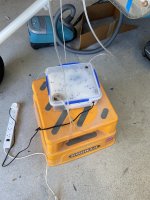
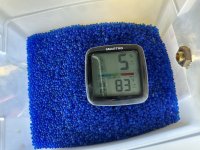
the container looks tiny. you want at least 3lbs of beads to extend time between baking (fills a tub like this https://www.amazon.com/dp/B004LSQVPA )
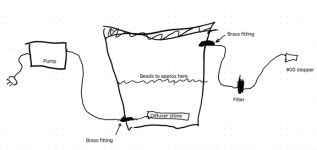
It's not hard to build your own, even I could do it 😀
I use 7.5 lbs at a time and keep an additional 7.5 lbs ready to go (I do note that silica gel beads have kind of shot up in price since 6 years ago). When the humidity in the chamber gets to 20%, I swap 'em out, take the used ones home to cook. I have to do that about 2-4 times per year...been doing it that way for almost 6 years. I use a restrictor on the pump tubing to keep a pretty low flow on the aquarium pump, just enough to be sure there is some positive pressure in the crankcase. I've tried higher air flow but I believe that high air volume from the pump is unnecessary and results in too-frequent bead changes. As I mentioned above, I periodically check the air flow by putting a condom on the output tube of my AS oil separator.

I had forgotten that I did create a PowerPoint on dehydrators for the two local EAA chapters several years ago but haven't been able to find it. Probably buried in my folder of work PowerPoints that have sitting around since I retired. I'll keep looking.
 
Back
Top