

Van's Air Force

The definitive Van's Aircraft support community! Buying, building or flying an RV? Join our exclusive family of mentors and enthusiasts!

Engine pump to carb hard fuel line?

Radioflyer

Well Known Member
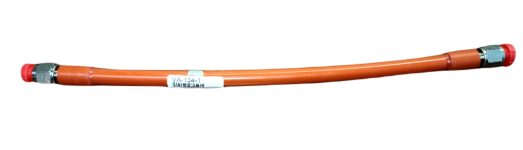
Just out of curiosity, why have I only seen hoses from the engine driven fuel pump to the carburetor? Pump and carb are solidly mounted to each other, so there should not be any motion/vibration issues. It seems to me that a nicely bent hard fuel line would be more compact and certainly much less expensive than a quality aviation fuel hose.
 
In the vast majority of installations, a fuel flow transducer (red cube) is between the engine driven fuel pump and the carb inlet, mounted somewhere convenient.
 
I would say for the fire-sleeving and resistance to vapor lock, especially if we are talking aluminum tubing. They now make lifetime fuel and oil hoses from conductive, integrated, fire-sleeved, PTFE (Polytetrafluoroethylene). I switched to them and really like them!
1780341993205.png
 
Last edited:
Hmmm, I suppose the less thermally conductive hose (whether rubber or ptfe) could be an advantage, but a hardline could be covered with firesleeve as well. In my installation, the fuel flow sensor is between gascolator and engine pump and working well.
 
Reading your suggested description in the first post, the initial pictured in my mind was a cracked flare / 28psi fuel gushing at a high rate / extreme hot exhaust runners / you get my idea…
I wouldn’t stray from the proven convention in this area.
 
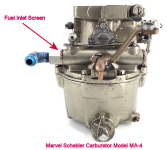
A rigid line would make inspecting the fuel inlet screen (during every annual) much more difficult.

My .02¢
Ah, true on certain carbs. For example, on the MA-4-5 carb, the fuel inlet screen is not accessed through the fuel inlet, so no need to disconnect the fuel line.
 
A rigid line would make inspecting the fuel inlet screen (during every annual) much more difficult.

My .02¢
I don’t know if all our carbs are like this, but on the ones that I’ve owned, I pull the carb inlet screen out from the side opposite the fuel line inlet. I think it can be pulled from either side. I might be wrong about that, but it’s the way I do it. Of course I don’t think that justifies using a hard line for the carb fuel inlet.
 
There is still vibration so a solid line would be bad. Look at the oil return lines from the cylinders to the crankcase. There is a short rubber hose to take care of the vibration plus any heat related expansion and contraction.

The SOLID constant speed prop oil line is stainless steel and uses steel fittings on both ends. At one time the fittings were aluminum and then an AD (IIRC) changed them to steel.

EXPERIMENTAL aviation can make changes but NO ONE recommends changes to the fuel system. Many, if not most, homebuilts have fuel systems similar to what is used on certificated aircraft. A failed fuel system could cause the lost of an aircraft.
 
There is still vibration so a solid line would be bad. Look at the oil return lines from the cylinders to the crankcase. There is a short rubber hose to take care of the vibration plus any heat related expansion and contraction.

The SOLID constant speed prop oil line is stainless steel and uses steel fittings on both ends. At one time the fittings were aluminum and then an AD (IIRC) changed them to steel.

EXPERIMENTAL aviation can make changes but NO ONE recommends changes to the fuel system. Many, if not most, homebuilts have fuel systems similar to what is used on certificated aircraft. A failed fuel system could cause the lost of an aircraft.
A failed fuel system in RV's And Rockets has cost lives.
 
Remember that prop governor lines used to be aluminum tubing. A few cracked, spewing hot oil, which prompted a mandate to replace with stainless tubing, supported by Adel clamps in specific locations, and steel flare adapters.

So, if you wanted to instrument your prototype stainless hard line with accelerometers to characterize what you would have, that would certainly fit under the "recreation and education" part of experimental.... OR just use a steel-braided and conductive hose with swaged ends and firesleeve like Steve et al supply.

The unpredictable thing here is vibration, and a crack in that tube would not be good.
 
It is experimental aviation.
Try it and let us know how long it lasted.......
That is if you are able to tell the story.
Seriously, some things you just don't do and using rigid aluminum lines in the fuel system FWF is definitely one of those.
True to my tag line " If you want things you've never had you must do things you've never done"
In your case, if you want an engine fuel fire you must use rigid aluminum tubing in the engine compartment.
I hope my comment is sufficiently sarcastic to make a believer out of you and install modern PTFE fuel hoses FWF
 
Last edited:
It’s been a long time since I ran a carb, but I always throw the fuel pump to servo hose in the trash and replace it with stainless hardline.
+1

Look at a modern auto engine. Filled with metal lines, except for those transitioning from engine to frame/body. Seem to be impervious to vibration. Usually corrosion that ends their life.

Back to our engines, they all have aluminum hard lines rigidly attached to the cylinder heads and never hear about them cracking. I am not sure i would use 3003 in the application discussed, but would have no issue with steel or SS lines, even 5 or 7 series aluminum.
 
Back to our engines, they all have aluminum hard lines rigidly attached to the cylinder heads and never hear about them cracking. I am not sure i would use 3003 in the application discussed, but would have no issue with steel or SS lines, even 5 or 7 series aluminum.
Almost correct but there is a flexible rubber connector on the return to the case on each of those aluminum lines absorbing vibration.
Also, there is no oil pressure in those lines just a dribble back to the case.
 
This is a Marvel Schebler Carburetor Model MA-4-5

View attachment 119320
Misleading picture, sorry. That arrow points only to the fuel inlet side of this carb . Yes, the fuel would go through the screen, but that is not how you access it for inspection. The inlet screen is on the opposite side and not accessible from the inlet side. (Your arrow would be correct for an MA-3 carb, however.). So, to stay on point, a hardline would not make inspection on this carb more difficult.
 
Remember that prop governor lines used to be aluminum tubing. A few cracked, spewing hot oil, which prompted a mandate to replace with stainless tubing, supported by Adel clamps in specific locations, and steel flare adapters.

So, if you wanted to instrument your prototype stainless hard line with accelerometers to characterize what you would have, that would certainly fit under the "recreation and education" part of experimental.... OR just use a steel-braided and conductive hose with swaged ends and firesleeve like Steve et al supply.

The unpredictable thing here is vibration, and a crack in that tube would not be good.
I will admit that sticking with flexible hose is the easiest, most guaranteed, if not traditional method in this application. For me, this is just an out of the box thought experiment and question. I think some good points have been made for and against a hardline between pump and carb.

So…given the field tested experience with governor oil hardlines, a properly supported, SS fuel line with steel end fittings seems quite viable. The rubber connector in cylinder to crankcase oil return lines is required because there is known to be a lot of motion and vibration from the cylinder itself. I don’t believe there is such motion between engine pump and carb since both are “motionless” and essentially mounted to the same stiff body.
 
I will admit that sticking with flexible hose is the easiest, most guaranteed, if not traditional method in this application…
Yes. In my 40+ years in the aerospace industry, GA’s practice of using hoses in this application is the outlier by far. The vast majority use hardline as the default. Hose, being heavy, bulky, fragile and expensive, is reserved for those specialty cases where there is motion between components OR maintenance access drive it into consideration. Properly fabricated, engineered and installed hardline is proven to be the most elegant solution.

The fact that some are not capable of high quality fabrication or learning the basic engineering does not make the concept unsafe - it only means that those people need to drop their credit card on a high quality supplier like TS Flightlines and let them do the work. To quote Dirty Harry: “A man’s got to know his limitations”.

Just don’t confuse your own personal limitations with engineering reality.
 
Almost correct but there is a flexible rubber connector on the return to the case on each of those aluminum lines absorbing vibration.
Also, there is no oil pressure in those lines just a dribble back to the case.
It is only rubber on one side. It is rigidly attached to the engine via the AN fitting, so will pick up any vibration from that engine. The rubber is not really isolating any vibration, just dealing with differential expansion rates in cyl vs CC; Al Tube is still vibrating.
 
It is only rubber on one side. It is rigidly attached to the engine via the AN fitting, so will pick up any vibration from that engine. The rubber is not really isolating any vibration, just dealing with differential expansion rates in cyl vs CC; Al Tube is still vibrating.
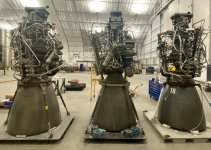
As a fluidline supplier, hoses are about 90% of our product catalog. In this case, a stainless tube might acceptable, if it were supported, and whatever movement would not loosen the pump fitting. Good case for Michael's post is the stainless prop governor tubes. Also, on most turbine and rocket engines, there is a lack of hoses, except where airframe to engine connections are necessary. So YES, well planned rigid tubes are great. Well planned, is the key. As for FWF on experimentals, we recommend NOT using aluminum, especially 3003, due to its potential flare cracking behind the sleeve. 304 or 316 stainless works well.
 

Attachments

  • Space X rocket engines.jpg
    Space X rocket engines.jpg
    132.9 KB · Views: 31
Misleading picture, sorry. That arrow points only to the fuel inlet side of this carb . Yes, the fuel would go through the screen, but that is not how you access it for inspection. The inlet screen is on the opposite side and not accessible from the inlet side. (Your arrow would be correct for an MA-3 carb, however.). So, to stay on point, a hardline would not make inspection on this carb more difficult.
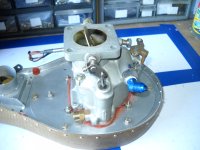
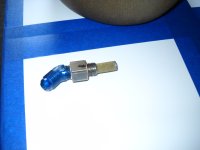
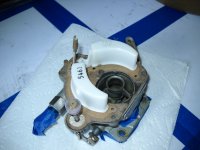
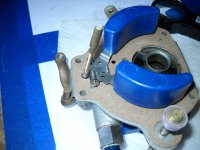
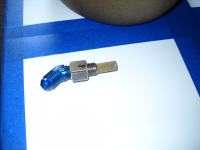
Well -- I have an Marvel Schebler Model MA-4 on my O-320-D2A in my RV-9A -- same one. The screen is removed by removing the inlet port nut that holds the inlet fitting itself. The barrel fuel screen comes out with inlet port and fitting as shown below in mine. Been inspecting my fuel inlet screen for 22-years during the condition inspections. Photos of my carburetor on the bench to replace the "old style" plastic float with the new greatly improved blue epoxy float (#F update) back in 2016. BTW -- when you pull your fuel inlet port, it's also a good idea to replace that copper washer, too.

1780415256500.jpeg 1780415737604.jpeg
1780416229727.jpeg 1780416151386.jpeg
 
Last edited:
1780417315050.jpeg

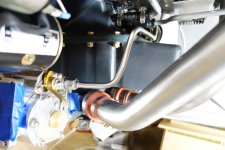
There are several threads on this subject. The above pic is from one of them. Picture shown BEFORE the supporting adel clamps were installed.

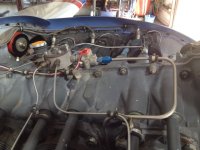
Not mine, but essentialy identical to the lines I made for my -8 many years ago and still providing reliable service to the current owner.
 
Last edited:
A hard line means more work when you service your carburetor, and you probably will at some point. So, I guess the question is -- what are the advantages of running hard fuel-line (stainless or aluminum) from your fuel pump to the carburetor, especially with lifetime conductive, integrated, fire-sleeved, PTFE now available?
 
A hard line means more work when you service your carburetor, and you probably will at some point. So, I guess the question is -- what are the advantages of running hard fuel-line (stainless or aluminum) from your fuel pump to the carburetor, especially with lifetime conductive, integrated, fire-sleeved, PTFE now available?
John, at the risk of getting burned by the flame war on the horizon, I'll answer this. Obviously a rigid tube has a smaller OD for the same ID as a hose. Sometimes a tighter bend radius, depending on the bend die thats used. In the above pic, the multiple bends will absorb any vibration and potential misalignment. It does take practice, patience and skill to make a custom rigid tube like that. That being said, most builders dont have the tools, practice, or time, and use teflon hoses. YES, teflon has a larger bend radius, especially with firesleeve. Yes, teflon is not life limited, and somewhat easier to use. I can tell you that making custom rigid tubes for installs from emails or non prototyped drawings is tough, and generally wasted time and expense. You never know if its going to fit, unless you are actually at the plane and do mockups. and you never know if there is something that will interfere with the tube. Pic below was Michael's I0540 circa 2018 with his stainless tube. Well designed, supported and fabricated. So, for most builders, teflon hose is the answer, but YES YMMV.
 

Attachments

  • Michael Robinson IO540 .jpg
    Michael Robinson IO540 .jpg
    63.6 KB · Views: 59
Well -- I have an Marvel Schebler Model MA-4-5 on my O-320-D2A in my RV-9A -- same one. The screen is removed by removing the inlet port nut that holds the inlet fitting itself. The barrel fuel screen comes out with inlet port and fitting as shown below in mine. Been inspecting my fuel inlet screen for 22-years during the condition inspections. Photos of my carburetor on the bench to replace the "old style" plastic float with the new greatly improved blue epoxy float (#F update) back in 2016. BTW -- when you pull your fuel inlet port, it's also a good idea to replace that copper washer, too.

View attachment 119357 View attachment 119359
View attachment 119361 View attachment 119360
O 320's use MA4SPA
 
Well -- I have an Marvel Schebler Model MA-4-5 on my O-320-D2A in my RV-9A -- same one. The screen is removed by removing the inlet port nut that holds the inlet fitting itself. The barrel fuel screen comes out with inlet port and fitting as shown below in mine. Been inspecting my fuel inlet screen for 22-years during the condition inspections. ...
The O-320s I've worked on typically have "MA4" carbs. Are you sure you have an "MA-4-5" ? My O360 has an MA-4-5 and know that it conforms to the service manual!
 
A hard line means more work when you service your carburetor, and you probably will at some point. So, I guess the question is -- what are the advantages of running hard fuel-line (stainless or aluminum) from your fuel pump to the carburetor, especially with lifetime conductive, integrated, fire-sleeved, PTFE now available?
Hardline is lower weight, lower volume, lower cost, and more durable. The degree of difficulty to “service the carb” can range from nothing to significant, and that factor - serviceability - is one of the things that can overcome the other advantages of hard lines. If your carb comes off often enough that the difference between one B nut or two B nuts is a factor, then flex hose starts to make sense.
 
The O-320s I've worked on typically have "MA4" carbs. Are you sure you have an "MA-4-5" ? My O360 has an MA-4-5 and know that it conforms to the service manual!
MA-4 with the fuel screen on the fuel inlet side as shown in my photos above -- not the MA-3 as you suggested previously. Again Jose, what advantage are you hoping achieve by using aluminum or stainless steel tubing over PTFE hose for your carburetor fuel supply line?
 
Last edited:
Misleading picture, sorry. That arrow points only to the fuel inlet side of this carb . Yes, the fuel would go through the screen, but that is not how you access it for inspection. The inlet screen is on the opposite side and not accessible from the inlet side. (Your arrow would be correct for an MA-3 carb, however.). So, to stay on point, a hardline would not make inspection on this carb more difficult.
MA-4 -- not the MA-3.
 
Correct -- the MA-4 model type -- not the MA-3 as Jose suggested.
My friend, you have mis-read the posts. No one suggested your engine had an MA-3. In fact, once you later mentioned you had an O-320 you were corrected in saying you had an MA-4-5. The MA-3 was mentioned much earlier as an example of one that had the inlet port and fuel screen on the same side as opposed to what you originally indicated in your original MA-4-5 labeled picture (post #10). BTW, thanks for quietly changing the picture which is now correct and also editing your later posts which seemed to confuse the MA-4-5 with the MA-4.

At any rate, it has been interesting hearing all responses to my original inquiry. If advantages of smoother fuel flow, fewer fittings, compactness, ruggedness, lightness, less expense, are important enough then it is an option. Of course, it has to be properly made of suitable metal and properly secured. The inlet screen inspection is not an issue with some carbs and only perhaps a slight nuisance with others. Incidentally, conductive PTFE fuel lines are great and is what is in my plane. I feel justified in questioning tradition, even if I stick with tradition.
 
But you posted...
My friend, you have mis-read the posts. No one suggested your engine had an MA-3. In fact, once you later mentioned you had an O-320 you were corrected in saying you had an MA-4-5. The MA-3 was mentioned much earlier as an example...
It's an MA-4 (typo was corrected). So, don't you think it's about time to get back to the intended thread topic guys?. And, I clearly demonstrated that my Lycoming carburetor (MA-4) and many others have the fuel screen on the fuel inlet port -- my picture clearly showed that -- correct? The actual point here -- not to split hairs -- right? (y)

1780461509979.png
 
Last edited:
As a brief aside, what is a recommended method for inspecting and cleaning that fuel inlet screen pictured, where the debris will be on the inside of the basket?
 
A few blasts of carb cleaner while allowing the filter to drain any debris out works nicely. And, putting the fuel inlet screen up to a light helps spot any debris inside.
 
Back
Top