
Van's Air Force
You are using an out of date browser. It may not display this or other websites correctly.
You should upgrade or use an alternative browser.
You should upgrade or use an alternative browser.
First Spark Plug Change-Too Oily?
- Thread starter rockitdoc
- Start date

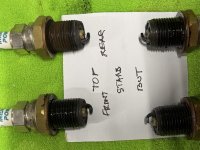
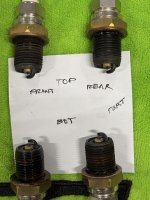

The adapters are on. So the threaded part is actually much longer than it appears in these pix. These are the plugs Lycoming put in. Nippon Denso.The engine is barely broken in yet so don’t worry too much. Do you lean aggressively for ground ops?
Not positive but those look like short reach plugs. My -390 uses long reach adapters and plugs. Are you sure those are correct for your application?
Yes. I lean during taxiing. Not sure how aggressively.The engine is barely broken in yet so don’t worry too much. Do you lean aggressively for ground ops?
Not positive but those look like short reach plugs. My -390 uses long reach adapters and plugs. Are you sure those are correct for your application?

50 hours on new IO390EXP in my -14A. Second oil change.
Do these look too oily to those of you with an eye for such things? Especially top front starboard. I realize bottoms might be darker than tops. View attachment 118258
Assuming those are bottom plugs this is normal for 50 hours

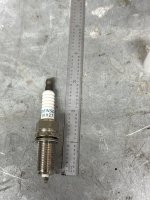
Ok. That looks like what I’d expect.The adapters are on. So the threaded part is actually much longer than it appears in these pix. These are the plugs Lycoming put in. Nippon Denso.
View attachment 118302

Doc,
You might be interested in this thread if you haven't already read it. See my post (#21).
Link: Picture of oily Denso IKH-27
You might be interested in this thread if you haven't already read it. See my post (#21).
Link: Picture of oily Denso IKH-27
None look dry, but only two are shinny. The oilly threads further confirms more oil than typical, but this oil could have been there since the first few hours where oil consumption is normally high. Threads only look like this when there is too much oil in the chamber area, pointing to a ring wall issue. Note how one plug shows evidence of earlier oil contamination, but since dried out, others did not. Implies three cylinders still have more oil than normal. Clean them off and see if it comes back. They are not bad, just not as dry as typical. Have you checked your cylinder walss for glazing? My speculation would be light glazing. While glazing can can burn more oil and leaves plugs like this, it is not a serious problem beyond those two.
I would say that at 50 hours, you are long past ring seating and oil volume above the rings will not improve over time.
I would say that at 50 hours, you are long past ring seating and oil volume above the rings will not improve over time.
Last edited:
Why are you pulling the adapters out with the spark plugs. The adapters should show less heat then the spark plugs. I suggest you pull the spark plug only next time and see the heat on the spark plug threads and how much oil is on the spark plug threads.
The adapters come out with the plugs when the plugs are removed.Why are you pulling the adapters out with the spark plugs. The adapters should show less heat then the spark plugs. I suggest you pull the spark plug only next time and see the heat on the spark plug threads and how much oil is on the spark plug threads.

This should not be. There is a differential torque value for adapters and plugs. From the LSE manual:The adapters come out with the plugs when the plugs are removed.
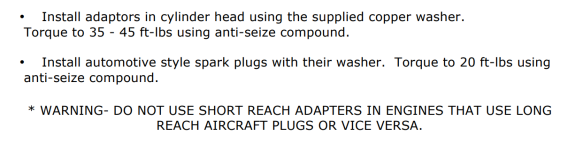


I would NEVER consider torquing those thin brass adapters to 45. Just asking for problems IMHO.This should not be. There is a differential torque value for adapters and plugs. From the LSE manual:
View attachment 118368
That's because, as Brian points out above, the adapters for PMags and LSE ignitions systems are quite different from one another. Here are the LSE adapters:I would NEVER consider torquing those thin brass adapters to 45. Just asking for problems IMHO.
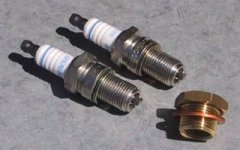
But by the same token, I agree with you: Personally, I would never go up to 45 ft-lb. as designated. I always use the lowest 35 ft-lb. torque, the same as any standard aviation spark plug. They remain fixed in the cylinders when rotating or changing the automotive plugs.
Norman CYYJ
Well Known Member
As long as the spark plugs are in the adapter the brass inserts can be torque to the required value, if you put the inserts in first and the instant that you try to torque them they will break. It doesn't matter whose inserts you use it is impossible to have enough wall thickness in them to take any kind of torque.I would NEVER consider torquing those thin brass adapters to 45. Just asking for problems IMHO.
Ummm . . . no.It doesn't matter whose inserts you use it is impossible to have enough wall thickness in them to take any kind of torque.
There is more than enough wall thickness in the LSE adapters to torque them fully without any plugs installed. We've been doing it for many, many years without issues, and the instructions in the manual are quite clear about it.
18-20 ft lb's is pretty much universal in the auto world for plugs and they never back themselves out. Great that you can get away with that, but why? Sure, the aviation plugs are spec'ed higher, but they are 18 instead of 14mm and also steel. The brass adapters are 14 and very thin in the walls. I still think anything over 20 is an unnecessary risk. Just my opinion posted for others benefit, not trying to challenge your approach
Ummm, yes. The thickness is the same regardless of who makes the adapter. wall thickness is determined by the two thread dimensions and cant be changed or manipulated. This is a snip from a post I made in the past.Ummm . . . no.
There is more than enough wall thickness in the LSE adapters to torque them fully without any plugs installed. We've been doing it for many, many years without issues, and the instructions in the manual are quite clear about it.
Yes, the wall thickness varies as the thread patterns criss cross, but we are concerned with where it is thinnest / weakest in this application. 45 ft/lbs is just crazy high for brass threads even if it was thicker. Your connecting rods bolts aren't even torqued that high and they are solid 3/8" alloy steel.Major Dia of the 14mm internal is 13.96 and the minor dia of the 18mm external is 15.93. The leaves 2 mm or .078" of brass (not steel) to hold all of that torque. That is not a lot; barely more than 1/16". If the adapters were steel, I would not be concerned with 35.
Again, no issue with what you are doing. Just don't want others to come around and think they should be using 45. just no reason to take that risk.
Last edited:
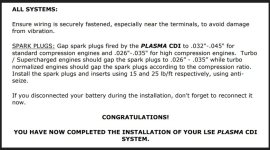
Klaus flipped on his install manual..... Anyone that installed LSi 20 years ago can look this up....This should not be. There is a differential torque value for adapters and plugs. From the LSE manual:
View attachment 118368
I installed the adapters IAW his (then) instructions. The adapters were removed once, when I installed new ECI (recall) cylinders.
They never come out with the plugs. And have always stayed torqued to the installed value.
I was having the same problem. I re-torqued the adapters to about 35 foot pounds. make sure you do it with the spark plugs in the adapters (I torqued to 18 ft-lbs) first, then torqued the adapter to 35. Had to buy a long reach 7/8-12 point socket to reach the adapter over the spark plug though.The adapters come out with the plugs when the plugs are removed.

I was having the same problem. I re-torqued the adapters to about 35 foot pounds. make sure you do it with the spark plugs in the adapters (I torqued to 18 ft-lbs) first, then torqued the adapter to 35. Had to buy a long reach 7/8-12 point socket to reach the adapter over the spark plug though.
If you use the NGK 2668 smaller hex for short reach plugs (5/8 vs 13/16, same other specs) makes it much easier to clear the plug to torque the adapter. (I use 30 ft lbs. for the adapter)