
Van's Air Force
You are using an out of date browser. It may not display this or other websites correctly.
You should upgrade or use an alternative browser.
You should upgrade or use an alternative browser.
Cracks in Lt. Aileron
- Thread starter b1skooter
- Start date

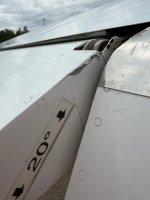
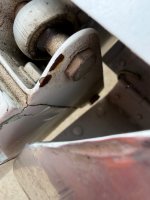
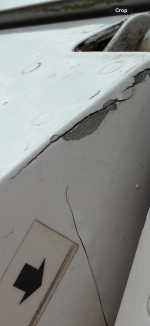

Hard to tell from the photos but this looks like there is fiberglass filler in the end rib that cracked. Ignoring the possibility of a chunk of stuff falling out an jamming the control surface I suggest this is mostly cosmetic.
But, easy enough to fix.
Carl
But, easy enough to fix.
Carl

Do you have a set of plans? Highly recommended.
As for issue, what Carl said.
As for issue, what Carl said.
Yeah, On the RV 6-7-8 the end ribs on the ailerons are recessed about 3/4" and the flanges face outward. The flaps and elevators are built the same way. I suspect all the other models are similar but don't know for sure. What happens is that in either a quest to wring out an extra ounce of drag reduction or maybe for aesthetic reasons, some people fill in that recess with fiberglass. It looks cool until it doesn't.
If that's what you've got going on, then the biggest potential hazard is a chunk of that coming loose and getting jammed between the aileron and the flap. The second biggest would be if they didn't leave a weep hole near the trailing edge to give any water that finds its way in there a place to drip out.
Here's a picture of the end of my RV7 aileron built to plan for reference.
If that's what you've got going on, then the biggest potential hazard is a chunk of that coming loose and getting jammed between the aileron and the flap. The second biggest would be if they didn't leave a weep hole near the trailing edge to give any water that finds its way in there a place to drip out.
Here's a picture of the end of my RV7 aileron built to plan for reference.
Attachments
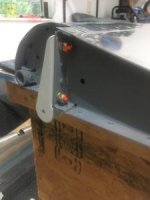

If I looked up the correct aircraft from the OP, this is from an RV-6A. So yeah, I would agree that it's likely a filler piece put in there to make everything pretty and get that extra quarter knot of top-end speed from drag reduction. And I would also agree with the others to cut that piece out. I few shots of white paint on the end rib that's now exposed (and the rusty bracket) and you'll likely never notice the piece missing. If it were to come out part of the way on its own in flight and get jammed against the flap, it could make for a very bad day.
Assuming you remove the aileron to do this, take pictures and/or take note of how the existing spacers and washers are installed on the hinges and pushrod. It would be most beneficial to get them installed back correctly (assuming they're in there correctly now), and they may not necessarily be exactly the same from one side to the other.
Assuming you remove the aileron to do this, take pictures and/or take note of how the existing spacers and washers are installed on the hinges and pushrod. It would be most beneficial to get them installed back correctly (assuming they're in there correctly now), and they may not necessarily be exactly the same from one side to the other.
It would be easier to access if you just disconnect the flap push rod and let the flap drop down. That way you wouldn’t need to take the aileron off to work on it.If I looked up the correct aircraft from the OP, this is from an RV-6A. So yeah, I would agree that it's likely a filler piece put in there to make everything pretty and get that extra quarter knot of top-end speed from drag reduction. And I would also agree with the others to cut that piece out. I few shots of white paint on the end rib that's now exposed (and the rusty bracket) and you'll likely never notice the piece missing. If it were to come out part of the way on its own in flight and get jammed against the flap, it could make for a very bad day.
Assuming you remove the aileron to do this, take pictures and/or take note of how the existing spacers and washers are installed on the hinges and pushrod. It would be most beneficial to get them installed back correctly (assuming they're in there correctly now), and they may not necessarily be exactly the same from one side to the other.
YMMV
FYI, after phase1 I read where someone claimed to pick up a knot or more by doing this. As a test, I took packing tape and sealed all of the flight control surface ends. This resulted in no noticeable speed benefit. Pulled off the tape and kept it all stock Vans.Need a little expertise on an aileron issue. Plane has about 1600hrs and no aerobatics. Appreciate thoughts on next steps to investigate/fix.
I always fill in exposed end ribs. There is no drag reduction, this is strictly cosmetic. The result (for me) is a more finished appearance.FYI, after phase1 I read where someone claimed to pick up a knot or more by doing this. As a test, I took packing tape and sealed all of the flight control surface ends. This resulted in no noticeable speed benefit. Pulled off the tape and kept it all stock Vans.
I did have to make a small hole in the HS fill to do the SB borescope inspection. All fills have a drain hole.
Carl
Attachments