Bcone1381

Well Known Member
I’ve been building for about 9 years. I have never seen a review of the “ In and out debarring tool”. I suspect it’s worth its price x 3. Any one have one? If I build again I’m buying a second drill and one of these.

 
They were somewhat of a thing when I built my RV 7 16+ years ago. They were called Cogsdill deburring tools after the original manufacturer. They are in the "nice to have but not absolutely necessary" category. I do still have mine and it did speed up the build. I'm not sure how useful they would be with the newer kits. I believe the RV14 and RV10 skin holes are drilled to size and don't require match drilling or deburring? Hopefully someone will correct me if I'm wrong.

Here's a link: Cogsdill

Thanks,

Joe
 
Been using the EZ-Burr version of these for years. They work great as a luxury tool. Definitely not required but are a very nice upgrade! They do make getting to the backside of some holes very easy.
 
I’ve been building for about 9 years. I have never seen a review of the “ In and out debarring tool”. I suspect it’s worth its price x 3. Any one have one? If I build again I’m buying a second drill and one of these.


In my opinion, they are a "must have". I don't use them for standard deburring, but there are countless places where you can't get to the back side of a drilled hole with a deburring tool.

I used these right up to the end of my build. The last spot I used one was putting on the data plate. The holes were easy to drill from the outside, but I'd of had to take off the 26 screws in the stabilizer fairing to get to the inside of the fuselage for deburring.

I've used then enough to replace a couple of the blades.
 
Cogsdill / EZ-Burr are nice but I found mine to be more trouble than it is worth. Broken blades needing replaced, drop on floor and bent becoming unusable. A very expensive tool that was broke more than it worked. Mine did not save me any building time.
 
Cogsdill / EZ-Burr are nice but I found mine to be more trouble than it is worth. Broken blades needing replaced, drop on floor and bent becoming unusable. A very expensive tool that was broke more than it worked. Mine did not save me any building time.
Broken blades? Did you have them adjusted properly?
 
We used them all the time when I was working in an aerospace machine shop years ago. The blade should last forever on aluminum. We got much shorter tool life on Inconel and other jet engine hot section alloys. The internal spring is another wear item on these tools.
 
I have a full set and have used them enough times. There are times that they are a life saver but they are not cheap or at least when I bought mine some 15-18 years ago, they were not cheap.
 
These look like they could save a whole lot of time. Can you use them to final drill all holes and simultaneously deburr?
 
They are useful when nothing else is effective, like on the inside of a tube. The tension is adjustable and if set incorrectly, the tool will rapidly countersink the hole. I think there was a version that combined drilling and deburring.
 
I've used them, as others mentioned they're very effective at getting to places you can't reach. Used properly, they're fast and effective, but also expensive. I deburred a lot of my skins with it, and it was great for that.
 
They seem to be somewhat hit/miss on thinner sheet metal. However, for thickness above .060-.080 they seem to work great. I use them in my machine shop all the time for backside-deburring holes that cannot be reached otherwise.

They operate best when finely adjusted, and you should blow out the chips with compressed air every 100ish holes.

My favorite tool to use them in are the 4V electric scewdrivers. They are much lighter weight, and only spin about 200 rpm so they're easy to just give it one or two whirls. When doing large production runs (from one hundred to a thousand pieces), I'll usually setup as many screwdrivers as I have all with their respective size deburr tool. Makes it easy to trade off quickly.

I also tried running them in the CNC machine. Spent hours getting it tuned to work marginally and ran about 1500 holes with them. Ultimately without the feel the machine could not use them consistently enough for backside deburring. (I thing the spring retract was not consistent enough as chips, tool pressure, or whatever else would change).

ACS Sells a knockoff set which are cheaper, and quality seems ok. I've found the original cogsdill burr-a-way's are the best, and monitoring ebay usually turns them up most affordably.

See below for my usual setup. Note, the 1/4 shank will fit nicely into a 1/4 hex receiver. I just drill/tap/set screw the tool nose to allow them to lightly clamp in place.
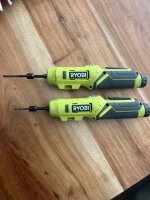

IMG_8019.jpeg
 
Last edited:
