agusgroh

Member
Hi everyone,

This is my first post on the forum, although I've been a visitor for a while.
I own a Van's RV-6A equipped with a Lycoming O-320-D1A and a Sensenich 70CM86160-0-16 propeller. I've been flying the airplane for about a year, and I've noticed it seems slower compared to other RV-6As with the same engine and propeller combination.

Here's some data from recent flight tests:
  • Pressure altitude: 7,500 ft
  • MP: 22" Hg
  • RPM: 2,300
  • IAS: 130 kt
  • OAT: 57°F
  • TAS: 145 kt

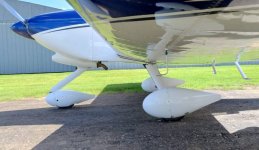
The airplane has gear leg fairings and wheel pants, but no intersection fairings installed. I've attached a photo showing the current setup.
Another thing I've noticed is that the airplane doesn't accelerate easily past 130 KIAS. Even pitching the nose down, I can't easily increase the speed. It feels like the airplane has a lot of drag.

Do these numbers look right for this model, or could something be wrong?

Thanks in advance!
 

Attachments

  • 2026-06-12 16.25.44.jpg
    2026-06-12 16.25.44.jpg
    60.7 KB · Views: 151
Hi everyone,

This is my first post on the forum, although I've been a visitor for a while.
I own a Van's RV-6A equipped with a Lycoming O-320-D1A and a Sensenich 70CM86160-0-16 propeller. I've been flying the airplane for about a year, and I've noticed it seems slower compared to other RV-6As with the same engine and propeller combination.

Here's some data from recent flight tests:
  • Pressure altitude: 7,500 ft
  • MP: 22" Hg
  • RPM: 2,300
  • IAS: 130 kt
  • OAT: 57°F
  • TAS: 145 kt

The airplane has gear leg fairings and wheel pants, but no intersection fairings installed. I've attached a photo showing the current setup.
Another thing I've noticed is that the airplane doesn't accelerate easily past 130 KIAS. Even pitching the nose down, I can't easily increase the speed. It feels like the airplane has a lot of drag.

Do these numbers look right for this model, or could something be wrong?

Thanks in advance!
1. (Minor) Using your numbers for PA and OAT 130 kias converts to 149 ktas.
2. At that altitude your MP looks to be at or close to full throttle, in which case your RPM looks low. Either your prop is over-pitched, or your engine is not making rated power. What do your climb numbers look like?
 
Check if the airspeed indicator is accurate.
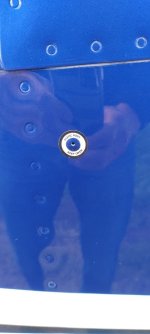
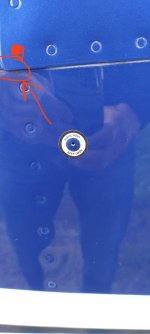
Are the static ports the type called for in the plans? [Photo and we can help]
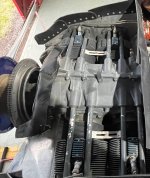
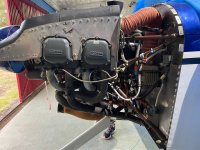
Give us photos of the engine baffling.
Does the plane fly straght, level, ball centered with hands and feet off?
 
The intersection fairings will be worth a few knots, give or take. As the others have said, FIRST make sure what you're measuring is correct. There are ground tests to validate your static system and another test to confirm your pitot system is correct. If you have GPS, there's also an in-flight test to confirm if the speeds you're seeing are correct. A brief search should lead you down the right path to perform these tests, or you can use the EAA Phase I testing book. It's not without some effort, but maybe another builder in your area can help. And yes, the location and type of the static ports can absolutely skew the results. Many a builder has purchased expensive static ports that don't work as well as the drilled out pulled rivets that Van's shows in their plans.

Once you've confirmed the TAS you're seeing is actually true, then we can start looking for what's slowing you down.
 
1. (Minor) Using your numbers for PA and OAT 130 kias converts to 149 ktas.
2. At that altitude your MP looks to be at or close to full throttle, in which case your RPM looks low. Either your prop is over-pitched, or your engine is not making rated power. What do your climb numbers look like?
Hi Bob,


  1. Thanks for the correction!
  2. The throttle wasn't fully open — I still had some MP available. As for climb performance, I'm seeing about 1,000 ft/min with pilot and passenger (308 lbs combined) and 19 gallons of fuel.
 
Check if the airspeed indicator is accurate.
Are the static ports the type called for in the plans? [Photo and we can help]
Give us photos of the engine baffling.
Does the plane fly straght, level, ball centered with hands and feet off?
Hi, I will take some photos to the static ports.
I've attached some photos of the engine bafflings
The airplane fly straight with hands and feet off.
 

Attachments

  • 2026-06-12 18.05.59.jpg
    2026-06-12 18.05.59.jpg
    166.5 KB · Views: 88
  • 2026-06-12 18.05.55.jpg
    2026-06-12 18.05.55.jpg
    175.9 KB · Views: 89
"It's not the plane, it's the pilot".

Not picking on you, just thought it would be fun to end the week with a bit of Top Gun: Maverick humor.
 
150 or 160 hp?
Poor picture angle, appears you do not have upper & lower leg fairings installed.
Pitot tube appears to be pointing down a bit.
Front engine baffle seals definitely not sealing properly.

Lots of posts on VAF regarding steps to maximize power & speed efficiency
 
If I recall correctly from testing we did fifteen years ago, Upper and Lower intersection fairings are good for 8-10 knots…huge compared to their size!
 
The intersection fairings will be worth a few knots, give or take. As the others have said, FIRST make sure what you're measuring is correct. There are ground tests to validate your static system and another test to confirm your pitot system is correct. If you have GPS, there's also an in-flight test to confirm if the speeds you're seeing are correct. A brief search should lead you down the right path to perform these tests, or you can use the EAA Phase I testing book. It's not without some effort, but maybe another builder in your area can help. And yes, the location and type of the static ports can absolutely skew the results. Many a builder has purchased expensive static ports that don't work as well as the drilled out pulled rivets that Van's shows in their plans.

Once you've confirmed the TAS you're seeing is actually true, then we can start looking for what's slowing you down.
Thank you for the detailed response — that makes a lot of sense. I'll validate the pitot-static system first before chasing drag issues.

I've looked into several static system tests. For the in-flight TAS verification, is there a specific table or spreadsheet you'd recommend for recording the data and calculating the results?
 
150 or 160 hp?
Poor picture angle, appears you do not have upper & lower leg fairings installed.
Pitot tube appears to be pointing down a bit.
Front engine baffle seals definitely not sealing properly.

Lots of posts on VAF regarding steps to maximize power & speed efficiency
Thank you Ralph,
Lycoming 160 HP.
I will take some more detailed pictures. I don't have installed the upper and lower leg fairings.

Pitot tube appears to be pointing down a bit.
Is there an specif positions in the plans? I am not the builder of the airplane.


Front engine baffle seals definitely not sealing properly.
I will do some research on how to improve engine baffling
 
If I recall correctly from testing we did fifteen years ago, Upper and Lower intersection fairings are good for 8-10 knots…huge compared to their size!
That's exactly one of the tests I'd like to perform. I've read a lot of threads on this — some people say the intersection fairings improve speed significantly, while others report little to no difference.
 
I've looked into several static system tests. For the in-flight TAS verification, is there a specific table or spreadsheet you'd recommend for recording the data and calculating the results?

Put EAA GPS method for validating airspeeds into Mr. Google's AI brain. It gives you all kinds of fodder for your perusal.

Lemme see if I can answer some more of your questions...
  • Regarding the pitot tube alignment, Van's typically has the pitot tube inlet leg parallel with the level flight reference. On a 7, that's the longeron at the cockpit. I would assume the 6 is the same. If I'm wrong, a 6 driver will chime in.
  • Yeah, your front baffle looks like it's seen better days. There are myriad threads on here about best practices for this. You can spend a lot of time going down that rabbit hole. Dan Horton has several posts on this forum with very good photos.
  • You can purchase both upper and lower intersection fairings from a place like Fairings, Etc., or you can make your own. If you don't have experience with fiberglass, I'd suggest just buying them. You still have to do some fitting to customize them to your build, but it'll save you a lot of time.
  • It sounds like you may not be the original builder, but it doesn't actually say that in your post. You can spend a lot of time chasing down each of these issues on a plane you're not intimately familiar with, but everything you learn adds to your knowledge base. it's not wasted time.
  • Lastly, I don't see a bunch of wires going to EGT and CHT probes on your photo. Just wait until you see the rabbit hole you can go down when you start chasing those numbers!!
 
Last edited:
Also, I like to test at 7500' Density Altitude. Otherwise on hot day vs. cold days your numbers are going to wander significantly.
At 7500' DA, the engine can only do 75% power, and so despite being Full Throttle, it isn't full power, and can run there all day long.
 
There's the first variable you can control. Go fly WOT and report back with IAS, TAS, RPM. And at that altitude, you can run WOT and lean too.
Just be aware that prop has a 2600 rpm do-not-exceed restriction.

We still don’t know the pitch of the prop so can’t determine if it is optimized for climb or cruise.
 
Put EAA GPS method for validating airspeeds into Mr. Google's AI brain. It gives you all kinds of fodder for your perusal.
Use one of the spreadsheets that reports the margin of error. I discovered I was only able to get good data in very smooth conditions. It may have been technique. 🤣
 
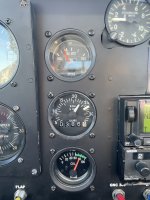
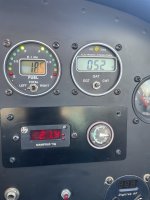
Hello all,

After performing some tests today, I gathered the following data from the flight.
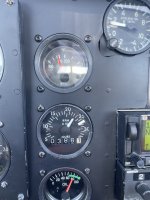
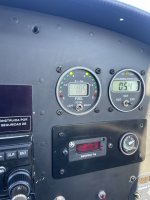
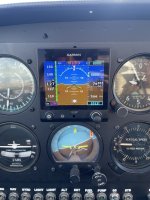
I've attached a few images.

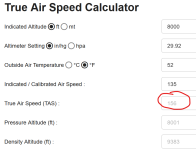
At 8000Ft PA I got 2500 RPM with WOT and 135 KIAS.

I flew two navigation legs and recorded the following:

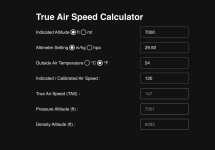
First Leg:
- P.A: 7000 ft
- IAS: 130 kt
- RPM: 2300
- MP: 21.7
- OAT: 54 °F

Based on this data, I get:

1781568697756.png

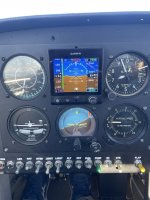
1781570569973.jpeg1781570591757.jpeg
1781570613415.jpeg
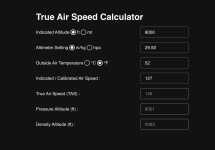
Second Leg:
P.A: 8000 Ft
IAS: 127KT
RPM: 2300
MP: 21.4
OAT: 52 F

1781568990934.png

1781570627832.jpeg
1781570635850.jpeg

1781570643414.jpeg


I hope this information proves useful. Please let me know if you need any further details.

Regards,

Agustin
 
Unless my quick and dirty calculations are wrong (quite possible!)... I get ambient pressure of 22.35 at 8000' and your temperature.
That means the MP is almost 1" less than ambient. The RV airbox is designed to give about enough pressure to make up for the pressure loss in the air filter.

Check:
  1. What kind of air filter? Paper or the called for oiled K&N?
  2. Filter condition? Clean?
  3. Seal between the airbox and the cowl air inlet - is it there? Sealing correctly?
You should see 180+ mph, and that would be 156 knots.
Turning only 2300 rpm at WOT is a big part of that. Borrow an optical tach and confirm accuracy of your tach at 1800 rpm.
 
Last week: RV-6, Sensenich cruise-pitch prop, IO-320. Not WOT, but still acheiving 2400 RPM at 7.2 gph at 7000, OAT 6ºC, altimeter 30.39 Hg.in.

TAS 163, IAS 147.

If you're only getting 2300 RPM at WOT, your prop is likely a lot coarser than mine? But mine's already pretty coarse, so ...

- mark


1781573546632.png
 
Unless my quick and dirty calculations are wrong (quite possible!)... I get ambient pressure of 22.35 at 8000' and your temperature.
That means the MP is almost 1" less than ambient. The RV airbox is designed to give about enough pressure to make up for the pressure loss in the air filter.

Check:
  1. What kind of air filter? Paper or the called for oiled K&N?
  2. Filter condition? Clean?
  3. Seal between the airbox and the cowl air inlet - is it there? Sealing correctly?
You should see 180+ mph, and that would be 156 knots.
Turning only 2300 rpm at WOT is a big part of that. Borrow an optical tach and confirm accuracy of your tach at 1800 rpm.
Hi, sorry maybe I wasn’t clear in my previous post.
At 8000 PA at WOT I get 2500 RPM and 135KIAS.

1. K&N filter
2. The filter is clean
3. The sealing still there and it’s ok

Are my parameters wrong ?
 
Last week: RV-6, Sensenich cruise-pitch prop, IO-320. Not WOT, but still acheiving 2400 RPM at 7.2 gph at 7000, OAT 6ºC, altimeter 30.39 Hg.in.

TAS 163, IAS 147.

If you're only getting 2300 RPM at WOT, your prop is likely a lot coarser than mine? But mine's already pretty coarse, so ...

- mark


View attachment 120604
Hi,

I am getting 2500 RPM at WOT at 8,000 ft pressure altitude, with an OAT of 52°F and 135 KIAS.

In the attached images, you can see that I am flying at 8,000 ft (second leg) at 2300 RPM and getting 127 KIAS.
Do these numbers look correct?

To achieve the speeds you mentioned, I would need to lower the nose and descend slightly.
 
Until you get intersection fairings installed you'll never know what speed your RV is capable of flying.

If 2500 rpm is all your engine can do at 7500' you have a humdinger of a cruise prop or less than optimum engine output. However, the draggy landing gear may be contributing to the low rpm.
 
Hi,

I am getting 2500 RPM at WOT at 8,000 ft pressure altitude, with an OAT of 52°F and 135 KIAS.

In the attached images, you can see that I am flying at 8,000 ft (second leg) at 2300 RPM and getting 127 KIAS.
Do these numbers look correct?

To achieve the speeds you mentioned, I would need to lower the nose and descend slightly.
OK, since we are trying to figure out your top speed, I don't know why you tried at 2300 rpm. I expected that was the best you could do, and totally missed the 2500 rpm data.

I agree with comments above about getting the intersection fairings installed.
 
I am getting 2500 RPM at WOT at 8,000 ft pressure altitude, with an OAT of 52°F and 135 KIAS.

In the attached images, you can see that I am flying at 8,000 ft (second leg) at 2300 RPM and getting 127 KIAS.

Help us understand why you did one WOT run in which you achieved 2500 RPM, 135 KIAS (156 KTAS) and then did your testing on the various legs at less than WOT?

At that altitude, you should be at WOT all the time (and leaned).

Of course your airplane will be slow if you compare it to others who are at WOT and you're not.

1781585702898.png
 
Until you get intersection fairings installed you'll never know what speed your RV is capable of flying.

If 2500 rpm is all your engine can do at 7500' you have a humdinger of a cruise prop or less than optimum engine output. However, the draggy landing gear may be contributing to the low rpm.
Hi Sam,
Yes, 2500 RPM and 135 KIAS at WOT is the best I can get at 8000 ft PA.
With these parameters I get 156 KTAS. Do these numbers look correct?

OAT: 52°F
RPM: 2500
MP: 22.2
IAS: 135 kt
PA: 8000 ft

I'm going to try building some intersection fairings to see if I can get better numbers.
What about power at this altitude with these parameters — am I over 74%?
 
OK, since we are trying to figure out your top speed, I don't know why you tried at 2300 rpm. I expected that was the best you could do, and totally missed the 2500 rpm data.

I agree with comments above about getting the intersection fairings installed.
Hi,
The reason I tried at 2300 RPM is that I was worried about exceeding 74% max continuous power.
At WOT with 2500 RPM and 22.2" MP, at 8000 ft PA and 52°F, I calculate 76% rated power — so I'm over the 74% limit

Please correct me if my calculation is off
 
Help us understand why you did one WOT run in which you achieved 2500 RPM, 135 KIAS (156 KTAS) and then did your testing on the various legs at less than WOT?

At that altitude, you should be at WOT all the time (and leaned).

Of course your airplane will be slow if you compare it to others who are at WOT and you're not.

View attachment 120614
Thanks for pointing that out. The reason I didn't run the other legs at WOT is that I was concerned about exceeding the engine's max continuous power. At WOT with 2500 RPM and 22.2" MP, at 8000 ft PA and 52°F (OAT), I calculate about 76% rated power — over the 74% I was trying to stay under. That's why I pulled the RPM back to 2300 for the test legs.
If that power concern is unfounded and I should just stay at WOT and lean at this altitude, that's an easy fix for the next round of testing.
One question: on the single WOT run, I got 156 KTAS at 2500 RPM / 135 KIAS. Does that TAS look right to you for this configuration, or does it still seem low? Let me know if I'm doing the calculation wrong anywhere.
 
My 2c.
Seems like 2 separate questions we need to answer.
1. Is my ASI indicating correctly?
2. If so, am I slow? Why? Fairings etc…

You need to answer #1 first.

To do this follow these instructions:


One question I have from your static port pic… where is it located? Correct spot per plans? Only reason I ask is that looks like a strange skin overlap and/or missing rivet.

IMG_6242.jpeg

Also, labels and stickers like that in the boundary layer right next to the port can trip the flow and cause erroneous static readings. The color and angle of the photo make it hard to tell the actual shape of the port.
 
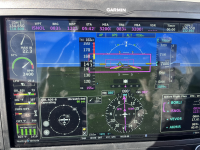
In two of the panel pics posted by the OP in post 21 showing airspeed indicators there are significant differences in the indicated airspeeds between the G5 and the steam gauge airspeed. That might be a clue? I would get that sorted out first, then read the Kit Planes article at this link:
Magazine article
Then fly the test plan exactly as described. This should give you an accurate starting point.

Joe
 
In two of the panel pics posted by the OP in post 21 showing airspeed indicators there are significant differences in the indicated airspeeds between the G5 and the steam gauge airspeed. That might be a clue? I would get that sorted out first, then read the Kit Planes article at this link:
Magazine article
Then fly the test plan exactly as described. This should give you an accurate starting point.

Joe
They both look "dead-on" to me. Is it possible you are looking at "mph" on the analog gauge?
 
Thanks for pointing that out. The reason I didn't run the other legs at WOT is that I was concerned about exceeding the engine's max continuous power. At WOT with 2500 RPM and 22.2" MP, at 8000 ft PA and 52°F (OAT), I calculate about 76% rated power — over the 74% I was trying to stay under. That's why I pulled the RPM back to 2300 for the test legs.
Above 7500' DA you won't be able to exceed 75% power, no need for calculations. That is why we are telling you to run wide-open throttle at that altitude. You do, however, need to respect the 2600 rpm restriction for your particular prop, and Sensenich is serious about it. But looks like this is not yet a factor for you since you can only achieve 2500 rpm..........provided your tach is accurate.

My RV-6 (160 hp) can see 2600 rpm at 7500' with an 80" pitch Sensenich but I have excellent gear fairings. We still haven't been told the pitch of your prop and that is a big hole in the info you are providing.
 
1. You must start by validating the accuracy of your indicated airspeed with some 3 or 4 way runs using the calculators mentioned in previous threads and available via the search function on this site.

2. You’re not going to hurt your normally aspirated engine at 8000’ or above via too much throttle unless the OAT is less than 0 degrees Celsius.

3. Install any drag-reducing fairings or engine baffling fixes before you start making decisions as to whether your prop is appropriately pitched.

4. Observe any RPM limitations imposed by your engine or propeller.

5. Lean appropriately for speed testing/max cruise speed flight. For purposes of testing, the old fashioned “lean until it runs a little rough and then richen until it smooths out” is adequate. You can delve into the finer points of leaning when everything else is sorted out. In the meantime, this approach provides a consistent baseline and you won’t damage anything.

6. Intersection fairings can make a HUGE difference in speed depending on what is currently left exposed without the fairings.

7. The shape and placement of your static ports can have a HUGE impact on the accuracy of your indicated airspeed. Of course since true airspeed calculations are based on indicated airspeed, this error can carry forward and screw up everything. Hence the need to verify the accuracy of your indicated airspeed via multi-track GPS runs and a spreadsheet (see point #1, above).

FYI… the original RV6 plans called for using a round head pulled rivet with the center shank punched out as static ports. If memory serves, the stock location is about 18” forward of the horizontal stabilizer and slightly lower than the horizontal stabilizer. Yours MAY be inaccurate depending on how much they vary from stock. Again, I specifically say MAY BE INACCURATE because you may be lucky and some non standard installation MAY be accurate. Again, determine if you really have a problem before making the effort to implement a solution (see point #1, above).

The overriding theme I want to leave you with is that you’ve gotta think logically in the process of comparison and, if necessary, implementing a solution. Otherwise, you’re just shotgunning and may or may not end up with a faster airplane, but will definitely be spending more time and effort than would otherwise be necessary.

My $0.02.

Hope this helps.