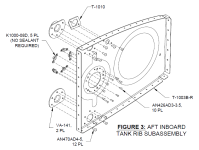
I'm building an RV-14A, and decided to use dual CiES fuel senders in each of my standard tanks. I just wanted to share my experience with the next builder coming along.
TL;DNR version:
Long version:
Right off, I'd like to say that working with CiES has been easy, and Daniel, in customer support, has been very responsive, although apparently very busy. However, not all has been smooth sailing.
After a long telephone chat with Daniel at CiES, it seemed that ordering would be a relatively painless process. I explained that I intended to install the inboard senders in the "per plans" location on the inboard end rib, and the outboard senders on the rear baffle of the tanks, in the most outboard bay. AFAIK, all of the RV-14 builders who've posted regarding installing an outboard sender used the baffle location for mounting.
I decided to pull the trigger and order a set of four senders. The online order form let me select the type of aircraft ("RV-14"), and the number of senders I needed per tank ("2" or "4"). Per other's experience, I believed this was all the info CiES needed to complete the order. I was told 3 to 4 weeks to complete construction, at which time I'd be invoiced for the order. While in process, I decided to splurge and added 2 CiES fancy (gold plated? ) nutring kits to my order (a total of 4 nutrings, plus everything to get them mounted).
About 3 weeks after ordering, the senders were ready to go. I paid the invoice, and promptly received my order. Pretty quickly, I ran into issues:
Daniel, at CiES, was helpful and agreed to send a pair of shorter arms, which his records showed had been used by previous RV-14 builders. He also agreed to let me return one of the nutring kits for full refund, and I sourced a pair of new Textron/Cessna nutrings from a VAF builder to use as a replacement (Thanks, Phil S.!). As for the right vs. left tank discrepancy, Daniel said the senders were profiled per the info they had on file regarding the Van's supplied inboard rib, so there was either a manufacturing defect with my ribs, or Van's has changed their spec (BTW, there were a couple of other VAF posts from builders who said their senders were backwards). But, no matter, this one was an easy fix: the sender marked "INBD LH" will go in the right tank, and the one marked "INBD RH" will go in the left tank.
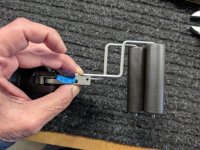
The replacement outboard sender arms eventually arrived, but they were still 3/4" too long! I artificially shortened the arm to the length I needed and sent pics and video to Daniel to show him what I needed, and how it would work in my tank. He said that they had one shorter arm I could try, but they have no records of any RV-14 builder who used arms this short (which was curious, because the pics in this PDF writeup, and a pic I found on VAF, appear to have arms the same length that I came up with in my trial-and-error testing. Hmm....). Anyway, this is what I needed (bottom), vs. what I received (top):
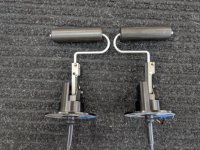
The next set of shorter arms arrived, and they looked like they would work. They turned out to be about 1/4" shorter than what I had during my testing, but a little short was better than a little long. Being a little short gave me mounting options, so that was okay ("Should the sender top out when the float contacts the top skin? When it reaches the expected max fuel level? Something else?"). I went ahead and mounted the new arms on the senders:
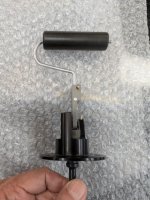
While all of this was going on, I'd made a cardboard mock-up of the baffle section over the outboard tank bay so I'd be able to test the sender location before cutting holes in the baffle. When I tried to mount the sender with the new, shorter, arm, it wouldn't fit through the CiES nutring. Argh! I decided to bend the arm to see if I could get it to work. It took a couple of bends to make it fit. It turned out that with the bent arms, the total sender length (5.6") almost matched what I came up with during testing (5.68"):
So, I this is what I'm going with. I returned the "reject" arms and nutring kit to CiES, and promptly received my refund for the kit.
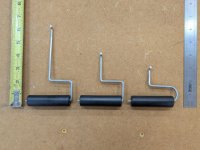
For comparison, here is the succession of arms that I tried with the outboard senders:
Anyway, I hope something here is helpful for someone down the road.
TL;DNR version:
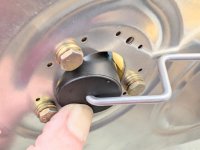
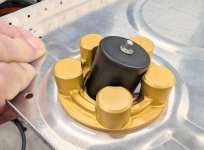
- the short, fat, floats used on the inboard senders do not fit through CiES' custom nutrings.
- the inboard senders were "clocked" opposite of their labeling, i.e. the one marked "INBD LH" will go in the right tank, and the one marked "INBD RH" will go in the left tank. Test your senders before installing!
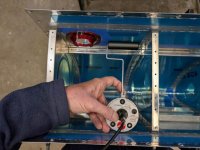
- the default arm shipped with the outboard sender is too long to mount on the tank baffle. Explicitly ask for a 2.5" arm.
Long version:
Right off, I'd like to say that working with CiES has been easy, and Daniel, in customer support, has been very responsive, although apparently very busy. However, not all has been smooth sailing.
After a long telephone chat with Daniel at CiES, it seemed that ordering would be a relatively painless process. I explained that I intended to install the inboard senders in the "per plans" location on the inboard end rib, and the outboard senders on the rear baffle of the tanks, in the most outboard bay. AFAIK, all of the RV-14 builders who've posted regarding installing an outboard sender used the baffle location for mounting.
I decided to pull the trigger and order a set of four senders. The online order form let me select the type of aircraft ("RV-14"), and the number of senders I needed per tank ("2" or "4"). Per other's experience, I believed this was all the info CiES needed to complete the order. I was told 3 to 4 weeks to complete construction, at which time I'd be invoiced for the order. While in process, I decided to splurge and added 2 CiES fancy (gold plated?
) nutring kits to my order (a total of 4 nutrings, plus everything to get them mounted).About 3 weeks after ordering, the senders were ready to go. I paid the invoice, and promptly received my order. Pretty quickly, I ran into issues:
- the arms of the outboard senders were sized more in line for mounting on on the rib, rather than on the baffle (but I think they were still too long for a rib mount on my std tank):
- the short-and-fat custom RV-14 floats used on the inboard senders were too fat to fit through their nutrings once attached to the rib (note: in the pics, the nutring is on the outside of the rib, but mounting it correctly didn't change anything):
- the inboard senders were "clocked" opposite of the intended tank where they were marked for (left vs. right).
Daniel, at CiES, was helpful and agreed to send a pair of shorter arms, which his records showed had been used by previous RV-14 builders. He also agreed to let me return one of the nutring kits for full refund, and I sourced a pair of new Textron/Cessna nutrings from a VAF builder to use as a replacement (Thanks, Phil S.!). As for the right vs. left tank discrepancy, Daniel said the senders were profiled per the info they had on file regarding the Van's supplied inboard rib, so there was either a manufacturing defect with my ribs, or Van's has changed their spec (BTW, there were a couple of other VAF posts from builders who said their senders were backwards). But, no matter, this one was an easy fix: the sender marked "INBD LH" will go in the right tank, and the one marked "INBD RH" will go in the left tank.
The replacement outboard sender arms eventually arrived, but they were still 3/4" too long! I artificially shortened the arm to the length I needed and sent pics and video to Daniel to show him what I needed, and how it would work in my tank. He said that they had one shorter arm I could try, but they have no records of any RV-14 builder who used arms this short (which was curious, because the pics in this PDF writeup, and a pic I found on VAF, appear to have arms the same length that I came up with in my trial-and-error testing. Hmm....). Anyway, this is what I needed (bottom), vs. what I received (top):
The next set of shorter arms arrived, and they looked like they would work. They turned out to be about 1/4" shorter than what I had during my testing, but a little short was better than a little long. Being a little short gave me mounting options, so that was okay ("Should the sender top out when the float contacts the top skin? When it reaches the expected max fuel level? Something else?"). I went ahead and mounted the new arms on the senders:
While all of this was going on, I'd made a cardboard mock-up of the baffle section over the outboard tank bay so I'd be able to test the sender location before cutting holes in the baffle. When I tried to mount the sender with the new, shorter, arm, it wouldn't fit through the CiES nutring. Argh! I decided to bend the arm to see if I could get it to work. It took a couple of bends to make it fit. It turned out that with the bent arms, the total sender length (5.6") almost matched what I came up with during testing (5.68"):
So, I this is what I'm going with. I returned the "reject" arms and nutring kit to CiES, and promptly received my refund for the kit.
For comparison, here is the succession of arms that I tried with the outboard senders:
Anyway, I hope something here is helpful for someone down the road.


 but of course the totalizer tells the story then. But if I had ER, would probably bite the money bullet.