rwarre

Well Known Member
Patron
Got serious about fixing my heavy left wing. Here's my plan, any advice is much appriciated. 1. Line up tooling holes on the wing and ailerons and measure the down angle of the outboard and inboard edges.(of the ailerons) Right now the angle of degrees is off by 6 degrees. So my plan would be to get new brackets and get the down angle both ailerons to match. Then fly it and see if there is a difference. Thanks
 
Got serious about fixing my heavy left wing. Here's my plan, any advice is much appriciated. 1. Line up tooling holes on the wing and ailerons and measure the down angle of the outboard and inboard edges.(of the ailerons) Right now the angle of degrees is off by 6 degrees. So my plan would be to get new brackets and get the down angle both ailerons to match. Then fly it and see if there is a difference. Thanks
Wait, what? The inboard edge and the outboard edge of *an* aileron are off by *6 degrees*? That's HUGE...and way wrong.
 
No the inboard and outboard edges are not off. I was talking about the angles of right and left ailerons.
This won’t fix a heavy wing; in flight the ailerons seek equilibrium, since they’re interconnected.
PS In measuring the 6 deg did you first lock the elevator in neutral?
With rv-10/14 (riveted aileron trailing edge) a heavy wing is often a slight difference in the vertical height of the hinge relative to the wing. With ‘folded’ trailing edges, slight differences in the fold are usually the cause.
 
This won’t fix a heavy wing; in flight the ailerons seek equilibrium, since they’re interconnected.
PS In measuring the 6 deg did you first lock the elevator in neutral?
With rv-10/14 (riveted aileron trailing edge) a heavy wing is often a slight difference in the vertical height of the hinge relative to the wing. With ‘folded’ trailing edges, slight differences in the fold are usually the cause.
This is actually an old wives tale and one I have proven many times over…when you shorten or lengthen the interconnecting rods, you can definitely affect roll within a small window…if for example you shortened both rods down to below the wing trailing edge, they don’t seek equilibrium….they induce drag and move the center of lift, forward…so if you have on aileron high…you should correct that with rigging on the ground…I have many times found an aileron mis-rigged and corrected it with re-rigging…now…when you use the trim bias spring aileron trim…you aren’t adjusting equilibrium…you are just increasing the load on the stick in one direction. Same thing with correcting out of rig conditions and the ailerons will tend to correct for small roll uneven moments. It won’t cure incorrectly formed skin, or mis-aligned mounting holes…or any of that.

Now if it’s a gross build issue…on the order of several degrees, where the stick is displaced….that’s much more accurate to Bob’s comment.

A minor trim issue is well covered elsewhere in the forum and pretty easily understood…but if you build it straight and rig it correctly…there’s shouldn’t be a big issue…the equilibrium you are referring to is the total component of lift, each wing is contributing so a significant roll, is one wing producing more than the other…
In the six…and I suspect most…as we burn fuel off one tank, you can induce a roll…and the ailerons aren’t seeking equillibrium…one wing is just making more lift than the other…which is why we displace the stick, or induce trim bias of the stick to keep it flying nice.
 

Here is another thread addressing the same issue. What -model are you flying?

Carl Froehlich here on VAF walked me through the numerous measurements necessary to diagnose a heavy wing.

My -7 left flap was made incorrectly and was .250 lower than the right flap. I am an A&P and not the builder. The builder mis-rigged the ailerons to make it fly less bad.
 
No the inboard and outboard edges are not off. I was talking about the angles of right and left ailerons.
So the ailerons are misrigged. Follow the instructions in the construction manual to adjust the pushrod lengths to rig them correctly before you start messing around with fixes like new brackets and such.

As noted, I thought this was the advice previously given?
 
No the inboard and outboard edges are not off. I was talking about the angles of right and left ailerons.
Assuming the ailerons were mis-rigged to make it fly less bad. You can chase your tail and throw the kitchen sink at it. Or you can make a series of accurate measurements and map out both wings with a spreadsheet. Incidence, sweep, twist, and how the flaps trail the wing.

With any problem you have to have a plan and work it. Mathematical equations are usually solved by systematically solving for one variable at a time.
When you have an accurate map, the path forward will be much clearer.
 
Last edited:
Assuming the ailerons were mis-rigged to make it fly less bad. You can chase your tail and throw the kitchen sink at it. Or you can make a series of accurate measurements and map out both wings with a spreadsheet. Incidence, sweep, twist, and how the flaps trail the wing.
I agree
And one of those measurements / checks should be to confirm the ailerons were built properly and have the proper trailing edge shape as described in Chapter 5.7 of Section 5 of the construction manual https://www.vansaircraft.com/service-information-and-revisions/5/
Nearly 1/2 of the RV's I have inspected that have folded trailing edges have issues with this to some degree, and depending on how bad it is, it can have a major influence on roll trim.
 

The other thing is the least of your concerns should be wing tip alignment. Is cosmetic. It’s not intuitive but the teachings of Danh and my experience support it
 
This is the second thread about this, and still no affirmation that the ailerons and pushrods were properly rigged in the first place. There are clear instructions in the manual and the plans on how to do this by locking the bellcrank with the jig and aligning the aileron using the tooling holes in the outboard rib of the wing. Before going about measuring the snot out of everything and messing around with new brackets and splitting wingtips and all that, it is *imperative* that the damned things be properly installed and aligned in the first place (and that the flaps are then set up to match the ailerons, as well).

To the OP: Have you done this? It seems pretty inconceivable that is was done, or done properly, if there is 6 degrees difference in deflection between the ailerons in the first place.

If you're starting from a misrigged setup, all you're going to do is chase the problem around, likely just making it worse.

 
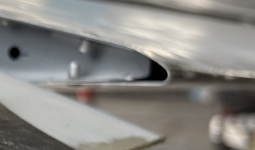
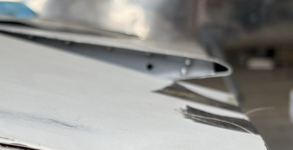
Looking at the trailing edge of the rib…I’d probably drill the aft 3 rivets out, or maybe the whole rib…remove the last 2-3 inches of the trailing edge of the rib, fabricate a new section to correct the bulge…and splice to the existing rib. I’d fix the aft two rivets that are difficult to buck with a flush pull rivet and get the skin pulled down and correct the trailing edge shape.

Following the advice of others to check and correct rigging makes sense as a first step.
 
Looking at the trailing edge of the rib…I’d probably drill the aft 3 rivets out, or maybe the whole rib…remove the last 2-3 inches of the trailing edge of the rib, fabricate a new section to correct the bulge…and splice to the existing rib. I’d fix the aft two rivets that are difficult to buck with a flush pull rivet and get the skin pulled down and correct the trailing edge shape.

Following the advice of others to check and correct rigging makes sense as a first step.
I don’t think this would do much to correct the misshapen aileron.
 
This is the second thread about this, and still no affirmation that the ailerons and pushrods were properly rigged in the first place. There are clear instructions in the manual and the plans on how to do this by locking the bellcrank with the jig and aligning the aileron using the tooling holes in the outboard rib of the wing. Before going about measuring the snot out of everything and messing around with new brackets and splitting wingtips and all that, it is *imperative* that the damned things be properly installed and aligned in the first place (and that the flaps are then set up to match the ailerons, as well).

To the OP: Have you done this? It seems pretty inconceivable that is was done, or done properly, if there is 6 degrees difference in deflection between the ailerons in the first place.

If you're starting from a misrigged setup, all you're going to do is chase the problem around, likely just making it worse.
Good first step if everything was built perfectly.

If you do this and things only get worse. You will know for certain that complete wing mapping is in your future.
 
Read this: If flying a non 9, 10 or 14 seems pretty straight forward. (And works)

 
Read this: If flying a non 9, 10 or 14 seems pretty straight forward. (And works)

I agree.... It does work, but no one should use that document and touch their ailerons with any tools, without using the expanded / deeper dive compliment document which is Chapter 5.7 in Section 5